Gas Furnace in a Houston Outage: Can a Home Battery Keep the Blower Running?

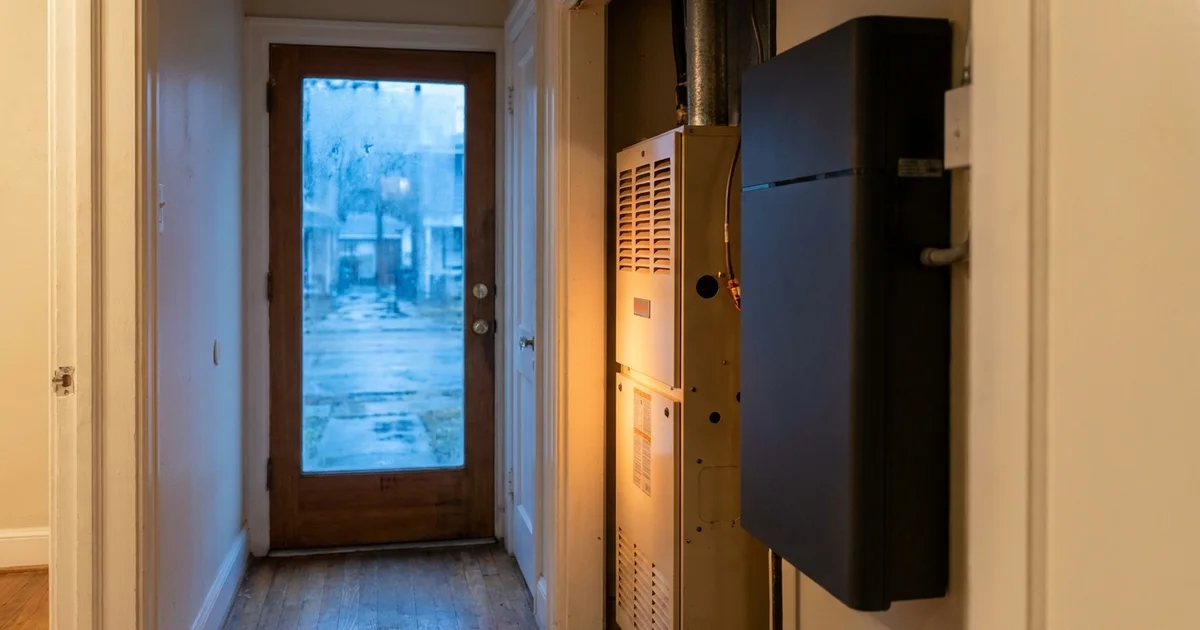
A gas furnace burns gas, so it feels like it should keep working when the grid goes down. It doesn't. The flame needs an igniter, the control board needs power, and the blower that moves warm air through your ducts needs a motor. Without electricity the furnace shuts itself off, and the house starts to cool.
The good news is that this is a small electrical load. A gas furnace is one of the easiest heating systems to back up with a battery. Below I walk through what it draws, how that fits an Eos plan, and the two things a battery cannot fix: a dead gas supply and unsafe workarounds.
Key Takeaways
- A gas furnace needs electricity for its fans, ignitor and controls. The U.S. Department of Energy summarizes the result bluntly: "power outage = no heat" (U.S. DOE, self-powered furnace peer review).
- The Virginia Tech wattage list gives a furnace 750 W (Virginia Cooperative Extension). Your nameplate overrides that.
- That is far below the 11.5 kW continuous rating of every Eos controller, so the furnace is rarely the problem. Runtime and the other loads are.
- A battery does not fix a gas supply interruption. Never heat with a gas oven or run a generator indoors.
Why does a gas furnace need electricity at all?
Three parts need power. The blower pushes air through the ducts. The ignitor lights the burner on each cycle. The control board decides when to do both and watches the safety switches. The DOE describes the furnace's electric loads as "fans, ignitor, and controls," and notes that these furnaces consume both electricity and natural gas (U.S. DOE, self-powered furnace peer review). The same slide lists the consequence of an outage as no heat, followed by costs like frozen pipes and spoiled food.
Older furnaces with a standing pilot light are the exception, since the pilot needs no power. Most furnaces sold in recent decades use electronic ignition instead, and the DOE's older consumer guidance notes that electric ignition saves gas because a pilot isn't burning continuously. If you aren't sure which type you own, the label inside the furnace door will tell you, or your HVAC technician can.
How many watts does a gas furnace draw?
The only published figure I could verify from a university extension is the Virginia Tech list, which puts a furnace at 750 W (Virginia Cooperative Extension, Estimating Appliance and Home Electronic Energy Use). The same page notes that a motor can draw about three times more current when starting than when running.
That is a range-style number, not a promise. Variable-speed blowers often draw much less than that on low, and older single-speed units can draw more. I looked for a DOE or manufacturer breakdown of ignitor and controller wattage and could not confirm one, so I'm leaving it out. The reliable move is to read the electrical data plate on your furnace: it lists the amperage of the unit, and amps times 120 volts gives you a working ceiling.
For planning, a 750 W blower with a startup spike of roughly three times that is about 2.25 kW for a moment. Every Eos plan uses one controller rated at 11.5 kW continuous and 17.1 kW surge, so the furnace sits comfortably inside it.
Our appliance wattage chart for Houston homes lists the rest of the household loads you will want to compare.
How long does a battery run a furnace blower?
This is plain division, not a field measurement. Take the Virginia Tech 750 W figure and imagine the blower running without stopping. Plan capacities come from our plan data, in usable kWh:
| Plan | Usable capacity | Blower at 750 W, nonstop |
|---|---|---|
| Essential | 8.76 kWh | about 11.7 hours |
| Plus | 17.52 kWh | about 23.4 hours |
| Pro | 26.28 kWh | about 35 hours |
| Premium | 35.04 kWh | about 46.7 hours |
| Ultimate | 43.80 kWh | about 58.4 hours |
A furnace does not run nonstop. It cycles on and off with the thermostat, so the real duty cycle is lower, and the real hours are longer than the table. But the battery is also carrying a fridge, a router and phone chargers, and the table ignores them. Treat the numbers as a ceiling for the furnace alone, not a runtime promise. For how load priorities stretch or shrink hours, see how long home battery backup lasts in Texas and our guide to battery kW versus kWh.
How does this compare with a heat pump or electric furnace?
Very favorably. A heat pump has a compressor and, often, resistance heat strips that can be larger than the controller's 11.5 kW rating. We cover that case in our heat pump and electric heat guide. An electric furnace is entirely resistance heat and is the hardest case.
A gas furnace is the opposite. The heat comes from gas, so the electric side stays small. If your home has a gas furnace and a separate electric heat pump, back up the furnace circuit first, because it gives the most warmth per kilowatt-hour of battery.
What will a smart panel put on the same circuit?
A furnace is usually on its own circuit, often a dedicated 15 amp or 20 amp breaker near the unit. That makes it simple to place on the backed-up side of the panel. Ask your installer to confirm that the furnace circuit is on the backup panel, and whether the thermostat and any zone controls share it or sit on another circuit. A furnace with no power to its thermostat won't call for heat either.
Pair the furnace with the loads that matter most in a cold outage: the fridge, the router, phone charging and any medical equipment. Our smart panel circuit prioritization guide explains how to rank them. Leave out the big electric loads that don't help in a freeze, like an electric water heater or a dryer. Our electric water heater guide covers why that one is worth planning around.
What about the gas supply in a freeze?
A battery runs the blower. It does not make gas flow. In a deep freeze, the gas has to reach your meter, and I don't have a verified source showing how often that failed for Houston homes, so I won't put a number on it.
What I can source is the upstream picture. The EIA reports that U.S. natural gas production in February 2021 averaged 104.8 Bcf/d, an 8.1 Bcf/d (7 percent) drop from January and the largest monthly decline on record. Texas fell by a record 4.3 Bcf/d (15 percent) to 21.5 Bcf/d, mostly because of freeze-offs, where liquids in wells froze and blocked flow (U.S. EIA, February 2021 weather triggers largest monthly decline in U.S. natural gas production). That tells you gas supply is not immune in a hard Texas freeze. It does not tell you your meter went dry, and for most Houston neighborhoods I can't say it did.
The practical read: a battery on the furnace covers the common failure, which is the power going out while the gas keeps flowing. For the rarer case where gas service itself drops, have a second plan, such as warm clothing, a closed-off room and a place to go. Our winter storm preparation guide covers that fallback.
What is not safe to do when the furnace stops?
When the heat goes out, people improvise, and improvising with fuel burners indoors is how carbon monoxide poisonings happen. The CDC says more than 400 Americans die each year from unintentional CO poisoning not linked to fires. It says never to heat your house with a gas oven, and never to run a generator inside your home or garage, even with doors and windows open. Outdoors, a generator should sit more than 20 feet from windows, doors and vents (CDC, carbon monoxide).
The Consumer Product Safety Commission adds that CO alarms with battery backup belong on every level of the home and outside sleeping areas (CPSC, Carbon Monoxide Information Center). A battery has no exhaust, which is part of why it fits this job. More outage safety basics are in our power outage safety guide for Houston homeowners.
Also keep your furnace serviced. The CDC recommends that gas-burning heating equipment be serviced by a qualified technician every year, ahead of the cold season, and not after the first freeze.
Before the first cold snap, what should you check?
You have a little time before the winter storms that matter. A short list:
- Find the furnace data plate and write down the amps and voltage.
- Check whether it uses electronic ignition or a standing pilot.
- Ask your installer which breaker feeds the furnace and thermostat, and whether both are on the backed-up panel.
- Test your CO alarms and replace dead batteries.
- Have the furnace serviced.
- Decide what else needs to ride on the battery: fridge, router, phones, medical equipment.
- If you already own a system, run the steps in our monthly self-test checklist.
For outages that last more than a day, read battery backup in extended Texas outages and what happens when a home battery runs out.
Ready to plan your winter backup?
If your home heats with gas, the electric side of your plan is small and easy to size. The planner takes a few minutes and tells you which plan fits your loads.
Or call Eos at 833-989-3737 to talk through your setup with an installer.
Frequently asked questions
Does a gas furnace work without electricity?
Usually not. The blower, ignitor and control board all need power, and the DOE sums up an outage as "no heat" for a furnace of this kind (U.S. DOE). A rare standing-pilot furnace is the exception, but it still needs air movement to heat the house well.
How many watts does a furnace blower use?
The Virginia Tech list gives a furnace 750 W, and notes motors can draw about three times that on startup (Virginia Cooperative Extension). Variable-speed units can draw less. Read your nameplate for the real number.
Can a home battery run a gas furnace?
Yes. A 750 W blower is a small fraction of an Eos controller's 11.5 kW continuous rating. Runtime depends on the battery capacity and on what else is running, so size the plan for the whole set of loads, not the furnace alone.
Will a battery keep my heat on if the gas goes out?
No. A battery supplies electricity, not gas. The EIA documented record gas production losses in the February 2021 freeze (U.S. EIA), so keep a non-gas, non-fuel plan for the rare case where gas service drops.
Is it safe to heat with a gas oven during an outage?
No. The CDC says never to heat your house with a gas oven (CDC). Keep CO alarms working and never run a generator or fuel-burning heater indoors.
Do I need to upgrade my panel to back up a furnace?
Not necessarily. The furnace is a small load, but your installer decides how its circuit is wired to the backed-up panel, and licensed electrical contractors and utility interconnection still apply. Our panel service upgrade guide covers when a panel change comes up.