Power Outage Safety for Houston Homeowners: What You Need to Know

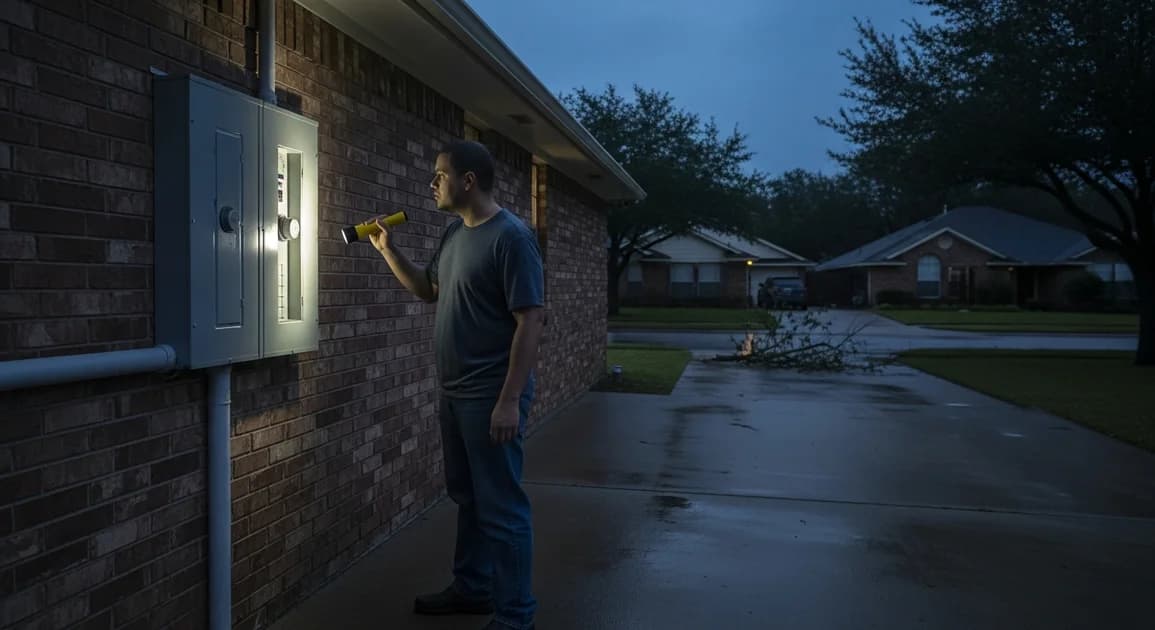
Hurricane Beryl killed at least 23 people across the Houston region in July 2024, and most of those deaths did not happen during the storm. They happened in the long, hot, dark days that followed (CNN, 2024). At peak, 2.2 million CenterPoint customers lost power (Houston Public Media, 2024). Carbon monoxide. Heat. Downed lines. Missed medications. This guide is the safety reference we hand to every Houston install client, covering five domains: electrical hazards, fuel and CO, food, medical equipment, and the call on when to leave.
The Bottom Line, four rules, no exceptions
- Treat every downed line as energized and stay 35 feet back.
- Never run a generator inside a garage, porch, shed, or within 20 feet of a window.
- Never use a charcoal grill, camp stove, or gas range to heat a room.
- If a household member depends on powered medical equipment and the outage will last past their backup window, leave for a hospital, shelter, or family member's home before the equipment dies, not after.
How do I deal with downed power lines around my Houston home?
Treat every downed power line as live and lethal. The Electrical Safety Foundation reports that downed lines remain energized in nearly 1 in 3 incidents even when they appear dead, and contact is fatal in seconds (ESFI, 2024). Set a 35-foot exclusion zone, keep family and pets clear, and call CenterPoint at 713-207-2222 or 800-332-7143 to report it.
[PERSONAL EXPERIENCE] After Beryl, our crews walked yards where homeowners had tried to drag a "dead" line off a fence with a wooden broom. Wood that's been sitting in Houston humidity is not an insulator. Neither is a garden hose, a plastic rake, or a dry tree limb. Do not touch the line with anything. Do not move a tree limb that's touching a line. Do not stand in standing water near a line, even shallow puddles, because energized water can carry current several feet from the source.
If your car contacts a fallen line, stay inside. Call 911. Only exit if the car is on fire, and when you do, jump clear with both feet together so you never bridge the car and the ground at the same time. Then shuffle away in small steps, feet touching, until you're at least 35 feet clear.
Do not drive over a fallen line. Tires are not reliable insulators, and the line can whip up into the undercarriage. Turn around. Mark the location. Call it in.
Citation capsule. Downed lines stay energized in roughly one in three cases even when visually dead, and contact is usually fatal within seconds (ESFI, 2024). Maintain a 35-foot exclusion zone and report to CenterPoint at 713-207-2222 before doing anything else.
What are the carbon monoxide rules for generators and grills?
The CDC attributes roughly 400 unintentional, non-fire carbon monoxide deaths per year nationally, and outage events spike that count sharply (CDC, 2024). After Beryl, Harris Health treated dozens of CO poisonings in the first 72 hours. The rule for any combustion device is simple: outdoors, far from openings, and never enclosed.
Run portable generators at least 20 feet from any window, door, or vent. Not in the garage, even with the door open. Not on a covered porch. Not in a shed. The exhaust does not vent the way you expect, and a Gulf Coast breeze can push it right back into the house through the attic soffit. Aim the exhaust away from the structure.
Install at least one battery-operated CO detector on every floor and outside each sleeping area. AA-battery models work when the AC is dead, which is exactly when you need them. Test the batteries at the start of every hurricane season.
Symptoms of CO poisoning, in order of escalation: headache, dizziness, nausea, confusion, loss of coordination, unconsciousness. If anyone in the house has a headache during generator operation, get everyone outside, call 911, and tell the dispatcher you suspect carbon monoxide.
Charcoal grills, camp stoves, gas ovens used as heaters, and propane patio heaters are never indoor devices. Not in the kitchen with the windows open. Not in the garage. The CO load from a charcoal grill in an enclosed space can reach lethal levels in under an hour.
Citation capsule. The CDC counts roughly 400 unintentional CO deaths nationally per year, with outages driving sharp spikes (CDC, 2024). Keep generators 20 feet from openings, run only outdoors, and install battery-powered CO detectors on every floor.
What food is safe to eat after a Houston power outage?
The FDA's rule is the one to memorize. A closed refrigerator holds safe temperature for about 4 hours. A full freezer holds for 48 hours, a half-full freezer for 24 hours (FDA, 2024). Keep both doors shut. Every time you open the fridge to "check," you reset the clock.
Beryl outages averaged two to five days for many Houston ZIP codes. That means most fridge contents are gone, but a packed freezer often saves. After power returns, throw out any meat, dairy, eggs, leftovers, or cut produce that sat above 40F for more than 2 hours total. Hard cheeses, butter, fresh whole fruit, jam, and most condiments survive.
Signs of unsafe food: off smell, slimy texture, color change, separation in dairy, ice crystals that have melted and refrozen on packaging. When in doubt, throw it out. A $200 grocery loss is cheaper than a hospital trip for salmonella.
Citation capsule. The FDA rule for outage food safety: 4 hours fridge, 48 hours full freezer, 24 hours half freezer, with doors kept shut (FDA, 2024). Anything above 40F for more than 2 hours goes in the trash.
How do I keep medical equipment running safely?
CenterPoint operates a Critical Care Program that flags addresses with life-sustaining equipment for priority restoration, but it does not guarantee uninterrupted power (CenterPoint Energy, 2024). Register before hurricane season, not during. The form requires a physician signature, so plan for a one to two week turnaround.
For oxygen concentrators, your DME provider can supply backup tanks that cover 4 to 6 hours each. Stage at least 24 hours of tank capacity at home. A manual resuscitation bag is a last resort, not a plan, and a caregiver needs training before they need to use one. For CPAP and BiPAP users, ask your provider about a DC battery pack rated for your specific machine. A single night without therapy is uncomfortable but rarely dangerous; a week without it has cardiovascular consequences.
Insulin and most biologics tolerate room temperature for 28 days once opened, per manufacturer guidance, but Houston ambient in July clears 90F indoors fast. A small cooler with ice packs holds safe temperature for 24 to 48 hours. Refresh the ice every 12 hours. Pharmacies along major corridors often run on generator power and can re-cool insulin in an emergency, but call ahead.
Dialysis patients should contact their center the moment a major storm enters the Gulf forecast, not after the outage starts. Centers run prioritized schedules and arrange transport. For non-medical transportation help, 211 Texas connects callers to cooling centers, shelters, and ride options (211 Texas, 2024). METROLift serves registered riders with disabilities.
[UNIQUE INSIGHT] A home battery backup sized for medical loads (concentrator, CPAP, fridge for insulin, a few lights, one window AC) typically draws 600 to 1,200 watts continuous. That's modest. The decision is rarely about whether the system can carry the load. It's about whether you've sized for the runtime your equipment actually needs.
Citation capsule. CenterPoint's Critical Care Program registers households with life-sustaining equipment for priority restoration but does not guarantee continuous power (CenterPoint Energy, 2024). Pair registration with at least 24 hours of independent backup capacity.
When should I leave the house?
Leave when staying becomes the bigger risk. The Mayo Clinic flags heat exhaustion onset above 85F indoor temperature for elderly, very young, pregnant, and chronically ill residents (Mayo Clinic, 2024). Use a five-trigger checklist. If any one is true, leave.
- Indoor temperature above 90F and outage is past 6 hours, with a vulnerable resident in the home.
- Indoor temperature at or below 50F in winter, with anyone elderly, infant, or chronically ill.
- Any medical device cannot run on remaining backup capacity for the expected outage duration.
- A downed line is on or touching your property and CenterPoint has not arrived.
- You smell natural gas, sulfur, or rotten eggs anywhere in the house.
For destinations: 211 Texas operates the cooling and warming center directory and arranges transport for callers without a vehicle. METROLift covers registered disability riders. The City of Houston Office of Emergency Management publishes pet-friendly shelter locations during named storms. Hospitals will not turn away anyone with a life-threatening emergency.
The ego cost of leaving is small. The cost of staying when you should not is permanent.
FAQ
How do I report a downed power line in Houston?
Call CenterPoint at 713-207-2222 inside Houston or 800-332-7143 from elsewhere in the service area, then call 911 if the line is across a road, touching a vehicle, or in standing water. CenterPoint's outage tracker also accepts reports online, but phone is faster during major events.
Is it safe to run a portable generator on my covered patio?
No. Covered patios trap exhaust the same way a garage does, and Gulf breezes can push CO back through the attic and walls. The CDC's 20-foot rule means 20 feet from any window, door, or vent, in open air, with the exhaust pointed away (CDC, 2024).
How do I know if my fridge food is still safe?
Use a thermometer. If interior temperature stayed below 40F the whole outage, contents are safe per FDA guidance (FDA, 2024). If you opened the door repeatedly, or the outage exceeded 4 hours, discard meat, dairy, eggs, leftovers, and cut produce. Smell and texture checks are not reliable.
What if my CPAP runs out of battery overnight?
One missed night is uncomfortable but not usually dangerous. Sleep with your head elevated on pillows to reduce airway collapse, avoid alcohol and sedatives, and call your sleep clinic in the morning. If you have severe daytime sleepiness, oxygen drops, or chest pain, go to an emergency room.
Where can I find a Houston cooling center during an outage?
Dial 211 to reach 211 Texas, which operates the live cooling and warming center directory and can arrange transportation if you do not have a vehicle (211 Texas, 2024). The City of Houston OEM site lists open shelters during named events. Many libraries and community centers also activate as cooling sites.
Wrapping up
Outage deaths in Houston are mostly preventable, and the prevention is boring: keep distance from lines, run combustion outside and far away, watch the fridge clock, plan for medical equipment before you need it, and leave when the trigger conditions hit. Print this list. Tape it inside a kitchen cabinet. Share it with neighbors who live alone. The next named storm is on a calendar we cannot see yet.