Does a Home Battery Work in a Houston Freeze? Cold-Temperature Limits Explained

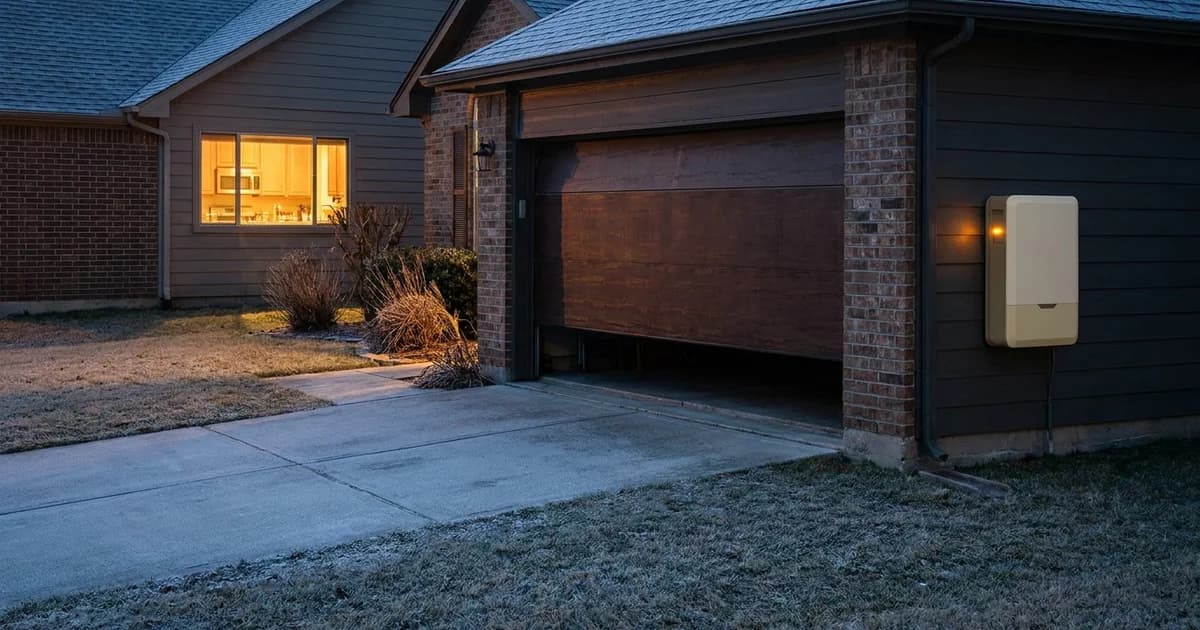
Most of what we write about Houston and batteries is about heat. This post is about the opposite: the handful of mornings a year when it drops below freezing, and the rare one when it drops far below. If your battery is supposed to carry the house through a winter outage, it helps to know what temperatures it can actually work in.
I'll give you the numbers I could confirm and say plainly where I could not.
Key Takeaways
- A published listing for the Sigenergy 9 kWh module gives an operating range of -4°F to 131°F (-20°C to 55°C) (Solar Electric Supply product page).
- Houston's coldest reading in the February 2021 freeze was 13°F (NWS Houston), which is inside that listed range.
- I could not find a published charging-temperature limit or a built-in heater for this module, so I am not claiming either one.
- Placement is a real lever: a garage wall is more sheltered than an exposed exterior wall.
How cold does Houston actually get?
Usually not very. But the tail matters, because that is when the grid is under stress.
In February 2021, the National Weather Service Houston office recorded 13°F in the City of Houston on the morning of February 16, with Galveston at 20°F and College Station at 5°F (NWS Houston, Valentine's Week Winter Outbreak 2021). Fox Weather reports the 13°F reading at Bush Intercontinental tied a record low from 1895, and that it was the first time the Houston office had ever issued a Wind Chill Warning (Fox Weather).
That is the extreme end of what the region has seen. A normal Houston cold snap is far milder. Wind chill is also not a battery number: it describes how cold exposed skin feels, and a wall-mounted unit sits at air temperature, not wind-chill temperature.
What temperature range is a home battery rated for?
The Solar Electric Supply listing for the Sigenergy 9 kWh module gives the operating temperature as -4°F to 131°F (-20°C to 55°C), and describes an enclosure rated for both indoor and outdoor installation (Solar Electric Supply). The same page lists 8.76 kWh usable from 9.04 kWh total, which matches the module size in our plans.
Two things stand out. The low end of that range, -4°F, is below Houston's 13°F record morning. And the high end, 131°F, is why we spend more time on summer placement, which our indoor vs outdoor guide covers.
Here is what I could not confirm:
- A charging-temperature limit. The product page lists operating and storage ranges only. Lithium batteries in general can have tighter limits for charging than for discharging, but I have no verified number for this module, so I will not guess one.
- A built-in heater. The page describes natural convection cooling and does not mention heating.
- Behavior at the edge of the range. The listing does not say whether output is reduced near the limits.
Spec sheets also differ between sources and model variants. Another source I saw gave a wider operating range for a different Sigenergy model, so the number for your exact unit comes from the datasheet for that unit. Ask for it before you sign anything.
Does it matter where the battery is installed?
A little. The rating tells you the unit can operate down to -4°F. Placement determines how close to that edge it ever gets.
A garage wall is shielded from wind and open sky. An exterior wall sees the full overnight low. For Houston, where a 13°F morning tied a record set in 1895, either location sits comfortably inside the listed range. The bigger placement decision is still heat, and our placement guide explains why we lean toward a shaded garage wall.
I'm not going to claim a specific temperature difference between a garage and an exterior wall. It depends on the garage, the insulation and the weather, and I have no measured figure.
Why does a freeze matter for a battery if the unit is rated for it?
Because the battery is rarely the weak link in a freeze. The grid is. During Winter Storm Uri, ERCOT lost roughly half of its generation at the peak, and outages stretched across days (FERC-NERC Joint Report, 2021). We walk through that in our winter storm preparation guide.
The practical consequences are about load and recharge, not only temperature:
- Heating load. Electric heat is a heavy draw. Our post on running a heat pump or electric heat in a Houston winter outage covers what a battery can and cannot carry.
- Recharge. Winter days are shorter. If you pair solar with storage, our December production guide shows what to expect. A multi-day cold outage may not let you fully recharge between days.
- Food. A refrigerator is safe about 4 hours without power and a full freezer about 48 (USDA FSIS). In a freeze, keeping the fridge running is the cheapest win a battery offers. See how long food lasts without power.
How long will a battery run in cold weather?
Capacity numbers on our plans are nominal. I don't have a verified figure for how usable capacity changes in the cold, so I can't hand you a percentage, and I would be wary of anyone who does without citing a datasheet.
What I can say is how to think about it. Size for the loads you cannot lose, then add margin. A single module with 8.76 kWh usable gives you hours of fridge, lights, Wi-Fi and phone charging. Adding electric heat changes the math quickly. Our appliance wattage chart lists common loads, and the planner shows how modules stack.
What should you do before a freeze?
A short checklist for the days before a hard freeze:
- Check the forecast low. If it is well above -4°F, which is nearly always true in Houston, the listed operating range is not the issue.
- Make sure the battery is full. Ask your installer how to hold a higher reserve before a storm.
- Look at the status in the app. Fix any alert while there is time.
- Keep the area around the unit clear. Do not stack boxes against it.
- Decide your priority loads. Fridge, lights, Wi-Fi, phones, medical devices, and heat if your system can carry it.
- Run the monthly self-test. Our self-test checklist takes a few minutes.
- Ask your installer for the datasheet. Get the operating and charging temperature limits for your exact model in writing.
What to do next
If you are choosing between a garage and an exterior wall, or sizing a system with winter in mind, start with the planner and tell us what you need to keep running. We will confirm the temperature limits for the exact hardware before you commit.
Or call Eos at 833-989-3737.
Frequently asked questions
Can a home battery work below freezing?
The Sigenergy 9 kWh module listing gives an operating range down to -4°F (-20°C) (Solar Electric Supply). Houston's 2021 record morning was 13°F. I could not verify a separate charging-temperature limit.
Does the battery have a built-in heater?
I could not find one in the published listing, which describes natural convection cooling only. Ask for the manufacturer datasheet for your model rather than assuming.
Should I put the battery in the garage or outside?
Either is within the listed temperature range for Houston. We lean toward a shaded garage wall mainly for heat, as explained in our placement guide.
How cold did Houston get in Winter Storm Uri?
NWS Houston reports the City of Houston reached 13°F on February 16, 2021, and Galveston 20°F (NWS Houston).
Will cold weather shorten my backup time?
I have no verified figure for capacity loss in the cold, so I will not quote one. Electric heat, which raises your load, will shorten runtime far more than the air temperature alone.