Home Battery Backup on a 100-Amp Panel in Houston: Upgrade, or Work Around It?

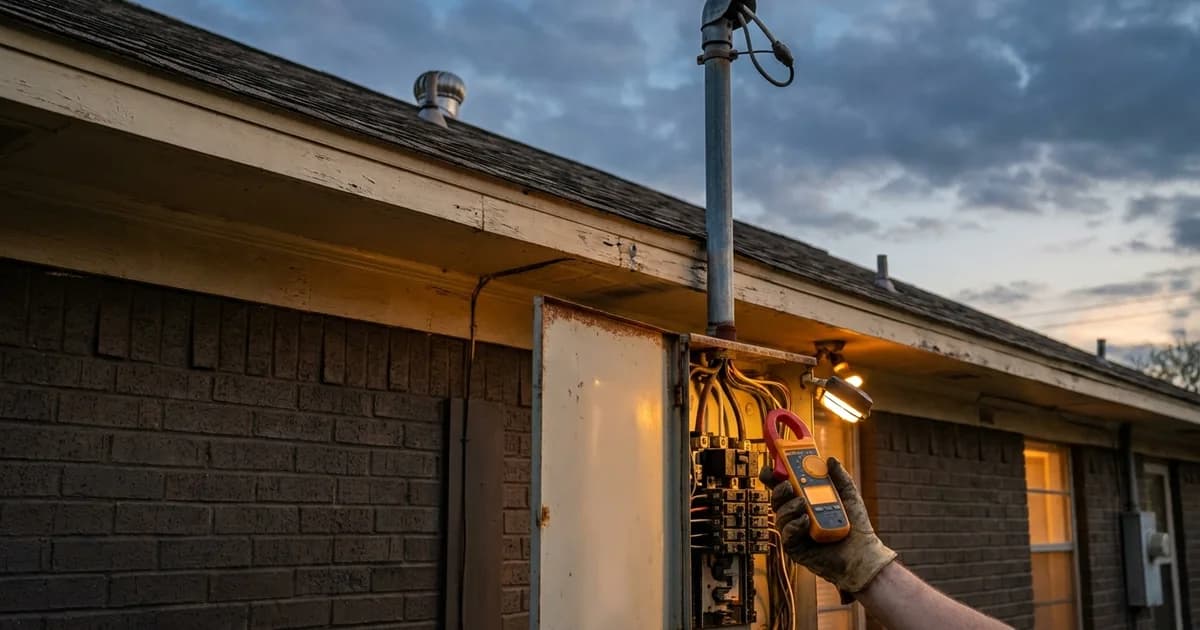
A 100-amp service is not a no. It is a fork in the road, and most homeowners get pushed down the expensive branch without ever being shown the other one.
Ask three installers whether a battery works on 100-amp service and you will probably hear one sentence three times: upgrade to 200. Sometimes that is correct. Often it is a default, because a service upgrade is easier to quote than an engineered workaround. This guide separates the two: the code sections that govern the decision, the load calculation that settles it, and what a CenterPoint service change actually involves.
Key Takeaways
- A 100A busbar leaves roughly 20A of back-fed breaker room under the 120 percent rule in NEC 705.12, which is not enough for a whole-home controller landed on the load side.
- That shortfall does not automatically mean a service upgrade. Supply-side connection (NEC 705.11), a power control system (NEC 705.13 with 750.30), and partial-home backup each avoid it.
- Texas has enforced the 2023 NEC statewide since September 1, 2023 (TDLR), so those are the sections a Houston inspector reads.
- The load calculation decides it. NEC 220.87 lets an electrician use a year of metered demand plus a 125 percent factor instead of an assumed load.
- A service upgrade is a separate scope from the battery: you own the weatherhead and mast, CenterPoint owns the drop and the meter (CenterPoint Energy).
Why do so many Houston homes still have 100-amp service?
Age, mostly. Around 47 percent of the US housing stock was built in the 1980s or earlier, and the median owner-occupied home reached 42 years old in 2024 (NAHB Eye on Housing, analysis of the 2024 American Community Survey, 2026). Houston's inner-loop stock skews older still.
Walk the Heights, Bellaire, Oak Forest or Meyerland and you are walking through housing built when 100 amps was the residential standard and central air was optional. Many of those homes have been renovated twice since, with a new kitchen sitting behind the original meter loop. The panel was never the part anyone wanted to spend money on.
One honest note. No agency publishes a count of how many Houston homes remain on 100-amp service. CenterPoint does not release it, and the Census Bureau's Year Built question tracks construction dates, not service size. Anyone quoting you a percentage is guessing. Read your own main breaker instead.
Will a home battery work on a 100 amp panel?
Not through a standard load-side back-fed breaker, no. The 120 percent rule in NEC 705.12 allows a 100A busbar to carry 120A of total source current, and a 100A main breaker consumes all but about 20A of that (NFPA, National Electrical Code, NFPA 70, 2023). Twenty amps is not enough room for a whole-home controller.
The busbar math itself we covered in detail elsewhere, so here is the two-sentence version. Multiply the busbar rating by 1.2, subtract the main breaker, and what remains is the largest back-fed breaker the panel can legally accept. On 200A service that leaves about 40A, which is why most modern homes need no panel work at all.
Now run it on 100A. A 100A bus times 1.2 is 120A. Take away the 100A main and you have 20A. For comparison, an Eos controller rated 11.5 kW continuous draws roughly 48 amps at 240 volts, which would need a 60A breaker. The gap is not marginal. It is more than double.
That is the whole reason 100-amp homeowners get quoted a service upgrade. It is also where most conversations stop, one code section too early.
Three code-legal ways around a service upgrade
The 120 percent rule only governs one connection method: a source landed on the load side of the service disconnect. Three other paths exist in the same article, and two of them were written specifically so that projects like yours would not be blocked.
Supply-side connection. NEC 705.11, "Source Connections to a Service," covers connections made ahead of the service disconnect (NFPA 70, 2023). When the battery gateway sits between the meter and the panel, the busbar rule in 705.12 is not the governing constraint, because the source never lands on the busbar. Your 100A service rating still is, which matters for the load calculation below.
A power control system. This is the one most homeowners have never heard of. A power control system actively limits total current so that the capacity of a connected busbar or conductor is never exceeded (UpCodes, NEC 705.13 Power Control Systems). Instead of proving the worst case can never happen, the equipment measures and controls it in real time. In the 2023 NEC that Texas enforces, 705.13 is titled Energy Management Systems and points to 750.30, where the system's role in controlling both loads and generation is defined (Mayfield Renewables, Code Corner: Energy Management Systems, 2023 NEC 705.13). The 2026 NEC restores the Power Control Systems title in 705.13 (IAEI Magazine, NEC 2026 Significant Code Changes). Same function, three names in six years, which is exactly why it gets overlooked.
Partial-home backup. Move the must-keep circuits to a protected subpanel and back up that, not the whole house. Less current, less busbar pressure, less scope. The least glamorous option, and on a 100A house with gas heat, frequently the smartest.
The load calculation that actually decides it
Code allows the connection; the load calculation decides whether your 100-amp service can still feed the house. NEC Article 220 gives two routes for a dwelling: the standard method in Part III, and the optional method in Part IV, which applies to services of 100 amps or greater (NFPA 70, 2023).
Here is the pattern I see repeatedly on surveys. An all-electric 100A home, meaning electric furnace or strip heat plus an electric water heater and an electric range, usually fails a standard calculation before the battery is even added. A home with a gas furnace, a gas water heater and a gas range often passes with room left over, because the two largest continuous electric loads simply are not there. Two houses of identical square footage, opposite answers.
Worth asking your electrician about: NEC 220.87 lets an existing service be evaluated on measured reality rather than assumption. With a year of maximum demand data from the utility, or a continuously recorded 30-day peak, the existing load is the highest 15-minute demand multiplied by 125 percent (UpCodes, NEC 220.87 Determining Existing Loads, NFPA 70 2023). One catch worth knowing before you get your hopes up: the method is not permitted where the service already has a renewable energy system or any form of peak load shaving.
That last clause is why sequence matters. If solar is on your list for later, the metered-demand route is easier to use now than after panels are on the roof.
What a CenterPoint service upgrade actually involves
If the calculation says upgrade, understand that you are buying two projects, not one. The ownership line runs straight through the middle of the work. CenterPoint owns and maintains the service drop, the meter and the meter box; the weatherhead is the property owner's responsibility, and damage to it requires a licensed electrician before power is restored (CenterPoint Energy).
In practice your licensed electrician replaces the mast, weatherhead, service entrance conductors, meter can and panel, then pulls a City of Houston electrical permit. CenterPoint disconnects, reconnects and re-meters. The utility asks customers to hire a licensed electrician at their own expense to prepare the site, allows three business days for locates and about 10 business days for construction, with three more for the meter set, targeting roughly 20 business days from request to finish (CenterPoint Energy, move or resize your meter). Services above 400 amps or three-phase trigger a formal design review.
One scheduling note that saves real grief: the service change permit and the battery permit are separate submissions, so the upgrade can be inspected and energized while the battery is still on order.
What drives the cost, without a made-up number
Service upgrade pricing in Houston is not published anywhere credible, and any figure quoted online without a site visit is invented. What is knowable is the list of variables that move it, and you can check most of them from the driveway.
- Overhead versus underground service. Overhead is a mast and weatherhead swap. Underground can mean trenching and conduit across a yard.
- Meter relocation. Leaving the meter in place costs less than moving it, and CenterPoint clearance rules sometimes force the move.
- Mast and roof penetration. A mast through a roof deck is a different job from one on a gable end wall.
- Panel location. Interior panels in older bungalows sometimes need relocating to an exterior wall.
- Restoration. Drywall, siding, brick and landscaping after the fact.
Eos plan tiers are published on the site, so start with the equipment cost you can verify, then treat electrical scope as its own line.
The decision table
| Path | Best fit | What it costs you | What it gets you |
|---|---|---|---|
| Full service upgrade to 200A | All-electric homes, planned EV charging, heat pump conversion, panel already full | Highest cost, longest timeline, utility coordination, restoration work | Whole-home backup plus capacity headroom for everything after |
| Power control system | Homes that pass the load calculation but fail the busbar math | Equipment cost and an installer who knows 705.13 and 750.30 | Whole-home or near whole-home coverage with the existing service |
| Partial-home backup | Gas heat and gas water heater homes, tight budgets, older housing stock | Fewer protected circuits, a real load-priority conversation | Fastest path to working backup, no utility scope at all |
A fourth option gets skipped too often: do nothing to the service, back up a subpanel now, and revisit the upgrade when another project makes it worth doing. Paired with a kitchen remodel or an EV charger, the upgrade rides along at a fraction of the standalone disruption.
Or call Eos at 833-989-3737 to talk through your setup with an installer.
Frequently Asked Questions
Do I need 200 amp service for a home battery?
Not necessarily. A 200A service makes a standard load-side connection easy, because the 120 percent rule in NEC 705.12 leaves roughly 40A of breaker room (NFPA 70, 2023). On 100A service, supply-side connection, a power control system, or partial-home backup can all deliver working backup without touching the service.
How do I know if I have 100 amp service?
Read the number stamped on your main breaker handle: 100, 125, 150 or 200. If the panel is a screw-in fuse box or has no visible main, treat that as a site survey item rather than a number you can trust.
Can an electrician downsize my main breaker instead of upgrading?
Sometimes. Replacing a 100A main with a smaller one raises the back-fed breaker room the 120 percent rule allows, since you subtract a smaller number from the same 120A ceiling. It only works if the load calculation still passes with the reduced main, which on an all-electric house it usually will not.
Does a power control system need special approval in Houston?
It needs a listed system and an inspector who reads the same code you do. Texas has enforced the 2023 NEC statewide since September 1, 2023 (TDLR), and municipalities may amend it further, so the design should reference 705.13 and 750.30 on the plan set rather than leaving the method implied.
Will my 100 amp service limit how much backup power I get?
During an outage, no. The battery controller, not the utility service, sets output while you are off grid, and Eos systems are rated 11.5 kW continuous with 17.1 kW surge. The service rating governs what the grid can feed the house on a normal day, and what the panel can legally accept as a source connection.
The short version
If your main breaker says 100, you have a design question, not a disqualification. Read the busbar, run the load calculation, and ask about NEC 705.11 and 705.13 before you accept an upgrade quote. Homes with gas heat and gas water heating often clear the bar with nothing more than a subpanel. All-electric homes usually do not.
Sources
- TDLR, Electricians Compliance Guide, retrieved 2026-09-08, https://www.tdlr.texas.gov/electricians/compliance-guide.htm
- NFPA, National Electrical Code (NFPA 70), retrieved 2026-09-08, https://www.nfpa.org/codes-and-standards/nfpa-70-standard-development/70
- UpCodes, NEC 705.13 Power Control Systems, retrieved 2026-09-08, https://up.codes/s/power-control-systems
- UpCodes, NEC 220.87 Determining Existing Loads (NFPA 70, 2023), retrieved 2026-09-08, https://up.codes/s/determining-existing-loads
- Mayfield Renewables, Code Corner: Energy Management Systems (2023 NEC 705.13), retrieved 2026-09-08, https://www.mayfield.energy/technical-articles/code-corner-energy-management-systems-2023-nec-705-13/
- IAEI Magazine, NEC 2026 Significant Code Changes, retrieved 2026-09-08, https://iaeimagazine.org/standards/nec-2026-significant-code-changes/
- CenterPoint Energy, Electric Equipment: Service Drops and Weatherheads, retrieved 2026-09-08, https://www.centerpointenergy.com/en-us/savings-solutions/resource-hub/safety-reliability/electric-equipment
- CenterPoint Energy, Move or Resize Your Meter, retrieved 2026-09-08, https://www.centerpointenergy.com/en-us/business/customer-service/move-or-resize-your-meter
- NAHB Eye on Housing, Almost Half of the Owner-Occupied Homes Built Before 1980, retrieved 2026-09-08, https://eyeonhousing.org/2026/03/almost-half-of-the-owner-occupied-homes-built-before-1980-2/
- U.S. Census Bureau, American Community Survey: Year Built and Year Moved In, retrieved 2026-09-08, https://www.census.gov/acs/www/about/why-we-ask-each-question/year-built/