What Happens When Your Home Battery Runs Out Mid-Outage

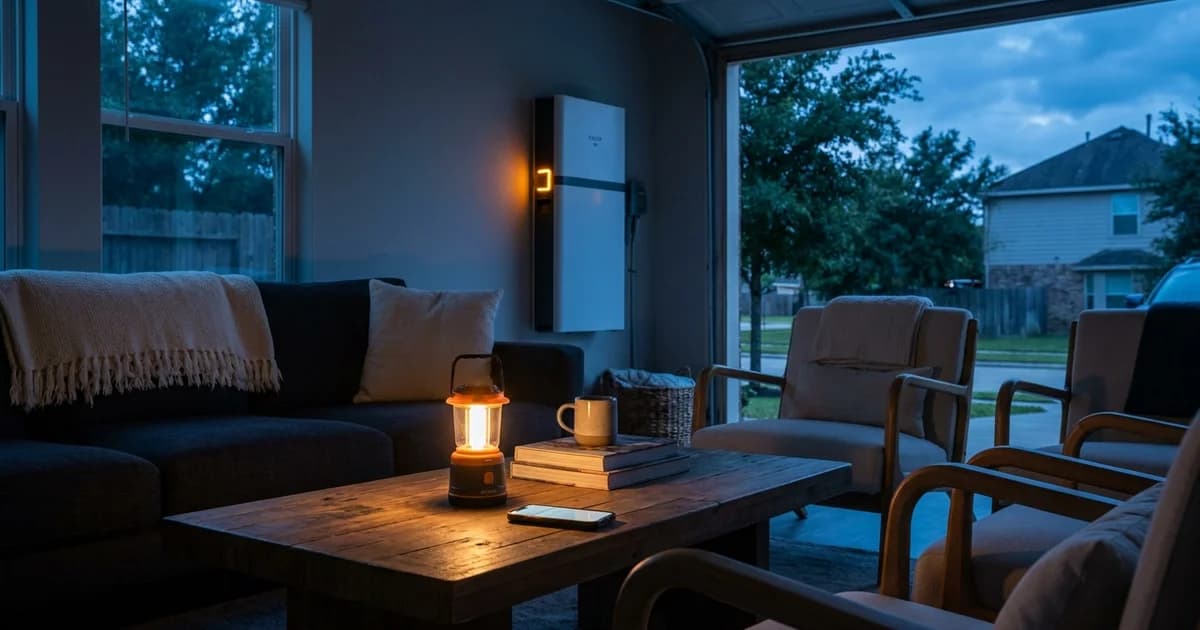
Nobody prints this number on a spec sheet, but it is the one you think about at 2 a.m. on the second night of an outage. What happens when the battery hits zero?
The short answer is anticlimactic. The inverter opens the backup path, the house goes dark the way it would in any outage, and the hardware waits for a charge source. No damage, no bricked battery, no emergency service call.
The longer answer is the useful one, because a properly configured system spends hours signaling before that moment, and whether you reach it at all is decided by load, not luck.
Key Takeaways
- At empty, the battery management system opens the DC path and the house goes dark. Nothing is damaged, and the system restarts on its own once a charge source returns.
- Depth of discharge is a lifespan lever. For lithium iron phosphate cells, cumulative energy throughput runs about 25 percent higher at 60 percent depth of discharge than at 80 percent (PNNL, Energy Storage Grand Challenge Cost and Performance Assessment 2022).
- Runtime is arithmetic, not a promise: usable kilowatt-hours divided by your average draw in kilowatts.
- When the grid returns, a five minute pause before reconnection is normal behavior, not a fault.
What actually happens the moment a home battery hits empty?
In 2024, U.S. electricity customers averaged 11 hours of interruptions, and major events such as Hurricanes Beryl, Helene and Milton accounted for 80 percent of those hours (U.S. Energy Information Administration, "U.S. electricity customers averaged 11 hours of interruptions in 2024", 2025). Most outages end long before a battery empties. When one does not, the sequence is mechanical and boring.
The battery management system watches cell voltage. When the pack reaches its low voltage floor, the BMS opens the DC contactor. The inverter loses its energy source, stops producing AC, and the backed up circuits drop out. Lights off, fridge silent, the same silence your neighbors have had for hours.
Two things do not happen. The pack does not discharge below its safe floor, and the system does not need a technician to wake up. When grid power or solar production returns, the controller closes the path and starts charging.
One clarification worth keeping: the zero on your app is zero percent usable, not zero percent absolute. There is charge left in those cells. You are simply not allowed to spend it.
Why does the battery stop before it is truly empty?
Every battery holds back a slice of its rated capacity, and it does so for a reason that shows up in year eight rather than day one. For lithium iron phosphate chemistry, the U.S. Department of Energy's storage cost and performance assessment reports cumulative discharge throughput roughly 25 percent higher at 60 percent depth of discharge than at 80 percent average depth of discharge, with an assumed calendar life of 16 years (PNNL, Energy Storage Grand Challenge Cost and Performance Assessment 2022).
There are two separate floors, and homeowners routinely confuse them.
The chemistry floor is fixed. Eos hardware rates each 9 kWh nominal module at 8.76 kWh usable, so roughly 3 percent stays permanently out of reach. That is the BMS protecting the cells, and no setting exposes it.
The reserve is yours to set. A 20 or 30 percent reserve tells the system to stop discharging early so there is something left for the next event, or for a medical device, or for one more night of fans. Raising it does not create energy. It moves the moment you go dark earlier and holds that energy for a purpose you chose.
Deep, repeated full discharges age cells faster than shallow ones. That is the honest trade behind the setting: a lower reserve buys hours today and spends warranty throughput you will want in a decade.
What a well configured system does before it runs out
A backup system that goes from comfortable to dark with no warning is a system that was never told what matters. The 2023 National Electrical Code recognizes energy management systems in Section 705.13 and Article 750.30, which permit controlled load shedding and power disconnection as a design method rather than an emergency measure (Mayfield Renewables, "Code Corner: Energy Management Systems").
In practice, the sequence looks like this:
- The grid drops. The controller isolates the house and picks up the backed up circuits within a fraction of a second.
- Non essential circuits shed first. Pool pump, EV charger, second HVAC zone, the garage freezer you forgot about. They come off automatically at defined state of charge thresholds.
- Comfort loads go next. Air conditioning is usually the last big load standing, and the first one worth surrendering when the numbers stop working.
- Critical circuits ride to the floor. Fridge, Wi-Fi, a lighting circuit, medical equipment.
Shedding is not only about energy. It is also about instantaneous power. The Eos controller delivers 11.5 kW continuous with 17.1 kW of surge headroom, so a compressor start landing on top of an oven and a well pump can exceed the ceiling even with the battery half full. A smart panel handles that ordering for you, the argument in our smart panel circuit prioritization guide. For the loads that usually stay off the backup side entirely, read what home battery backup does not power.
How do you compute your own runtime instead of trusting a headline number?
Runtime is one division: usable kilowatt-hours divided by average draw in kilowatts. Nothing else. The variable that decides the answer is cooling, which accounted for 19 percent of U.S. residential electricity use in 2020, ahead of space heating and water heating at 12 percent each (U.S. Energy Information Administration, "Use of energy explained: Energy use in homes").
Here is the arithmetic across Eos residential capacities, at two honest load levels.
| Usable capacity | Essentials only, about 1.5 kW | Summer comfort with AC, about 5 kW |
|---|---|---|
| 8.76 kWh | about 5.8 hours | about 1.8 hours |
| 17.52 kWh | about 11.7 hours | about 3.5 hours |
| 26.28 kWh | about 17.5 hours | about 5.3 hours |
| 35.04 kWh | about 23.4 hours | about 7.0 hours |
| 43.80 kWh | about 29.2 hours | about 8.8 hours |
Treat those as ceilings. Straight division ignores inverter conversion losses and compressor cycling, so real results land lower. The point is not the table. It is that your number depends on a load profile only your house can supply, which is why the full runtime breakdown for Texas homes and the sizing walkthrough both start with your panel, not with a product.
Can solar refill the battery during a daytime outage?
Sometimes, and the difference is configuration plus weather. One Houston homeowner ran his house for nine consecutive days after Hurricane Beryl on a solar and battery system (The Texas Tribune, "Why more Texans are taking their power back", April 2026). That is the ceiling of what current residential equipment does, and it required daytime production that exceeded daytime consumption.
The arithmetic is unforgiving. If the array puts back less than the house pulls, solar slows the drain, it does not reverse it. Heavy cloud during a tropical system, a shaded roof, or a hot afternoon of AC cycling can each flip a recharging day into a slower losing day. We will not publish a production figure here, because daily output at your address depends on array size, tilt, orientation and shading, and any number we quoted would be fiction.
One more thing worth knowing: a grid tied array without islanding capability produces nothing during an outage, because the interconnection standard requires the equipment to cease energizing when the grid is abnormal (New York State Department of Public Service, "Requested Documentation of IEEE 1547-2018 Setting Requirements", 2022). Panels alone are not backup.
What should you do when the battery reaches 30 percent?
Thirty percent is the moment to act, not the moment to worry. Food safety gives you the schedule: with the doors closed, food stays safe up to 4 hours in a refrigerator, 48 hours in a full freezer, and 24 hours in a half full freezer (Centers for Disease Control and Prevention, "Keep Food Safe After a Disaster or Emergency").
A triage list that actually buys hours:
- Raise the thermostat. Every degree of setpoint you give back is compressor runtime you keep. In a Houston summer this is the single biggest lever you have.
- Stop opening the fridge. Decide what you need, open once, close. The FDA recommends appliance thermometers in both units so you judge safety by temperature rather than by smell (U.S. Food and Drug Administration, "Food and Water Safety During Power Outages and Floods").
- Leave the freezer shut entirely. A full one holds its own for two days. Treat it as a sealed box.
- Charge phones and medical devices now, while there is comfortable margin, not at 8 percent.
- Unplug the extras. An older refrigerator uses roughly 20 percent more energy than an ENERGY STAR certified model (ENERGY STAR, "Refrigerators"), and a second beverage fridge in the garage is runtime you are giving away.
- Move cooking off the battery. Grill outside. An electric range can pull more than the rest of the house combined.
For the full food timeline, see how long food lasts in the fridge without power. For multi day planning against a Beryl class event, see battery backup for extended Texas outages.
What happens when grid power comes back?
Expect a pause. The default enter service delay under IEEE 1547-2018 is 300 seconds, a five minute check that the utility voltage and frequency are genuinely healthy before the equipment reconnects (New York State Department of Public Service, "Requested Documentation of IEEE 1547-2018 Setting Requirements", 2022). Your neighbor's lights may come on before yours. That is the standard working, not a defect.
After reconnection the controller starts refilling the pack, and a high reserve means a hard charge for the first stretch. Restoration is also when the grid is least stable, so a system that waited out a false restart just protected your electronics from a second hit.
Two storms set the Texas planning baseline. Hurricane Beryl left about 3 million people without power in July 2024, and roughly 226,000 customers were still dark eight days later (The Texas Tribune, July 2024). During Winter Storm Uri, outages peaked at 4,011,776 customers, 31 percent of the state, and 58 counties spent 48 or more hours with at least a fifth of customers unpowered (Texas 2021 winter storm outage analysis, PMC, 2023).
So will a battery cover your whole outage? It depends on your load and your capacity, and the only way to answer it is to run your own numbers. Browse the plan capacities once you know your target hours.
Or call Eos at 833-989-3737 to talk through your setup with an installer.
Frequently Asked Questions
Does running a home battery to zero damage it?
No. The battery management system opens the DC path at the low voltage floor before cells reach a harmful state. Deep, repeated full discharges do shorten service life, though: throughput for lithium iron phosphate cells is about 25 percent higher at 60 percent depth of discharge than at 80 percent (PNNL, 2022).
Will the system restart by itself after it empties?
Yes. Once grid power or solar production returns, the controller closes the path and begins charging without intervention. Under IEEE 1547-2018 the default reconnection delay is 300 seconds (NY DPS, 2022), so a five minute wait after the grid returns is expected.
What reserve percentage should I set?
There is no universal answer. A higher reserve protects a medical device or a second night; a lower one buys hours now. Set it against a purpose you can name. Cooling makes the decision matter, since air conditioning was 19 percent of U.S. home electricity use in 2020 (EIA).
How much food can I lose if the battery dies overnight?
Less than most people fear, if the doors stay closed. Food stays safe up to 4 hours in a refrigerator, 48 hours in a full freezer and 24 hours in a half full freezer (CDC). Discard perishables held above 40 degrees Fahrenheit for 2 hours or more.
Sources
- Centers for Disease Control and Prevention, "Keep Food Safe After a Disaster or Emergency," retrieved 2026-09-06, https://www.cdc.gov/food-safety/foods/keep-food-safe-after-emergency.html
- U.S. Food and Drug Administration, "Food and Water Safety During Power Outages and Floods," retrieved 2026-09-06, https://www.fda.gov/food/buy-store-serve-safe-food/food-and-water-safety-during-power-outages-and-floods
- U.S. Energy Information Administration, "U.S. electricity customers averaged 11 hours of interruptions in 2024," retrieved 2026-09-06, https://www.eia.gov/todayinenergy/detail.php?id=66744
- U.S. Energy Information Administration, "Use of energy explained: Energy use in homes," retrieved 2026-09-06, https://www.eia.gov/energyexplained/use-of-energy/electricity-use-in-homes.php
- Pacific Northwest National Laboratory, "Energy Storage Grand Challenge Cost and Performance Assessment 2022" (PNNL-33283), retrieved 2026-09-06, https://www.pnnl.gov/sites/default/files/media/file/ESGC%20Cost%20Performance%20Report%202022%20PNNL-33283.pdf
- New York State Department of Public Service, "Requested Documentation of IEEE 1547-2018 Setting Requirements," retrieved 2026-09-06, https://dps.ny.gov/system/files/documents/2022/11/si-requested-documentation-of-ieee-1547-2018-setting-requirements-tsrg_iso-ne-sample.pdf
- Mayfield Renewables, "Code Corner: Energy Management Systems (2023 NEC 705.13)," retrieved 2026-09-06, https://www.mayfield.energy/technical-articles/code-corner-energy-management-systems-2023-nec-705-13/
- The Texas Tribune, "Hundreds of thousands of Texans still without power after Hurricane Beryl," retrieved 2026-09-06, https://www.texastribune.org/2024/07/15/texans-power-outages-hurricane-beryl/
- The Texas Tribune, "Why more Texans are taking their power back," retrieved 2026-09-06, https://www.texastribune.org/2026/04/13/why-more-texans-are-taking-their-power-back/
- Texas 2021 winter storm power outage analysis, PMC, retrieved 2026-09-06, https://pmc.ncbi.nlm.nih.gov/articles/PMC9851928/
- ENERGY STAR, "Refrigerators," retrieved 2026-09-06, https://www.energystar.gov/products/refrigerators