Can a Home Battery Run a Heat Pump or Electric Heat in a Houston Winter Outage?

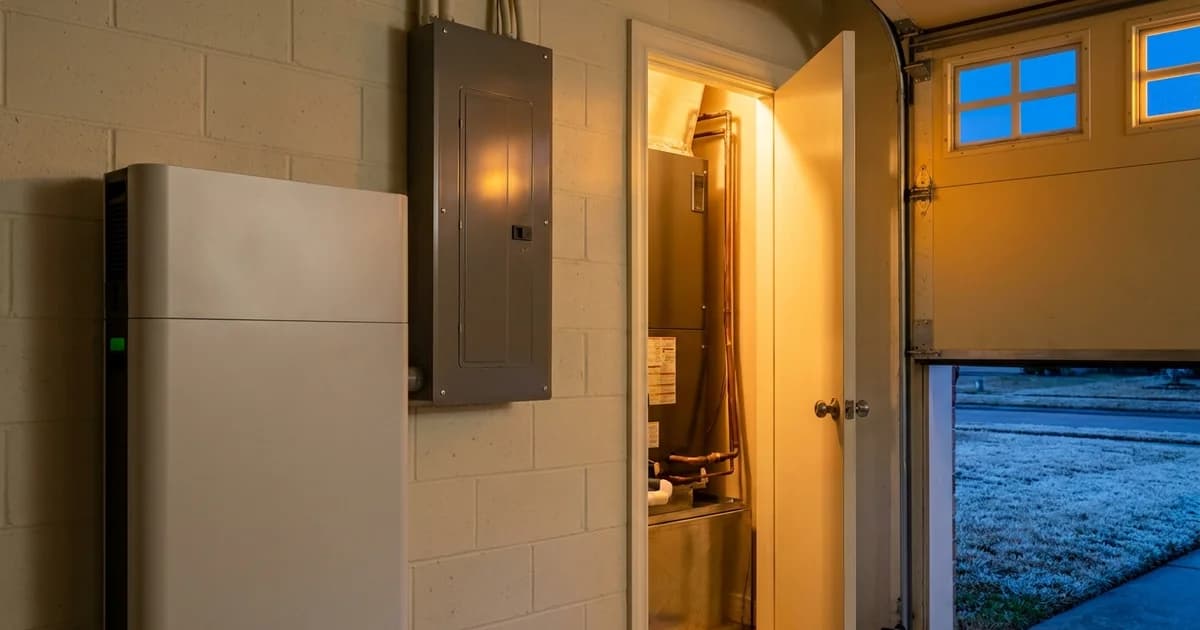
Yes, a home battery can run a heat pump in a Houston winter outage. The part that trips people up is the electric heat strips inside the air handler. The compressor is a modest load. The strips are not. If you lock them out or limit them, a battery handles a heat pump well. If you let them run freely, they can exceed what one controller can deliver.
This post covers heating loads only. Cooling is a different problem, and we cover it in our guide to central AC tonnage and battery sizing. General freeze preparation is in our winter storm preparation guide. Here we stay on the question of whether your heat keeps running.
Key Takeaways
- A gas furnace needs only a blower, so it is the easiest heating system to back up.
- A heat pump's compressor is a manageable load. Its electric heat strips are the risk.
- Residential Eos systems deliver 11.5 kW continuous and 17.1 kW surge per controller, so one large strip kit can exceed that alone.
- Lock out or stage strip heat, and heat one zone, not the whole house.
What actually draws power in a Houston heating system?
Three things draw power in an electric heating system: the outdoor compressor, the indoor blower, and the resistance heat strips. The U.S. Department of Energy notes that electric resistance heat converts all incoming electricity to heat, but that it is often more expensive to operate than other heat sources (U.S. DOE, Energy Saver, electric resistance heating). A heat pump moves heat instead of making it, which is why it uses less.
The DOE also reports that cold climate air-source heat pumps can cut household energy use by up to 40 percent, with the biggest savings for homes that now heat with electric resistance (U.S. DOE, Cold-Climate Air Source Heat Pumps). That efficiency gap is the whole story for battery planning. Heat that costs little grid energy also costs little battery energy.
So the first question is not "how big is my battery." It is "what is my system doing when it is cold enough that the heat pump can't keep up alone?"
How cold does Houston actually get?
Not very, most winters. The National Weather Service lists a January normal high of 63.8F and a normal low of 46.1F at Houston Hobby, using 1991 to 2020 normals, with a record low of 5F set in 1940 (NWS Houston/Galveston, January normals for Hobby). Inland stations run colder than Hobby.
That matters in two ways. On a normal Houston cold snap, a heat pump handles the load and strips seldom run for long. During a rare hard freeze, the system leans on strips exactly when the grid is most likely to fail. Winter Storm Uri is the example everyone remembers. The final state health report counted 246 deaths, and close to two-thirds of them came from hypothermia (Texas Tribune, citing the Texas Department of State Health Services final report).
Heating during a hard freeze is not a comfort question. It is a safety question. That is why the strip problem deserves real attention.
Why do heat strips break the math?
Heat strips are sized in kilowatts, and the big ones are larger than a single controller's continuous rating. A Daikin and Goodman specification sheet for air handler heat kits lists strip capacities from 3.0 kW up to 25.0 kW at 240 volts, and the HKR family runs from 4.75 kW to 19.6 kW (Daikin Comfort, SS-DHKR electric heat kit specification sheet). That is one manufacturer's range, and your kit may differ. Check the nameplate on your air handler.
Every residential Eos plan uses one controller rated at 11.5 kW continuous and 17.1 kW surge, per the plan data on our plans page. So a 15 kW strip kit running at full output asks for more than the controller can deliver by itself. Add the blower and the compressor, and the gap widens. Strip kits are usually staged in steps, so not every strip fires at once, but a thermostat in emergency heat mode can call for all of them.
The arithmetic on runtime
Take a strip kit pulling 9.6 kW, which is one of the sizes on that sheet. This is plain division, not a field measurement. The Essential plan stores 8.76 kWh usable, so full strip output would drain it in under an hour. The Premium plan stores 35.04 kWh usable, which is closer to three and a half hours. Even the largest residential plan stores 43.80 kWh, or under five hours at that draw.
Compare that with a heat pump alone. Because it moves heat, the same battery lasts a good deal longer, though we don't publish a single runtime number because compressor draw varies by model. For tier-by-tier capacity, see how long home battery backup lasts in Texas.
What about defrost and the blower?
Heat pumps periodically reverse to melt frost off the outdoor coil. Many systems turn on strips during that cycle so the house doesn't blow cold air. In a Houston freeze with damp air, defrost cycles happen often.
That is how the three loads coincide. The compressor is running, the blower is moving air, and strips are firing to cover the defrost. That stack is what produces a short spike above the continuous rating. The 17.1 kW surge figure absorbs brief peaks, but it is not a sustained number. We would not design a plan that depends on riding the surge limit for hours.
Is this a flaw in the battery? No. An 11.5 kW controller is sized for a home with prioritized loads, not for every resistance element in the house running at once. The fix is on the load side.
Which heating systems back up easily?
Ranked from easiest to hardest:
- Gas furnace. The burner uses gas. Only the blower and controls need electricity. This is the simplest backup case in the house, and it is why a small battery plan can keep a gas-heated home warm for a long time. Check your furnace's ignition and blower rating, and confirm gas service is still flowing.
- Heat pump with strips locked out. Compressor plus blower. A manageable load for any residential tier.
- Heat pump with staged strips. Workable if load control caps strip stages. Needs setup.
- Electric furnace. The DOE notes electric furnaces cost more to operate than other resistance systems because of duct losses and the energy needed to move air (U.S. DOE, Energy Saver, electric resistance heating). The whole load is resistance. This is the hardest case.
If you have a gas furnace and an electric heat pump on separate systems, back up the one with the smaller draw first.
How do you lock out strip heat?
You control strip heat in three ways, and a good plan combines them.
At the thermostat. Many heat pump thermostats let an installer set a lockout so strips run only below a set outdoor temperature, or disable them. Emergency heat mode is the opposite of what you want on battery power, because it forces strips on and shuts the compressor off. Utility GVEC, a Texas electric cooperative, warns not to use emergency heating unless absolutely necessary because strips use far more energy than the heat pump (GVEC, heat pumps, heat strips and emergency heating).
At the panel. A smart panel can put the strip circuit on the load-shed list, so it drops first. Our smart panel circuit prioritization guide explains how to rank circuits. Rank the compressor and blower above the strips.
At the breaker. In a worst case, an installer can leave the strip circuit off the backed-up panel altogether, so the strips simply have no power during an outage. The heat pump still runs. This is the simplest option to reason about, and a sensible starting point.
Ask your installer for a load calculation, not a guess. Our guide on kW versus kWh explains why the controller's kW rating and the battery's kWh capacity answer two different questions.
Heat one zone, not the whole house
In a multi-day freeze, the realistic goal is one warm zone, not every room at 72F. Whole-home electric heat through several days of deep freeze may exceed what a single controller and a single battery stack can carry. We would rather say that plainly than sell a plan that quietly fails on day two.
A reasonable strategy:
- Run the heat pump with strips locked out, and set the thermostat a few degrees lower than usual.
- Close doors to unused rooms and focus on one living area and one sleeping area.
- Keep the fridge, router, phone charging and medical equipment on priority circuits.
- Pair the battery with a non-electric backup if your home has one, like a fireplace with a working flue.
For outages that run past a day, our post on battery backup in extended Texas outages covers how load shedding stretches runtime. Texas outages aren't always short. In Uri, more than 4.5 million people lost power, some for as long as four days, and ERCOT ordered 20,000 MW of rolling blackouts (CBS News, final FERC and NERC report coverage).
A note on generators
If you plan to supplement with a portable generator, treat carbon monoxide as a real danger. The CDC says more than 400 Americans die each year from unintentional CO poisoning not linked to fires, and it says never to run a generator inside your home or garage, even with doors and windows open (CDC, carbon monoxide). A battery has no exhaust.
What did Texas change about installing home batteries?
Since September 1, 2025, Texas Senate Bill 1252 stops municipalities from regulating the installation or inspection of residential energy backup systems that provide no more than 50 kW or store no more than 100 kWh. A municipally owned utility can still regulate within its own service area. Electrical work still has to follow Texas Occupations Code Chapter 1305 and the National Electrical Code, performed by licensed Texas electrical contractors (TDLR, SB 1252 changes).
For heating, that means your installer's licensed electrician decides how the heat pump circuit is wired to the backed-up panel. Utility interconnection with your wires company is a separate question. Placement questions, like HOA rules, are separate again, and we check them case by case.
Ready to plan your winter backup?
If you want a straight answer for your house, the planner is the fastest way to start. It takes a few minutes.
Or call Eos at 833-989-3737 to talk through your setup with an installer.
Frequently Asked Questions
Can a home battery run a heat pump?
Yes. A heat pump's compressor and blower are moderate loads that a residential battery handles well. The risk is the electric heat strips, which can be sized well above a single controller's 11.5 kW continuous rating. Lock them out or put them on a load-shed list, and the heat pump runs on battery power.
Can a battery run an electric furnace?
Usually only for a short time, or with a smaller zone strategy. An electric furnace is all resistance heat, and the DOE notes electric furnaces cost more to run than other resistance systems because of duct losses. Check the unit's kW rating against the controller before you count on it.
Will heat strips overload my battery controller?
They can. Manufacturer data shows strip kits ranging from 3.0 kW to 25.0 kW at 240 volts, and a large kit can exceed 11.5 kW by itself. Add the blower and compressor, and the total goes higher still. Staging or lockout prevents the overload.
Is a gas furnace easier to back up?
Yes. A gas furnace burns gas and uses electricity only for the blower and controls. It is the lightest heating load in a home and the simplest to keep running through a winter outage, provided gas service continues.
How cold does Houston get in January?
The NWS normal low at Hobby is 46.1F, with a normal high of 63.8F. The record low there is 5F. Most winters are mild, but a rare hard freeze is when heating backup matters most.
Does the city have to inspect my home battery?
Not for a residential system under 50 kW or 100 kWh in most of Texas. SB 1252 bars municipalities from regulating installation or inspection of those systems, though licensed electrical contractors and the NEC still apply, and municipally owned utilities keep authority in their service areas.