Battery Backup for Houston Food Pantries and Community Nonprofits

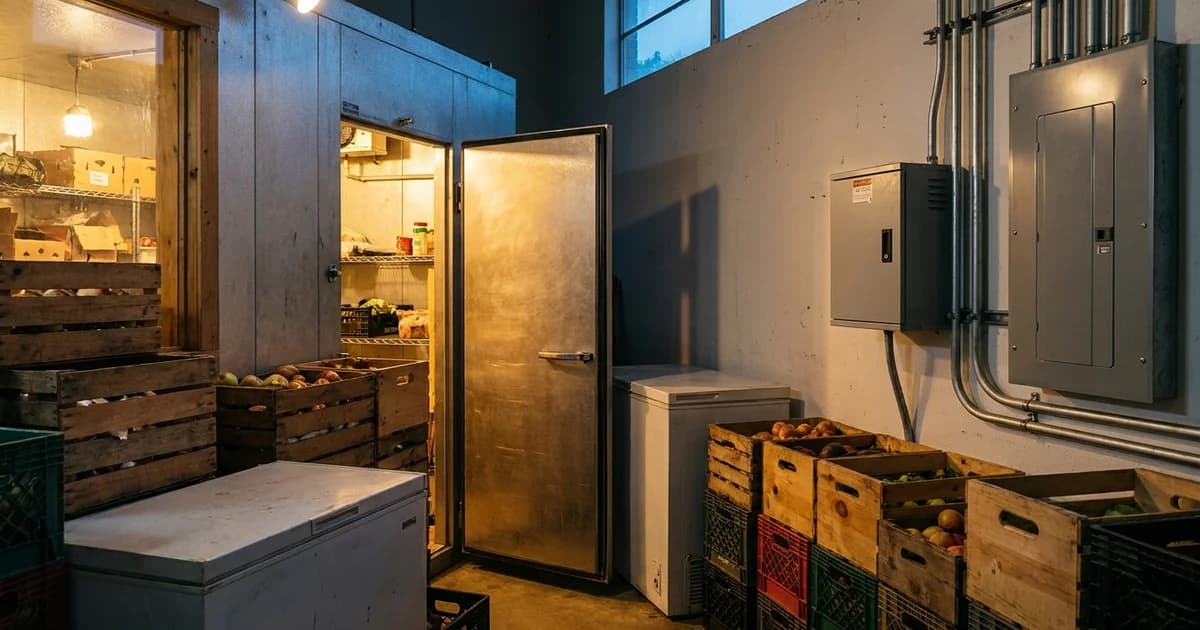
A grocery store buys its inventory and can reorder it. A food pantry is handed its most perishable stock, often with a few hours' notice, and the people who come for it are the ones least able to replace what spoils. When the power drops in Houston, the pantry loses more than refrigeration. It loses the donation that was supposed to be on a family's table that week.
That is the whole problem with food pantry backup power in Houston: the cooler is full of food that arrived for free, the volunteers are only there a few hours a week, and the outage tends to land exactly when demand jumps. This article is about the cold chain for donated perishables and what it takes to protect it.
The pantry, loads, and scenarios in this article are a composite built from public food safety guidance and Gulf Coast outage records. No real pantry or organization is named or described. This is not food safety advice. Your local health authority decides what is safe to serve.
Key Takeaways
- Per USDA guidance, an unopened refrigerator holds safe temperature for about 4 hours, and a full freezer for about 48 hours.
- After Hurricane Beryl in July 2024, about a quarter of the Houston Food Bank's partner organizations temporarily shut down for lack of power.
- One 11.5 kW controller can carry a walk-in cooler, a freezer, lights and a router.
- Verify permitting yourself: Texas SB 1252 covers residential systems, not pantry buildings.
How Long Does a Pantry Cooler Really Hold Without Power?
In 2026, the USDA's Food Safety and Inspection Service guidance, as relayed by WVU Extension, still says an unopened refrigerator keeps food cold for about 4 hours, and a full freezer holds for about 48 hours (24 if half full). Perishables past those windows need a food safety decision, not a guess.
Those numbers were written for a kitchen. A pantry is a different animal. Doors open all day, the cooler is restocked from a truck, and the stock turns over in days. A cooler that is opened constantly will not behave like the 4 hour figure.
There is also a rule behind the guidance. Under Texas Civil Practice and Remedies Code chapter 76, the Good Faith Donor Act, a nonprofit's liability protection for donated food depends on substantial compliance with applicable storage and handling laws. Keeping food at safe temperature is part of that picture. Texas donation rules also point to 41°F as the cold holding line.
Notice what we are not saying. We can't tell you a given pantry loses its protection after any particular hour. That is a legal question for your counsel and your health authority.
What Happens to Pantries After a Houston Storm?
After Hurricane Beryl in July 2024, CenterPoint reported 2.26 million customers impacted, the largest outage in its history. The Houston Food Bank worked with more than 300 organizations, moving upward of 700,000 pounds of food daily on about 60 refrigerated trucks, even as roughly a quarter of its usual partners shut down until power returned.
Read that twice. The system leans on small partner sites, and those same sites go dark in the same storm that creates the demand. Its president told Grist that households faced an immediate question: "I don't have power. What am I going to cook?"
Households were also throwing out their own refrigerated food. The Houston Food Bank helped SNAP recipients reload their cards so they could replace what spoiled at home. We could not find a public, verifiable figure for how much donated food pantries themselves lost in that storm, so we don't offer one.
Here is the pattern worth planning around. Demand rises right after the storm. A pantry with cold storage that survived the outage can take in surplus perishables others cannot hold. A pantry without it turns the same food away.
Why Is the Nonprofit Version Different From a Store or a Shelter?
Three things separate a pantry from the commercial sites we have covered. First, the inventory is donated and unpredictable, so you cannot size to a stock plan. Second, volunteers run limited hours, so nobody is standing by to babysit a generator. Third, the building is often borrowed space.
Compare it to a grocery or convenience store, where refrigeration is the product and a point-of-sale system must stay live. A pantry has no checkout to protect. It has a cold room and a clipboard.
It also differs from an animal shelter, where the load is ventilation for living animals and the budget framing is fixed. Here the question is simpler and narrower: can the cooler and freezer stay cold until someone with a key arrives?
Many pantries operate out of a congregation's building. If yours does, read our piece on places of worship, and for the public-facing side of storm response, see Houston cooling centers and emergency resources.
How Do You Size Backup for a Pantry Cold Room?
Size from nameplates, not guesses. Each compressor has a running wattage on its label and a starting surge several times higher. Multiply running watts by the share of time the compressor actually runs, then by the hours you want to cover. That gives kilowatt-hours.
Here is a deliberately hypothetical example, using assumed numbers you must replace with your own nameplates. A walk-in cooler drawing 2.0 kW while running, cycling 60% of the time, averages 1.2 kW. An upright freezer at 0.5 kW running half the time averages 0.25 kW. Lights, a router and a phone charger add 0.3 kW. Total: about 1.75 kW on average.
Now the platform. Eos Commercial Essential uses four battery modules, 35.04 kWh usable, on one 11.5 kW continuous, 17.1 kW surge controller. At the assumed 1.75 kW average, that is roughly 20 hours of cold room. Cut the lights and comms and the number grows. Add a second cooler and it shrinks.
The surge rating matters because compressors start hard. A 17.1 kW surge ceiling comfortably covers the assumed starts, but your real units may differ. Have a licensed electrician confirm starting current before you rely on any of this.
Honest limit: one controller is the right answer for a cooler, a freezer, lights and communications. It is not the answer for a commercial kitchen with ovens, a dish machine and a large HVAC load. That needs a bigger conversation, and possibly more than one controller.
What Should Get Priority on the Backed Up Panel?
Decide the order before the storm, not during it. A pantry's critical loads fit on one short list, and a smart panel lets you put only those circuits on the battery.
- Walk-in cooler or reach-in refrigeration.
- Freezers, especially anything holding donated protein.
- Lighting in the cold room and the main entrance, for safety.
- A router and phone charging, so the coordinator can reach volunteers and the food bank.
- Fans, if the storage room gets hot.
Leave out the rest. Space heaters, coffee urns, and a second AC unit can all wait. Our commercial battery backup guide for Texas businesses explains how critical load panels work for non-home sites.
Pair the hardware with a habit. A thermometer in every unit, a written log, and a sign that says "keep doors closed" cost almost nothing. The USDA guidance depends on a food thermometer for refreeze decisions, and the Houston Food Bank's partner storage rules require its product to be kept in locked, separated storage. Check the current version with them for the rest.
What About Permits, Landlords and Installation Rules?
This is where a lot of well-meaning articles go wrong. Texas SB 1252 took effect on September 1, 2025. TDLR explains that cities may no longer regulate the installation or inspection of a residential energy backup system, defined as one providing no more than 50 kW or storing no more than 100 kWh.
The key word is residential. A pantry in a commercial or institutional building falls outside that definition, so do not assume the same relief applies. Local permitting for a nonresidential site is a question to put to your installer and the authority having jurisdiction, in writing, before work starts.
What does not change: Texas still requires licensed electrical contractors working to the National Electrical Code under Occupations Code chapter 1305. Utility interconnection is a separate process with the wires company.
Then there is the building itself. If you rent or share space, the owner or board has to approve a wall-mounted cabinet and conduit. Flood-zone placement, deed restrictions and insurance terms are separate questions. We verify each one per site and don't assume.
What Does a Realistic First Step Look Like?
Start with an afternoon of paperwork, not a purchase. Photograph every nameplate on every cooler and freezer. Write down the hours someone is actually in the building. Note which circuits feed the cold room and where the main panel sits.
Then decide the target. Is it covering a 12 hour overnight gap until a volunteer arrives, or a multi-day grid failure like the ones after a hurricane? Those are different batteries. Our guide to how long food lasts in a fridge without power helps frame the household side of the same clock.
An Eos site visit turns the nameplate list into a proposal: how many modules, how many controllers, where they mount. There is no obligation, and no pressure to oversize.
Or call Eos at 833-989-3737 to talk through your setup with an installer.
Frequently Asked Questions
How long can a food pantry go without power before food spoils?
USDA guidance says about 4 hours for an unopened refrigerator and about 48 hours for a full freezer, per the WVU Extension summary. A busy pantry cooler with frequent door openings will do worse. Your health authority decides what is safe to distribute.
Does Texas law protect a pantry that loses power?
Chapter 76 protects nonprofits distributing apparently wholesome donated food when they are in substantial compliance with storage and handling rules. It excludes gross negligence and recklessness. It is not a promise about any specific outage. Ask your attorney.
Does SB 1252 mean we skip the city permit?
Not necessarily. SB 1252 addresses residential energy backup systems. A pantry is typically a nonresidential building, so confirm local requirements with your licensed contractor and the authority having jurisdiction.
Can one battery system run a walk-in cooler and a freezer?
Usually yes for a small pantry. One 11.5 kW controller with 17.1 kW surge can carry a cooler, a freezer, lights and communications, if the starting current checks out. A full commercial kitchen is a different sizing job. See our commercial plans.
Did pantries really lose power in Houston during Beryl?
Yes. Reporting in Grist said roughly a quarter of the food bank's partners temporarily shut down. CenterPoint put the outage at 2.26 million customers.