Freeport and Surfside Beach Battery Backup: Vacation Homes on the Gulf

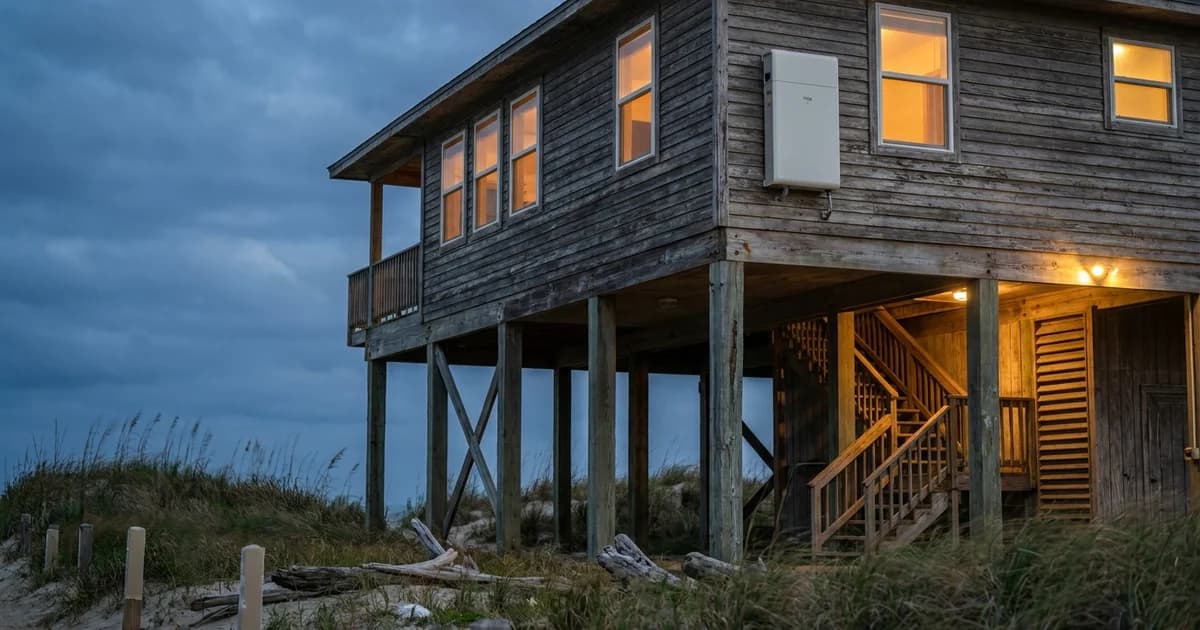
A beach house on the Brazoria County coast has a problem most primary homes don't. It spends weeks or months with nobody inside, and the power can fail on any of those days. When Hurricane Beryl came ashore near Matagorda on July 8, 2024, it was a Category 1 storm that still produced a 94 mph gust in Freeport and storm surge of 3 to 7 feet near Surfside Beach, according to Fox Weather's landfall coverage.
If you own a vacation home, a rental, or a family beach place in Freeport or the Village of Surfside Beach, this guide is about the part nobody mentions: what happens to a house you aren't in when the grid drops. We'll cover freezers, humidity, guests, evacuation, and where a battery can and can't help.
Key Takeaways
- Beryl left 80 to 90% of Brazoria County without power the day it landed (ABC13, 2024).
- An empty house still needs power: a full freezer holds about 48 hours, a refrigerator about 4 (USDA).
- Mold risk rises above 60% indoor humidity (EPA).
- A battery protects the house you are away from. It does not replace an evacuation plan.
What Did Beryl Actually Do to Surfside Beach and Freeport?
Beryl knocked out power to 80 to 90% of Brazoria County on the Monday it made landfall, and ABC13 reported that many beachfront houses in Surfside Beach lost roofs and siding (ABC13, 2024). The same report called it CenterPoint's largest outage in company history, with 2.26 million customers affected.
Those numbers matter for one reason. Outages on this coast are not a rounding error. When a Category 1 storm can strip siding from beach houses and drop a county's grid, restoration is measured in days, and barrier-coast streets are not first in line. Houston trucks go where the most customers are.
That is a different problem than the one inland. Our Lake Jackson and Clute guide covers the industrial, inland side of Brazoria County. Our Galveston guide covers the island. Surfside and Freeport sit between them, and the defining trait is absence: the owner is usually somewhere else.
Quick honesty note on utilities. Listings show CenterPoint as the delivery utility for Freeport and Surfside Beach, but ABC13's Beryl report also mentions Texas-New Mexico Power customers elsewhere in the county. Check the delivery company on your own bill before you assume anything.
Why Does an Empty House Still Need Power?
A refrigerator keeps food safe for about 4 hours without power, and a freezer holds for 24 hours if half full or 48 hours if full, with the doors kept closed (USDA). That clock runs whether you're home or not, and a weekend house often has a freezer stocked with fish, shrimp, and ice.
Food is the visible loss. The quieter one is moisture. The EPA advises keeping indoor relative humidity below 60%, ideally 30 to 50%, and cleaning wet spots within 48 hours (EPA). A Gulf-front house closed up in July has no one to open a window or notice the smell.
Here's how the sequence tends to go for an unattended home:
- The grid drops and the AC stops.
- Indoor humidity climbs within a day or two in a sealed house.
- The freezer thaws and refrigerated food warms.
- If the outage runs long, surfaces stay damp past the 48-hour mark.
The useful mindset shift is this. For a primary home, backup power is about comfort. For a second home, it is about preventing a slow, expensive loss you discover on your next visit. A battery sized for that job can be much smaller than one sized to run a full house in August.
Which Loads Should the Battery Carry While You're Away?
For a vacation home, the priority list is short: the freezer, the refrigerator, a dehumidifier or a minimum cooling setting, internet for cameras and monitoring, and a few lights. Each Eos plan pairs batteries with a controller rated for 11.5 kW continuous and 17.1 kW surge (Eos plans), so the limit is usually energy, not power.
That is where plan size comes in. The Plus plan stores 18 kWh nominal, with 17.52 kWh usable, and handles the surge from a central AC compressor starting up. The Essential plan, at 9 kWh, fits an absentee-owner profile built mostly around cold storage and monitoring.
If you want to keep full cooling running for guests or family, size up. If the goal is protecting an empty house, you can often size down.
I won't quote runtime hours for your house, because they depend on your freezer, your AC unit, and how many circuits you put on the backed-up panel. The planner asks about those directly.
What About Remote Monitoring?
You can't fix what you can't see. A battery that runs the router and a camera while you're three hours away turns an unknown into a status check, and that is half the value of backup power for an empty house.
I'm deliberately not listing app features here. Monitoring capabilities change by system version, so ask your installer to show you exactly what you can see remotely, and what alerts you would get if the grid goes down or the battery runs low. Make them demonstrate it on a live system, not a brochure.
Two practical habits help regardless of hardware. Put a cheap temperature and humidity sensor inside the home that reports to your phone. And give a neighbor or property manager a key and a call tree for storm weeks.
Rentals and Short-Term Guests
If you rent the house, backup power changes the guest experience in a storm and the maintenance call you'd otherwise get. A guest in a dark, hot house on a barrier coast is a stressed guest, and an evacuation order may arrive while they're still there.
Here's the part owners should plan around: during Beryl, Brazoria County issued a voluntary evacuation for low-lying areas including Surfside Beach, Quintana, Follett's Island, and Treasure Island, while Quintana ordered a mandatory evacuation and Surfside Beach ordered RVs and watercraft out (KSAT, 2024). The county judge warned that once winds reached 40 mph, emergency workers would shelter in place.
Back in 2017, Brazoria County ordered a mandatory evacuation of coastal communities on the Gulf side of the Intracoastal Waterway ahead of Hurricane Harvey, affecting about 4,000 people (FOX 26 Houston, 2017). Orders differ by storm and by jurisdiction, so check your village or county announcements each time rather than relying on a past event.
Two lessons follow. First, a battery will not keep guests safe in a surge zone, and you shouldn't market the house as a shelter. Second, what the battery can do is protect the property after everyone has left. For a rental owner in Houston, our landlord guide covers the long-term-lease version of this question.
Can the Equipment Survive a Beach House Site?
Homes on pilings, which are common in coastal high hazard zones, change where equipment can go. FEMA guidance describes elevating new construction in V zones on pilings, posts, piers, or columns so waves pass underneath (FEMA). The same logic applies to your battery: the lower the unit sits, the more surge and debris it is exposed to.
Placement is a site question, not a brochure question. Ask your installer where the equipment will mount relative to your flood elevation, how it is protected from salt air, and how it is anchored against wind. We go deeper on the wind side in our wind and hail rating guide.
I'm not going to give a flood zone verdict for any address. Flood zone, elevation certificate, lender requirements, and local floodplain rules are all property-specific, and you should confirm each with the Village of Surfside Beach, the City of Freeport, or Brazoria County.
What Did Texas Change About Permits for Home Batteries?
Short answer: a lot, and it helps you. Senate Bill 1252 took effect September 1, 2025. It bars a municipality from adopting or enforcing an NEC amendment, or any ordinance or rule, that regulates the installation or inspection of a residential energy backup system, defined as no more than 50 kW or 100 kWh of storage (TDLR, 2025). Municipally owned utilities keep authority in their own service areas.
What that doesn't change: installation must still follow Texas Occupations Code Chapter 1305 and the National Electrical Code, performed by licensed Texas electrical contractors. Utility interconnection with your delivery company is a separate process and still applies. Every Eos residential plan is under 100 kWh.
So when a contractor tells you the village or city will inspect your battery, ask which rule they mean. Then confirm with the contractor and your utility, not with an old blog post, including ours.
What About Insurance?
A separate point worth knowing: Brazoria County is one of 14 first-tier coastal counties where the Texas Windstorm Insurance Association can provide wind and hail coverage (Texas Department of Insurance). Many coastal owners carry windstorm coverage through that route or a private carrier.
I'm not making any claims about what a policy covers or whether a battery changes your premium. Ask your agent. Coverage for equipment, spoiled food, and absentee-owner conditions varies by policy, and the wording matters more than any summary written here.
A Simple Planning Checklist for Absentee Owners
Before next hurricane season, work through these steps:
- List the loads you'd want powered while you're away: freezer, fridge, dehumidifier, router, cameras.
- Decide whether guests will use backup power or only the property will.
- Find your delivery utility on your bill.
- Ask where the equipment can mount relative to flood elevation.
- Confirm the monitoring you'll actually see on your phone.
- Write down your evacuation trigger and who checks the house afterward.
Or call Eos at 833-989-3737 to talk through your setup with an installer.
If you also own or are looking at property closer to Houston, see Houston battery backup options or our Pearland page.
Frequently Asked Questions
Does a battery keep a vacation home safe from hurricane damage?
No. It keeps the house powered after the grid fails, which protects freezers and limits humidity. It does not stop wind or surge. Beryl produced 3 to 7 feet of surge near Surfside Beach (Fox Weather, 2024), and structure and elevation matter far more.
How long will food last in an empty house during an outage?
A full freezer holds about 48 hours and a half-full one about 24, with doors closed. A refrigerator holds about 4 hours (USDA). If nobody can return within that window, a battery on those circuits is what makes the difference.
Can I get remote alerts if the power goes out?
Often yes, but it depends on the system and your internet connection. The battery has to keep your router running. Ask the installer to demonstrate the alerts on a live system, and add an independent humidity sensor as a backup.
Do I need a city permit for a home battery in Freeport or Surfside Beach?
Under SB 1252, municipalities can't regulate the installation or inspection of residential backup systems up to 100 kWh (TDLR, 2025). Licensed contractors and the NEC still apply, and your utility has its own interconnection steps. Confirm both before you sign.
What was not verified for this guide?
Post-storm re-entry rules for Surfside Beach and Freeport, utility boundaries by ZIP code, and any insurance policy terms. We could not confirm them from public primary sources, so we left them out. Check with Brazoria County and your carrier directly.