Coffee Shop Backup Power Houston: Keep the Morning Rush Running

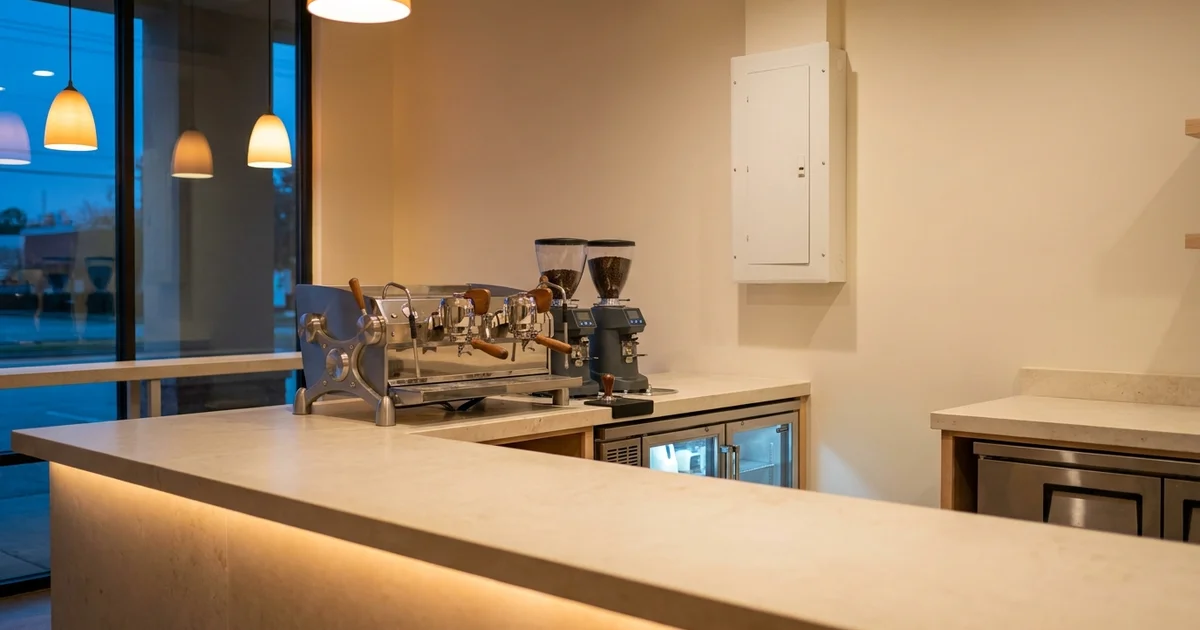
A cafe sells most of its day in a few hours, and the grid rarely cares which ones. When Hurricane Beryl hit in July 2024, CenterPoint reported 2.26 million affected customers, the largest outage in its history (Houston Landing, 2024). A shop that lost power at 6:45 a.m. lost the line out the door, not just the lights.
This article walks through a composite Houston coffee shop and the battery backup that keeps it pouring. The shop and its loads are a composite built from manufacturer spec sheets, Texas food safety guidance and public outage data. It is not a single real customer, and every number below is either cited or labeled as an assumption.
Key Takeaways
- A two group commercial espresso machine lists a 4,600 W element and a 30 A service (La Marzocco, 2025).
- Cold milk must stay at 41°F or below, so refrigeration is the load you cannot skip.
- A cafe is mostly electric and small, which makes it a good fit for one 11.5 kW controller.
Why does an outage hurt a cafe more than most shops?
A restaurant can often cook on gas and keep a dining room moving by candlelight. A cafe cannot make its core product without electricity. The espresso boiler, grinder, milk cooler, point of sale and Wi-Fi are all on the grid, and the busiest window is the early morning commute. That is the stretch where one dark hour costs the most.
Revenue per hour and shop counts are not publicly available in a form I can verify, so I am not quoting them. The logic holds without a number: if your best hours are 7 to 10 a.m., an outage then removes your best hours first.
Restaurants have their own story, and our restaurant backup guide covers gas cooking, hoods and walk-in coolers. A cafe is the simpler case, and that simplicity works in your favor.
What does a cafe actually need to keep running?
Five groups of loads matter, and only one of them is large. The espresso machine dominates. Everything else, taken together, is closer to a rounding error than a second machine.
- Espresso machine. The La Marzocco Linea PB lists a 4,600 W element for the 2 group and 6,100 W for the 3 group, on 208-240 V single phase, drawing a 30 A and 50 A service respectively (La Marzocco, 2025).
- Grinders. Distributor listings put a Mazzer Major VP at 650 W (ekuep). Most shop grinders sit under a kilowatt.
- Refrigeration. ENERGY STAR lists certified solid door undercounter units at roughly 0.6 to 0.9 kWh per day each (ENERGY STAR, 2026).
- Pastry case, lights, point of sale, Wi-Fi. Small, steady and easy to carry.
- Water filtration pump. Small, but if it stops, so does the machine.
Other brands and models differ, so read the nameplate on your own equipment. These numbers are one well documented example, not a universal rule.
Why is 41°F the line you can't cross?
Milk, cream, cut fruit and many pastry fillings are time and temperature controlled foods. The FDA Food Code sets cold holding at 41°F or below (FDA, 2022). Texas follows the same threshold in its Food Establishment Rules.
Texas guidance spells out what happens when a cooler warms up. The Department of State Health Services notes that cold food above 41°F for more than four hours calls for voluntary destruction as a corrective action (Texas DSHS, 2023). Texas also allows time as a public health control, which lets food sit between 41°F and 135°F for a limited time if you have written procedures ready in advance (Texas DSHS, 2023).
That is a paper fallback, not a plan. Batteries keep the coolers at 41°F, so you never need the fallback.
Does espresso heat-up need a surge-proof system?
Short answer: not the way a central air conditioner does. A motor-driven load, like an AC compressor, briefly pulls several times its running current at startup. An espresso boiler is different. It is a resistive heating element, so it draws roughly its rated wattage while it heats and then cycles off.
I started this article assuming heat-up would be the surge problem. The spec sheet says otherwise. A 4,600 W element is a sustained load, not a spike, and it sits well inside what one controller can hold. The Eos Smart controller is rated for 11.5 kW continuous and 17.1 kW surge (Eos plans).
Surge matters for the grinders' motors and compressors in the coolers. Those starting kicks are brief and small next to 17.1 kW.
How does the load math work for a composite shop?
Take a composite cafe with a 2 group machine, two grinders, two undercounter coolers, a pastry case and a counter of electronics. This is an illustrative worst case with everything running at once.
| Load | Assumed draw |
|---|---|
| 2 group espresso machine, elements on | 4.6 kW (spec sheet) |
| Two grinders at 650 W | 1.3 kW (listing) |
| Coolers, pastry case, pump, point of sale, Wi-Fi, lights | about 1 kW (my allowance, not measured) |
| Total simultaneous peak | about 6.9 kW |
That is under 11.5 kW continuous with room to spare. Even a 3 group machine at 6.1 kW brings the same shop to roughly 8.4 kW.
Energy is the other question. Commercial Essential carries 35.04 kWh usable on 4 battery modules and one controller (Eos plans). Run the machine's elements at their full rating for a whole 10 hour day and you would use 46 kWh, which is more than the battery holds. Real machines cycle, so the true figure is lower, but a manufacturer duty cycle for daily kWh is not publicly available. Meter your own shop for a week before you size it.
What if you add a second machine or an oven?
Sequencing earns its place as the shop grows. If you add a panini press, a second espresso machine, or a small oven, the combined elements can approach the 11.5 kW ceiling.
The fix is simple and costs nothing. Stagger the morning startup. Bring the espresso machine up first, then the water heater or oven a few minutes later, rather than switching everything on together. A smart panel can also shed noncritical loads automatically.
If you have already decided which circuits are essential, an installer can wire only those to the backup panel. That is how the same single controller handles a bigger shop than it first appears to.
For other kinds of small commercial sites, see our guides on coworking spaces and salons and barbershops. For the broader Texas picture, read commercial battery backup for Texas businesses.
Why not just buy a generator?
A small portable generator can run a cooler. An espresso machine on 208-240 V and a 30 A service is a different matter. It needs a properly sized unit and a transfer switch, and a generator in a shop front adds noise and exhaust next to customers and food. Fuel can also be hard to find after a hurricane.
A battery is silent, has no exhaust, and switches in automatically. Eos lists a transfer time under 20 ms on its commercial plans (Eos plans), so a point of sale terminal keeps its session through the swap. Match any machine to the supply voltage with your installer before you commit.
What should a cafe owner do this week?
Start with a one page list. Write down every machine's nameplate wattage and voltage. Mark which circuits you cannot lose: espresso machine, grinders, coolers, point of sale, Wi-Fi. Photograph your panel.
Then check your food safety plan. If you hold written procedures for time as a public health control, keep a copy near the walk-in and the cold bar. Batteries reduce the odds you need it, but an inspector will still ask.
Or call Eos at 833-989-3737 to talk through your setup with an installer.
Frequently Asked Questions
How much power does a commercial espresso machine use?
A La Marzocco Linea PB lists 4,600 W for a 2 group and 6,100 W for a 3 group on a 208-240 V service (La Marzocco, 2025). Other brands vary, so check your own nameplate.
Will one controller run my whole cafe?
Often yes. A simultaneous peak near 7 kW sits inside a controller rated for 11.5 kW continuous and 17.1 kW surge. A larger shop with ovens needs a load list first.
How cold does milk need to stay during an outage?
Cold time and temperature controlled food must stay at 41°F or below under the FDA Food Code (FDA, 2022). Texas guidance calls for destroying food above 41°F for over four hours (Texas DSHS, 2023).
How long was Houston without power after Beryl?
On July 10, 2024, CenterPoint still had 1.28 million of its 2.26 million affected customers dark (Houston Landing, 2024). Restoration stretched across days (PBS NewsHour, 2024), which is why a single hour of backup is not enough.
Is a cafe a good fit for battery backup?
It is one of the cleaner fits, because the loads are electric, compact and mostly concentrated in a single machine. Confirm your own numbers first. A short call or a few minutes in the planner will show you the options.