Will a Home Battery Run My AC? Sizing by Tonnage in Houston

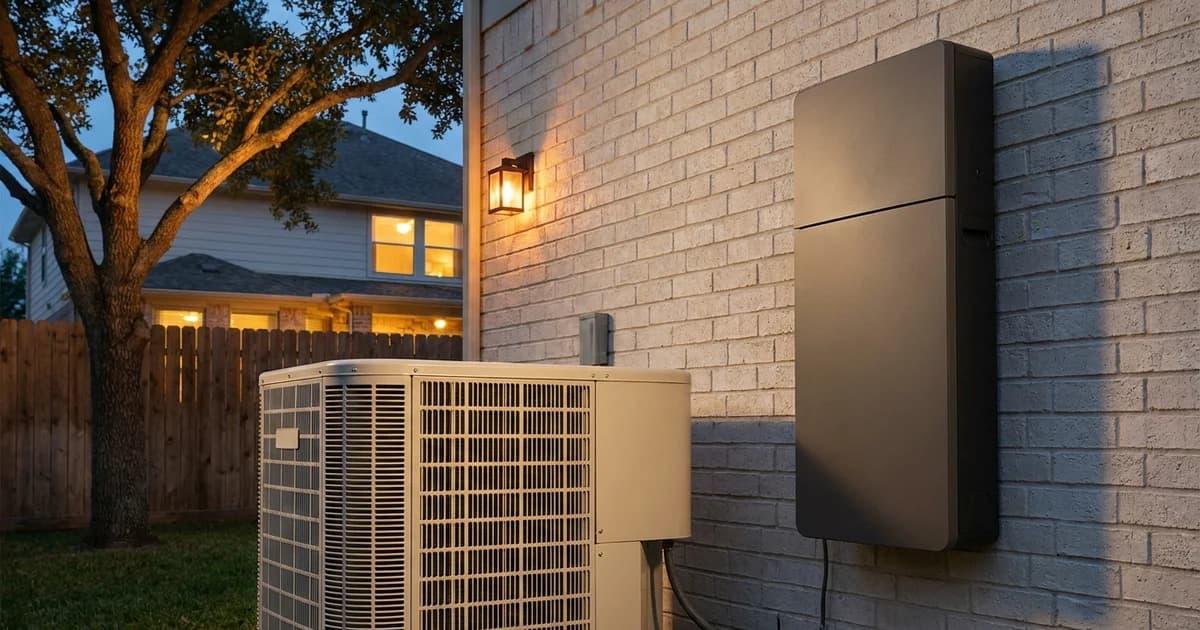
Yes. A properly sized home battery system will start and run a central air conditioner, including a 5-ton unit in most Houston homes. What decides it is not how many kilowatt-hours you buy. It is whether the system can supply the compressor's startup surge and then carry the running load without tripping. Capacity buys hours. Capability buys the air conditioner. Those are two separate purchases, and most sizing guides only talk about the first one.
Two qualifiers. A single-stage compressor with no soft starter is the hard case, and cooling through a hot afternoon is a far smaller ask than cooling through a five-day restoration. This guide converts tonnage into watts, tests those watts against real system limits, and lands on a zoning decision you can hand to an installer.
Key Takeaways
- Yes, a properly sized home battery runs a central AC, and it is the startup surge, not the battery capacity, that decides whether it can.
- Convert tonnage to watts first: one ton equals 12,000 Btu/h, and full-load draw is capacity divided by EER2.
- An Eos residential system delivers 11.5 kW continuous and 17.1 kW surge from a single smart controller. Adding batteries adds kWh, not kW.
- A soft starter or an inverter-driven variable-speed compressor makes the surge question routine. A single-stage compressor with no soft start is the one to check.
- In 2020, two-thirds of US households cooled with central AC or a central heat pump, and air conditioning ran about 19% of home electricity use (EIA, 2020 RECS; both sourced below).
Will a home battery run my central AC?
Yes, when the system's surge rating clears the compressor start and its continuous rating clears the running load. Air conditioning is the load that matters here. In 2020 it accounted for about 19% of electricity use in US homes, roughly 254 billion kWh a year (U.S. Energy Information Administration, How much electricity is used for air conditioning in the United States?), and two-thirds of households cooled with central equipment (U.S. Energy Information Administration, Nearly 90% of U.S. households used air conditioning in 2020).
The question runs through three gates, in this order:
- Surge gate, instantaneous. Can the system deliver the compressor's inrush for the fraction of a second it lasts, on top of everything else running at that moment? Pass or fail.
- Continuous gate, sustained. Can it carry the AC's running draw plus the rest of the backed-up panel inside its continuous rating? Pass or fail.
- Runtime, a number. How many hours does your usable capacity buy at an August duty cycle? Not a gate, just an answer.
Most articles skip straight to gate three. That is why so many homeowners buy capacity and still end up asking why the compressor will not start.
One more piece of honesty. "Running the AC" during an outage means cycled operation at a raised setpoint, not grid-normal comfort at 71 degrees. For the other half of that problem, our guide on
covers the behavior side.How many watts does a 3-ton, 4-ton, or 5-ton AC actually use?
Start with the definition. One ton of cooling equals 12,000 Btu/h of capacity. Electrical draw at full load is that capacity divided by EER2, the full-load efficiency ratio measured at a 95F outdoor condition. Efficiency floors are regional. Since January 1, 2023, split-system central air conditioners installed in the Southeast region, which includes Texas, have had to meet at least 14.3 SEER2 below 45,000 Btu/h and 13.8 SEER2 at 45,000 Btu/h and above. DOE set a minimum EER2 only for the Southwest region, so a Texas unit's EER2 comes from its certified rating rather than from a federal floor (U.S. Department of Energy, 2023 Central Air Conditioner Standards FAQ, 2022).
So the arithmetic is one line: watts = Btu/h divided by EER2. A 3-ton unit is 36,000 Btu/h. At an EER2 of 12 that is 3,000 watts. At an EER2 of 10 it is 3,600 watts. The table below runs that division across an EER2 planning band of 10 to 13. Treat that band as an estimating assumption, not as a certified value.
| Nominal tonnage | Rated capacity | Estimated running draw at full load | Typical Houston context |
|---|---|---|---|
| 2.5 ton | 30,000 Btu/h | roughly 2.3 to 3.0 kW | small home, single zone |
| 3 ton | 36,000 Btu/h | roughly 2.8 to 3.6 kW | most common single-zone size |
| 4 ton | 48,000 Btu/h | roughly 3.7 to 4.8 kW | 2,500 to 3,000 sq ft typical |
| 5 ton | 60,000 Btu/h | roughly 4.6 to 6.0 kW | upper end of a single residential unit |
These are derived figures, not a manufacturer spec sheet. Look up your own model in the AHRI Directory of Certified Product Performance for its certified capacity and EER2, then redo the division with your number (AHRI).
Two Houston adjustments. On a 100F afternoon the unit sits near the top of its band, because rated efficiency is measured at 95F and falls off as outdoor temperature climbs. The indoor blower then adds a few hundred watts on top of the compressor and condenser fan.
Why compressor inrush, not battery capacity, is the real limit
Here is the part almost every competing article misses. A compressor at rest is an induction motor with no back electromotive force opposing the applied voltage. For the fraction of a second before the rotor accelerates, it pulls far more current than it does once running. That spike is printed on the outdoor unit's data plate as LRA, locked rotor amps, right next to RLA, rated load amps. Those two values exist because the National Electrical Code governs branch circuits for hermetic refrigerant motor-compressors under Article 440 (NFPA 70, National Electrical Code).
Locked-rotor current is a defined, bounded quantity in motor standards, not a mystery. ANSI/NEMA MG 1 Part 12 codifies locked-rotor limits by design letter for polyphase induction motors, with Design B as the general-purpose class (NEMA, ANSI/NEMA MG 1, Part 12). Your single-phase residential compressor is not a Design B polyphase motor, so do not borrow a multiplier from that table. Starting current is several times running current, and your exact figure is stamped on the nameplate.
Now the system side, stated plainly. An Eos residential system supplies 11.5 kW continuous and 17.1 kW surge from one smart controller, and every residential tier from Essential through Ultimate ships exactly one controller. Stacking battery modules raises kilowatt-hours and runtime. It does not raise the 11.5 kW or the 17.1 kW ceiling by a single watt. If your air conditioner will not start, a bigger battery is the wrong purchase.
Our finding from the field: a 5-ton unit drawing 4.6 to 6.0 kW running has a comfortable continuous margin inside 11.5 kW. Its unmitigated start event is the tight moment, especially when the refrigerator compressor, a well pump, or a garage door opener happen to share that instant. Load management at the panel matters as much as capacity does.
How soft starters and variable-speed compressors change the answer
There are only two ways to make the surge gate a non-issue: ramp the start, or eliminate it. Both are common in Houston homes, and either one turns a marginal answer into a routine one.
A soft starter installs at the condenser and ramps voltage to the compressor instead of applying it all at once, so the motor accelerates across a short window rather than slamming to full inrush. You will find percentage-reduction claims all over the internet. They come from vendor marketing pages, so we do not quote them. Your installer verifies the result against your compressor's nameplate LRA and the system's surge budget, which is the only comparison that means anything.
A hard start kit is not the same device, and outage forums confuse the two constantly. It adds capacitance to boost starting torque, so the compressor gets moving faster. It shortens the start. It does not reduce the peak current the system has to supply.
An inverter-driven variable-speed compressor modulates speed instead of cycling on and off. It starts slow and ramps, so there is effectively no hard start event to survive, and it spends most of its runtime at part load rather than at full nameplate draw.
| Compressor type | Start behavior on battery | What we usually do |
|---|---|---|
| Single-stage, no soft starter | Full inrush at every start | The case to check. Add a soft starter or shed other loads at the panel during starts. |
| Single-stage plus soft starter | Ramped start across a short window | The usual Houston retrofit, and usually the end of the conversation. |
| Two-stage or inverter variable-speed | Starts low and ramps, mostly part load | The easy case. Typically no start-event problem at all. |
For the whole-home version of this exercise, see our companion guide on
.Should you back up the whole HVAC system or just one zone?
In most Houston homes, backing up one zone is the better engineering answer and the cheaper one. Federal building-science guidance is blunt about the underlying habit: rules of thumb are widely misused for sizing and produce systems that are badly oversized, which costs money and wastes energy (U.S. Department of Energy, HVAC: Proper Sizing of HVAC Systems). The same instinct shows up in backup planning.
A home of 2,500 sq ft and up often runs two systems, which means two condensers and two compressors. Backing up both doubles your surge exposure and your continuous load to buy comfort nobody uses, because during a real outage the household collapses into one part of the house anyway. On the surveys we run across the Houston metro, that is the most common correction we make to a homeowner's initial ask.
Zoning is simple at the panel. The condenser you actually want sits on the managed side, non-essential circuits drop out, and the controller keeps the instantaneous total inside budget. One cool zone at a raised setpoint across a long outage beats whole-house comfort for three hours.
It is also why square-footage rules of thumb mislead. Square footage is a proxy for tonnage, tonnage is a proxy for watts, and watts are the thing you are buying.
How long will it actually run in a Houston August?
Runtime is set by duty cycle, not by the nameplate. A correctly sized air conditioner does not run continuously. It cycles, and on a 100F Houston afternoon with the setpoint raised it typically runs a majority of each hour, then far less overnight. Cooling load is why the grid peaks late in the day: ERCOT hourly peak load hit a record 91.1 GW on July 22, 2026, at 6:00 p.m. CT (U.S. Energy Information Administration, Hourly peak load in ERCOT set a new record, 2026).
Here is the arithmetic, assumptions visible. Each Eos battery module is 9 kWh nominal, 8.76 kWh usable. Take a 3-ton unit at roughly 3.2 kW running, at a 70% afternoon duty cycle, which is a planning number rather than a measurement. That is about 2.2 kWh per hour for the AC, plus roughly 0.5 kWh per hour for the refrigerator, lights, Wi-Fi, and fans. Call it 2.7 kWh per hour.
- Plus (2 modules, 17.5 kWh usable): about 6 hours of afternoon cooling
- Pro (3 modules, 26.3 kWh usable): about 9 hours
- Premium (4 modules, 35.0 kWh usable): about 13 hours
Overnight the picture improves sharply. Drop the duty cycle to 35% and the whole house lands near 1.5 kWh per hour, roughly doubling the hours per module. Real outages mix both, which is why the honest answer is a range.
That range is the reason to size for the tail rather than the average. Hurricane Beryl knocked out power to roughly 2.2 million CenterPoint customers at peak in July 2024, and more than a million were still waiting days later (Houston Public Media, 2024), while NWS heat indices ran 100 to 106F through the restoration (NWS Houston/Galveston, 2024). A four-hour thunderstorm and a five-day restoration are not the same purchase.
For the full treatment of that question, see
.What to check before you ask for a quote
Six things, five of them printed on equipment you already own. Ten minutes in the side yard with your phone camera answers most of the sizing question.
- Read the outdoor condenser data plate. Photograph it. Write down the model number, the tonnage or rated capacity, the RLA, and the LRA.
- Look up the model in the AHRI Directory for certified capacity and EER2, then divide capacity by EER2 for your own running-watt figure.
- Identify the compressor type. Single-stage, two-stage, or inverter-driven variable-speed. The spec sheet or the model nomenclature will say.
- Check for an existing soft starter. It is a small module wired inside the condenser's electrical compartment.
- Count the condensers. One system or two changes both the surge budget and the zoning conversation.
- List what must stay on at the same instant. Well pump, refrigerator, medical equipment, sump pump, garage door.
If you cannot find half of this, you are not blocked. An Eos site survey confirms all of it at the panel and at the condenser before anything is quoted or ordered.
The bottom line
Three things to carry away. Tonnage is not a power rating, so convert it: capacity divided by EER2 gives watts, and a Houston 3-ton unit lands near 2.8 to 3.6 kW. The gate is the start event, not the kilowatt-hours, and adding modules moves runtime while leaving the 11.5 kW and 17.1 kW ceilings where they were. And zoning the air conditioner, rather than backing up every condenser on the property, is usually both the better engineering call and the smaller system.
Read your nameplate first. It answers more of the battery question than your square footage ever will.
Or call Eos at 833-989-3737 to talk through your setup with an installer.
Frequently asked questions
Will a home battery run my central air conditioner?
Yes, when the surge and continuous ratings clear your unit. An Eos residential system delivers 11.5 kW continuous and 17.1 kW surge from one controller. Running draw for a residential AC sits well inside that continuous figure. The brief start event is the part to check against your nameplate LRA.
How many watts does a 3-ton AC use?
Roughly 2.8 to 3.6 kW at full load, from dividing 36,000 Btu/h by an EER2 planning band of 10 to 13. Your own figure comes from your unit's certified capacity and EER2 in the AHRI Directory, divided the same way. Expect the high end on a 100F afternoon, plus a few hundred watts for the blower.
Can a battery start a 5-ton AC?
Usually yes. A 5-ton unit runs at roughly 4.6 to 6.0 kW, comfortably inside 11.5 kW continuous. The start event is the item to verify, and a soft starter or a variable-speed compressor makes it straightforward.
Does a soft starter help a home battery run the AC?
Yes. It ramps voltage to the compressor instead of applying it instantly, so the motor accelerates over a short window and the peak drops. A hard start kit is a different device: it boosts starting torque and shortens the start, but does not reduce peak current.
How long can a battery run my AC in a Houston outage?
At 3.2 kW running and a 70% afternoon duty cycle, a home uses about 2.7 kWh per hour including basics. That is roughly 6 hours on two modules, 9 on three, and 13 on four, with overnight hours running longer.
Sources
- U.S. Energy Information Administration, How much electricity is used for air conditioning in the United States?, retrieved 2026-08-14, https://www.eia.gov/tools/faqs/faq.php?id=1174
- U.S. Energy Information Administration, Nearly 90% of U.S. households used air conditioning in 2020, retrieved 2026-08-14, https://www.eia.gov/todayinenergy/detail.php?id=52558
- U.S. Energy Information Administration, Hourly peak load in ERCOT set a new record, exceeding 91 GW on July 22, retrieved 2026-08-14, https://www.eia.gov/todayinenergy/detail.php?id=67906
- U.S. Department of Energy, 2023 Central Air Conditioner Standards FAQ, retrieved 2026-08-14, https://www1.eere.energy.gov/buildings/appliance_standards/pdfs/2023_CAC_Standards_FAQ_10-5-2022_Final.pdf
- U.S. Department of Energy, Building Science Education, HVAC: Proper Sizing of HVAC Systems, retrieved 2026-08-14, https://bsesc.energy.gov/energy-basics/hvac-proper-sizing-hvac-systems
- AHRI, Directory of Certified Product Performance, retrieved 2026-08-14, https://www.ahridirectory.org/
- NEMA, ANSI/NEMA MG 1, Part 12: Tests and Performance, AC and DC Motors, retrieved 2026-08-14, https://www.nema.org/docs/default-source/standards-document-library/mg-1-part-12-watermark.pdf
- NFPA, NFPA 70, National Electrical Code, retrieved 2026-08-14, https://www.nfpa.org/codes-and-standards/nfpa-70-standard-development/70
- Houston Public Media, Houston power outages after Hurricane Beryl, retrieved 2026-08-14, https://www.houstonpublicmedia.org/articles/news/hurricane/2024/07/08/492833/houston-power-outages-hurricane-beryl-centerpoint/
- NWS Houston/Galveston, Post Tropical Cyclone Report: Beryl, retrieved 2026-08-14, https://www.weather.gov/media/hgx/TropicalEventSummary/PSHHGX_2024AL02_Beryl_Summary.pdf
- U.S. Department of Energy, Consumer Central Air Conditioners and Heat Pumps, retrieved 2026-08-14, https://www.energy.gov/cmei/buildings/consumer-central-air-conditioners-and-heat-pumps
Eduardo Donadi Neto is Founder and CEO of Eos Backup and Battery, which designs and installs home battery backup systems across the Houston metro. Equipment ratings reflect Eos residential specifications as of August 2026. Confirm your own AC nameplate values at the site survey.