Will a Home Battery Work With My 200A Service Panel in Houston?

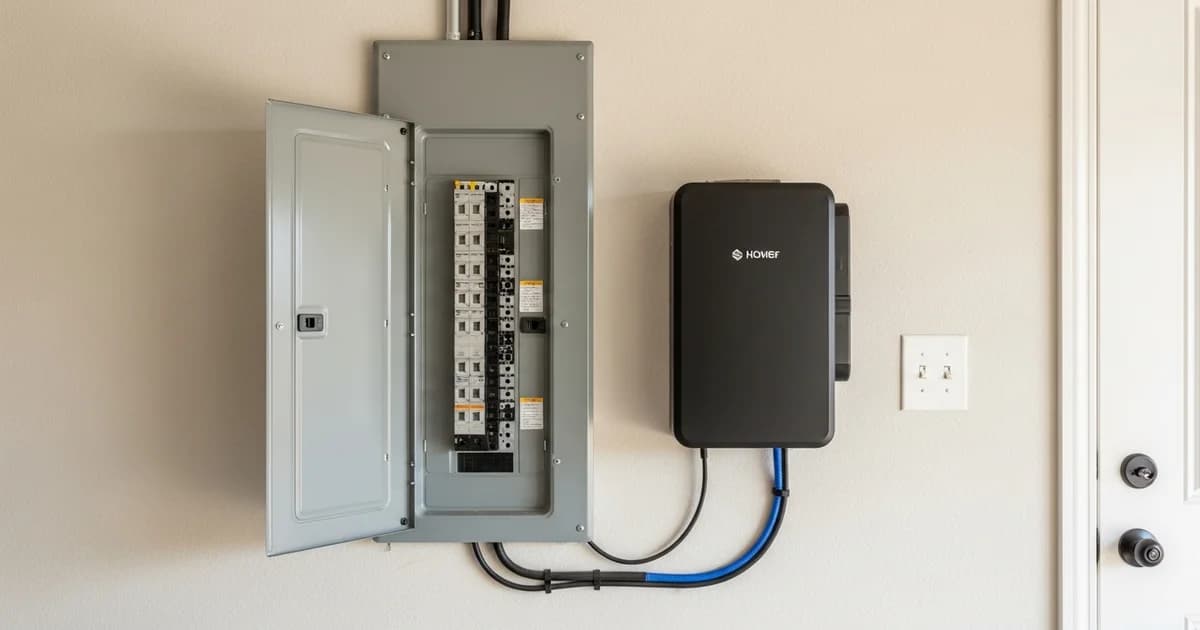
If you already know you have 200A service, you are most of the way to a yes. A 200A panel is the most common residential service size in modern Texas homes, and it is battery-ready in the large majority of cases. Yet plenty of homeowners stall here, worried that a battery means a costly panel swap before they can even start. It usually does not. This guide shows you how to self-assess your 200A panel, explains the one rule that decides compatibility, and covers the few edge cases that change the answer.
[INTERNAL-LINK: get a Houston battery backup quote in under 2 minutes -> /home-backup-planner?source=blog&slug=home-battery-200a-service-panel-compatibility]
Key Takeaways
- A 200A service panel is the most common residential size in Texas and is fully compatible with home battery backup in the large majority of cases.
- The 120% rule (NEC 705.12) lets a 200A busbar carry up to 240A total, which typically leaves room for roughly a 40A back-fed battery breaker.
- Compatibility is decided by the gateway's continuous output amps versus the busbar rating, not by the battery's storage size in kWh.
- Upgrades or a smart panel come up only in specific edge cases, such as a paralleled whole-home system or an already full panel.
- A 30 to 45 minute site survey confirms it by reading three things: busbar rating, main breaker amps, and open breaker space.
Will a home battery work with a 200A service panel?
Yes. A 200A panel is the modern residential service standard, and it is fully compatible with home battery backup in the large majority of Houston installs. Most homes built after about 2000 carry 200A service (U.S. Census American Housing Survey, 2023), which gives the battery's back-fed breaker the headroom it needs.
Both backup paths work on 200A service: whole-home backup that protects the entire panel, and critical-load backup that protects a smaller subpanel of must-keep circuits. What actually decides compatibility is not the battery's storage capacity. It is the relationship between your panel's busbar rating and the gateway's continuous output, expressed as the amps of the back-fed breaker. All residential energy storage installs are governed by NEC Article 706, and the panel connection itself falls under NEC Article 705.
A 200A service panel is the most common residential size in Texas and is battery-compatible in the large majority of cases, because the busbar has room for a back-fed breaker once the 120% rule is applied. Whether your panel works is decided by the gateway's continuous output amps versus the busbar rating, not by how many kilowatt-hours the battery stores.
[INTERNAL-LINK: compare battery backup plans -> /plans]
How the 120% rule decides it (the only math that matters)
On a 200A panel with a 200A main breaker, the 120% rule allows the busbar to carry up to 240A total from all sources, leaving room for roughly a 40A back-fed battery breaker. That single calculation, set by NEC 705.12, is what governs how much battery output a standard panel can accept (NFPA, National Electrical Code 705.12, 2023).
The math is short. Take your busbar rating and multiply by 1.2. A 200A bus times 1.2 equals 240A of allowable total load. Subtract the 200A main breaker, and you have about 40A left for the back-fed feeder that connects the battery. For most single-battery systems, 40A is plenty, which is exactly why so many 200A homes need no panel work at all.
Here is the part homeowners most often get wrong. The 40A figure is about the gateway or inverter's continuous output, not the battery's stored energy. A 9 kWh system and a 27 kWh system can present the same back-fed breaker amps if their inverters output the same continuous power. So a bigger battery does not automatically mean a bigger panel. That conflation between kWh and amps is the single most common myth I correct on a survey.
When the 120% headroom is tight, there is a clean workaround. A supply-side, or line-side, tap connects the battery ahead of the main breaker rather than back-feeding the busbar, which sidesteps the 120% limit entirely (NEC 705.11). For the full wiring path and gateway hardware, see how a home battery wires into your electrical panel.
When is a panel upgrade or smart panel needed?
A 200A panel usually needs no upgrade. An upgrade or smart panel only comes up when the back-fed breaker would exceed the 120% headroom, or when the existing panel is already full or aged. In our recent Houston metro work, the large majority of 200A-service homes we surveyed proceeded on the existing panel with no upgrade.
The most common trigger is a large or paralleled whole-home system that needs more than the roughly 40A of back-fed headroom a standard 200A panel offers. Rather than a full and expensive service upgrade, two options usually solve it. A smart panel acts as a load-managing gateway that dynamically sheds non-essential loads, keeping you within the busbar limit while still backing up the whole home. A supply-side tap, mentioned above, connects ahead of the main and avoids the 120% math.
The genuine upgrade case is different: a panel that is already physically full, corroded, or an obsolete brand with no safe breaker space left. In that situation the panel was due for attention regardless of the battery. A site survey is what separates "your panel is fine" from "your panel needed work anyway."
A smart panel or a supply-side tap avoids a full service upgrade when the back-fed headroom is tight, because both keep total busbar load within the NEC 705.12 limit without enlarging the service. Under NEC 705.11, a supply-side tap connects the battery ahead of the main breaker, which removes the 120% constraint entirely.
[INTERNAL-LINK: check if your home qualifies for a 9 to 45 kWh system -> /home-backup-planner?source=blog&slug=home-battery-200a-service-panel-compatibility]
The 100A and 400A edge cases
If your service is not 200A, the answer shifts but is rarely a dead end. 100A panels often need a critical-load subpanel or an upgrade, while 400A services have ample headroom and are rarely a constraint. Pre-1995 housing stock frequently runs 100A to 125A service (U.S. Census American Housing Survey, 2023), so older Houston homes are where this comes up most.
On a 100A panel, the 120% math is tight: 100A times 1.2 is 120A allowable, minus a 100A main leaves only about 20A. That is often not enough for whole-home backup, so the practical path is a critical-load subpanel that backs up the circuits that matter most, frequently for less than a full service upgrade. Whole-home backup on 100A service usually does mean an upgrade.
A 400A service is the opposite problem, which is to say barely a problem. It is typically built as two 200A panels or a 400A meter-main, so there is plenty of capacity. The design question becomes which subpanel the battery ties into and how the backed-up loads are grouped, not whether there is room. Any panel work, large or small, runs through permitting, so review the Houston permit and inspection requirements for panel work before you schedule.
What the site survey actually checks on your panel
The site survey confirms compatibility in 30 to 45 minutes by reading three things off your panel: the busbar rating, the main breaker amps, and the open breaker space. Those three numbers turn the rough yes from this article into a fixed-scope quote for your specific home.
The most common surprise is a panel labeled "200A" at the meter that turns out to carry a 150A or even 125A main breaker. The meter label reflects the utility service, but the main breaker is what the 120% math actually uses. I see this often enough that I never trust the meter sticker alone. Reading the main breaker, checking busbar condition, and confirming there is real space for the back-fed breaker is exactly what the survey is for.
The technician also confirms where the gateway will mount and how the conductors route from there to the panel, since those drive the scope. From that, the rough compatibility answer becomes a firm design and price. For what happens once the survey is done, see the full Houston installation process.
A 30 to 45 minute site survey reads the busbar rating, the main breaker amps, and the open breaker space to confirm battery compatibility, because the meter label often overstates the real service. A home marked 200A at the meter not uncommonly has a 150A main, and only the main breaker amperage drives the NEC 705.12 calculation.
Ready to move forward?
Here is the short version. A 200A service panel is compatible with home battery backup the large majority of the time. The 120% rule and your actual main breaker decide it, not the battery's kWh. The edge cases, a 100A panel, a paralleled whole-home system, or an already full panel, each have a clear path: a critical-load subpanel, a smart panel, a supply-side tap, or an upgrade the panel likely needed anyway. The survey confirms which case is yours in well under an hour.
[INTERNAL-LINK: book a free Houston home assessment -> /home-backup-planner?source=blog&slug=home-battery-200a-service-panel-compatibility]
Or call our Houston office at 713-471-3367 to talk through your panel before scheduling a visit.
FAQ
Will a home battery work with my 200A panel?
Yes, in the large majority of cases. A 200A panel is the most common residential service size in Texas, and the 120% rule (NEC 705.12) lets the busbar carry up to 240A total. After the 200A main breaker, that typically leaves about 40A of headroom for the back-fed battery breaker, which is enough for most single-battery systems with no panel work.
Do I need to upgrade my electrical panel for a home battery?
Usually not on 200A service. Most 200A homes proceed on the existing panel because the 120% rule leaves room for a roughly 40A back-fed breaker. Upgrades or smart panels come up only in specific edge cases, such as a large paralleled whole-home system that exceeds the headroom, or a panel that is already full, corroded, or an obsolete brand.
Does battery storage size (kWh) decide if my panel works?
No. Compatibility is set by the gateway's continuous output, expressed as the back-fed breaker amps, versus the panel's busbar rating under NEC 705.12. A larger 27 kWh battery and a smaller 9 kWh battery can present the same back-fed amps if their inverters output the same continuous power. Bigger storage does not automatically mean a bigger panel is needed.
Can a 100 amp panel handle a home battery?
Often only through a critical-load subpanel. On a 100A panel the 120% math allows 120A total, and a 100A main leaves only about 20A, which is usually too little for whole-home backup. A critical-load subpanel that backs up essential circuits is the common path, frequently cheaper than a full upgrade. Whole-home backup on 100A service typically needs a service upgrade.
Does a 400 amp service need anything special for battery backup?
No. A 400A service, usually two 200A panels or a 400A meter-main, has ample headroom, so the busbar capacity is rarely the constraint. The design question becomes which subpanel the battery ties into and how the backed-up loads are grouped. A site survey confirms the layout and produces a fixed-scope quote for the specific configuration.
The bottom line
A 200A service panel is battery-ready in the large majority of Houston homes. The 120% rule allows about 40A of back-fed headroom on a standard 200A bus, which covers most single-battery systems with no panel work. The deciding factor is the gateway's output amps against the busbar rating, not the battery's kWh, so a bigger battery does not mean a bigger panel. Edge cases like 100A service, paralleled whole-home systems, or full panels each have a clear path, and a 30 to 45 minute survey reads your busbar, main breaker, and breaker space to confirm exactly what your home needs.
[INTERNAL-LINK: get a fixed-price install quote for your address -> /home-backup-planner?source=blog&slug=home-battery-200a-service-panel-compatibility]