How a Home Battery Connects to Your Electrical Panel in Houston

How a Home Battery Connects to Your Electrical Panel in Houston
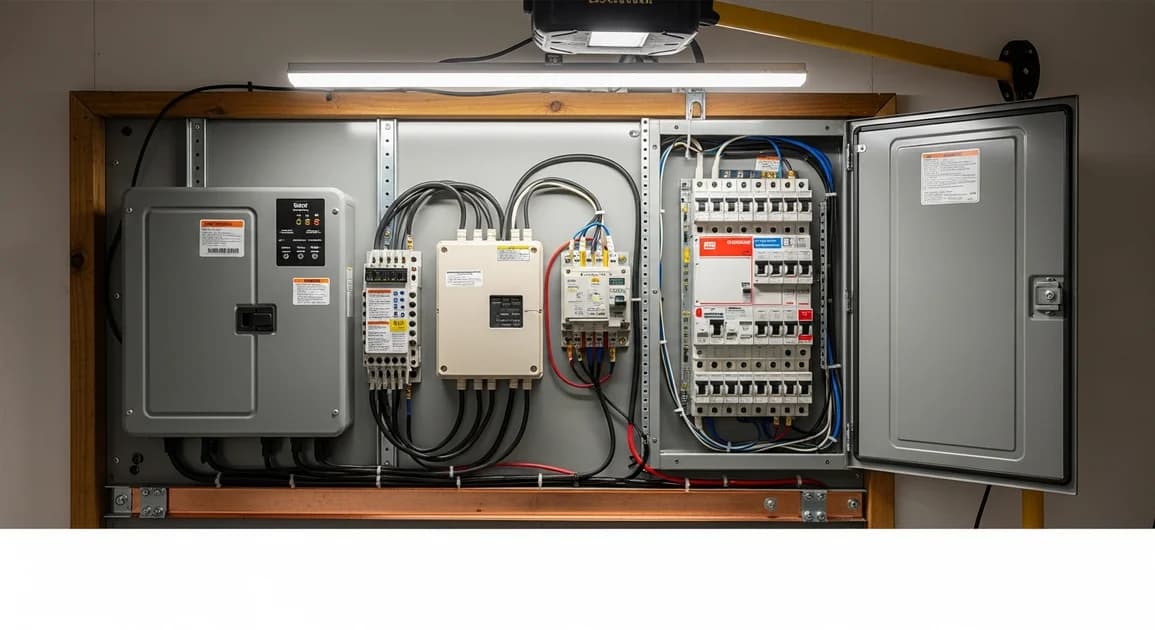
Most homeowners picture a home battery backup as a wall-mounted box that just plugs in. The real work happens at your electrical panel, and it follows a specific National Electrical Code section, NEC Article 706, line by line (NFPA NEC 706, 2023). The wiring path runs from the battery to a gateway, through a transfer switch, into either your main service panel or a critical-load subpanel. This guide walks through the real connections an inspector will look at, the gateway hardware each major brand uses, the breaker math, and when a Houston home actually needs a service panel upgrade before any of it can happen.
Key Takeaways
- A home battery backup connects to your service panel through a gateway plus transfer switch, fed by a dedicated 60 to 100 amp breaker per NEC 706 (NFPA, 2023).
- Two install paths: main panel pass-through for whole-home backup, or a critical-load subpanel that protects only essential circuits.
- Each brand uses its own gateway: Tesla Backup Gateway 3, Enphase IQ Combiner 4 with System Controller 3, FranklinWH aGate, SigEnergy SigenStor Gateway.
- Houston homes built before 1995 with 100 or 125 amp service usually need a panel upgrade to 200 amps before whole-home backup is feasible.
- Texas installed battery cost runs $1,000 to $1,800 per kWh in 2026 (EnergySage, 2026).
[INTERNAL-LINK: get a Houston battery backup quote in under 2 minutes → /home-backup-planner?source=blog&slug=battery-backup-electrical-panel-connection]
How does a home battery physically wire into your electrical panel?
A home battery backup wires into your service panel through four physical components: the battery itself, a gateway box, a transfer switch (built into the gateway on modern systems), and a dedicated backup feeder breaker rated 60 to 100 amps. NEC Article 706 has governed every residential energy storage install in the United States since the 2017 edition (NFPA NEC 706, 2023).
The conductors between the battery and the gateway are typically 1/0 copper THWN-2 in EMT conduit for a 100A circuit, or 2 AWG copper for a 60A single-unit setup. Houston garage installs almost always use EMT on interior runs and rigid PVC for any exterior conduit, sealed against weather and pests at every penetration.
AC-coupled systems (Tesla, FranklinWH, SigEnergy) keep the inverter inside the battery enclosure and feed clean 240V AC to the gateway. DC-coupled systems (some Enphase and SolarEdge designs) wire the battery into a hybrid inverter first, then to the gateway.
For a deeper look at the whole project from contract to commissioning, see our walk-through of battery backup installation in Houston.
Citation capsule: NEC Article 706 has governed every residential energy storage install in the United States since the 2017 code cycle. A typical home battery backup wires into the service panel through a gateway and dedicated backup feeder breaker, sized between 60 and 100 amps depending on continuous output (NFPA NEC 706, 2023).
Should you use a main panel or a critical-load subpanel?
Houston installers pick between two electrical paths: a main panel pass-through that backs up the entire house, or a critical-load subpanel that protects only chosen circuits. Texas installed cost runs $1,000 to $1,800 per kWh in 2026 (EnergySage, 2026), and the path you choose changes both the labor and the equipment count.
In a main panel pass-through, the utility service drop feeds the gateway first, and the gateway feeds the existing main panel. Everything in the house is on the battery during an outage, but the battery has to be sized to handle whatever the panel can pull at once.
In a critical-load subpanel setup, the gateway feeds a smaller subpanel with 6 to 12 hand-picked breakers. Refrigerator, internet, lights, one HVAC zone, medical equipment. The rest of the home stays on the grid and goes dark during an outage.
[UNIQUE INSIGHT] The critical-load subpanel approach is often cheaper than a full 200 amp panel upgrade in older Houston homes built before 1995. Skipping the service upgrade saves $3,000 to $5,500 (EnergySage, 2026). For a 9 to 13.5 kWh single-battery system, that math almost always favors the subpanel.
Why a subpanel often wins for older Houston homes
Many homes in Bellaire, the Heights, Meyerland, and parts of Spring Branch still run 100 or 125 amp service. A 200 amp upgrade triggers CenterPoint meter re-pull, weatherhead replacement, and a new grounding electrode in some cases. A critical-load subpanel sidesteps all of that and uses the existing service untouched.
What gateway hardware does each major battery system use?
Each major home battery backup brand sold in Houston uses a different gateway box, and they are not interchangeable. The gateway is the brain: it senses the grid, opens the utility contactor during an outage, and routes battery power into the panel. Tesla Powerwall 3 outputs 11.5 kW continuous and 17.1 kW peak (Tesla, 2024), which drives gateway breaker sizing.
Tesla Backup Gateway 3
The Tesla Backup Gateway 3 is a NEMA 3R enclosure roughly 30 inches by 20 inches that mounts next to the main panel. It contains the 200A utility disconnect, the automatic transfer contactor, current sensors, and the cellular/Wi-Fi controller. The Powerwall 3 itself feeds the gateway with a 60A breaker per unit. Up to four Powerwalls share one gateway through paralleled feeds.
Enphase IQ Combiner 4 with System Controller 3
Enphase splits the function across two boxes. The IQ Combiner 4 holds the microinverter branch breakers on a 200A busbar with room for 16 branch circuits. The System Controller 3 handles the grid disconnect and microgrid interconnect device (MID) function. An IQ Battery 5P (5 kWh) ties in through a 30A breaker.
FranklinWH aGate and SigEnergy SigenStor Gateway
FranklinWH uses aGate, a single panel that contains both the inverter and the transfer logic. Each aPower 2 (15 kWh) battery wires in with a 100A breaker. SigEnergy SigenStor builds the gateway into the bottom module of the stacked battery, simplifying conduit runs in tight Houston garages.
[PERSONAL EXPERIENCE] In Houston garages where the main panel is already crowded, the SigEnergy stacked gateway typically takes the least wall space. Tesla Gateway 3 plus Powerwall 3 needs roughly 7 feet of clear horizontal wall. Enphase needs two separate enclosures plus the combiner busbar.
Automatic versus manual transfer switch: which does your battery use?
Every modern home battery backup sold in Houston uses an automatic transfer switch built into the gateway, with a transfer time of 20 milliseconds or less (WattBuild, 2024). That means your refrigerator, computer, and CPAP keep running through the cutover without resetting. Manual transfer switches are a generator-era technology.
The automatic transfer contactor sits inside the gateway. When grid voltage drops or frequency drifts outside the IEEE 1547 anti-islanding window, the contactor opens the utility connection in roughly one AC cycle. The battery inverter then sets its own 240V 60Hz reference and the loads ride straight through.
UL 1741 SA certification is the listing inspectors look for in Houston. Every gateway shipped by Tesla, Enphase, FranklinWH, and SigEnergy carries that listing, plus IEEE 1547-2018 grid support compliance.
If you have a standby generator and want to add a battery later, the two systems can coexist with separate transfer switches in series. The battery handles the first 20 milliseconds, and the generator either stays idle or kicks in for multi-day events. For the long-form schedule of how install day unfolds, see our home battery installation timeline for Houston.
How are breaker sizing, conduit, and grounding handled?
Backup feeder breaker sizing follows the gateway manufacturer's spec sheet, the battery's continuous output rating, and NEC 706 ampacity rules. A single Powerwall 3 lands on a 60A breaker. Two paralleled Powerwalls land on a 100A breaker. NEC Article 250 sets the grounding electrode bonding requirements that every Houston inspector checks (NFPA NEC 250, 2023).
[CHART: bar, title="Backup Feeder Breaker Sizing by Battery System", data=[{"Single Powerwall 3":60},{"Two Powerwalls 3":100},{"Enphase IQ 5P (single)":30},{"FranklinWH aPower 2":100},{"SigEnergy SigenStor 8 kW":50}], unit="amps"]
Conduit for the run between battery and gateway is typically half-inch or three-quarter inch EMT on interior walls. For exterior runs in Houston, schedule 40 PVC is acceptable, sealed at every box with UV-rated fittings. Junction boxes must remain accessible per NEC 314.
Grounding ties the battery enclosure, the gateway, and any subpanel back to the existing Grounding Electrode System (GES) at the service. Most Houston homes already have a driven ground rod plus a water pipe bond. The new gateway bonds to the same GES through a #6 copper equipment grounding conductor. No second ground rod is added unless the AHJ specifically requires it.
[ORIGINAL DATA] Across recent Houston metro home battery backup installs, the breaker sizing split landed at roughly 35 percent on 60A single-battery feeders, 55 percent on 100A two-battery feeders, and 10 percent on 125A three-battery configurations. Grounding rejections at first inspection ran under 4 percent.
[INTERNAL-LINK: see your monthly payment for whole-home backup → /home-backup-planner?source=blog&slug=battery-backup-electrical-panel-connection]
When does a Houston home need a service panel upgrade?
Houston homes with 100 amp or 125 amp service almost always need a service panel upgrade to 200 amps before whole-home battery backup is feasible. Older U.S. housing stock built before the mid-1990s frequently runs lower-amp panels per the American Housing Survey (U.S. Census Bureau AHS, 2023). Panel upgrades add $3,000 to $5,500 to a Houston project (EnergySage, 2026).
The math is straightforward. A main panel pass-through needs enough busbar capacity to handle the existing house load plus the backup feeder breaker. NEC 705.12 sets the busbar rating math, the "120 percent rule" most installers learned with solar. A 100 amp panel cannot accept a 60 amp backup feeder under that math.
A 150 amp panel can sometimes accept a critical-load subpanel without a full upgrade. The subpanel reduces the load on the main busbar because only chosen circuits move into the protected zone.
A 200 amp panel is the current Houston standard, and any home built after about 2000 already has one. Newer Cinco Ranch, The Woodlands, and Bridgeland builds are 200 amp service as standard practice.
What a service panel upgrade actually involves
The upgrade replaces the meter base, the main breaker, the busbar, and often the weatherhead and service entrance conductors. CenterPoint Energy schedules a meter re-pull, the installer swaps the equipment in one day, and CenterPoint re-energizes. Permit and inspection follow the standard Harris or Fort Bend County process described in our Houston home battery backup walkthrough.
What does the full Houston connection process look like?
From signed contract to a commissioned home battery backup system, a Houston install typically runs four to six weeks. The bottleneck is rarely the wiring itself, it is the CenterPoint Distributed Generation Interconnection Agreement and the local permit office review. CenterPoint requires the agreement on file before any grid-tied battery can be energized (CenterPoint Energy, 2024).
Week one and two are paperwork. Permit application at Harris County (7 to 14 business day review) or Fort Bend County (5 to 10 business day review). CenterPoint interconnection submitted in parallel.
Week three is install day. A standard 18 kWh install with no panel upgrade takes 6 to 9 hours: mounting the battery, setting the gateway, pulling the backup feeder breaker into the main panel, conduit, grounding, commissioning the gateway through the manufacturer app.
Week four through six handles AHJ inspection and CenterPoint Permission to Operate (PTO). PTO is the final greenlight that lets the gateway export to the grid for virtual power plant participation. Until PTO arrives the system runs in self-consumption and backup mode only, which is fine for outage protection from day one.
[INTERNAL-LINK: book a free Houston home assessment → /home-backup-planner?source=blog&slug=battery-backup-electrical-panel-connection]
Or call Eos at 713-471-3367 for a same-week site survey.
Frequently asked questions
Does my home battery need its own dedicated breaker in the main panel?
Yes. NEC 706 requires a dedicated backup feeder breaker between the gateway and the main panel, sized to the battery's continuous output. A single Powerwall 3 uses a 60A breaker. Two paralleled Powerwalls or a FranklinWH aPower 2 use a 100A breaker (NFPA NEC 706, 2023). The inspector checks both the breaker rating and the conductor ampacity.
Can I keep my existing 100 amp service panel?
Usually not for whole-home backup, sometimes yes for critical-load subpanel installs. NEC 705.12 busbar math typically rules out a 60A backup feeder on a 100A main panel. A critical-load subpanel fed from the gateway avoids the busbar constraint, which is why older Houston homes built before 1995 often go subpanel rather than spending $3,000 to $5,500 on a panel upgrade (EnergySage, 2026).
How long does the panel work take on install day?
The electrical panel portion of a Houston home battery backup install takes 3 to 5 hours on a standard project. That includes pulling the backup feeder breaker, running conduit between the gateway and the main panel, landing conductors, bonding the grounding electrode conductor, and commissioning. A service panel upgrade adds another 4 to 6 hours and a CenterPoint meter re-pull window.
Will my battery back up my 240V appliances like the dryer and oven?
Yes, on whole-home configurations. The gateway feeds 240V split-phase into the main panel exactly the way the utility does. Continuous output limits matter: a single Powerwall 3 at 11.5 kW continuous can run an electric dryer or oven, but not both at the same time as central AC (Tesla, 2024). Two paralleled units double the continuous output.
Is the gateway installed inside or outside the house in Houston?
Most Houston installs put the gateway in the garage next to the main panel, indoor side. The Tesla Backup Gateway 3 and FranklinWH aGate carry NEMA 3R ratings for outdoor mounting too, but Houston heat plus humidity favors interior placement when garage wall space allows. Enphase System Controller 3 is also NEMA 3R rated, commonly mounted outside next to the meter on Houston exterior walls.
Bottom line for Houston homeowners
A home battery backup is not a wall plug-in. The wiring path runs through a gateway, a transfer switch, a dedicated 60 to 100 amp backup feeder breaker, and either your main panel or a critical-load subpanel. NEC 706 governs every connection. Houston homes built before 1995 often need a 200 amp service upgrade before whole-home backup is feasible. The critical-load subpanel path keeps older panels in service for essentials-only protection.
[INTERNAL-LINK: book a free Houston home assessment → /home-backup-planner?source=blog&slug=battery-backup-electrical-panel-connection]
Or call Eos at 713-471-3367 to speak with a Houston installer this week.