Battery Backup for a Houston Townhome or Patio Home: Working With No Side Yard

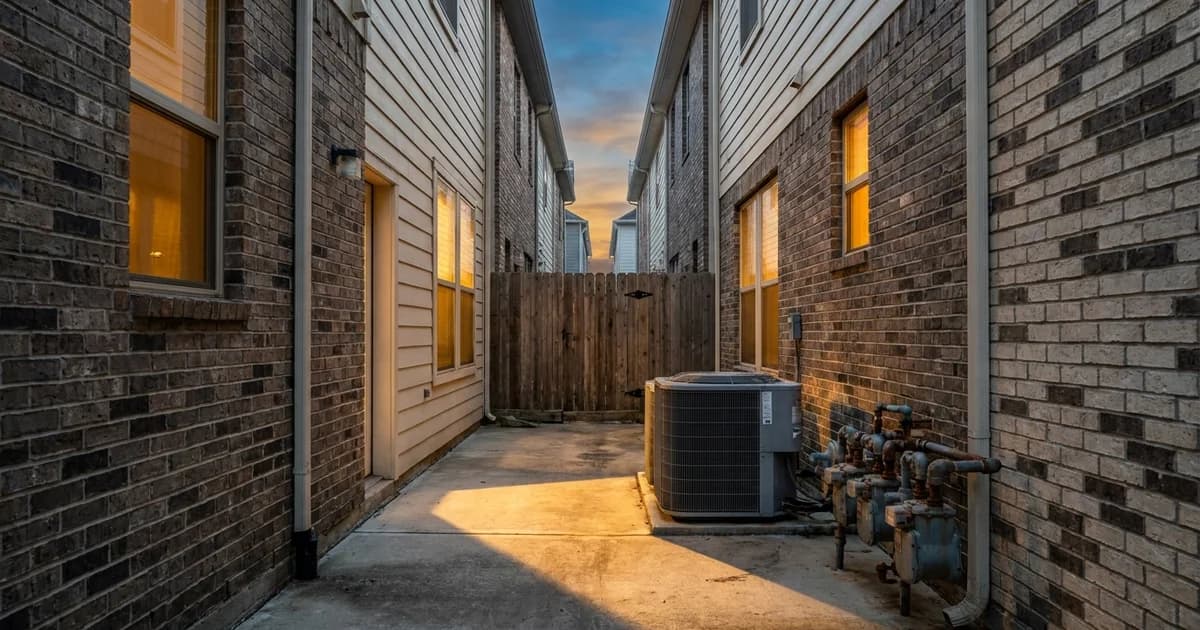
If you own a Houston townhome or patio home, the backup power conversation usually ends at the same place: someone walks the side of the house, looks at the strip of concrete between your wall and the fence, and gets quiet. That strip is often three feet wide, and half of it is already spoken for by the gas meter and the condenser.
That does not mean you cannot have battery backup. It means the outdoor wall is off the table and the real decision moves inside. Here is how that decision gets made, in code terms and in neighbor terms.
Key Takeaways
- The electrical code wants a 3 ft deep, 30 in wide, 6 ft 6 in tall working space in front of the equipment (NEC 110.26). A 3 ft side yard rarely survives that once the meter and condenser are placed.
- The attached garage wall and a dedicated utility closet are the two placements that usually work. NFPA 855 allows up to 80 kWh in a garage and 40 kWh in a utility or storage room, and no ESS in habitable space.
- Your party wall is not an option. The IRC bars mechanical equipment, ducts and vents inside a townhouse common wall.
- Smaller footprint, shorter load list. Most townhomes land on the smallest tier rather than a whole-home system.
Why does a three foot side yard fail a battery install?
Because the code protects the space in front of the equipment, not the equipment itself. NEC 110.26 requires a clear working space at least 3 ft deep for the ordinary 0 to 150 volt dwelling condition, at least 30 in wide or the width of the equipment, whichever is greater, and at least 6 ft 6 in of headroom (NEC 110.26 working clearance guide, Section 110.26(A)(2), Section 110.26(A)(3)).
Run the arithmetic on a zero lot line house. The cabinet is roughly a foot deep. Add 3 ft of working space in front of it and you need close to four feet of clear passage with nothing in it. A three foot side yard gives you three feet total, before the gas meter, the condenser pad, the hose bib and the drainage swale.
Fire code adds a second constraint. Outdoor units have to sit at least 3 ft from doors and windows (Mayfield Renewables, Fire Codes and NFPA 855 for Energy Storage Systems). On a narrow wall with a kitchen window and a side entry door, that alone can eliminate every remaining foot.
This is the part homeowners rarely hear stated plainly: the constraint is not the battery's size. It is the space an inspector needs to stand in. Two systems with identical footprints will pass on a 40 ft wide lot and fail on a 20 ft one, for reasons that have nothing to do with the hardware.
Houston has a lot of these lots on purpose. The city cut its by-right minimum lot size from 5,000 sq ft to 3,500 sq ft inside the I-610 Loop in 1998, allowed subdivisions down to 1,400 sq ft per lot, and extended the rules citywide in 2013. Roughly 80,000 houses have been built on those small lots since (Mercatus Center, Learning from Houston's Townhouse Reforms). Zero lot line construction is not an edge case here. It is a large share of the housing built in the last twenty years.
Where does a townhome battery actually go?
Two places, in practice: the attached garage wall, or a dedicated utility or storage closet. NFPA 855 caps an individual residential ESS unit at 20 kWh, permits an aggregate of 80 kWh in a garage, an accessory structure or outdoors, and 40 kWh in a utility closet or storage space (Florida Solar Design Group, Residential Battery ESS Size Limits). Living areas and bedrooms are off limits entirely, and units need 3 ft of spacing from each other unless UL 9540A test results permit closer placement (Mayfield Renewables).
For a two or three story townhome, the ground-floor garage is the strong candidate. It usually shares a wall with the panel, it is already fire separated from the living space above, and it gives the working depth the side yard cannot. A wall-mounted cabinet sits above the hood of the car and costs you no parking.
The utility closet is the fallback when the garage wall is consumed by the panel, water heater and air handler. It works, but the 40 kWh aggregate limit plus ventilation and access rules make it a tighter problem. Get the closet measured before anyone quotes it.
An interior install deserves an honest safety conversation rather than a reassuring one. What matters is the listing on the equipment, the test data behind it, and how the installer treats separation requirements. We covered that in home battery fire safety in Texas, and the heat tradeoffs between a garage wall and an exterior wall in indoor vs outdoor installation in Houston.
Can the battery go on the wall you share with your neighbor?
No, and the code is unusually blunt about it. The International Residential Code requires that common walls separating townhouse units "be constructed without plumbing or mechanical equipment, ducts or vents, other than water-filled fire sprinkler piping in the cavity" (IRC R302.2.2, as adopted in WAC 51-51-0302). No conduit chase, no penetrations, no equipment hung into that cavity.
One version of this looks harmless and is not. Lag-bolting a cabinet into the studs on the interior face of the party wall puts fasteners into a rated assembly and gives a plan reviewer reason to reject the submittal. Use a wall that is yours alone, an exterior wall or a partition on your side.
Then the courtesy question, which no code covers. Your neighbor's bedroom may be eight feet from your equipment. A battery is silent under load, and the only sound is a small cooling fan under heavy draw. That is a different negotiation than a generator, where noise and exhaust are the whole conflict. We compared the two in why Houston homeowners are ditching generators. Tell the neighbor before the crew shows up anyway.
Does your townhome association get a vote?
Almost certainly yes, and Texas law gives you less protection than you might expect. Section 202.010 of the Texas Property Code voids association rules that prohibit a "solar energy device," and the Tax Code definition it borrows explicitly covers "a mechanical or chemical device that has the ability to store solar-generated energy" (Tex. Prop. Code 202.010, Tex. Tax Code 171.107).
Read that carefully. The protection attaches to storage of solar-generated energy. A grid-charged battery with no panels on the roof is a harder argument. The separate statute for standby generators, Section 202.019, defines the protected device as one "powered by natural gas, liquefied petroleum gas, diesel fuel, biodiesel fuel, or hydrogen," which a lithium battery plainly is not (Tex. Prop. Code 202.019).
In practice this matters less than it reads, because the winning move is placement. An interior garage install is invisible from the street, changes no elevation, and gives an architectural committee nothing to review. The applications that stall propose an exterior cabinet on a front-facing wall. Fee simple ownership does not exempt you from the party wall agreement or the dedicatory instruments recorded against the development. The approval sequence is in how to get a yes from a Texas HOA.
How much capacity does a townhome actually need?
Less than a detached house, usually, and that is the good news here. A townhome has a smaller conditioned envelope, fewer exterior walls losing heat, one air handler, and a shorter list of circuits worth protecting. The critical load list on a 1,600 sq ft three-story unit is often the refrigerator, internet equipment, lighting, device charging, the garage door opener and one bedroom's worth of cooling.
Our smallest residential tier fits that profile: one 9 kWh battery module, 8.76 kWh usable, on a controller rated 11.5 kW continuous and 17.1 kW surge, delivering up to 6 hours at minimal load. That single module sits well under the NFPA 855 per-unit ceiling and inside the utility closet aggregate limit, which is why it survives placements a larger stack does not. Two modules double usable capacity to 17.52 kWh on the same controller and the same wall footprint, stacked vertically.
We worked through the daily kWh math in home battery size for a 1,500 sqft Texas home. Current pricing for each tier lives on the Essential plan page and across all residential plans.
Context for why any of this is worth doing: US electricity customers averaged 11 hours of interruption in 2024, nearly twice the annual average of the preceding decade, and Hurricane Beryl alone left 2.6 million Texas customers without power that July (U.S. Energy Information Administration).
When is the honest answer no?
Sometimes it is. A townhome with a tuck-under garage full of mechanical equipment, no utility closet, a shared exterior wall on the only accessible side, and an association requiring consent from adjoining owners is a project that should not be sold. Same for a patio home where the only compliant wall is inside a bedroom.
On the small-lot sites our crews survey in Houston, most work with a garage wall install, a meaningful minority need the smallest tier rather than the one they asked about, and a few get told no. We would rather deliver that last answer during the site survey than after a deposit clears. If your building has nowhere compliant, ask whether the association would consider a shared common-area system, covered in multi-family battery backup for Texas apartments and condos.
A detached garage or a rear structure on the alley reopens options a side yard cannot, with different wiring and permitting. See battery backup for detached garages, sheds and ADUs.
Or call Eos at 833-989-3737 to talk through your setup with an installer.
Frequently asked questions
Can a battery be installed outdoors on a zero lot line townhome?
Rarely. NEC 110.26 wants 3 ft of working depth in front of the equipment plus 30 in of width, and NFPA 855 wants outdoor units 3 ft clear of doors and windows. A typical 3 ft side yard, already holding a gas meter and condenser, cannot deliver both at once.
Is an interior battery install in a townhome safe?
It is the standard placement for attached housing. NFPA 855 permits residential energy storage in garages, utility closets and storage spaces, caps a single unit at 20 kWh, and prohibits installation in habitable rooms such as bedrooms. Ask your installer for the listing documentation and the manufacturer clearance sheet.
Can I mount the cabinet on my party wall?
No. The IRC requires townhouse common walls to be built without mechanical equipment, ducts or vents inside the assembly, other than fire sprinkler piping. Mounting hardware into a rated common wall compromises the assembly and will fail plan review. Use an exterior wall or a partition on your side.
Does a Texas HOA have to approve a home battery?
Not automatically. Texas Property Code 202.010 protects solar energy devices, and the borrowed Tax Code definition covers storage of solar-generated energy. A grid-charged battery with no panels sits outside that language, so approval depends on your dedicatory instruments. An interior garage placement usually avoids the dispute.
What size battery does a Houston townhome need?
Most land on one battery module. A townhome's shorter critical load list, single air handler and smaller envelope mean whole-home capacity is usually overbuying. Run your own circuit list through the planner before choosing a tier.
Sources
- ExpertCE, NEC Working Clearance Requirements: A Visual Guide (110.26), retrieved 2026-09-08, https://expertce.com/learn-articles/nec-working-clearance-requirements-110-26/
- Electrical License Renewal, NEC Section 110.26(A)(2) Width of Working Space, retrieved 2026-09-08, https://www.electricallicenserenewal.com/Electrical-Continuing-Education-Courses/NEC-Content.php?sectionID=3077
- Electrical License Renewal, NEC Section 110.26(A)(3) Height of Working Space, retrieved 2026-09-08, https://www.electricallicenserenewal.com/Electrical-Continuing-Education-Courses/NEC-Content.php?sectionID=3078
- Mayfield Renewables, Fire Codes and NFPA 855 for Energy Storage Systems, retrieved 2026-09-08, https://www.mayfield.energy/technical-articles/fire-codes-and-nfpa-855-for-energy-storage-systems/
- Florida Solar Design Group, Residential Battery ESS Size Limits, retrieved 2026-09-08, https://floridasolardesigngroup.com/residential-battery-ess-size-limits
- Washington State Legislature, WAC 51-51-0302 (IRC Section R302.2.2, Common walls), retrieved 2026-09-08, https://lawfilesext.leg.wa.gov/law/WAC/WAC%20%2051%20%20TITLE/WAC%20%2051%20-%2051%20%20CHAPTER/WAC%20%2051%20-%2051%20-0302.htm
- Texas Property Code Section 202.010, Regulation of Solar Energy Devices, retrieved 2026-09-08, https://texas.public.law/statutes/tex._prop._code_section_202.010
- Texas Tax Code Section 171.107, definition of solar energy device, retrieved 2026-09-08, https://texas.public.law/statutes/tex._tax_code_section_171.107
- Texas Property Code Section 202.019, Standby Electric Generators, retrieved 2026-09-08, https://texas.public.law/statutes/tex._prop._code_section_202.019
- U.S. Energy Information Administration, Hurricanes in 2024 led to the most hours without power in the United States in 10 years, retrieved 2026-09-08, https://www.eia.gov/todayinenergy/detail.php?id=66744
- Mercatus Center, Learning from Houston's Townhouse Reforms, retrieved 2026-09-08, https://www.mercatus.org/research/policy-briefs/learning-houstons-townhouse-reforms