Home Battery HOA Approval in Texas: How to Get a Yes

Home Battery HOA Approval in Texas: How to Get a Yes
For most Texas homeowners, an HOA is not a barrier to a home battery, it is a form to fill out. A home battery is silent, produces no exhaust, and usually mounts inside the garage where it is not visible from the street, which removes the appearance concerns HOAs care about most. Texas law also limits what an HOA can do with solar energy systems. This guide walks through what the law covers, why an indoor mount is the easy path, and the approval steps. It is general information, not legal advice.
Key Takeaways
- Texas Property Code Section 202.010 bars an HOA from prohibiting a solar energy device, though it may still regulate location, appearance, and require prior approval (Texas Property Code, 2025).
- That protection covers a device that stores solar-generated energy, so a battery paired with solar has a strong case; a standalone, grid-charged battery is less clearly covered and goes through normal architectural review.
- An indoor or garage-mounted battery is not visible from the street, which sidesteps the aesthetic objections HOAs focus on.
- If an HOA denies a request, Texas law gives you a hearing right: you can request a board hearing within 30 days of the denial (Texas Property Code 209.00505, 2025).
- This is general information. Read your own HOA documents and consult your HOA or an attorney for your situation.
[INTERNAL-LINK: start a low-friction, HOA-friendly install → /home-backup-planner?source=blog&slug=battery-backup-hoa-approval-texas]
Will my HOA let me install a home battery in Texas?
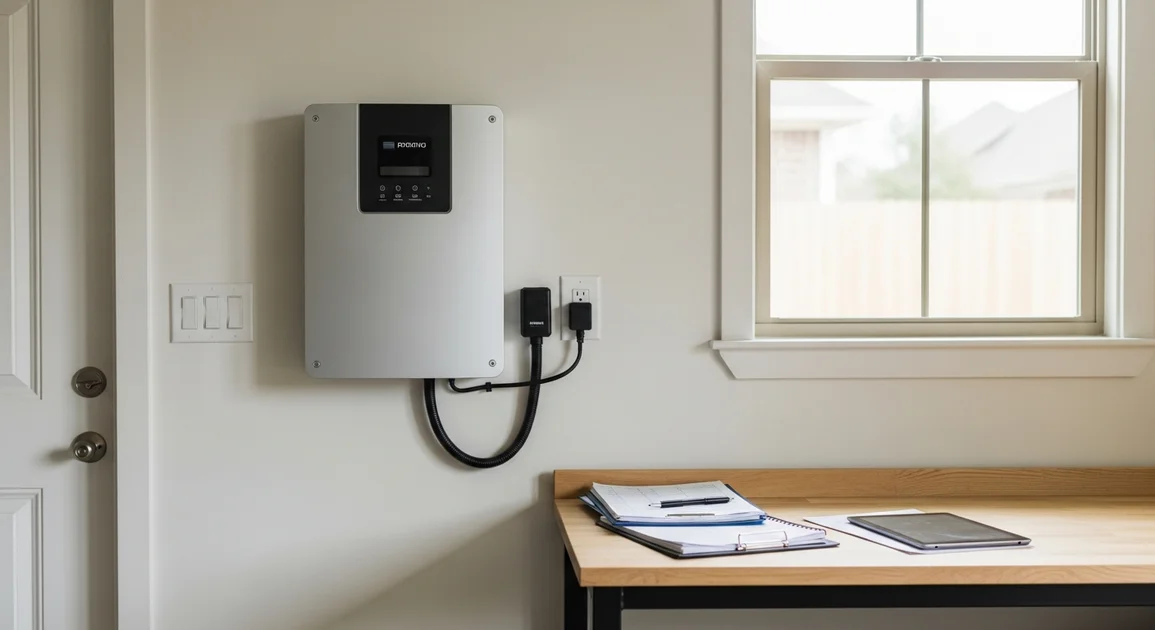
Usually yes, and the path is easier than most people expect. Because an Eos battery mounts on a wall, runs silently, and typically lives in the garage, it does not create the visible exterior change that HOA rules are written to control. In most neighborhoods, an indoor battery is a routine architectural approval, not a fight.
Texas law helps too, within limits. An HOA cannot flatly ban a solar energy device, but it keeps real authority over placement, appearance, and prior approval. Knowing exactly what the law does and does not cover is the difference between a smooth submission and a surprise.
What does Texas law actually do here?
Texas Property Code Section 202.010 says an HOA may not enforce a rule that prohibits or restricts installing a solar energy device (Texas Property Code, 2025). It still allows the HOA to set conditions, including on where a roof device sits, its color and conformity to the roofline, and a requirement to get approval first. The location exception is measured by energy production, not looks alone: an HOA generally must allow a homeowner's preferred spot unless an alternate location would raise output by more than 10 percent using an NREL modeling tool.
The battery question turns on one word: solar. The legal definition of a solar energy device includes a device that stores solar-generated energy. A battery charged by your solar has a strong argument for that protection. A standalone battery charged only from the grid does not clearly fit that language, and Texas courts have not settled the point, so treat it as an open question rather than a guarantee. A separate statute on standby generators does not apply either, since a battery is not a fuel-powered generator.
Why does an indoor wall-mount usually sidestep HOA objections?
HOA architectural rules are built around what the neighborhood sees. The entire structure of the solar statute is about rooflines, visible piping color, and yard visibility, which tells you where an HOA's real concern sits. A battery mounted inside the garage is simply not part of that picture.
When we install for homes in Houston HOAs, the indoor wall-mount is almost always the answer, because it turns an aesthetic debate into a non-issue. You still submit for approval, but there is nothing visible from the curb to object to. For the placement trade-offs, see our guide on [INTERNAL-LINK: indoor versus outdoor battery installation → /blog/battery-backup-indoor-vs-outdoor-installation-houston].
[INTERNAL-LINK: see the wall-mounted battery plans → /plans]
How do you get HOA approval? The steps
The process is a short, predictable sequence. Read your rules, submit for approval, and know your appeal rights if it comes to that.
What do you submit, and how long does it take?
Most HOAs want a simple architectural application: the equipment specifications, where the battery will mount, and photos of the spot. Because the unit is indoors, that packet is usually straightforward and gives the committee nothing to push back on visually.
Timing varies. Texas law does not set one universal deadline for the initial decision, only that it happen within a reasonable period or the window in your CCRs. If you are denied, though, the appeal timeline is concrete: you can request a hearing within 30 days, and the board must hold it promptly (Texas Property Code 209.00505, 2025). For the separate city permit, see our guide on [INTERNAL-LINK: home battery permits in Houston → /blog/home-battery-permit-houston-tx].
[INTERNAL-LINK: get a home battery quote in under 2 minutes → /home-backup-planner?source=blog&slug=battery-backup-hoa-approval-texas]
Prefer to talk it through? Call Eos at 713-207-2222 for a same-week Houston site survey.
Frequently asked questions
Can an HOA ban a home battery in Texas?
An HOA cannot flatly ban a solar energy device under Texas Property Code Section 202.010, though it can regulate location and appearance (Texas Property Code, 2025). A standalone battery is less clearly covered, so it typically goes through the HOA's normal architectural approval. Check your own documents.
Does the Texas solar law cover a home battery?
It covers a device that stores solar-generated energy, so a battery paired with your solar has a strong argument for protection. A battery charged only from the grid is a genuine gray area that Texas courts have not resolved, so do not assume automatic protection. This is general information, not legal advice.
Where does the battery go to avoid HOA issues?
Indoors, usually the garage. A wall-mounted battery there is silent and invisible from the street, which removes the aesthetic concern that drives most HOA architectural rules.
What do I submit to my HOA?
Typically an architectural application with the equipment specs, the mounting location, and photos. Keeping the battery indoors makes that submission simple, since there is no visible exterior change to review.
How long does HOA approval take?
It depends on your HOA's rules, since Texas law sets no single fixed deadline for the first decision. If you are denied, you can request a hearing within 30 days under Section 209.00505 (Texas Property Code, 2025).
This article is general information about HOA approval for home batteries in Texas and reflects Eos specifications as of July 2026. It is not legal advice. Read your HOA's governing documents and consult your HOA or an attorney for your specific situation.