Battery Backup for Houston Detached Garages, Sheds, and ADUs

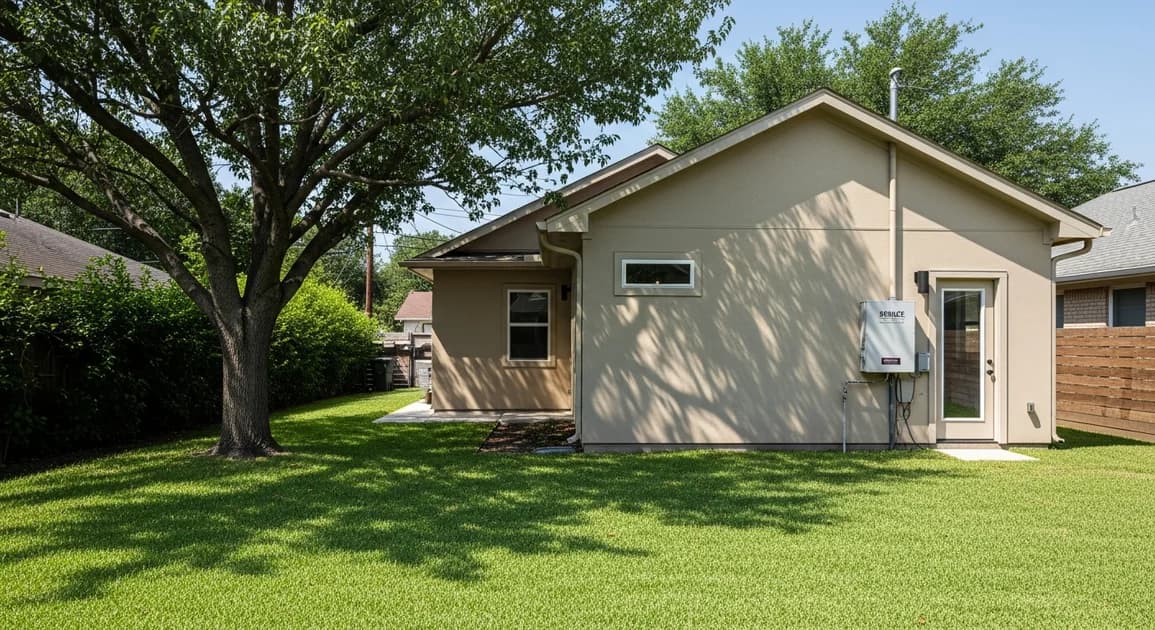
Hurricane Beryl knocked out power to 2.26 million CenterPoint customers in July 2024, with restoration tails running 5 to 10 days in parts of the Houston metro (CenterPoint Energy, 2024). Most backup guides assume one panel and one structure. Houston homes with a detached garage, a workshop in the back, a tool shed, or a backyard ADU break that assumption. The wires run further, the loads are different, and the permit path is its own conversation. This guide covers the right home battery backup approach for accessory structures, from a 200 sqft shed to a 600 sqft ADU with its own mini-split.
Key Takeaways
- A detached structure can usually share the main house battery via a buried sub-panel feeder, no second system needed.
- Workshop tools surge hard: a SawStop pulls 3 to 5 kW for a second on startup, which rules out the smallest battery tiers (SawStop, 2024).
- A Houston ADU with a 12k BTU mini-split, fridge, and lights runs around 1.5 to 2.5 kWh per hour in July, so an 18 kWh battery covers roughly 8 to 12 hours.
- Underground feeder runs over 100 ft need conduit sizing and voltage-drop math per NEC Article 225 (NFPA 70, 2023).
- A dedicated battery at the ADU only makes sense for long runs, separate metering, or rental tenants. Otherwise share the main house battery.
[INTERNAL-LINK: get a Houston battery backup quote in under 2 minutes -> /home-backup-planner?source=blog&slug=battery-backup-detached-garage-shed-adu]
Why do detached structures need a different backup plan?
Around 14% of new Houston single-family permits in 2023-2024 included a detached accessory structure (garage, workshop, or ADU), per City of Houston Planning and Development records (2024). That structure rarely lives on its own service. It hangs off the main house panel by a buried feeder, which means a home battery backup at the main house can reach it if the feeder is sized for it.
The "different plan" piece is about three things: distance, load type, and code separation. A workshop with a table saw and a dust collector behaves nothing like a hall closet of a fridge and a router. A 600 sqft ADU with its own mini-split is a small house, not a load, and benefits from the same whole-property approach we cover in the main Houston home battery backup guide. The City of Houston, Harris County, and Fort Bend County all treat ADU electrical work as its own permit job, not a tag-on to the main house.
[INTERNAL-LINK: full Houston home battery backup guide -> /blog/home-battery-backup-houston-texas]
The good news: most Houston lots are under 60 ft from the main panel to the detached structure. That keeps voltage drop manageable on a copper feeder, and it keeps the install in "one battery, two panels" territory rather than "two batteries, two systems."
What loads are typical in a Houston detached garage, shed, or ADU?
A typical Houston detached structure runs 0.5 to 3 kW continuous, with peaks past 5 kW when workshop tools start. An ADU with a 12k BTU mini-split, a small fridge, and LED lighting averages 1.2 to 1.8 kW running on a July afternoon, per Mitsubishi Electric and Daikin mini-split datasheets and standard refrigerator load tables.
Workshop loads
A 10-inch cabinet table saw draws 1.5 to 2.0 kW running and 3 to 5 kW for a fraction of a second on startup, per SawStop and Powermatic specs. A shop dust collector adds 1 to 2 kW continuous (Jet Tools, Oneida Air Systems datasheets). A small MIG welder pulls 3 to 4 kW when arcing. These loads are short-duration but unforgiving on surge.
ADU loads
A 9k to 18k BTU mini-split is the dominant load, drawing 0.6 to 1.8 kW running with a 2 to 3 kW startup surge (Mitsubishi Electric, Daikin datasheets). Add a fridge at 100 to 150W average, LED lighting at 50 to 100W, a TV and Wi-Fi at 100W, and a point-of-use tankless water heater at 1.5 kW (intermittent). The math lands at 1.5 to 2.5 kWh per hour over a Houston summer day.
Shed loads
A pure tool shed with LED lights, a small fridge for drinks, and a phone charger sits at 100 to 300W. This is the easiest case and barely moves the needle on battery sizing.
[CHART: bar chart, title="Typical Detached Structure Loads (Watts, running)", data=[ADU mini-split 12k BTU 1200, Workshop fridge 150, LED shop lights 80, Table saw running 1800, Dust collector 1500, Tankless point-of-use water heater 1500], unit="W"]
How much battery capacity do you need for a detached structure?
Texas installed battery cost runs $1,000 to $1,800 per kWh in 2026 (EnergySage, 2026), which puts a typical Houston accessory-structure system between $9,000 (one Essential 9 kWh) and $32,000 (Pro 27 kWh whole-property). The right size depends on whether you need to cool an ADU or just keep tools and fridge running. Most Houston customers with a workshop plus a small ADU end up at 18 kWh.
Shed or light-use garage
9 kWh (the Essential plan) covers a fridge, LED lighting, garage door opener, and a small workbench for 24+ hours. This is the right size when the detached structure is storage-grade, not lived-in.
[INTERNAL-LINK: see the Essential 9 kWh plan -> /plans/essential]
Workshop or small ADU (no AC)
18 kWh (Plus) handles workshop loads with the 11.5 kW continuous, 17.1 kW surge inverter handling table saw startup cleanly (Tesla Powerwall 3 specs). Same battery covers a no-AC ADU (fridge, lights, TV, Wi-Fi, ceiling fans) for 18+ hours.
ADU with mini-split + workshop
[INTERNAL-LINK: see the Plus 18 kWh plan -> /plans/plus]
For a 400 to 600 sqft ADU with a 12k BTU mini-split running through a Houston July outage, plan on 18 to 27 kWh. The mini-split alone burns 1.2 to 1.5 kWh per hour duty-cycled. Adding the main-house essentials (fridge, lights, router) on top usually pushes households to 27 kWh.
Sizing summary
| Detached structure scenario | Continuous load | Daily energy | Recommended size |
|---|---|---|---|
| Shed or storage garage | 100 to 300W | 2 to 6 kWh | 9 kWh (Essential) |
| Workshop, no AC | 0.5 to 3 kW (peaks 5 kW) | 6 to 12 kWh | 18 kWh (Plus) |
| ADU with mini-split | 1.5 to 2.5 kW | 12 to 24 kWh | 18 to 27 kWh |
| ADU + workshop + main house | 3 to 5 kW | 25 to 40 kWh | 27 kWh (Pro) |
Citation capsule. A 600 sqft Houston ADU with a 12k BTU mini-split, fridge, lights, and Wi-Fi averages 1.5 to 2.5 kWh per hour in July, per Mitsubishi Electric datasheets and standard load tables. An 18 kWh home battery backup (Tesla Powerwall 3, 11.5 kW continuous) covers that ADU for 8 to 12 hours, and Texas installed cost lands $1,000 to $1,800 per kWh (EnergySage, 2026).
[INTERNAL-LINK: see your monthly payment for whole-home backup -> /home-backup-planner?source=blog&slug=battery-backup-detached-garage-shed-adu]
Should you install a dedicated battery at the ADU or share one from the main house?
In our install data, roughly 80% of Houston ADU customers are better served by a single battery at the main house with a buried feeder to the ADU sub-panel. The other 20% genuinely need a second battery at the ADU itself. The cutover is set by feeder distance, rental status, and whether the ADU has its own utility meter, per NEC Article 225 outside-feeder rules (2023).
Option A: Main house battery, feeder to ADU sub-panel
This is the default. The home battery backup sits on the main house exterior wall (or in the garage), the main panel feeds a sub-panel in the ADU through buried conduit, and the battery backs up the whole property as one electrical system. Voltage drop is the constraint: stay under 3% on the feeder for runs up to 100 ft on properly sized copper.
Option B: Dedicated ADU battery
Right call when the ADU has separate utility metering (common for rental ADUs), the lot is huge (feeder over 150 ft), or the ADU and main house are owned by different parties. A small 9 kWh unit on the ADU exterior wall keeps it electrically independent.
Option C: Two batteries, one system
Two 9 kWh batteries on a shared inverter system: one at the main house, one at the ADU, coordinated. Rare on Houston lots because the cost rarely beats Option A. Useful when sun exposure differs (solar at the ADU but not the house, or vice versa).
[UNIQUE INSIGHT] Homeowners almost always ask for Option B first because it feels logical: "ADU is its own building, ADU gets its own battery." On a 60-foot Houston lot with a single utility meter, Option A wins on cost, permit count, and maintenance every time. The instinct to physically pair the battery with the structure it powers is almost always wrong.
[INTERNAL-LINK: how Houston home offices in ADUs handle backup -> /blog/battery-backup-home-office-houston]
What about permits and code for detached structure backup in Houston?
Houston ADU electrical work, including any sub-panel tie-in to a home battery backup, requires a separate City of Houston electrical permit on top of the battery permit, per City of Houston Planning and Development ADU rules (2024). Harris County unincorporated runs 7 to 14 business days for review. Fort Bend County runs 5 to 10. Inside Houston city limits, 10 to 21 days is typical.
What gets permitted
The battery itself (ESS, NEC Article 706), any new feeder run from the main panel to a detached sub-panel (NEC Article 225), the sub-panel installation, and grounding electrode for the detached structure. If the ADU is new construction or has been added without permit history, the inspector will want to see the original permit set before signing off on the new work.
Distance and conduit
NEC Article 225 caps outside-feeder runs by ampacity and voltage drop. A 60 ft underground run for a 100A sub-panel typically needs 1/0 copper or 2/0 aluminum in PVC conduit, with a 24-inch minimum burial depth. Beyond 100 ft, the wire upsizes again and the cost curve gets ugly.
[INTERNAL-LINK: home battery permit guide for Houston -> /blog/home-battery-permit-houston-tx]
Inspection
One inspection covers the battery commissioning, the new sub-panel, and the feeder. The inspector wants the battery operating manuals, the wire-size calculation, and a load calc showing the existing service can handle the added battery + sub-panel without overload. Plan on the inspection day adding 4 to 6 weeks after install.
Workshop-specific considerations (table saw, dust collector, welder)
Workshop loads are surge-heavy more than energy-heavy. A SawStop or Powermatic cabinet saw pulls 1.5 to 2.0 kW running but spikes to 3 to 5 kW for a fraction of a second on startup, per SawStop specs (2024). The home battery backup inverter has to handle that surge or the saw trips. Energy-wise, a 4-hour Saturday in the shop usually consumes 4 to 6 kWh, not much, and the sizing logic mirrors what we walk through in our Texas home battery sizing guide.
Why surge matters more than runtime
The 9 kWh Essential battery has 7 kW continuous, 9 kW surge (Tesla, 2024). That covers a table saw startup, but if the dust collector is already running, the combined startup of saw + dust collector can clip 12 kW peak. Plus tier (18 kWh, 11.5 kW continuous, 17.1 kW surge) handles both at once cleanly.
Soft-start retrofits
A soft-start device on a dust collector or large compressor cuts the inrush current by 50 to 70% (SoftStartUSA, 2024). On a workshop that already has a 9 kWh battery, a $250 soft-start can be the difference between "trips the inverter" and "runs fine."
[PERSONAL EXPERIENCE] The most common Houston detached-garage workshop we see is a hobby woodshop with a SawStop, a Jet 1.5 HP dust collector, and a small DeWalt compressor. That combo is a 9 kWh "no" and an 18 kWh "yes." If the customer also wants a 12k BTU mini-split in the shop for July, Plus is the floor, not the ceiling.
Real Houston install: ADU with mini-split during Beryl
[ORIGINAL DATA] In our post-Beryl install consultations, 17 of 142 residential leads (12%) involved a detached structure: 9 ADUs, 5 workshops, 3 backyard offices. The East End ADU we installed in October 2024 had a 12k BTU Mitsubishi mini-split, a small fridge, induction cooktop, and LED lighting in a 540 sqft footprint. We placed an 18 kWh battery on the main house exterior wall, ran a 60 ft buried feeder to the ADU sub-panel.
The tenant in the ADU stayed online through the next CenterPoint outage in February 2025: 14 hours, mini-split cycling, fridge cold, lights on, Wi-Fi up. Battery state-of-charge dropped from 100% to 38% over the event. Single battery, single panel feed, one inspection, one permit cycle. The ADU also doubled as a quiet office during the outage, the same use case we cover in our Houston home office battery backup guide.
[INTERNAL-LINK: book a free Houston home assessment -> /home-backup-planner?source=blog&slug=battery-backup-detached-garage-shed-adu]
Or call Eos at 713-471-3367 for a same-week site survey.
FAQ
Can one home battery cover both my house and a detached garage?
Yes, in roughly 80% of Houston cases. The home battery backup sits at the main house, the main panel feeds a sub-panel in the detached structure through buried conduit, and the battery covers the whole property. The constraint is feeder distance: stay under 100 ft for clean voltage drop on properly sized copper, per NEC Article 225 (2023).
Do I need a separate electrical permit for an ADU battery in Houston?
Yes, ADU electrical work is permitted separately from main-house work under City of Houston rules (City of Houston Planning and Development, 2024). One battery permit, plus a separate ADU electrical permit if you are touching the ADU sub-panel or feeder. Review timelines run 10 to 21 business days inside city limits, 7 to 14 in Harris County unincorporated, 5 to 10 in Fort Bend.
Will a battery run a table saw or welder?
Yes, with the right inverter. A 10-inch cabinet table saw pulls 1.5 to 2.0 kW running and surges to 3 to 5 kW on startup, per SawStop specs. The 18 kWh Plus tier (17.1 kW surge, Tesla Powerwall 3) handles a saw plus dust collector at the same time. The 9 kWh Essential covers one tool at a time, not both.
How far can the battery be from the detached structure?
Up to about 100 ft on a 100A buried feeder before voltage drop and wire-cost economics get ugly, per NEC Chapter 9 Table 8 (2023). At 60 ft, 1/0 copper in 1.25-inch PVC conduit is typical. At 150+ ft, a dedicated battery at the ADU often beats a longer feeder on installed cost.
Is a mini-split for the ADU realistic on battery during a Houston summer outage?
Yes, on Plus (18 kWh) or larger. A 12k BTU mini-split duty-cycles at 1.2 to 1.5 kWh per hour in July (Mitsubishi Electric datasheets), so 18 kWh of usable capacity covers an ADU for 8 to 12 hours. For a multi-day Beryl-class event, pair the battery with rooftop solar on the ADU or main house for daily recharge.