Home Battery Fire Safety in Texas: What UL 9540A and NFPA 855 Actually Require

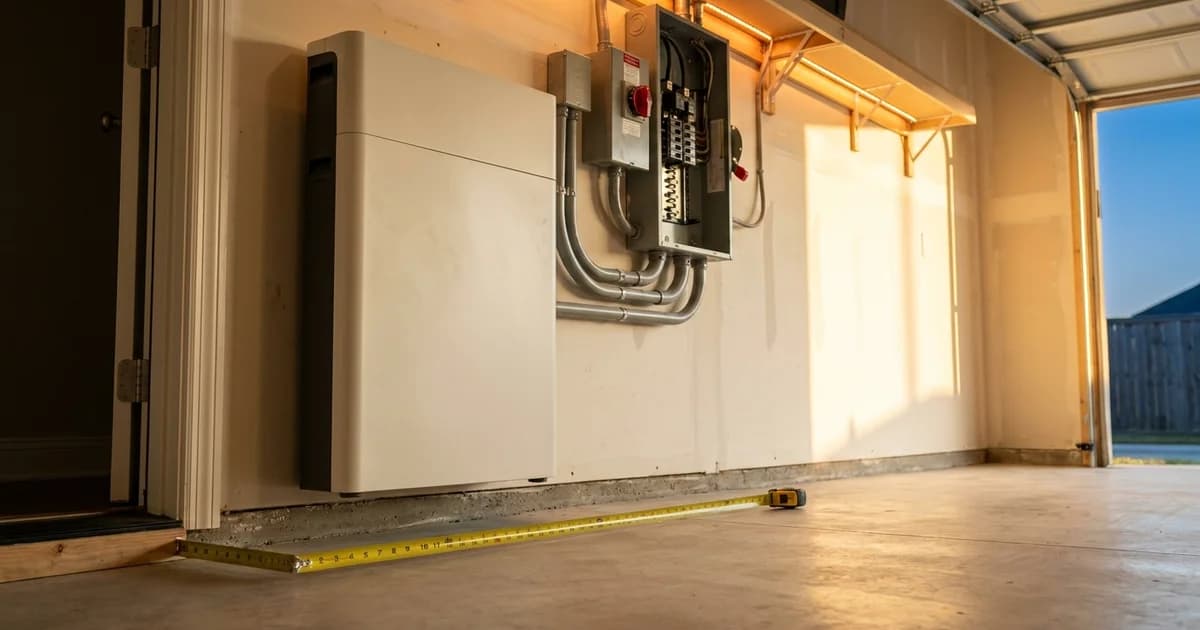
If you have seen a battery fire on the news, you almost certainly watched a utility-scale container burn, not a garage cabinet. Different machines, different settings, different rules. That footage tells you nothing about the box an installer wants to bolt to your wall.
So "is it safe" is the wrong question. Every installer answers yes. The question with a real answer is: which documents prove it, and who checks them?
Key Takeaways
- UL 9540 is a system listing. UL 9540A is a test method that produces a data report, not a certification.
- NFPA 855 sends one- and two-family dwellings to Chapter 15 only, which caps an individual residential unit at 20 kWh.
- Minimum 3 feet between units and 3 feet from doors and windows opening into the dwelling, unless large-scale UL 9540A data documents closer spacing.
- LFP cells reach thermal runaway later than NMC cells, but no lithium chemistry is non-flammable.
- Houston runs the 2021 I-Codes and the 2023 NEC, so permit and inspection are where these requirements land on your house.
Can a home battery catch fire?
Yes. Any lithium-ion cell can enter thermal runaway under abuse, manufacturing defect, or physical damage. Thermal runaway is a self-sustaining internal heating reaction that vents flammable gas and can spread cell to cell. The standards structure below exists because of that fact, not in spite of it.
In 2022, UL's Fire Safety Research Institute ran three full-scale experiments inside a 24-foot by 24-foot two-story compartment built to represent a two-car garage, testing NCA and LFP off-gas and one 18 kWh NCA pack driven to runaway (UL Fire Safety Research Institute, October 2022). The scenarios: immediate ignition of vented gas, delayed deflagration after gas built up, and propagation through the pack.
Here is the honest boundary, stated once. No home battery is risk free. The risk is managed by three things together: a listed product, correct clearances, and a competent install. Two of the three have nothing to do with the chemistry inside the box.
What we see in the field: the cell is the part already engineered, tested, and certified by people with calorimeters. The wall the cabinet gets bolted to has not been. That asymmetry is why installation standards exist.
UL 9540 vs UL 9540A: one is a listing, one is a test
These get conflated constantly, including on spec sheets. UL 9540 is the safety standard a complete energy storage system is certified to, currently Edition 3, published June 28, 2023 (UL Solutions, Energy Storage System Certification). UL 9540A is something else: a test method for evaluating thermal runaway fire propagation, whose output is a report of test data (UL Solutions, UL 9540A Test Method).
"UL 9540A tested" on a brochure is not the same claim as "UL 9540 listed." A product can hold 9540A data without carrying a 9540 listing. If a salesperson uses the two interchangeably, that is your first data point about them.
| UL 9540 | UL 9540A | |
|---|---|---|
| What it is | Product safety standard | Test method |
| What it produces | A listing and a certification mark | A report of measured test data |
| Is it a certification? | Yes | No |
| What it evaluates | The whole system: charge and discharge, protection, controls, enclosure | How a runaway event propagates, and what gas and heat it releases |
| What to ask for | The listing for your exact model number | The report, and which test levels were run |
The current edition is ANSI/CAN/UL 9540A:2025, the 5th, published March 12, 2025 (ANSI Webstore). It runs at four levels: cell, module, unit, and installation. The 6th edition drops that to three for most applications, but unit-level testing stays required for residential systems (UL Solutions). Most competing pages still describe the older structure, so check which edition a claim is anchored to (Solar Power World, April 2025).
Why does this reach your garage? Large-scale 9540A data is what lets units sit closer together than the code default. No data, no reduction.
What NFPA 855 requires in a house
NFPA 855, the Standard for the Installation of Stationary Energy Storage Systems, routes one- and two-family dwellings and townhouses to Chapter 15 (NFPA 855). The rest of the standard covers commercial and utility installations. If someone quotes you a warehouse requirement for your garage, they are reading the wrong chapter.
| Chapter 15 requirement | Figure |
|---|---|
| Maximum energy per individual ESS unit | 20 kWh |
| Aggregate limit, garage, accessory structure, or outdoors | 80 kWh |
| Aggregate limit, utility closet or storage space | 40 kWh |
| Minimum spacing between units | 3 feet |
| Minimum clearance from doors and windows entering the dwelling | 3 feet |
| Prohibited locations | Living areas and bedrooms |
Sources: Mayfield Renewables and HeatSpring, reading Section 15.4.1 of the 2023 edition. The 3-foot spacing is reducible only where large-scale UL 9540A testing documents it.
The 20 kWh figure gets misquoted more than any other number in residential storage. It is a per-unit cap, not a whole-house cap. Two 18 kWh cabinets are two compliant units, not one 36 kWh violation.
Aggregate ceilings are a separate question, and the standard is only half that story. Your authority having jurisdiction can require extra fire review well below the standard's ceiling. In Houston the practical trigger sits at 20 kWh aggregate, far under the 80 kWh garage number, so plan around it before picking a stack size. We cover the Houston permit and inspection process step by step.
Permitted locations: attached garages separated from living and sleeping areas, detached garages and accessory structures, exterior walls, and enclosed utility or storage spaces the AHJ approves. For how those play out in a Houston summer, see where the cabinet actually goes in a Houston garage.
One underused fact: NFPA publishes free read-only access to its standards online. Open Chapter 15 and check your installer's claims against the source text.
NEC Article 706 and the electrical side
NFPA 855 governs where the box goes. The National Electrical Code governs how it is wired, and Article 706 of NFPA 70 covers energy storage systems specifically (NFPA 70). Texas adopted the 2023 NEC as the state minimum effective September 1, 2023, and Houston's administrative provisions took effect January 1, 2024 (Houston Permitting Center).
An inspector standing in your garage is checking four things on the electrical side. Is there a labeled, accessible disconnecting means? Is conductor sizing and overcurrent protection correct for the equipment rating? Is the required working space in front of the equipment clear? Is code-required marking and signage present, so a firefighter opening that door knows stored energy sits behind it?
None of that is exotic. All of it is what quietly goes wrong on an unpermitted job, because nobody outside the crew ever looks. For the wiring sequence in detail, see how a Houston install is actually wired, and the system sizes we install list the controller rating each configuration is built around.
LFP vs NMC, honestly
LFP cells have a wider thermal margin than NMC and NCA cells. A peer-reviewed comparison in sealed enclosures found the LFP cell "took significantly longer to reach thermal runaway due to its higher exothermic onset temperature," and that NMC cells produced substantially more gas and higher pressure than comparably sized LFP cells (Journal of Loss Prevention in the Process Industries, 2022). The same work cites 2 to 9.2 liters of vent gas per amp-hour across the cells studied.
That last number is the correction to the marketing version. A wider margin is not immunity. LFP still vents flammable gas in runaway, which is exactly why FSRI tested LFP off-gas alongside NCA. Anyone telling you an LFP battery is non-flammable is selling, not explaining.
Published onset temperatures vary widely by cell format, state of charge, and test method, so a single headline number misleads more than it informs. The directional finding is consistent: LFP starts later and releases less energy (Sandia National Laboratories, Energy Storage Safety).
Market context, not a safety guarantee: NREL's Annual Technology Baseline notes LFP became the primary chemistry for stationary storage from 2022 onward (NREL, Annual Technology Baseline). That is why most modern residential cabinets are LFP. For our own hardware, see our published system specifications, then ask any installer, us included, for the listing and test documentation on the exact model quoted.
Where the incident numbers come from: the industry's leading failure database tracks utility-scale and commercial systems only, and residential failures are not currently tracked (EPRI, BESS Failure Incident Database). So a "battery fire rate" quoted at you for a home battery was not measured on home batteries. A per-install residential failure rate is not publicly available. Anyone who hands you one is estimating.
The four documents your installer should hand you
This is the part you can act on this week. On every quote review we run, we ask for four things in writing before anything gets signed.
1. The UL 9540 listing for the exact model quoted. Not the product family, not the brand. The model number. You can verify it yourself in UL's certification database at ul.com/database, or by browsing category code FTBW.
2. The UL 9540A report, or the manufacturer's published summary. Look for which test levels were run and what spacing the results support. If your plan puts two cabinets closer than 3 feet apart, this document justifies it.
3. The manufacturer installation manual clearance page. Manual clearances can be tighter or looser than the NFPA default, and the manual is what the inspector reads. Get the page, not a verbal summary.
4. The permit number. No permit means no inspection, and no inspection means nobody outside the crew checked the clearances, the disconnect, or the signage.
There is a behavioral tell here. An installer who already works to these standards emails all four the same day, because the PDFs live in a folder on their laptop. One who asks why you want them is answering a different question. For the rest of that conversation, use the full installer vetting checklist.
How Texas and Houston actually enforce this
Standards only bind you through local adoption, and around Houston they do. Houston City Council adopted the 2021 I-Codes, including the International Residential Code and the International Fire Code, effective January 2, 2024, and ICC noted the updated codes include requirements for energy storage systems (International Code Council, 2023). The 2023 NEC took effect the day before.
Statewide, Texas Local Government Code Section 214.212 adopts the International Residential Code as the municipal residential building code, and municipalities may amend it after a public hearing (Section 214.212). The baseline is statewide, the details are local, which is why a real answer to "what are the rules" always ends with the name of a city.
So plan review and inspection are the checkpoint where clearance, location, disconnect, and signage get verified by someone who does not work for your installer. An unpermitted install skips that entirely, which is why it is the real fire-safety risk, not the chemistry.
For scale on the alternative, in its 2021 annual estimates the CPSC reports an average of about 100 people in the United States die each year from carbon monoxide poisoning caused by portable generators (U.S. Consumer Product Safety Commission, Non-Fire Carbon Monoxide Deaths).
The short version
The cell is the engineered part. The install is the variable. Standards exist to constrain the variable.
No home battery is risk free. It is a managed risk, and the management is visible in four documents and one inspection. Ask for the UL 9540 listing on your exact model, the UL 9540A report, the manual's clearance page, and the permit number. If all four arrive without friction, you are dealing with someone who does this properly. If they do not, you have learned more than any brochure would tell you.
Or call Eos at 833-989-3737 to talk through your setup with an installer.
Frequently Asked Questions
Can a home battery catch fire?
Yes. Under abuse, defect, or damage, a lithium-ion cell can enter thermal runaway, vent flammable gas, and propagate. UL's Fire Safety Research Institute demonstrated immediate ignition, delayed deflagration, and pack propagation in a simulated two-car garage in 2022 (FSRI). A listed product, correct clearances, and a permitted install is how that risk gets managed.
Is UL 9540A a certification?
No. UL 9540A is a test method for evaluating thermal runaway fire propagation, and its output is a report of measured data (UL Solutions). UL 9540 is the listing a complete energy storage system carries. A product can hold 9540A test data without carrying a 9540 listing, so ask for both by name.
How far does a home battery have to be from a window?
Three feet. NFPA 855 Chapter 15 requires a minimum of 3 feet from doors and windows opening directly into the dwelling unit, and 3 feet between units, per Section 15.4.1 of the 2023 edition (HeatSpring). Closer spacing between units is allowed only where large-scale UL 9540A test data supports it.
Is LFP safer than NMC?
LFP has a wider thermal margin. Peer-reviewed testing found LFP cells took significantly longer to reach thermal runaway because of a higher exothermic onset temperature, and produced less gas than comparable NMC cells (Journal of Loss Prevention in the Process Industries, 2022). A wider margin is not immunity. LFP still vents flammable gas in runaway.
Does Houston inspect a home battery for fire safety?
Yes. Houston runs the 2021 I-Codes and the 2023 NEC, and plan review plus on-site inspection is where clearances, location, disconnect, and signage are verified (ICC). Systems crossing the local aggregate threshold also draw fire marshal review, covered in our Houston permit guide.
Sources
- UL Fire Safety Research Institute, "Experiments Investigating Explosion Hazards of Lithium-Ion Battery Thermal Runaways," retrieved 2026-09-08, https://fsri.org/research-update/experiments-investigating-explosion-hazards-lithium-ion-battery-thermal-runaways
- UL Solutions, "Energy Storage System Testing and Certification (UL 9540)," retrieved 2026-09-08, https://www.ul.com/services/energy-storage-system-testing-and-certification
- UL Solutions, "UL 9540A Test Method," retrieved 2026-09-08, https://www.ul.com/services/ul-9540a-test-method
- ANSI Webstore, "ANSI/CAN/UL 9540A:2025, Test Method for Evaluating Thermal Runaway Fire Propagation in Battery Energy Storage Systems, 5th Edition," retrieved 2026-09-08, https://webstore.ansi.org/standards/ul/ansiul9540a2025
- National Fire Protection Association, "NFPA 855, Standard for the Installation of Stationary Energy Storage Systems," retrieved 2026-09-08, https://www.nfpa.org/codes-and-standards/all-codes-and-standards/list-of-codes-and-standards/detail?code=855
- National Fire Protection Association, "NFPA 70, National Electrical Code," retrieved 2026-09-08, https://www.nfpa.org/codes-and-standards/all-codes-and-standards/list-of-codes-and-standards/detail?code=70
- Houston Permitting Center, "Update: 2023 National Electrical Code Now Effective," retrieved 2026-09-08, https://www.houstonpermittingcenter.org/news-events/update-2023-national-electrical-code-now-effective
- International Code Council, "Houston's City Council Approves Adoption of the 2021 International Codes," retrieved 2026-09-08, https://www.iccsafe.org/about/periodicals-and-newsroom/houstons-city-council-approves-adoption-of-the-2021-international-codes/
- Texas Local Government Code Section 214.212, "International Residential Code," retrieved 2026-09-08, https://texas.public.law/statutes/tex._local_gov't_code_section_214.212
- Journal of Loss Prevention in the Process Industries (2022), comparative thermal runaway and vent gas study of LFP and NMC cells in sealed enclosures, retrieved 2026-09-08, https://pmc.ncbi.nlm.nih.gov/articles/PMC11927001/
- Sandia National Laboratories, "Energy Storage Safety," retrieved 2026-09-08, https://www.sandia.gov/energystoragesafety/
- National Renewable Energy Laboratory, "Annual Technology Baseline: Utility-Scale Battery Storage," retrieved 2026-09-08, https://atb.nrel.gov/electricity/2024/utility-scale_battery_storage
- Electric Power Research Institute, "BESS Failure Incident Database," retrieved 2026-09-08, https://storagewiki.epri.com/index.php/BESS_Failure_Incident_Database
- U.S. Consumer Product Safety Commission, "Non-Fire Carbon Monoxide Deaths Associated with the Use of Consumer Products, 2021 Annual Estimates," retrieved 2026-09-08, https://www.cpsc.gov/s3fs-public/Non-Fire-Carbon-Monoxide-Deaths-Associated-with-the-Use-of-Consumer-Products-2021-Annual-Estimates-FY24.pdf
- Solar Power World, "UL enhances 9540A battery testing to better address ESS industry of the future," April 2025, retrieved 2026-09-08, https://www.solarpowerworldonline.com/2025/04/ul-enhances-9540a-battery-testing-to-better-address-ess-industry-of-the-future/
- Mayfield Renewables, "Fire Codes and NFPA 855 for Energy Storage Systems," retrieved 2026-09-08, https://www.mayfield.energy/technical-articles/fire-codes-and-nfpa-855-for-energy-storage-systems/
- HeatSpring, "A Look at NFPA 855 Locations for Energy Storage in One- or Two-Family Dwellings," retrieved 2026-09-08, https://blog.heatspring.com/a-look-at-nfpa-855-locations-for-energy-storage-in-one-or-two-family-dwellings/
This article summarizes published safety standards and Houston-area code adoption as of September 2026. It is general information, not a code interpretation or a fire safety determination for your property. Confirm requirements with the City of Houston or your local authority having jurisdiction, and with the manufacturer installation manual for the exact model quoted.