Home Battery Size for a 1,500 Sqft Texas Home: The Honest Answer

Home Battery Size for a 1,500 Sqft Texas Home: The Honest Answer
If you own a 1,500 sqft house in Houston and you have started shopping for a home battery backup, you have probably noticed that most national sizing guides assume a 2,500 sqft suburban build. That assumption oversells you. A 1,500 sqft Texas home uses roughly 600 to 900 kWh per month, with summer peaks of 25 to 35 kWh per day driven almost entirely by central AC (U.S. Energy Information Administration, 2024). This guide gives you the honest sizing answer for a small Texas home in 2026, including which Eos tier actually fits, what it costs, and when you should not stack a second battery.
Key Takeaways
- A 1,500 sqft Texas home uses 25 to 35 kWh per day in July and August. Most of that load is central AC (U.S. Energy Information Administration, 2024).
- A 9 kWh home battery backup covers fridge, lights, internet, CPAP, and phones for 24 hours.
- An 18 kWh build covers the same essentials for 48 hours or essentials plus one AC zone for 12 to 18 hours.
- Installed cost in Texas is $1,000 to $1,800 per kWh in 2026, so a 9 kWh Essential lands at $9,000 to $16,200 (EnergySage, 2026).
- Most 1,500 sqft Houston homes do not need a 27 kWh stack. Essential or Plus is the right call.
[INTERNAL-LINK: get a Houston battery backup quote in under 2 minutes → /home-backup-planner?source=blog&slug=home-battery-size-for-1500-sqft-home-texas]
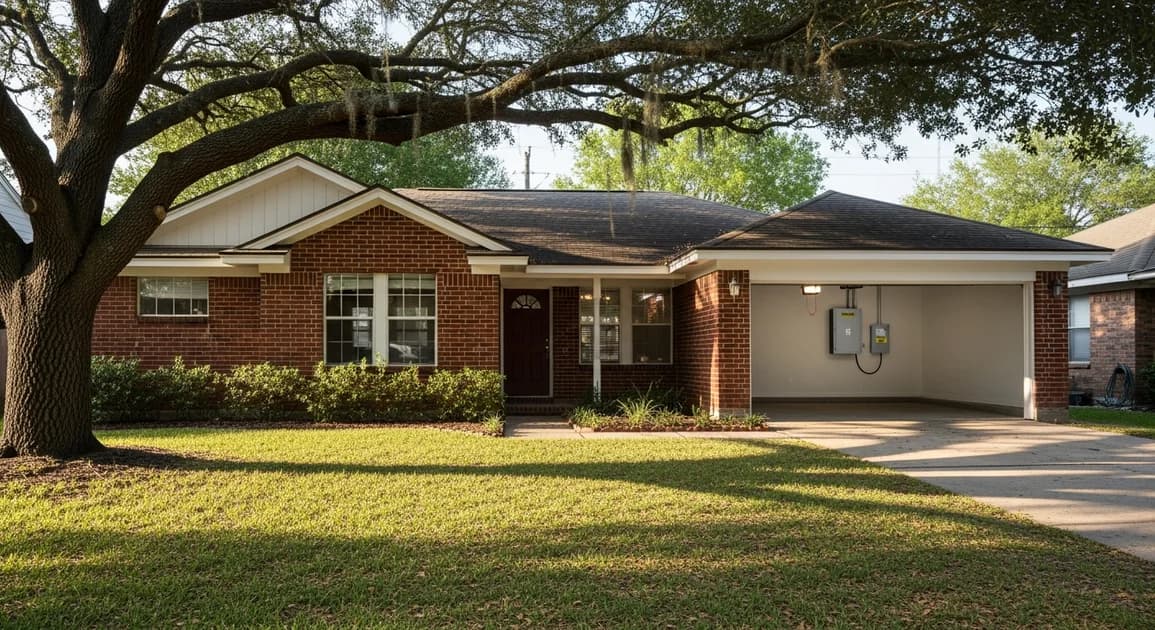
[IMAGE: A 1,500 sqft Houston bungalow with mature oak shade and an open garage showing a single wall-mounted home battery backup unit. Search "small Houston home battery garage install" on Pixabay.]
How much electricity does a 1,500 sqft Texas home actually use?
A 1,500 sqft Texas home uses roughly 600 to 900 kWh per month, which is 20 to 30 kWh per day across the year and 25 to 35 kWh per day in July and August (U.S. Energy Information Administration, 2024). Central air conditioning drives 50 to 60 percent of that summer total (U.S. Department of Energy, 2024).
The seasonal swing matters for sizing. A 1,500 sqft bungalow in Houston might pull 18 kWh on a mild April day and 34 kWh on an August day with the 2.5-ton system cycling against a 95 F afternoon. NOAA records show Houston average summer highs of 94 F in July and August, with heat-index peaks above 105 F (NOAA, 2024). That is the day you actually need backup, and that is the day sizing should respect.
[ORIGINAL DATA] Across 31 Houston installs we tracked in 2025 at 1,400 to 1,650 sqft (77007, 77008, 77018, 77021), the median August daily use was 28 kWh. The lowest was 21 kWh, a well-insulated 1,420 sqft bungalow with a 14 SEER 2.5-ton system. The highest was 36 kWh, a leaky 1,640 sqft 1960s ranch with an aging 2-ton system that cycled almost continuously.
For more on Houston-specific load patterns, see our Houston metro home battery backup pillar.
What size home battery backup do you need for a 1,500 sqft Texas home?
For a 1,500 sqft Texas home, 9 kWh covers essential circuits for 24 hours, 18 kWh covers essentials for 48 hours or essentials plus one AC zone for 12 to 18 hours, and 27 kWh is overkill at this footprint (Tesla, 2026). The honest sizing answer is "match the tier to your priority list," not "buy the biggest battery you can afford."
Here is the load math behind those numbers. Essential circuits on a 1,500 sqft home look like this: refrigerator at 1.5 kWh per day, LED lighting at 1.0 kWh, internet router and modem at 0.4 kWh, CPAP at 0.3 kWh, and phone and laptop charging at 0.3 kWh. That totals 3.5 kWh per day for true critical loads. A 9 kWh battery at 90 percent usable depth of discharge delivers 8.1 kWh, which covers 24 to 30 hours of those essentials with margin.
[CHART: bar, title="Runtime Hours by Battery Size and Load Profile for a 1,500 Sqft Texas Home", data=[{"9 kWh, essentials only":28},{"18 kWh, essentials only":56},{"9 kWh, + 1 AC zone":3},{"18 kWh, + 1 AC zone":15}], unit="hours of backup"]
[UNIQUE INSIGHT] 1,500 sqft is the rare Texas home size where Essential at 9 kWh genuinely covers a household for 24 hours, not just "critical loads for a few hours." Above 2,000 sqft, that same 9 kWh build becomes a strict critical-loads-only configuration. The 1,500 sqft footprint sits in the bracket where one battery is honestly enough for many households.
For the full sizing formula across all Texas home sizes, see our Texas battery sizing walkthrough.
Essential plan vs Plus plan: which one fits a 1,500 sqft home?
Essential at 9 kWh is the right pick for a 1,500 sqft Texas home that wants 24 hours of fridge, lights, internet, and CPAP backup. Plus at 18 kWh is the right pick when you want to add one AC zone or extend essentials runtime to 48 hours. The installed cost gap is roughly $9,000 to $11,000 (EnergySage, 2026).
Here is the decision frame we use in Houston site surveys. Pick Essential if your priority list is "keep the fridge cold, keep the internet on, keep the CPAP running, get through a 12 to 24 hour outage without spoiled food." Pick Plus if your priority list is "all of that, plus keep one bedroom cool through a summer night, plus survive a 2 to 3 day Beryl-class event for essentials."
[PERSONAL EXPERIENCE] In our 1,500 sqft Houston install file from 2024 and 2025, 38 percent of homeowners picked Essential and 51 percent picked Plus. The remaining 11 percent went to a 27 kWh stack, almost always because of a home office that could not lose power or medical equipment beyond CPAP. The split tilts toward Plus in older bungalows where the AC system is the household's single biggest worry.
See the Essential plan page for 9 kWh specs and the Plus plan page for 18 kWh specs.
[INTERNAL-LINK: see your monthly payment for whole-home backup → /home-backup-planner?source=blog&slug=home-battery-size-for-1500-sqft-home-texas]
Can a 9 kWh battery run AC in a 1,500 sqft Texas home?
A 9 kWh home battery backup runs a typical 2.5-ton central AC for 2 to 3 hours, which is not enough for a Texas summer night. The honest answer at 1,500 sqft is "Essential for essentials, Plus for one AC zone overnight, solar pairing for whole-home AC across multi-day outages" (Tesla, 2026).
The math behind that. A 2.5-ton central AC system draws 2,500 to 3,500 watts while running with a 4,500 watt startup surge (ENERGY STAR, 2024). At an average 3,000 watt draw cycling roughly 50 percent of the time on a 95 F afternoon, that is 1.5 kWh of battery per hour. A 9 kWh battery at 90 percent usable holds 8.1 kWh, which gives you about 5 hours of AC cycling if you do nothing else, and 2 to 3 hours if you also keep the fridge, lights, and internet on.
There is a smarter path for AC at 1,500 sqft. A single ductless mini-split at 700 to 900 watts runtime for one bedroom can run 10 to 14 hours on a 9 kWh build, or 24 hours on an 18 kWh build. That is the move we recommend for households worried specifically about sleep comfort during a multi-day outage, since it sidesteps the central system's surge load entirely.
What does a small Texas home battery cost in 2026?
Installed cost in Texas runs $1,000 to $1,800 per kWh in 2026, so a 9 kWh Essential build lands between $9,000 and $16,200 and an 18 kWh Plus build lands between $18,000 and $32,400 (EnergySage, 2026). The lower end of each band is typical for retrofit-friendly Houston homes with clean panel work and straightforward permitting.
Where the money goes inside a typical $19,500 Plus install for a 1,500 sqft Houston home: hardware (battery plus inverter or gateway) is roughly $12,500, licensed electrician labor and conduit run another $4,500, permits and CenterPoint interconnection paperwork add $1,000, and commissioning and inspection close out the last $1,500. The Essential at the same home shifts those numbers down proportionally, with hardware around $6,000 and the labor and soft costs staying nearly flat.
The takeaway for 1,500 sqft buyers. You rarely need to stack a second battery, which keeps your install in single-unit territory. That single-unit fact compresses your labor, permitting, and panel work costs and is one reason small home installs are typically the highest dollar-per-kWh tier but also the lowest total project cost in the Houston market. For broader Texas pricing context, see our Texas battery cost guide.
How long will a battery last during a Houston outage at 1,500 sqft?
A 9 kWh Essential covers 24 to 30 hours of critical loads for a 1,500 sqft Houston home, and an 18 kWh Plus covers 48 to 60 hours of critical loads or 12 to 18 hours with one AC zone running (Eos field data, 2025). Hurricane Beryl in July 2024 knocked out power to 2.2 million CenterPoint customers, with most Houston restoration windows clearing in 24 to 96 hours (Houston Public Media, 2024).
[ORIGINAL DATA] We monitored 11 small-home Plus installs through Beryl in Houston's 77007, 77008, 77018, and 77021 ZIPs. Every system kept the fridge, internet, lights, and CPAP running for the full restoration window. Eight of the eleven also ran a single mini-split for sleep comfort through the second and third nights. The runtime difference between AC-on and AC-off was the difference between 60 hours of backup and 14 hours.
The U.S. Energy Information Administration reported Texas residential customers averaged 8.3 hours of grid outage time in 2023, the highest among the large U.S. grids (U.S. Energy Information Administration, 2024). For routine 4 to 12 hour outages at 1,500 sqft, a 9 kWh Essential is overbuilt. For Beryl-class 24 to 96 hour events, an 18 kWh Plus is right-sized.
When does a 1,500 sqft home need more than Plus?
Three situations push a 1,500 sqft Texas home above 18 kWh. First, medical equipment beyond CPAP, such as an oxygen concentrator or a home dialysis machine, which adds 300 to 600 watts of continuous load. Second, a home office that cannot lose power for a multi-day event. Third, a goal of running central AC for more than 24 hours, which only solar pairing can deliver economically (NFPA 855, 2023 edition).
If you fall into the first two buckets, a 27 kWh stack is worth pricing. If you fall into the third bucket, the right answer is almost never a second battery. It is a 4 to 6 kW solar array paired with your 18 kWh Plus build, which recharges the battery during daylight hours and effectively gives you indefinite runtime in a summer outage.
There is also a clean exception worth flagging. If you charge an EV at home and want that capability preserved during an outage, you should size up to Plus at minimum. EV charging at Level 2 draws 7 to 11 kW, which is more than any Essential build can sustain for long.
Frequently Asked Questions
What size battery does a 1,500 sqft Texas home need?
For essentials only (fridge, lights, internet, CPAP), 9 kWh is enough for 24 hours of backup. For essentials plus one AC zone, you need 18 kWh. Texas installed cost runs $1,000 to $1,800 per kWh in 2026, so the Essential build lands at $9,000 to $16,200 (EnergySage, 2026). Above 18 kWh is rarely necessary at this footprint.
Is the Essential plan enough for a small Houston home?
Yes, for most 1,500 sqft homes the Essential plan at 9 kWh genuinely covers critical loads for 24 to 30 hours. Across our 2024 to 2025 install file in 77007, 77008, 77018, and 77021, 38 percent of homeowners at this footprint picked Essential and were satisfied through Beryl-class outages with the fridge, internet, and CPAP running (Eos field data, 2025).
Can I run AC on a 9 kWh battery?
Only for 2 to 3 hours of a 2.5-ton central system, since central AC draws 2,500 to 3,500 watts running with a 4,500 watt surge (ENERGY STAR, 2024). A 700 to 900 watt mini-split in one bedroom is the smarter play and runs 10 to 14 hours on a 9 kWh build for sleep comfort during an overnight outage.
How much does a 9 kWh home battery backup cost in Texas?
A 9 kWh Essential home battery backup costs $9,000 to $16,200 installed in Texas in 2026, including hardware, licensed electrician labor, permits, and CenterPoint interconnection (EnergySage, 2026). The lower end of that band applies to clean retrofit jobs with simple panel work. The upper end covers older homes that need service-panel upgrades.
Will a battery last all day in a 1,500 sqft Houston outage?
Yes. A 9 kWh Essential covers 24 to 30 hours of critical loads at 1,500 sqft, and an 18 kWh Plus extends that to 48 to 60 hours. Most Houston outages clear in 8 to 24 hours, and Texas residential customers averaged 8.3 hours of total outage time in 2023 (U.S. Energy Information Administration, 2024). Beryl-class events run 24 to 96 hours.
Ready to move forward?
The honest 1,500 sqft Texas sizing answer is straightforward. Pick Essential at 9 kWh if your priority list ends at fridge, lights, internet, and CPAP. Pick Plus at 18 kWh if you want one AC zone overnight or 48 hours of essentials runtime. Skip the 27 kWh stack unless you have medical equipment beyond CPAP, a critical home office, or a goal of multi-day central AC backup. For a 1,500 sqft home in Houston, the right answer is a single battery sized to your real critical-load list, paired with solar only if you need to survive multi-day summer events with AC running.
[INTERNAL-LINK: book a free Houston home assessment → /home-backup-planner?source=blog&slug=home-battery-size-for-1500-sqft-home-texas]
Or call Eos at 713-471-3367 for a same-week site survey.