Adding Battery Backup to a Generator You Already Own

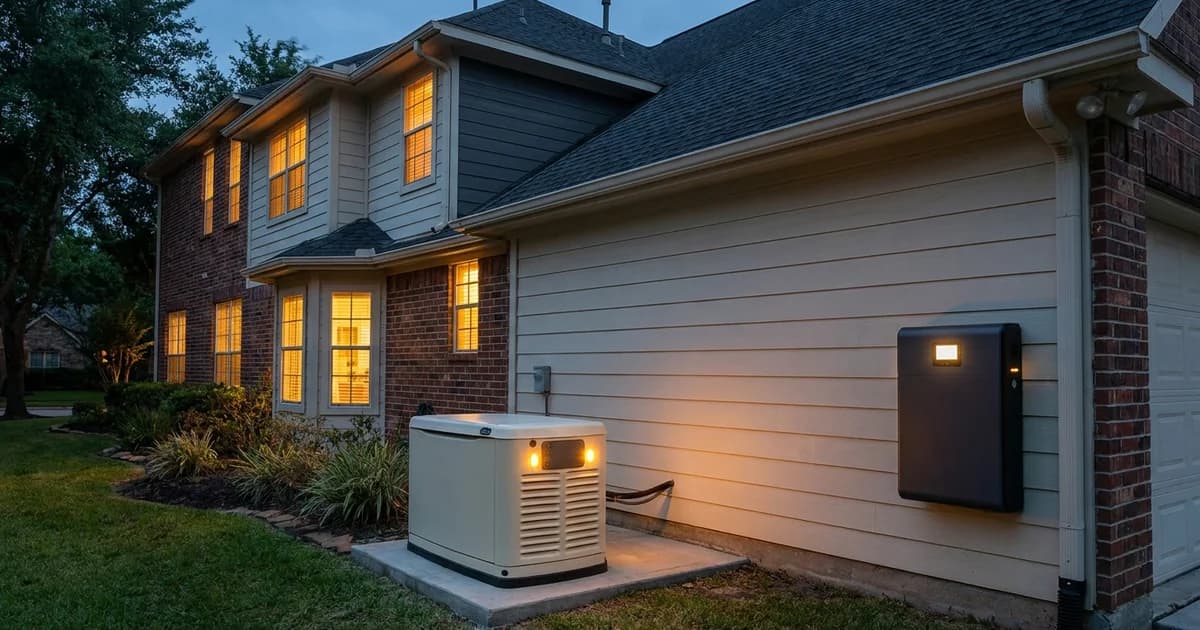
You spent real money on that generator. Nothing in this article asks you to rip it out.
Most writing about batteries and generators treats the decision as either/or. That framing stops being useful the moment the pad is poured, the gas line is run, and the transfer switch is bolted to the wall. The real question is different: what does a battery add to a generator you intend to keep?
Two things a standby generator does badly have nothing to do with how good your unit is. It cannot pick up the load instantly, and it cannot run quietly. A bigger generator fixes neither. A battery fixes both. Here is what the battery adds, how the two wire together, who carries which hours, what your panel needs before a second source goes in, and the honest case for doing nothing.
Key Takeaways
- You can keep the generator. The battery covers the transfer gap and the quiet overnight hours; the generator covers multi-day depth.
- The gap is structural, not a defect: NFPA 110 Type 10, the class written for life-safety loads, still allows 10 seconds before emergency power reaches the load (Consulting-Specifying Engineer, 2025).
- The generator's transfer switch stays upstream. The battery and smart panel go downstream on the backed-up loads.
- Adding a second source is a busbar question first. NEC 705.12 counts every existing source, not just the new one.
- If your generator is newer, correctly sized, and the gap and noise genuinely do not bother you, skip the battery.
What does a battery do that a generator cannot?
A generator's transfer gap is written into the code, not a flaw in your unit. Under NFPA 110, a Type 10 system, the class used for life-safety loads, is required to begin supplying emergency power within 10 seconds of the failure of the normal source (Consulting-Specifying Engineer, 2025). Ten seconds is the ceiling the strictest class has to beat. Residential units are not even held to it: a home standby generator is an optional standby system under NEC Article 702, and NFPA 110 does not address optional standby systems at all.
Four capability gaps follow from that, and a battery closes all four.
No transfer gap. A battery has no engine to start. Clocks, routers, home servers, CPAP machines, garage openers, and any compressor with a restart lockout all notice a 10 to 30 second dark window. Most standby generators use an open transition transfer switch, break-before-make, which the Department of Energy's Pacific Northwest National Laboratory describes as the most common transfer switch type and one that "interrupts the load during the transition between primary and backup power" (PNNL). The load is briefly connected to nothing. That is by design.
Silent overnight operation. No engine means no noise at 2 a.m. In a dense Houston neighborhood, that one difference is why most people call us.
No fuel run during a storm. In July 2024, after Hurricane Beryl, Houston gas stations were "either closed or swamped with long lines of people desperate to fuel their cars and home generators" (Insurance Journal, 2024), because stations without power could not run their pumps. That hits gasoline and propane units; a natural gas standby sidesteps it while gas service holds.
No weekly exercise cycle. Generac's residential manuals set the standard weekly exercise at roughly 12 minutes of engine run time, with a reduced-speed Quiet-Test option that runs about five (Generac owner's manual, 2024). A battery has no scheduled run.
Citation capsule: Under NFPA 110, a Type 10 system must begin supplying emergency power within 10 seconds of the failure of the normal power source, and that is the strictest life-safety class (Consulting-Specifying Engineer, 2025). Residential generators are optional standby systems under NEC Article 702, a category NFPA 110 does not address, so they carry no such time limit.
What the generator still does better
Runtime depth, and it is not close. In 2024, U.S. electricity customers averaged about 11 hours of interruption, with major events like Beryl, Helene, and Milton accounting for 80% of those hours (EIA, 2025). Beryl's Houston tail ran far past any average, and a fueled engine is the only residential source that does not care how long that tail is.
In July 2024, Hurricane Beryl knocked out roughly 2.2 million CenterPoint customers at peak (Houston Public Media, 2024). More than a million were still dark days later, while National Weather Service heat indices ran 100 to 106 F through the restoration (Texas Tribune, 2024). No battery bank a homeowner can afford carries a whole house through that alone. A generator with fuel arriving does.
The engine also handles heavy simultaneous draw with no state-of-charge ceiling: two air conditioners, a well pump, and an electric range at once, for days.
That is exactly why this article is about adding, not replacing. If your generator already does the deep hours well, you do not need a battery for the deep hours. You need it for the hours the generator handles badly.
Citation capsule: In 2024, U.S. electricity customers averaged roughly 11 hours without power, nearly double the prior decade's typical year, and interruptions attributed to major events alone averaged close to nine hours (EIA, 2025). Multi-day duration is the one dimension where a fueled generator still outperforms any residential battery.
How a battery and a generator share one house
They meet at the transfer point, and the order matters. The generator's automatic transfer switch stays exactly where it is, upstream at the service. The battery system and its smart panel sit downstream on the backed-up loads, with their own fast transfer that does not wait for an engine.
Why not drop the battery behind the generator ATS and call it done? Because in that arrangement the generator becomes the battery's "grid," and the battery's islanding logic has to be configured for a source that is not the utility. Both sources also have opinions about where the neutral is bonded, and getting that wrong is the most common field mistake we see on two-source jobs. It is why the inspection matters. This is an installer decision, not a weekend project.
The useful upgrade here is automatic generator start. Some configurations let the battery call the engine when state of charge drops to a set threshold, so the generator runs when it is needed rather than for the whole outage.
The other question that comes up on every one of these jobs: will the battery actually charge off the generator? Usually yes, but it depends on the engine's power quality and on how the battery is configured to treat that source. Inverter generators produce a clean, stable waveform that battery systems accept readily. Older non-inverter units can run with enough voltage and frequency wander that the battery either refuses the source or throttles the charge rate down to something close to useless. Test it before you count on it, because a battery that refills during the generator's daytime run is what makes the overnight handoff repeatable on day two and day three rather than a one-night trick.
Our walk-through of
covers the single-source version of this wiring path.Citation capsule: Open transition, or break-before-make, is the most common automatic transfer switch type and it interrupts the load during the transition between primary and backup power (PNNL). That momentary interruption is the structural reason a generator handoff has a gap and a battery handoff does not.
If what you own is a portable generator
Everything above assumes a permanently installed standby unit with its own automatic transfer switch. If your generator lives in the garage and comes out when the forecast turns, the retrofit changes in three ways, mostly in your favor.
There is no ATS to design around. A portable feeds the house through an interlock kit or a manual transfer switch, which means somebody has to be awake, dressed, and outside to start it. Adding a battery gives the house the automatic layer it never had: the load transfers in the first cycle, and the decision about whether the outage is bad enough to drag the generator out can wait until morning.
The refueling problem gets bigger, not smaller. A portable running a partial house load empties its tank on a schedule that has no interest in when you sleep, and the storm-week fuel line is the same one described above. A battery that carries the overnight block is the difference between one refill a day and three.
The siting risk changes too. Portables are the units that end up too close to the house when the weather is bad, because nobody wants to walk out in it. Every hour the engine does not have to run is an hour that exhaust is not sitting near a door or a window well.
Who carries which hours
The division of labor is the whole point. Battery first, generator for depth. Here is the pattern we configure on layered installs in the Houston area, hour by hour.
| Window | Who carries it | What changes for you |
|---|---|---|
| Seconds 0 to 30 | Battery only | Nothing in the house notices the grid left |
| Hours 0 to 6 | Battery on backed-up loads | Short outages end before the engine ever starts |
| Daytime, hours 6 to 18 | Generator, full house | Heavy simultaneous draw; battery recharges while it runs |
| Overnight, 22:00 to 06:00 | Battery | Engine off, neighbors asleep, you sleep |
| Day 2 onward | Alternating | Fewer cold starts, less fuel per outage |
Our finding: across the layered retrofits we configure, the overnight handoff is the change homeowners mention first, not the transfer gap. The gap makes them research. The sleep makes them buy.
The hardware side is simple. Our modules are 9 kWh nominal, 8.76 kWh usable each, stacking behind a controller rated 11.5 kW continuous and 17.1 kW surge. That surge headroom lets the battery ride through a motor start on its own instead of waking the engine.
Here is the argument almost nobody makes: the generator gets better with a battery in front of it. Fewer cold starts. No short-cycle runs to serve a refrigerator and a couple of lamps at 3 a.m. Less fuel burned per outage. And when the engine does run, it runs against a real daytime load rather than loafing at 15% of rating, which is the condition small engines like least.
Which circuits sit on the battery is its own decision. Our guide on
covers the tiering.What your panel needs before you add a second source
Adding a second source to a panel that already has one is a code question before it is a product question. NEC Article 705 governs interconnected electric power production sources, and its busbar rules count every source on the bus, not just the one you are adding. A panel that passed inspection with a generator alone can fail with a generator plus a battery.
The arithmetic lives in 705.12. Under the widely used 120% allowance, where two sources sit at opposite ends of a busbar carrying loads, 125% of the inverter output current plus the rating of the busbar's main overcurrent device cannot exceed 120% of busbar ampacity (Mayfield Renewables, 2023). The alternative method sums every overcurrent device on the panel, supply and load, against busbar ampacity.
Two other articles apply. NEC Article 706 covers permanently installed energy storage systems, which is exactly what a whole-home battery is, and it points the point-of-connection question straight back at 705.12 (IAEI Magazine, 2019). NEC Article 702 covers optional standby systems, the category your generator sits in and the reason it carries no 10-second obligation.
All of that turns into one site visit. The installer pulls your panel schedule, reads the busbar rating and main breaker, counts what already feeds the bus, and then says yes or says the panel needs work first. Code cycles differ on power control systems, so your jurisdiction and its inspector have the final word. If service capacity is the real question, see our notes on
.Citation capsule: NEC 705.12's busbar allowance limits the combination of source current and the busbar's overcurrent protection to 120% of busbar ampacity, and every existing source on that bus counts toward the calculation (Mayfield Renewables, 2023). Adding a battery to a panel that already carries a generator is therefore an arithmetic check before it is a purchase.
When adding a battery is not worth it
Sometimes it is not, and no one selling batteries will tell you that. If your generator is under about five years old, was sized to the load you actually run, is on a maintenance contract, and your household honestly does not mind the transfer gap or the engine noise, a battery buys you convenience rather than capability. Do not buy it.
The disqualifiers we see on site surveys are consistent:
- A recent, correctly sized whole-home standby unit with service in force.
- No gap-sensitive loads in the house. No home office, no medical device, no server rack, no aquarium, no well pump with a restart problem.
- A detached or rural property where the noise bothers nobody, including you.
- A panel that would need a full service upgrade before a second source fits. Once the total scope grows that much, convenience alone stops justifying it.
The flip side is just as consistent. Gap-sensitive loads that trip on every transfer. A dense neighborhood or an HOA where the overnight engine is a running argument. Sleep that matters to somebody. Fuel anxiety in storm season. Or a generator already past its comfortable service life, where the battery becomes the reliable layer while the engine ages out.
The two calls we get most often are exactly the first two rows: the home office that reboots on every transfer, and the neighbor who finally said something. Narrow problem, narrow fix.
If you have not committed either way,
covers the head-to-head, and argues the case against.What the retrofit process looks like
Four steps, in order.
Panel and source audit. Breaker by breaker, with the panel door open. Busbar rating, main breaker, existing sources, available spaces, and where the generator ATS actually sits relative to the service.
Load and circuit tiering. Which circuits ride the battery through the quiet hours, which wait for the generator, and which stay on utility only. This is where the surge headroom question gets settled: 17.1 kW of surge per controller decides whether a given motor load starts on the battery or wakes the engine.
Transfer topology decision. Where the battery transfers, how islanding and neutral bonding are configured against a generator source rather than the utility, and whether automatic generator start is worth wiring.
Permit and inspection. Both sources declared, plans submitted, and an inspection that specifically looks at the two-source arrangement. This is not the step to skip.
If the audit comes back saying your generator is the wrong starting point,
covers that path.Or call Eos at 833-989-3737 to talk through your setup with an installer.
Frequently asked questions
Can a home battery and a generator run at the same time?
They live in the same house but do not typically feed the same busbar at once in a residential open-transition setup, because an open transition switch breaks one source before it makes the other (PNNL). The battery carries the instant seconds and the quiet hours, the generator carries the deep hours, and the transfer topology decides each handoff.
Do I have to remove my generator to install a battery?
No. The generator's automatic transfer switch stays exactly where it is, upstream at the service. The battery system and smart panel install downstream on the backed-up loads. Nothing about the existing generator, its pad, its gas line, or its ATS gets relocated in a standard layered retrofit.
Will adding a battery make my generator run less?
Yes, and that is the design intent. Short outages end before the engine ever starts, and overnight loads move to the battery. In 2024 the average U.S. customer saw about 11 hours of interruption (EIA, 2025), and a large share of those hours never need an engine at all.
Does adding a second source require a panel or service upgrade?
Sometimes. NEC 705.12 counts every existing source on the busbar, so a panel with headroom for a generator alone may have none left for a battery (Mayfield Renewables, 2023). Your installer confirms it against the panel schedule before quoting anything.
The short version
Keep the generator. It already does the thing a battery cannot, which is carry a house through days of outage with fuel arriving.
- The battery fixes the transfer gap and the noise, not the runtime.
- They meet at the transfer point, with the generator's ATS staying upstream.
- The NEC 705 busbar check comes before any product conversation.
- Layering cuts engine hours, cold starts, and fuel burned per outage.
- If your generator is newer, right-sized, and the gap does not bother anyone, do nothing. That is a legitimate answer.
The reason this question gets asked so often in Houston is that a lot of people bought a generator after Beryl and then discovered the two things it does badly. Keeping it and covering those two gaps is usually the cheaper honest answer than starting over.
Sources
- Consulting-Specifying Engineer, "What you need to know about the types of standby power systems," retrieved 2026-08-11, https://www.csemag.com/what-you-need-to-know-about-the-types-of-standby-power-systems/
- Pacific Northwest National Laboratory (U.S. Department of Energy), "Best Practices for Automatic Transfer Switches Operation and Maintenance," retrieved 2026-08-11, https://www.pnnl.gov/projects/om-best-practices/automatic-transfer-switches
- U.S. Energy Information Administration, "Hurricanes in 2024 led to the most hours without power in the United States in 10 years," retrieved 2026-08-11, https://www.eia.gov/todayinenergy/detail.php?id=66744
- Mayfield Renewables, "Code Corner: 2020 NEC 705.12(B)(3)(1) and (2)," retrieved 2026-08-11, https://www.mayfield.energy/technical-articles/code-corner-2020-nec-705-12b31-and-2/
- IAEI Magazine (International Association of Electrical Inspectors), "Energy storage systems: NEC Article 706," retrieved 2026-08-11, https://iaeimagazine.org/2019/2019march/energy-storage-systems-nec-article-706/
- Insurance Journal, "No Shops, No Gas: Large Swaths of Houston Are Still in the Dark," retrieved 2026-08-11, https://www.insurancejournal.com/news/southcentral/2024/07/11/783372.htm
- Houston Public Media, "Houston power outages after Hurricane Beryl," retrieved 2026-08-11, https://www.houstonpublicmedia.org/articles/news/hurricane/2024/07/08/492833/houston-power-outages-hurricane-beryl-centerpoint/
- Texas Tribune, "Beryl power outage, debris, rain and heat," retrieved 2026-08-11, https://www.texastribune.org/2024/07/11/beryl-power-outage-debris-rain-heat-sargent-texas/
- Generac, "20 kW Air-Cooled Standby Generator Owner's Manual," retrieved 2026-08-11, https://www.generac.com/globalassets/products/residential/standby-generators/owners-manual/g-20kw-60hz-standby-generator-owners-manual.pdf
This article is general information for Houston-area homeowners and reflects Eos specifications as of August 2026. It does not promise a specific runtime, engine-hour reduction, or code outcome. Confirm panel capacity, transfer topology, and permitting for your address with a licensed electrician and your local authority having jurisdiction.