Meyerland and Braeswood Battery Backup: Elevated Homes and Repeat Flooding

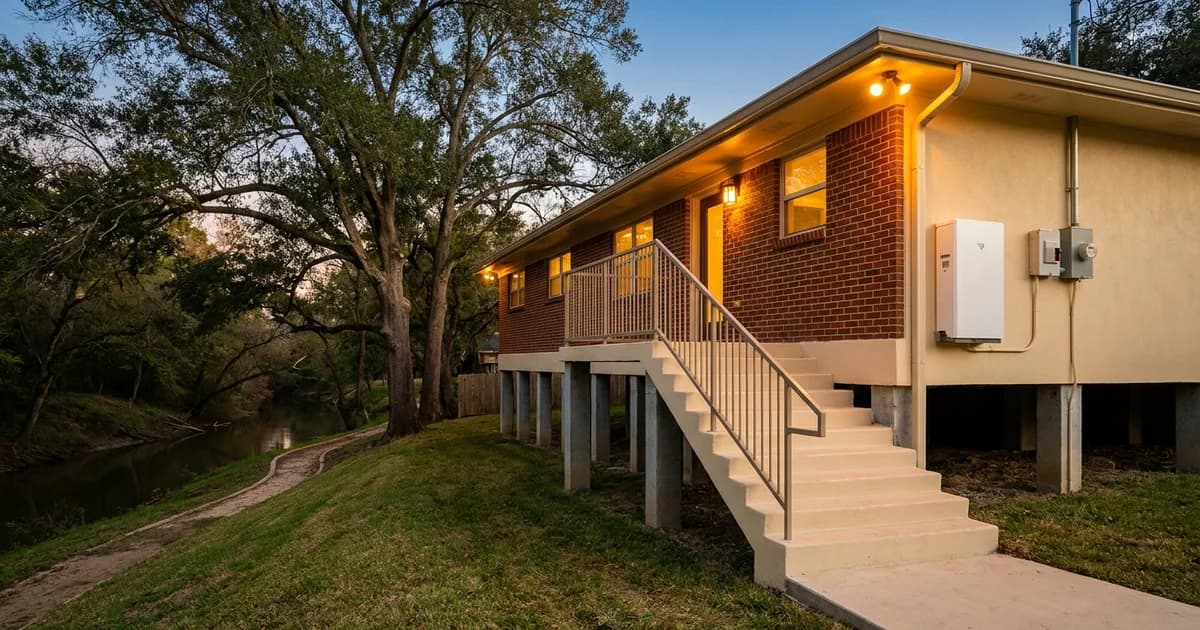
Walk a Meyerland street and you can read its history in the rooflines. A 1950s brick ranch sits at grade on one lot. Next door, an identical house stands on a foundation six or ten feet taller, with a new staircase climbing to the front door. That difference is three floods, a lot of rebuilding, and a set of decisions about where the important equipment lives. A home battery is now one of those decisions.
This guide is the neighborhood case. The metro-wide mounting rules already have a home in our flood zone placement guide, so here we stick to what is particular to Meyerland, Braeswood and the streets along Brays Bayou.
Key Takeaways
- Project Brays, the $480 million channel and detention project on Brays Bayou, was declared complete on May 26, 2022 (Reduce Flooding). Officials said it reduces flood risk, not eliminates it.
- A raised house changes the battery job: the mounting wall, the conduit run and the service entrance all move up with the structure.
- A battery keeps the lights and sump pump on during an outage. It does not make a flooded panel safe.
What did Meyerland actually go through?
Meyerland took three major floods in about two and a half years. A Fox 26 retrospective describes the Memorial Day 2015 storm as dumping 162 billion gallons of water over a nine-hour period, and notes that residents rebuilding afterward faced the Tax Day flood and then Hurricane Harvey (Fox 26 Houston). That sequence is why the neighborhood looks the way it does.
I should be careful here. The Harris County Flood Control District's own Tax Day 2016 page reports roughly 240 billion gallons across the county and names Upper Cypress Creek, Addicks and Barker among the hardest hit areas, and it does not mention Brays Bayou (HCFCD, Spring Floods 2016). So the "three floods" label is local shorthand from news coverage, and each event hit different parts of the county differently. We can't find a public, per-event count of Meyerland structures flooded, so we are not going to quote one.
What the record does support is the recovery pattern. Years later, a Click2Houston report quoted a homeowner whose house was raised 6 feet, said 75 percent of residents stayed after Harvey, and described the community center campus rebuilding after flooding (Click2Houston).
Did Project Brays finish the job?
Mostly, and it matters for how you think about backup power. HCFCD describes Project Brays as a $480 million cooperative effort with the U.S. Army Corps of Engineers: 21 miles of bayou widened across 13 segments, 32 bridge modifications and four detention basins holding 3.5 billion gallons (HCFCD). The Meyerland stretch between Loop 610 and Fondren Road was the final channel phase, roughly 15,000 feet of widening that began in mid-2018.
Some older coverage still describes the project as underway. It isn't. The project was declared complete on May 26, 2022, and County Judge Lina Hidalgo said the improvements reduce flood depth by an average of 2 feet for more than 15,000 structures (Reduce Flooding). The same report notes that no one at the ceremony promised Brays would never flood again.
That is the honest framing. HCFCD also says thousands of structures remain in the currently mapped 100-year floodplain of the 127-square-mile watershed (HCFCD, Brays Bayou watershed). Lower risk is real. Zero risk is not on offer.
For a backup battery, that split decides the design. A completed Brays reduces how often the outage and the flood arrive together. It does not change the fact that a Houston storm can take the grid down with no water in your yard at all. The battery earns its place on the outage side, and the elevation work protects it on the water side.
How does a raised house change the battery install?
A raised house moves every reference point the installer works from. The slab, the meter and the exterior walls are no longer at ground level, and the battery's mounting height is measured against the new structure, not the old lot. The practical result is that the "where does it go" question has more good answers than it does on a slab-on-grade ranch.
The wall is already high. A cabinet on the raised level's exterior wall, or on a protected wall of a rebuilt garage, starts well above a grade-level flood line. In a house lifted by several feet, the mounting-height problem often solves itself, which is the opposite of the tight-wall problem we describe for slab homes.
The conduit run gets longer. Equipment up high and the service entrance somewhere else means more conduit, and every foot of it needs a path that stays above your elevation too. Your installer should walk the route at the survey, not guess it from photos.
Access still counts. A cabinet on an elevated wall needs a safe, legal way to reach it for service. A tall stair landing, a deck or a platform has to satisfy the working-clearance rules we cover in the placement guide. Height alone is not a pass.
Rebuilds follow the current rules. A home that is rebuilt after a substantial-damage determination has to be brought into compliance before repair permits are issued. FEMA defines substantial damage as repair cost equal to or greater than 50 percent of the home's pre-flood market value, and lists elevation, relocation or demolition as the usual outcomes (FEMA, Fact Sheet: Substantial Damage). If your Meyerland or Braeswood house went through that, the battery goes in on top of an already-permitted structure, which tends to make the paperwork cleaner. Our Houston battery permit walkthrough covers which office handles what.
How high did people go? A 2018 ABC13 report found one contractor had lifted 65 homes since Harvey, and a homeowner whose house sat 10 feet higher than when first built (ABC13). That is a small sample, not a neighborhood census, and we have not found a published count of raised Meyerland homes. Treat the numbers as color, not data.
What size battery fits a rebuilt Meyerland house?
Rebuilt and raised homes in this part of Houston tend to be larger than the ranches they replaced, with more air conditioning load. That pushes the sizing question toward the bigger tiers. The numbers below come straight from our plan data, and the same smart controller sits behind every tier.
Every Eos plan uses one controller rated for 11.5 kW continuous output and 17.1 kW surge. What changes is how many battery modules sit behind it. The Pro plan has three modules, 27 kWh nominal and 26.28 kWh usable, and is rated for up to 18 hours of backup at minimal load (refrigerator, Wi-Fi, lights and medical devices). Run the whole house with central air and it drains faster. That's physics, not a flaw.
Two Meyerland-specific sizing notes:
- Sump and drainage pumps are small loads, but they are the critical ones. If your lot has a sump or a yard drain pump, put it on the protected circuits. We worked through the numbers in our sump pump backup guide.
- Do not size for the flood. Size for the outage. The grid, not the bayou, is what takes your power most of the time.
Eos plans are listed on the Pro plan page. For a recommendation tied to your square footage and air conditioning tonnage, the planner is faster than a phone tree.
What happens when the water does come back?
A battery does not make a flooded house safe to power. CenterPoint Energy's guidance, as reported by ABC13 in 2018, is to contact a licensed electrician before turning on the main circuit breaker if water has risen above your electrical outlets, and to let submerged electrical equipment dry for at least a week and be checked by a qualified repair person before it is switched on (ABC13, citing CenterPoint Energy).
Apply that to your battery. If floodwater reaches the cabinet or its disconnect, do not power it up, and do not try to dry it yourself. Call the installer and, where there is any smoke, hissing or smell, call the fire department. The point of mounting high is that this conversation never happens.
Insurance is a separate track. No public rule we could find names a residential battery for a specific payout, so ask your carrier directly and keep your elevation certificate, permit and installation records together. We lay out the claim sequence in power outage insurance claims in Houston.
Where does Braeswood differ from Meyerland?
Braeswood and Meyerland share the bayou and much of the story. Both sit in the Brays Bayou watershed, and the same HCFCD project served both. The difference you will notice is housing stock. Parts of Braeswood have a mix of older ranches, townhome clusters and mid-rise buildings, which means more homeowners with limited exterior wall, shared walls, or an HOA to ask first.
If you live in a cluster or townhome, read our HOA approval guide and the townhome and patio home guide before you pick a wall. For the neighboring cities inside the loop, the Bellaire and West University battery backup guide covers the permit differences by city.
We do not make claims in this guide about property values. We could not find a source worth quoting.
Ready to plan a battery for a raised home?
Start with three facts: whether your house is raised or at grade, where your meter and panel sit now, and whether you run a sump or drainage pump. Those three answers cut the survey time in half. The planner collects them in a few minutes, and an installer reviews the result.
Or call Eos at 833-989-3737 to talk through your setup with an installer.
Frequently asked questions
Is Project Brays finished?
Yes. The $480 million project was declared complete on May 26, 2022. Officials said it reduces flood depth by an average of 2 feet for over 15,000 structures, and that nobody promised Brays would never flood again (Reduce Flooding).
Does a raised house make battery installation easier?
Often, yes. The exterior wall already sits above grade-level flood lines, so mounting height is less of a fight. Conduit runs get longer and access has to stay safe and legal. Your installer should confirm both at the survey.
Can a home battery run through a flood?
It can keep your lights, refrigerator and sump pump running through an outage. It cannot make flooded wiring safe. If water has reached outlets, a licensed electrician must clear the system first, per CenterPoint Energy's guidance reported by ABC13.
Which plan suits a large rebuilt Meyerland home?
Bigger homes with central air usually look at the three-module Pro plan or larger: 26.28 kWh usable behind an 11.5 kW controller. The right tier depends on air conditioning tonnage and what you want protected. See the Pro plan or the planner.
Do I need a new permit if my home was already raised?
Yes. A battery is a separate electrical permit regardless of earlier elevation work. A raised house with a current floodplain permit on file can make the review smoother. Check city versus county jurisdiction first, as our permit guide explains.
The bottom line
Meyerland rebuilt itself higher, and the bayou project behind it is finished. A backup battery fits that story when it is placed with the same logic: above the water, reachable for service, and sized for the outage you will most likely face. Bring your elevation certificate and your panel photos, and the rest is routine.
Sources
- Harris County Flood Control District, Brays Bayou watershed, retrieved October 2026, https://www.hcfcd.org/Find-Your-Watershed/Brays-Bayou
- Harris County Flood Control District, Construction starts on final Project Brays channel improvements from Loop 610 to Fondren Road in Meyerland area, August 2018, https://www.hcfcd.org/Community/Press-Room/post/construction-starts-on-final-project-brays-channel-improvements-from-loop-610-to-fondren-road-in-meyerland-area
- Harris County Flood Control District, Spring Floods 2016, retrieved October 2026, https://hcfcd.org/storm-center/spring-floods-2016
- Reduce Flooding, $480 Million Project Brays Complete After 40 Years, May 26, 2022, https://reduceflooding.com/2022/05/26/480-million-project-brays-complete-after-40-years/
- Fox 26 Houston, Five years ago Memorial Day Flood devastated homes in Meyerland, https://www.fox26houston.com/news/five-years-ago-memorial-day-flood-devastated-homes-in-meyerland
- Click2Houston, Hurricane Harvey 5 years later: Meyerland, August 23, 2022, https://www.click2houston.com/news/local/2022/08/23/hurricane-harvey-5-years-later-meyerland-neighborhood-continues-to-recover-after-hurricane-damaged-homes-businesses/
- ABC13, Meyerland homes either sold or lifted after years of Houston flooding anguish, August 20, 2018, https://abc13.com/post/harveys-flood-forced-meyerland-homeowners-to-leave-or-lift/4010513/
- FEMA, Fact Sheet: Substantial Damage, retrieved October 2026, https://www.fema.gov/blog/fact-sheet-substantial-damage
- ABC13, Important pre- and post-storm electric and natural gas safety tips (CenterPoint Energy), August 13, 2018, https://abc13.com/post/pre--and-post-storm-electric-natural-gas-safety-tips/2339241/