Home Battery Backup vs Whole House Generator: Texas Homeowner's Guide

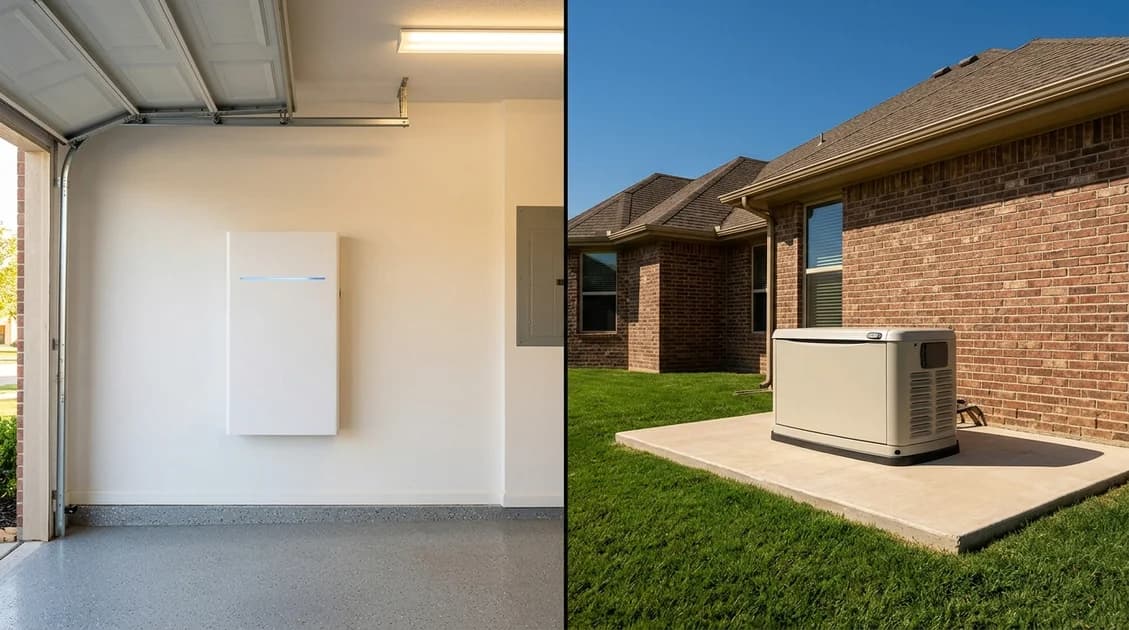
Texas leads the nation in power outages. From 2019 to 2023, the state recorded 263 major grid events, more than any other state in the country (U.S. Department of Energy, via Governing, 2024). Hurricane Beryl knocked out power for 2.6 million customers in July 2024, with some Houston-area homes waiting more than eight days for the lights to come back on (EIA, 2025).
You already know you need backup power. The question is which kind. A whole house generator is the obvious answer, but obvious isn't the same as right. This guide covers every factor that matters for Houston homeowners: real installed costs in the Texas market, runtime in actual outage conditions, fuel supply chain risks during disasters, summer heat effects on battery systems, and the safety differences that most comparison guides skip over.
Key Takeaways
- Texas recorded 263 major power outages from 2019-2023, more than any other U.S. state (DOE, 2024)
- Home battery systems average $15,228 installed; standby generators run $13,000-$20,000+ in Texas
- Over 20 years, solar-plus-battery totals ~$61,000 vs ~$91,000 for a gas generator (EnergySage, 2026)
- Generators win on unlimited runtime via natural gas; batteries win on noise, safety, and long-term cost
- Propane supply chains failed during both Winter Storm Uri (2021) and Hurricane Beryl (2024)
How Much Does Each Option Cost to Install in Texas?
A whole house standby generator runs $13,000-$20,000+ installed in the Houston metro, with equipment at $7,000-$12,000 and labor adding $6,000-$8,000 depending on system size (Madd Roofing, February 2026). A home battery backup system averages $15,228 installed for a 13.5 kWh unit, based on installer quotes collected by EnergySage in the second half of 2025 (EnergySage, 2026). The upfront numbers are close. The 20-year picture is not.
According to EnergySage's 2026 lifetime cost analysis, a solar-plus-storage system totals roughly $60,961 over 20 years, while a comparable natural gas standby generator runs approximately $91,319, a difference of more than $30,000 (EnergySage, 2026). That gap is almost entirely fuel and maintenance. Battery systems carry essentially zero ongoing fuel cost. Generators need annual servicing at $200-$600 per year, regular oil and filter changes, and fuel for every hour they run.
The annual maintenance math compounds quickly. At $400 per year average for a standby generator, you're spending $8,000 in maintenance costs over 20 years before accounting for a single drop of fuel. Battery systems typically need only remote firmware updates pushed by the manufacturer. No oil, no filters, no spark plugs, no technician visits.
One nuance worth understanding: the $15,228 battery figure covers a single 13.5 kWh unit. Whole-home coverage for a typical Houston house usually requires two or three units to handle air conditioning loads during summer outages, pushing the total to $25,000-$35,000. That's still well below the generator's 20-year cost, but the upfront investment is higher than the generator's installed price.
How Long Will Each System Run During a Texas Outage?
A standby generator on a natural gas line runs indefinitely. That's its single biggest advantage. Connected to the utility gas line, a 22 kW Generac keeps running as long as gas supply holds, regardless of how long the grid is down. On propane, a 500-gallon tank powers that same generator for roughly 100-120 hours at typical household loads, about 4-8 days depending on consumption (Generac Support). A single 13.5 kWh home battery lasts 8-12 hours for a whole-home load in summer, or 24 hours or more when you limit usage to essential circuits (EnergySage, 2026).
Texas outages after Hurricane Beryl lasted up to eight days in the Houston metro. A battery-only system without solar can't sustain that kind of extended event. Honest sizing for multi-day Texas coverage means either a larger battery array, 27-30 kWh minimum, combined with rooftop solar for daytime recharge, or accepting that a battery system handles the typical 8-24 hour outage well but not a Beryl-scale week-long event.
The right comparison depends on which scenario you're actually planning for. Most of the 263 Texas grid events from 2019-2023 were hours long, not weeks long. The two catastrophic multi-day events, Uri in 2021 and Beryl in 2024, are outliers. A properly sized battery system handles the vast majority of typical Texas outages. The generator's unlimited runtime advantage matters most for the rare catastrophic storm event.
Air conditioning load is the biggest variable. Central AC in a Houston summer draws 3-5 kW continuously. That single appliance cuts a 13.5 kWh battery's runtime nearly in half compared to an essential-loads-only scenario. If keeping the AC running matters, plan on at least 27 kWh of storage, or a solar-plus-battery setup that recharges during daylight hours.
What Are the Real Safety and Noise Differences?
Generators kill. The Consumer Product Safety Commission estimates 85-100 Americans die each year from carbon monoxide poisoning caused by residential generators (CPSC, 2023). Most of those deaths happen during and after storms, when homeowners run generators in garages or near open windows to avoid going outside in bad weather. Carbon monoxide is odorless and colorless. You won't notice it until it's too late.
Battery backup systems produce zero emissions. There's no combustion, no exhaust, and no CO risk, which means you can install them indoors in a garage, utility room, or climate-controlled closet. No outdoor placement clearances are required, and there's no need for added CO detectors beyond what a standard home already has.
From our installers: CO safety comes up in nearly every consultation with a homeowner who has previously owned a generator. Several customers have mentioned knowing someone personally affected by CO poisoning during a storm. It's one of the most consistent reasons people make the switch to battery.
Noise is the other factor most homeowners underestimate until they've actually lived through a multi-day outage. A Generac Guardian standby generator runs at 66 decibels measured at 23 feet, roughly the noise level of a dishwasher running in the next room (Generac Support). Larger units from Kohler and Briggs run at 68-69 dB. Home battery inverters run under 50 dB, effectively silent in normal living conditions. When your generator runs continuously for three days in July while your neighbors go without power, the noise becomes a real friction point, and a potential HOA problem in neighborhoods with residential noise ordinances.
What Happens to Texas Generators During a Disaster?
Propane deliveries were suspended across much of Texas during Winter Storm Uri in February 2021. Fuel shortages hit the Houston metro within roughly 48 hours of Hurricane Beryl in July 2024. Generator owners who had relied on propane tanks found their 500-gallon reserves were adequate for normal outages but not when supply chains failed at the same moment as the grid.
Texas propane costs $2.95 per gallon as of March 2026 (EIA). Running a 22 kW generator on propane at typical household loads costs roughly $8-11 per hour in fuel. At 120 hours of annual use, the Texas average for outage hours, that's $960-$1,320 in propane per year before you add $200-$600 in annual maintenance. Natural gas generators connected to the utility line avoid the propane shortage problem and run at roughly 40% of propane's per-BTU cost.
From our installers: During Beryl, we had customers with propane generators calling to ask about battery backup because they couldn't get a propane delivery. We had no calls from battery customers about fuel. Battery systems are completely indifferent to what's happening to the fuel supply chain during a disaster.
The honest picture: if your home has a natural gas line connection and you install a natural gas standby generator, the fuel availability problem mostly disappears. Natural gas line pressure can drop during major winter freeze events, as Uri demonstrated, but for most Houston-area storm outages, a gas-connected generator is reliable. Propane-dependent generators carry real supply chain risk in disaster conditions. Battery systems have no fuel dependency at all, and when paired with rooftop solar, they recharge during daylight regardless of what the supply chain is doing.
Does Texas Summer Heat Affect Battery Performance?
Lithium battery systems operate within a rated temperature range of 32°F to 113°F for most residential units. Houston averages daily highs above 90°F for roughly five months of the year, regularly hitting 95-100°F in July and August. That's within operating range, but thermal management matters when you're asking a battery to work hard during a summer outage when it's hottest outside.
Installation location makes a significant difference. A battery mounted on an exterior wall in direct afternoon sun in a Houston summer will see thermal derating, meaning the battery management system reduces output to protect cell temperature, delivering less than rated capacity. A battery installed in a shaded garage interior or climate-controlled utility room maintains full performance year-round.
Standby generator installation has no equivalent concern in this area. A generator on an outdoor concrete pad in full Texas sun runs hot but doesn't experience the same performance reduction that a battery at high ambient temperature does. For battery installations in the Houston area, indoor or shaded placement isn't optional, it's part of proper system design.
The other Texas-specific sizing factor is AC load. The average Houston home's air conditioning consumption in summer is substantially higher than national calculator estimates suggest, because national averages include cooler climates like Seattle, Boston, and Minneapolis. A 2,500 square foot Houston home running central AC on a July afternoon draws 4-6 kW continuously. Battery sizing for Texas summer outages should start from that real load number, not from a generic calculator built for national averages.
Which Is Right for Your Houston Home?
For most Houston homeowners, battery backup is the better choice. Texas outages are typically measured in hours, not weeks. Battery systems handle those events silently, with no fuel cost, no maintenance calls, and no CO risk. Over 20 years, they cost $30,000 or more less than a gas generator. Battery systems also transfer to backup power in 10-20 milliseconds, fast enough that most electronics never notice the grid failed (Aurora Solar, 2025). Generator automatic transfer switches take 30-90 seconds from grid failure to generator power, during which your home is dark and computers restart. For medical equipment, home offices, or food storage with tight temperature requirements, that difference matters.
Generators still make sense in specific situations: homes with very high whole-home loads and no solar potential, properties where extended multi-week coverage is the primary concern, or homeowners who already have a natural gas line stub and prioritize the simplest path to unlimited runtime.
Battery Backup vs Whole House Generator: Texas Side-by-Side
| Factor | Home Battery | Standby Generator |
|---|---|---|
| Typical installed cost | $15,000-$35,000 | $13,000-$20,000+ |
| 20-year total cost | ~$25,000-$61,000 | ~$91,000 |
| Annual maintenance | ~$0-$50 | $200-$600 |
| Runtime without solar | 8-48 hrs by system size | Days to unlimited |
| Noise level | Under 50 dB (near-silent) | 66-69 dB at 23 ft |
| Emissions | None | CO plus exhaust |
| Fuel dependency | None | Gas or propane |
| Transfer to backup | 10-20 milliseconds | 30-90 seconds |
| Indoor installation | Yes | No |
| Texas disaster fuel risk | None | High (propane), low (natural gas) |
Frequently Asked Questions
Is a home battery backup better than a whole house generator in Texas?
For most Houston homeowners, yes. Texas averaged more than 50 major grid events per year from 2019-2023, but most lasted hours rather than weeks. Battery systems handle those outages with no noise, no fuel cost, and no CO risk. Generators have the edge on unlimited runtime via natural gas, but they cost $30,000 more over 20 years (EnergySage, 2026).
How much does a standby generator cost to install in Texas in 2026?
A whole house standby generator runs $13,000-$20,000+ installed in the Houston metro. Equipment for a 20-22 kW unit costs $7,000-$12,000; labor adds $6,000-$8,000. Annual maintenance runs $200-$600 on top of that (Madd Roofing, February 2026).
How long did Houston lose power after Hurricane Beryl?
Hurricane Beryl in July 2024 knocked out power for 2.6 million Texas customers. Some Houston-area homes in CenterPoint's service territory went eight days or more before power was restored, making it the worst outage event for CenterPoint customers since the 2021 winter freeze (EIA, 2025).
Can a home battery backup run AC during a Texas summer?
A 13.5 kWh battery can run central AC for approximately 3-4 hours before depleting. For all-night or all-day AC coverage, plan on 27-30 kWh (two to three units) at minimum. A solar-plus-battery setup extends runtime indefinitely since the solar array recharges the battery during daylight while the grid is down.
What happened to propane generators during Texas disasters?
During Winter Storm Uri in February 2021, propane deliveries were suspended across much of Texas for several days. Gas stations in the Houston metro ran short of fuel within roughly 48 hours of Hurricane Beryl in July 2024. Propane-dependent generator owners found themselves without fuel during extended outages. Natural gas generators on a utility line avoid this problem, and battery systems have no fuel dependency at all.
The Bottom Line: Battery vs Generator for Texas Homes
Battery backup and standby generators are both legitimate backup power technologies. For most Houston homeowners, battery wins on long-term cost, safety, and the kind of outages that actually occur here. For homes that need genuinely unlimited runtime and have natural gas access, a standby generator is still a reasonable option, particularly when extended week-long outages are the primary concern.
The right system depends on your load requirements, whether you plan to add solar, and how much weight you put on avoiding ongoing fuel logistics. Most customers we work with start with a battery system sized to handle essential loads including AC overnight, then evaluate solar as a next phase.
- Texas leads the U.S. in power outages: 263 major events from 2019-2023
- Battery systems cost $30,000+ less than generators over 20 years
- Generators win on unlimited runtime via natural gas line connection
- Propane supply chain failure is a documented Texas disaster risk
- Battery transfer time (10-20 ms) protects sensitive electronics and medical equipment