Fire Ants, Spiders and Wasps: Pest-Proofing a Home Battery in Houston

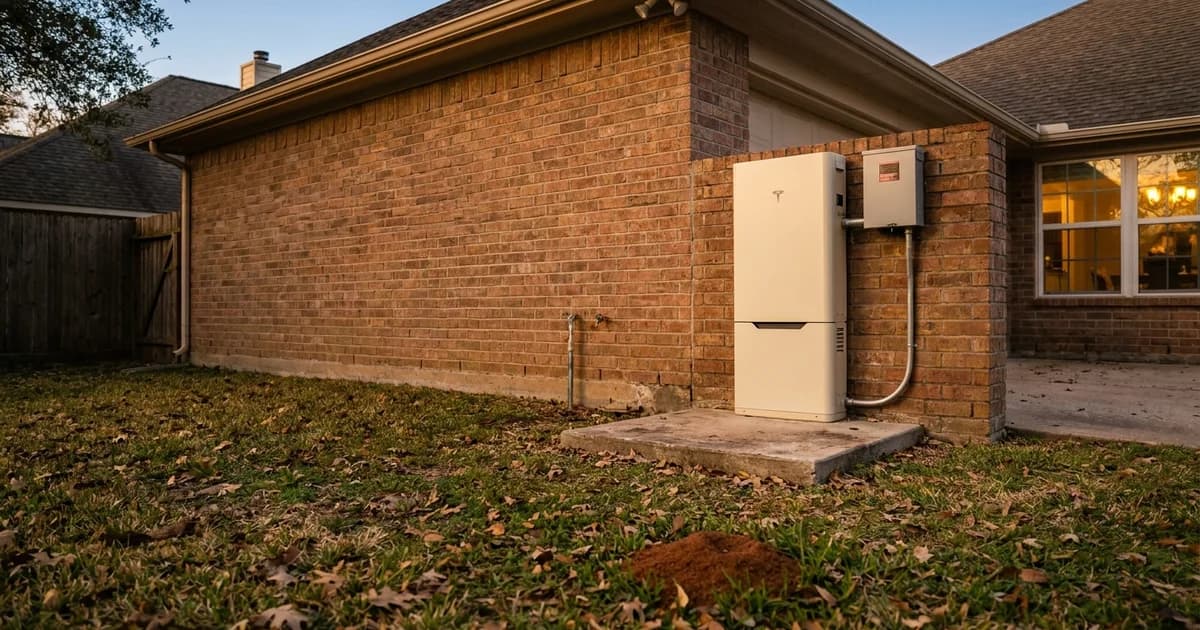
Fire ants are not a myth when it comes to electrical gear. Texas A&M researchers have documented them chewing insulation and packing soil into signal cabinets, and Houston has a second invader, the tawny crazy ant, with the same habit. For a home battery the real-world risk is low, and the prevention is cheap. It happens at install, not afterward.
This guide covers what the research says, what a careful installer builds in, and the short list of things an owner can safely do.
Key Takeaways
- Texas A&M research found electric fields and a protected space are the main draws of fire ants to signal cabinets (Texas Transportation Institute, 1989).
- Pest-proofing is mostly installation work: sealed entries, gasketed knockouts, a raised pad.
- Owners should inspect the outside, never open the enclosure, and never spray insecticide into equipment.
- The odds are low and no public incidence data exists for home batteries.
Do fire ants really get into electrical equipment?
Yes, and the evidence is old and consistent. A Texas Transportation Institute study for the Texas A&M University System concluded that "electric fields and protected environment appear to be the principal attractors of fire ants to signal cabinets" (Texas Transportation Institute, 1989). A companion report listed three problems: ants moving into equipment and causing shorts, soil carried into cabinets causing corrosion, and damaged insulation (Texas Transportation Institute, 1989).
Those studies looked at traffic signal cabinets, not home batteries. We are not aware of any public incidence data for residential battery systems, so we won't invent a number. The mechanism, though, applies to any warm, dry, energized enclosure with a gap in it.
A Texas A&M AgriLife fact sheet on electrical equipment says the same thing in plainer terms: fire ants are drawn to energized equipment, and treating energized gear takes specialized approaches (Texas A&M AgriLife Extension, FAPFS011).
Why is Houston a harder place for this?
Houston has more than one ant problem. Tawny crazy ants (Nylanderia fulva) were first found around Houston in Harris County in 2002, and Texas A&M reports that they have accumulated in electrical equipment, "causing short circuits and clogging switching mechanisms resulting in equipment failure" (Texas A&M Urban Entomology, tawny crazy ant).
Think about what the Gulf Coast offers an ant colony. Heavy rain pushes colonies to look for dry ground. Mild winters leave them active nearly year-round. A battery enclosure is warm, sheltered and quiet, which is the profile the Texas A&M researchers describe.
Here is the practical catch. The same Texas A&M page says the ants "are not attracted to most bait products," that contact insecticide barriers are "often breeched within 2-3 months," and that effective products "are not readily available to the consumer" (Texas A&M Urban Entomology). A spray bottle is not a plan.
What else moves in besides ants?
Ants are the headline, but a few neighbors show up around outdoor equipment all over the Houston area.
Paper wasps. Texas A&M notes their nests commonly occur "underneath eaves, in or on structures and plants" and mature nests hold up to 200 cells and 20 to 30 adults (Texas A&M AgriLife, paper wasp). A louver or underside of a cabinet is just another eave to them.
Mud daubers. These wasps plaster mud into cracks and openings. Texas A&M describes them as "rarely aggressive," but their nests can block a vent or small opening (Texas A&M AgriLife, mud daubers). A blocked cooling path is the real concern for a battery, not the sting.
Widow spiders. Texas A&M lists "gas and electric meters and other undisturbed places" among the spots where black widows settle around homes (Texas A&M Urban Entomology, black widow). That is a reason to be careful with your hands near the equipment, not a reason to panic.
Rodents. Mice need only a gap slightly larger than a quarter inch to get in, and rats a little over half an inch (University of Nebraska-Lincoln Extension, G1530). Conduit and wall penetrations are where those gaps tend to be.
How does an installer pest-proof a home battery?
Most of the work is done before the system is ever energized. The details vary by site and product, so treat this as a typical checklist, not a spec.
- Sealed conduit entries. Every place a conduit enters the enclosure or the wall is closed with a fitting that suits the conduit, not left as an open sleeve.
- Gasketed knockouts. Unused knockouts get proper plugs. An empty knockout is a front door.
- A raised pad. Setting equipment on a concrete pad above grade keeps it off bare soil, where fire ant mounds form, and out of splash zones during heavy rain.
- Metal, not foam, for rodent gaps. The Nebraska guide lists galvanized sheet metal, hardware cloth and copper or stainless steel wool for sealing gaps, and spray foam is not on that list (University of Nebraska-Lincoln Extension).
- Clearance and placement. Keep vegetation, mulch and stored items back from the unit, and keep the manufacturer's clearance envelope intact.
Placement matters here too. A shaded garage wall and an exterior wall expose equipment to different pest and heat conditions, and we cover that tradeoff in our guide to indoor vs outdoor battery installation in Houston. Our broader battery backup installation guide for Houston explains where this work fits in the install sequence.
A note on ratings. An enclosure rated for outdoor use, such as NEMA 3R, is built to shed rain. That rating is about weather, not insects. Pest-proofing is a separate job done at the entries and the pad.
What can a homeowner safely do?
Quite a lot, as long as it stays on the outside of the equipment.
- Look, don't open. Walk the exterior once a month. Check for ant trails, mounds within a few feet, mud tubes, wasp nests under the cabinet or around vents, and webbing.
- Keep the area clear. Trim vegetation and cut back mulch. Texas A&M recommends removing outdoor harborage such as fallen limbs, rocks and leaf litter when dealing with crazy ants (Texas A&M Urban Entomology).
- Wash down paper wasp nests from a distance. Texas A&M suggests dislodging nests with high-pressure water from a safe distance, and the wasps will eventually abandon the nest (Texas A&M AgriLife). Do this only on nests away from the equipment, and stop if wasps become defensive.
- Call a professional for ants. If you see ants on or around the unit, bring in a licensed pest control operator and tell them an energized battery is nearby.
- Log it. Add a pest check to your monthly battery checklist.
Our annual maintenance checklist covers the louvers and clearance side of this in more detail.
What should an owner never do?
Never open the enclosure. The inside of a battery cabinet carries high-voltage DC. Opening it is a job for a qualified technician, and it can affect your warranty.
Never spray insecticide into the equipment. Liquids and aerosols can leave residue or conductive moisture on energized parts, and the Texas A&M fact sheet is clear that treating energized equipment calls for specialized methods (Texas A&M AgriLife Extension, FAPFS011). We have not verified every manufacturer's wording on this, so read your own manual and ask your installer before any treatment near the unit.
Never stuff foam into vents or louvers. Cooling airflow matters, and a blocked vent trades a pest problem for a heat problem.
Never assume bait will fix it. Texas A&M says crazy ants ignore most baits, and a retail product is unlikely to reach a whole colony (Texas A&M Urban Entomology).
How worried should you be?
Honestly, not very. The research on electrical equipment is real, but it covers traffic cabinets and utility housings, and no public dataset tells us how often a sealed, professionally installed home battery gets infested. We would rather say that plainly than make up a statistic.
The sensible way to think about it is cost and probability. Prevention is a few fittings, plugs and a pad, installed once. Cleanup after an infestation is a service call at best. Pests are a good reason to choose an installer who treats entries and pad height as part of the job, and a bad reason to skip backup power in a region that gets hurricanes.
Or call Eos at 833-989-3737 to talk through your setup with an installer.
Frequently asked questions
Do fire ants damage home batteries?
Fire ants are documented to damage electrical equipment in Texas by chewing insulation and carrying in soil (Texas Transportation Institute, 1989). No public data shows how often this happens to residential batteries, so the honest answer is that it is possible but uncommon, and prevention is cheap.
Can I spray ant killer on my battery?
No. Do not spray insecticide into or onto energized equipment. Texas A&M notes that treating energized equipment needs specialized approaches (FAPFS011). Call a licensed pest professional, and check your manual for what the manufacturer allows.
What are tawny crazy ants and are they in Houston?
They are an invasive ant first found in Harris County in 2002, and Texas A&M reports they have caused short circuits in electrical equipment (Texas A&M Urban Entomology). Consumer baits rarely work on them, so a professional is the right call.
Does a raised pad really help?
It helps in two ways. It keeps equipment off bare soil where fire ant mounds form, and it keeps the base out of standing water during heavy rain. It does not replace sealed entries, so the two work together.
Who should I ask about pest-proofing my specific system?
Your installer. Entry points, enclosure ratings and clearances differ by product and by site, which is why the pest plan belongs in the install scope. Our specifications page lists the equipment, and the planner will help you scope the rest.