Solar Plus Battery in a Houston Winter: What December Actually Produces

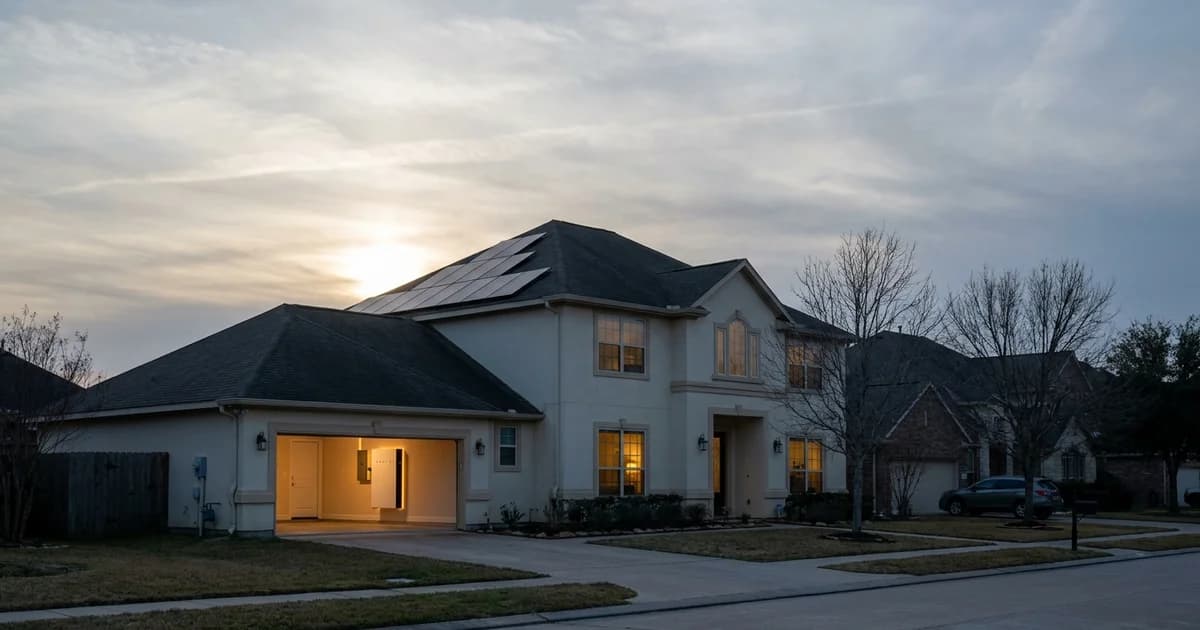
Does solar still work in a Houston winter? Yes, but not like it does in June. We ran the federal PVWatts model for a typical Houston roof, and December came out at roughly 64% of June's output. That is a smaller drop than most people expect, and a much bigger one than you want to ignore if you are counting on panels to refill a battery during a winter outage.
This guide shows the numbers, the exact inputs so you can rerun them, and what they mean for sizing a battery.
Key Takeaways
- A 1 kW roof array in Houston makes about 86 kWh in December and 135 kWh in June, per our PVWatts run.
- Winter months (December to February) deliver about 19% of the year's output, not the 25% a flat year would give.
- In a multi-day winter outage, solar stretches your battery but does not replace its size.
How much does solar produce in Houston in December?
In our run, each kilowatt of panels on a typical Houston roof produced about 86 kWh in December, or roughly 2.8 kWh per day. June produced about 135 kWh per kilowatt, or 4.5 kWh per day. The model is PVWatts v8 from the federal energy lab, using typical-year weather, so these are averages, not guarantees for any single day.
I ran the tool rather than estimating, and I am publishing the inputs so you can check me. Here is exactly what went in:
- Location: latitude 29.76, longitude -95.37 (central Houston). PVWatts matched it to the nearest weather grid cell at 29.77, -95.38.
- Weather data: the "NSRDB PSM V3 GOES tmy-2020 3.2.0" typical-meteorological-year dataset, the default PVWatts v8 dataset.
- System size: 1 kW DC, so every result scales linearly to your array.
- Array type: fixed, roof mounted (array_type 1).
- Tilt and azimuth: 20 degrees tilt, 180 degrees azimuth (due south).
- Module type: standard.
- System losses: 14%. PVWatts says this default is appropriate for most typical systems.
- Run date: October 6, 2026.
This run assumes no shading, no snow and a clean array. Your own roof angle, trees and neighbors will move the results, so treat the table as a baseline.
What does the full year look like month by month?
Here is the monthly output from that same run, per kilowatt of panels, with the daily average beside it.
| Month | kWh per kW-DC per month | kWh per kW-DC per day |
|---|---|---|
| January | 92.8 | 3.0 |
| February | 87.7 | 3.1 |
| March | 128.7 | 4.2 |
| April | 126.6 | 4.2 |
| May | 137.5 | 4.4 |
| June | 134.7 | 4.5 |
| July | 139.6 | 4.5 |
| August | 134.2 | 4.3 |
| September | 122.8 | 4.1 |
| October | 121.7 | 3.9 |
| November | 109.1 | 3.6 |
| December | 86.0 | 2.8 |
| Year | 1,421 | 3.9 |
Source: PVWatts v8 monthly output, inputs above, retrieved October 6, 2026.
December is the low point at 86.0 kWh, about 64% of June. Hold that thought, because a monthly average hides the thing that matters most in an outage: a gray week is not an average week.
Citation capsule. In a PVWatts v8 run for central Houston (20 degree tilt, south facing, 14% losses), a 1 kW array produced about 86 kWh in December versus about 135 kWh in June, roughly 64%, and December to February together supplied about 19% of the year's 1,421 kWh.
Why does December drop so much?
Two things shrink winter output: shorter days and a lower sun. In the same run, the sunlight reaching the tilted panels was about 109 kWh per square meter in December versus about 187 kWh in June. That is the driver, not temperature.
Houston's day is roughly 10 hours long at the winter solstice versus nearly 14 at the summer solstice, which you can confirm with NOAA's solar calculator. The sun also sits lower, so each hour delivers less.
Cold actually helps a little. The Department of Energy notes that solar cells generally work best at low temperatures. Houston's December normal is a mean of 55.4°F against 83.0°F in June, per NWS 1991 to 2020 normals. That cool air nudges efficiency up, though it does not come close to offsetting the lost daylight.
What about cloudy days?
Clouds are the real winter wildcard. Climatology from the National Climatic Data Center, as compiled by Current Results, puts Houston at about 51% of possible sunshine in December. That is a long-term average. It does not tell you what any single week looks like.
Here is the honest limit of what I can give you. PVWatts monthly output is a typical-year average. I did not run a worst-case overcast stretch, and I could not find a publicly available, sourced figure for how much a Houston array produces on a heavy overcast December day. So I will not invent one.
What I can say is directional. Overcast skies cut output well below the monthly average. A week of low cloud can leave a battery barely recharging, while a clear cold front day can beat the average. Plan around the bad week, not the average one.
Our takeaway: A monthly average is a budget. An outage is a bad week. Size for the bad week and treat solar as a bonus.
Why do the numbers matter if the grid goes down?
Because the January and February outages are not hypothetical in Texas. During Winter Storm Uri in February 2021, FERC, NERC and regional entities found that more than 4.5 million people in Texas lost power, some for as long as four days. The full FERC and NERC staff report attributes the failures mainly to frozen generating equipment and fuel problems.
Winter is also when your home uses power in a different pattern. Heating loads rise, nights are long, and your panels have the fewest hours of the year to refill the battery. I did not find a verified, home-level figure for how much solar production Houston homes actually saw during Uri, so I will not quote one. The mechanism, though, is clear from the table: fewer sun hours, lower yield.
Grid-tied panels also shut off when the grid fails unless a battery and islanding equipment are in place. Our guide on adding a battery when you already have solar covers that piece.
How much will your panels refill the battery in winter?
Use this simple budget. Take your array size in kW, multiply by 2.8 for an average December day, then subtract what your house uses in daylight hours. What is left goes to the battery.
For example, an 8 kW array would average about 22 kWh on a December day in this model, about 36 kWh on a June day. That is before your daytime loads. The same array running a refrigerator, internet and a few lights in the afternoon sends the rest to the battery, while heavy daytime heating eats most of it.
One Eos fact keeps the math honest. Every Eos residential battery module adds 8.76 kWh of usable storage, and a single smart controller delivers 11.5 kW continuous with 17.1 kW surge. Panels extend the battery's life across days, but the module count sets how long you hold without sun.
What does this change about battery size?
It means size the battery for the night and the gray day, and let solar earn its keep on top. Three working rules follow from the numbers.
- Size for the dark hours. The battery alone must carry you from sunset to the next useful sun, and winter nights are the longest. Our battery sizing for extended outages guide walks through that math.
- Treat winter solar as a partial refill. Count on December's 64% of June, then discount again for clouds.
- Prioritize loads. Use circuit prioritization so the panels' smaller winter harvest covers the essentials. Our whole house battery for solar guide covers how to think about whole-house versus critical-load setups.
Solar helps most when the sun is shining and the battery is not empty. In a multi-day winter outage, that makes the battery the floor and the panels the extension. If you are still weighing the tradeoffs, see how solar battery storage in Houston fits together, and read the Texas winter storm preparation guide for the rest of the checklist.
You can compare Eos tiers on the plans page, or start the planner and we will match capacity to your roof and your loads.
Or call Eos at 833-989-3737 to talk through your setup with an installer.
Frequently Asked Questions
Does solar work in winter in Houston?
Yes. In our PVWatts run, a Houston roof makes about 86 kWh per kW in December, around 64% of June's roughly 135 kWh. Winter is lower mainly because days are shorter and the sun sits lower, not because it is cold (PVWatts v8).
Can solar panels recharge my battery during a winter outage?
If your system is set up to island from the grid, yes, during daylight. The refill is smaller than in summer, and it depends on cloud cover. Treat it as an extension of your battery, not a replacement for its capacity.
Does cold weather hurt solar panels?
Not much. The Department of Energy notes that solar cells generally work best at low temperatures. Houston winters are mild, so the real loss comes from fewer daylight hours and cloud, not temperature.
How many sunny days does Houston get in December?
Long-term data puts Houston near 51% of possible sunshine in December (Current Results, citing NCDC). That is an average over many years. I could not find a sourced count of fully clear days, so I do not quote one.
Numbers in this post come from a PVWatts v8 run on October 6, 2026. Real production depends on your roof, shading and equipment. Eos plan details are on the plans page.