How to Add Battery Storage to Your Solar System in Houston


When Hurricane Beryl knocked out power to 2.2 million CenterPoint customers in July 2024, thousands of Houston homeowners had solar panels on their roofs that produced exactly zero electricity. Some waited ten days for the grid to come back (Houston Public Media, 2024). Their panels were fine. The problem was something most people don't think about when they go solar: a grid-tied solar system shuts off the moment the grid does.
Battery storage fixes that. Adding a battery to your existing solar system turns a system that fails during outages into one that keeps your home running. This guide covers the five steps to do it in Houston, from checking compatibility to what happens on installation day.
Key Takeaways
- Grid-tied solar is legally required to shut off when the grid goes down. A battery is what lets your solar keep producing during an outage.
- Most Houston systems installed after 2015 are battery-compatible without replacing the inverter, using AC coupling.
- The average installed cost in Texas is $17,472 for a 13 kWh system, ranging from $14,851 to $20,093 (EnergySage, Dec 2024).
Why Does Grid-Tied Solar Shut Off During a Houston Outage?
Every grid-tied solar inverter has built-in anti-islanding protection, a safety feature required by electrical code that shuts the system down whenever it detects grid failure. Without it, a solar system could back-feed electricity onto downed lines and create a hazard for utility crews restoring service.
This isn't a design flaw. It's intentional. But it means a homeowner with 20 solar panels on their roof gets no power during an outage, the same as a neighbor with nothing installed.
Houston's situation adds a local layer most guides skip. ERCOT operates as a largely isolated grid with far fewer connections to neighboring states than most US utilities. That isolation amplified Winter Storm Uri's damage in 2021 and contributed to Beryl's extended restoration times in 2024. Houston homeowners face a specific combination of hurricane risk, summer heat, and grid isolation that makes this question practical rather than hypothetical.
Battery storage breaks the grid dependency by creating an island circuit. Your solar panels charge the battery, and the battery powers your home's circuits independently of the grid.
Step 1: Check If Your Existing System Is Battery-Compatible
By the end of this step, you'll know whether your current inverter can accept a battery without being replaced.
Most solar systems installed in Houston after 2015 are compatible using a method called AC coupling, which means no panel changes and no inverter replacement in most cases.
How to check in three steps:
- Find your inverter. It's usually mounted in the garage or on an exterior wall near the main electrical panel.
- Note the brand and model number.
- Call your original installer and ask: "Is my inverter compatible with AC-coupled battery storage?" or look up the model on the manufacturer's site.
What you'll likely find by brand:
- Enphase microinverters: AC coupling is built in. Enphase IQ Batteries pair natively with IQ7 and IQ8 series microinverters.
- SolarEdge string inverters: Most support AC-coupled batteries through a separate battery inverter. SolarEdge's own home battery uses DC coupling and requires a compatible interface unit.
- Older string inverters: AC coupling through a third-party battery inverter is still possible, but a compatibility check with an installer is worth doing first.
One practical note on warranties: adding a battery from a third-party brand can sometimes affect the inverter warranty if the installation doesn't follow the manufacturer's guidelines. Get written confirmation from your original installer or the inverter manufacturer before signing anything.
Texas ranks 2nd nationally in installed energy storage at 26,271 MWh (SEIA, March 2026), which means qualified Houston installers have done this hundreds of times. The compatibility question is usually settled in a 15-minute site assessment.
Step 2: Size the Battery for Your Houston Home
The average Texas residential battery system is 13 kWh (EnergySage, Dec 2024). That's a reasonable starting point, but the right size comes down to one question: does your air conditioning need to run during an outage?
Essential loads only (no AC):
A typical Houston home's essential daily load: refrigerator, lights, fans, device charging, and router. That runs about 5-6 kWh per day. A 10-13 kWh battery covers it for 24-48 hours. With solar recharging during the day, the window extends indefinitely when the sun is out.
With air conditioning:
Central AC draws 3,000-5,000 watts continuously. A 13 kWh battery running central AC is empty in 2-3 hours. Meaningful AC backup requires solar pairing, which keeps the battery charged during daylight hours instead of depleting it.
The sizing formula:
Battery size = (daily critical load kWh × backup days) ÷ 0.90
Example 1: Essential loads only (no AC)
- Daily critical load: ~6 kWh (fridge, lights, fans, devices, router)
- Two-day backup: 12 kWh gross
- Adjusted for 90% usable capacity: 12 ÷ 0.90 = 13.3 kWh
One 10-13 kWh battery covers this comfortably.
Example 2: Essential loads plus a window AC unit
- Window AC running 8 hours: 1,100W × 8h = 8.8 kWh added
- Total daily: ~15 kWh; two-day gross: 30 kWh
- Adjusted: 30 ÷ 0.90 = 33 kWh (two to three standard battery units)
The chart below shows how long a 13 kWh battery (at 90% usable capacity) lasts under three realistic load scenarios.
Step 3: Choose AC or DC Coupling
For almost every Houston retrofit, AC coupling is the right method. Here's why.
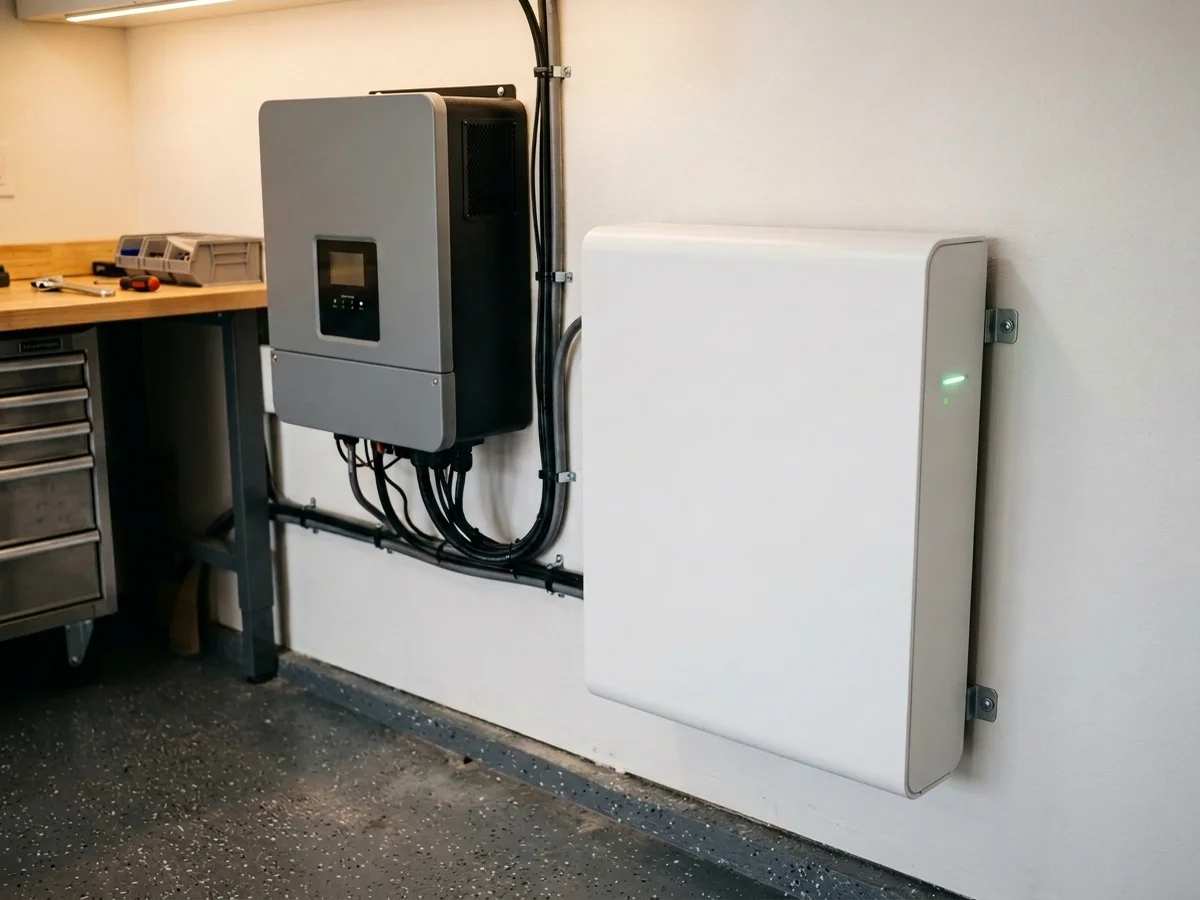
AC coupling connects the battery to the AC output side of your existing inverter. The solar and battery each have separate inverters that communicate at the AC level. Your existing inverter stays in place. Installation is faster, most battery brands are compatible, and there's no need to redesign the existing system.
DC coupling connects the battery on the DC side before the inverter, which requires a hybrid inverter that manages both solar and storage. For a retrofit, that means replacing your existing inverter, adding cost and disruption.
Most Houston retrofit jobs use AC coupling regardless of inverter brand. The one case where DC coupling makes sense for a retrofit is when the existing inverter is already at end of life. If you'd be replacing it within a year or two anyway, pairing that replacement with a hybrid inverter capable of DC coupling can be worth it. Otherwise, AC coupling is faster, less expensive, and equally capable for daily solar-plus-battery operation.
The efficiency difference between the two methods is real but small: AC coupling loses about 3-5% in the DC-to-AC-to-DC conversion process (EnergySage, 2025). That gap doesn't change the value of the system for most homeowners.
Step 4: Navigate Permitting and CenterPoint Interconnection
Adding a battery to an existing solar system requires a permit in Houston. Skipping this step isn't an option.
What's required:
- Electrical permit. The City of Houston requires an electrical permit for battery storage additions. Unincorporated Harris County has a parallel process. Your installer handles the application, but you're the permit holder.
- CenterPoint notification. If the battery operates in island mode only (no export of battery power to the grid), the interconnection process is relatively straightforward. Exporting battery power to the grid requires an interconnection amendment, which adds time.
- Texas SB 1252 (2025). This law limits utilities' ability to delay or block residential battery installations and requires interconnection decisions within 30 days (NATiVE Solar, 2025). It has meaningfully shortened what used to be an unpredictable timeline.
Texas battery storage additions exceeded 5,200 MW of new capacity in 2025 alone (Inside Climate News, Feb 2025). The permitting and interconnection process for residential retrofits in Houston is now well-established.
Work with a licensed Texas electrical contractor who has filed CenterPoint interconnection paperwork before. An experienced installer knows which forms to submit and how to avoid the delays that come from incomplete applications.
Step 5: What to Expect on Installation Day
A typical AC-coupled battery retrofit in Houston takes one full day. No roof work. No new exterior conduit in most cases. No changes to the existing solar panels.
The sequence:
- Morning: Installer confirms battery location (garage wall, utility room, or exterior wall), verifies panel configuration, and reviews the permit.
- Midday: Battery is mounted, wiring runs to a new critical loads subpanel or the existing backup panel. The battery inverter is connected to the solar inverter's AC output.
- Afternoon: System is powered up. Solar inverter and battery are paired. Monitoring app is configured. The installer verifies island mode by simulating a grid loss.
- After installation: A city inspector signs off before the system goes live. Most Houston installations clear inspection within one to two weeks.
Most homeowners are surprised by how little disruption a retrofit causes compared to the original solar installation. The heaviest work is usually the subpanel wiring. By late afternoon, the system is operational.
Cost context: EnergySage reports the average installed cost for a 13 kWh battery system in Texas at $17,472, ranging from $14,851 to $20,093 depending on system size and battery brand (EnergySage, Dec 2024).
Frequently Asked Questions
Can I add a battery to my existing solar system without replacing the inverter?
Yes, in most cases. AC coupling connects a battery system to the AC output of your existing inverter without replacing it. Enphase, SolarEdge, SMA, and most inverter brands support AC-coupled retrofits. Only older inverters without communication capability, or those already at end of life, may require replacement.
How much does it cost to add battery storage to an existing solar system in Texas?
EnergySage reports the average installed cost in Texas at $17,472 for a 13 kWh system, with a range of $14,851 to $20,093 as of December 2024. Cost per kWh ranges from $651 for budget systems to $1,510 for premium units. System size, battery brand, and labor all affect the final number.
Does adding a battery affect my electricity buyback plan in Texas?
Most Houston homeowners won't see their buyback rate affected if the battery only charges from solar and doesn't export battery power to the grid. Texas has no statewide net metering law, so your retail electric provider contract governs what's allowed. Confirm with your provider before installation if you plan any grid-export configuration.
Will adding a battery to my solar void my warranty?
Your solar panel warranty (typically 25 years) is not affected by adding a battery. Your inverter warranty may be affected if a third-party battery is connected without following the inverter manufacturer's guidelines. Get written confirmation from your inverter manufacturer or original installer that the planned battery is compatible before signing a contract.
Is it worth adding a battery to solar in Houston?
For most Houston homeowners, the value is primarily resilience: keeping essential loads running during outages like Beryl. The direct financial payback from battery storage is longer than for solar panels alone, because Texas lacks statewide net metering. The calculation changes if you have a time-of-use rate or a buyback plan where battery discharge during peak hours reduces your bill. A site assessment helps clarify the numbers for your specific situation.
The Next Step
If you already have solar and want to know what a battery retrofit looks like for your specific setup, a site assessment is the place to start. An installer reviews your inverter, panel configuration, and electrical panel, then gives you a sizing recommendation and quote.
The compatibility check in Step 1 is worth doing today: find your inverter model, confirm it supports AC coupling, and you'll be ready for that first conversation.