Where Does a Home Battery Go in a Houston Flood Zone?

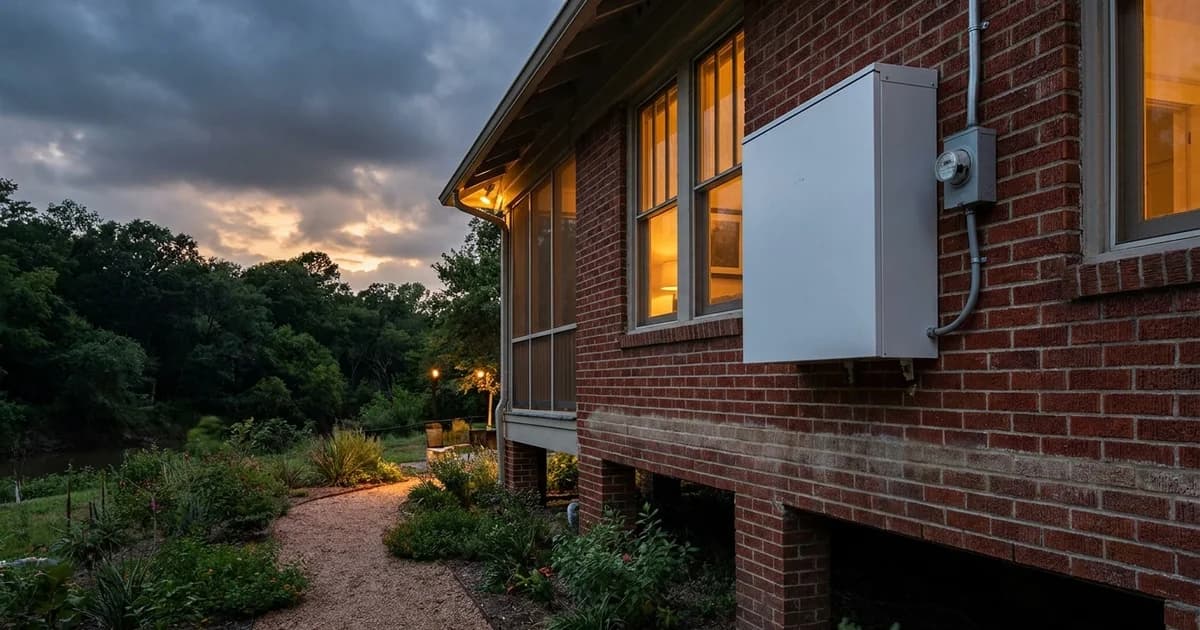
Most Houston homeowners find out where their battery can go about three days before the crew shows up. That is late. In a mapped floodplain the mounting height is not a preference, it is a number set by an ordinance, and it decides the wall, the conduit routing, and sometimes the plan itself. This part of the install gets settled by a map and a survey, not by a salesperson.
Key Takeaways
- Harris County requires electrical distribution panels and other mechanical or electrical equipment to sit at least 24 inches above the 0.2 percent (500-year) flood elevation (Harris County Floodplain Management Regulations, effective July 9, 2019).
- Your flood zone letter and your Base Flood Elevation are two different things. The zone says whether the rules apply. The elevation says how high.
- Raising equipment can collide with NEC 110.26 working clearance, so height and access get solved together, not in sequence.
- A submerged lithium battery is a disposal job, not a dry-it-out job.
How do you find your flood zone and your Base Flood Elevation?
FEMA defines Base Flood Elevation as "the elevation of surface water resulting from a flood that has a 1% chance of equaling or exceeding that level in any given year" (FEMA glossary). The zone letter and that elevation come from two different lookups, and homeowners routinely stop after the first one.
Start at the FEMA Flood Map Service Center
The Flood Map Service Center is, in FEMA's own words, "the official source for National Flood Insurance Program flood hazard information," carrying FIRM panels, Flood Insurance Study reports, Letters of Map Change and the National Flood Hazard Layer (FEMA, Flood Map Products and Tools). Search your address, open the effective FIRM panel, and note two things: the zone label, and whether a Base Flood Elevation is printed for your area.
Cross-check with the Harris County education map
The Harris County Flood Control District runs a plain-language version at harriscountyfemt.org, which draws the 1 percent, 0.2 percent and coastal floodplain boundaries against individual properties. Read its disclaimer, though: the District states that "the Flood Education Mapping Tool is not the effective FIRM." It's for orientation, not for a permit application.
Get the elevation that actually governs
Neither map tells your installer how high your slab sits. Harris County's FAQ points homeowners to hire "a licensed land surveyor or licensed professional engineer" to prepare an Elevation Certificate (Harris County Flood Education Mapping Tool FAQs). The county also requires a post-construction Finished Floor Elevation Certificate sealed by a Texas registered surveyor, engineer or architect for structures in a Special Flood Hazard Area, plus a Floodplain Development Permit for all work in the floodplain (Harris County Office of the County Engineer).
That gap is where most flood-zone battery jobs go sideways. The homeowner knows the zone letter, assumes the property is either disqualified or exempt, and nobody pulls the elevation number until the electrician is standing in the side yard with a drill.
What do the codes actually require?
Three layers stack here, and the strictest one wins. ASCE 24 sets the national floor, the local ordinance usually raises it, and the NEC governs how the equipment is reached once it's up there.
ASCE 24, the standard behind the building code
ASCE 24, Flood Resistant Design and Construction, is a referenced standard in the International Codes, and buildings within the scope of the IBC located in any flood hazard area must be designed in accordance with it (FEMA, Highlights of ASCE 24-14). Its rule for equipment is direct: attendant utilities and equipment must be at or above specified elevations, or be specifically designed, constructed and installed to prevent floodwaters from entering or accumulating within components. For Flood Design Class 2, the class that covers ordinary homes, ASCE 24-14 Table 7-1 puts utilities and equipment at BFE plus one foot, or the design flood elevation, whichever is higher.
Harris County, the number that governs unincorporated addresses
Harris County moved its whole baseline off the 100-year event, because NOAA Atlas 14 rainfall showed the updated 100-year rainfall now approximates the old 500-year rainfall. The result: for new construction, substantial improvement, or repair after substantial damage, "water heaters, furnaces, air conditioning systems, electrical distribution panels and any other mechanical or electrical equipment must be elevated to at least twenty-four (24) inches above the 0.2 percent or 500-year flood elevation" (Harris County Floodplain Management Regulations, amended and effective July 9, 2019). The same section requires separate circuits for any level below that elevation, dropped from above.
City of Houston, Chapter 19
Inside city limits, the governing document is Chapter 19. Houston Public Works took a revision to City Council in March 2018 that extended coverage from the 100-year floodplain into the 500-year floodplain and set protection at two feet above the 500-year flood elevation, replacing an older standard of one foot above the 100-year elevation. The same summary put 31 percent of Houston inside the 100-year floodplain (Houston Public Works, Chapter 19 Floodplain Ordinance Summary).
Two neighbors on one street can be held to different numbers because one is in the city and one is not. Confirm jurisdiction before anyone quotes a mounting height. Our Houston battery permit walkthrough covers which office signs off on what.
Where does the battery physically go?
Elevation is the answer almost every time. FEMA's own mitigation guidance is blunt about it: "Since most electrical components are not water resistant and can be damaged or destroyed when exposed to floodwater, elevation is the most effective overall solution" (FEMA P-2181, Fact Sheet 3.4.2, Building Utility Systems, Electrical, March 2022).
Wall mount above the regulated elevation. The common Houston answer. Cabinet, disconnect and gateway go on an exterior or garage wall high enough to clear the local number, with conduit entries above the same line.
Elevated platform or pedestal. FEMA's fact sheet describes elevating primary electrical components on platforms or pedestals above the flood protection level. On a slab-on-grade lot with no usable high wall, that is often the only path.
Relocation. Moving equipment to a higher floor or a different spot on the property is an equal option in the same guidance, and it's frequently cheaper than fighting a bad wall.
Where height fights the code
Here's the constraint that gets skipped. FEMA states that elevating electrical system components "must comply with National Fire Protection Association (NFPA) 70, which presents the National Electrical Code (NEC) requirements for access and minimum working clearance." Texas has adopted NFPA 70, 2023 edition, without amendments as the Texas Electrical Code (UpCodes, Texas TDLR Electrical Code 2023).
NEC 110.26(A)(2) requires working space at least 30 inches wide, or the width of the equipment, whichever is greater, with doors or hinged panels able to open at least 90 degrees. NEC 110.26(A)(3) requires working space height of at least 6 feet 6 inches, measured from the floor, grade or platform, or the height of the equipment itself, whichever is greater (NEC 110.26 reference text).
Push equipment high enough to clear a 500-year number plus freeboard and you can run out of usable wall before you run out of height, especially under a soffit or on a garage wall shared with a water heater. Manufacturers publish their own mounting height and orientation limits too, and those don't bend for a floodplain ordinance. When the constraints collide, the platform usually wins: it raises the equipment and the standing surface together, so the 6 feet 6 inches gets measured from a legal platform instead of from grade.
Placement also interacts with heat, weather rating and setbacks. We covered that tradeoff in indoor versus outdoor battery installation in Houston, and the neighborhood-level version in Kingwood battery backup flood considerations.
What happens to a lithium battery that goes underwater?
It becomes a fire risk and a disposal problem. It does not become a repair. The U.S. Fire Administration's guidance for lithium-ion batteries exposed to flooding says to notify your local fire department, disconnect potentially flooded battery-powered devices from chargers, and remove potentially flooded batteries from buildings and garages (USFA, Lithium-Ion Battery Safety After Flooding).
Disposal is specific. USFA instructs owners to place flood-damaged lithium-ion products in metal or non-combustible tubs kept at least 6 feet from debris and structures, never to put them out with storm debris for pickup, and never inside garbage or recycle carts. If a unit is emitting smoke or gases, or making a popping or hissing sound, move to a safe distance and call the fire department. Do not investigate it.
That is why mounting height matters more than any spec sheet line. A dry battery is an asset after the storm. A submerged one is a hazmat call and a replacement.
How does elevation change insurance and documentation?
Elevation is also a rate question. Harris County's homeowner FAQ notes that a property inside a mapped floodplain can still qualify for lower flood insurance rates when it sits above the Base Flood Elevation, which is why the Elevation Certificate earns its survey fee even when nobody is forcing you to pull one.
Keep the paper. Photograph the finished install with a tape measure against the mounting height, and file the elevation certificate, the permit and the manufacturer's installation record together. Harris County's substantial damage determination turns on whether restoring the structure would cost 50 percent or more of its pre-damage market value, assessed by the County Engineer with a FEMA-approved damage estimator and an on-site inspection when needed. Your documentation is what that file gets built from.
One honest note: no publicly published flood insurance rule singles out a residential battery system by name, so nobody should promise you a specific payout for one. Treat coverage as a conversation with your carrier, and see our walkthrough on Houston power outage insurance claims.
Or call Eos at 833-989-3737 to talk through your setup with an installer.
Frequently asked questions
Does being in a flood zone disqualify my home from battery backup?
No. It changes the mounting height and the permit path, not your eligibility. Harris County requires electrical equipment 24 inches above the 500-year flood elevation, which usually means a higher wall position or an elevated platform, not a different system (Harris County Floodplain Management Regulations).
What's the difference between a flood zone and a Base Flood Elevation?
The zone tells you which rules apply. The Base Flood Elevation is a water surface level, defined by FEMA as the elevation of a flood with a 1 percent annual chance of being equaled or exceeded. Two homes in one zone can face very different mounting heights.
Can my installer just tell me how high to mount it?
Not from a map alone. The regulated height comes from your property's flood elevation, documented on an Elevation Certificate prepared by a licensed surveyor or professional engineer, then measured against the local ordinance. Harris County requires a sealed certificate for structures in Special Flood Hazard Areas.
Does a Houston address follow the county rule or the city rule?
City limits follow Chapter 19, which Houston Public Works set at two feet above the 500-year flood elevation. Unincorporated Harris County follows the county regulations. Confirm jurisdiction first: the numbers and the permitting office both change.
Can a battery run my sump pump during a flood?
Yes, if it's sized and wired for it, and that's a separate calculation from flood elevation. We ran the numbers in battery backup for sump pumps in Houston.
The bottom line
Flood elevation is the first constraint on a Houston battery install, not the last. Pull the FEMA panel, check the county map, get the Elevation Certificate, then let the strictest of ASCE 24, your local ordinance and NEC 110.26 set the height. Do that in order and the install is routine. Do it backwards and you pay for a redesign. To see what a compliant system looks like at your address, compare the Eos backup plans or start with the planner.
Sources
- FEMA, Base Flood Elevation (BFE) glossary entry, retrieved September 2026, https://www.fema.gov/glossary/base-flood-elevation-bfe
- FEMA, Flood Map Products and Tools, retrieved September 2026, https://www.fema.gov/flood-maps/products-tools
- FEMA, Highlights of ASCE 24-14 Flood Resistant Design and Construction, retrieved September 2026, https://www.fema.gov/sites/default/files/2020-07/asce24-14_highlights_jan2015.pdf
- FEMA P-2181, Fact Sheet 3.4.2, Building Utility Systems, Electrical, March 2022, retrieved September 2026, https://www.fema.gov/sites/default/files/documents/fema_p-2181-fact-sheet-3-4-2-building-systems-electrical.pdf
- U.S. Fire Administration, Lithium-Ion Battery Safety After Flooding, retrieved September 2026, https://www.usfa.fema.gov/downloads/pdf/publications/lithium-ion-battery-after-flooding-handout.pdf
- Harris County, Regulations for Floodplain Management, amended and effective 9 July 2019, retrieved September 2026, https://www.eng.hctx.net/portals/23/fpmregs-effect190709.pdf
- Harris County Office of the County Engineer, Floodplain Management permits, retrieved September 2026, https://oce.harriscountytx.gov/Services/Permits/Floodplain-Management
- Harris County Flood Control District, Flood Education Mapping Tool, About, retrieved September 2026, https://www.harriscountyfemt.org/about.aspx
- Harris County Flood Control District, Flood Education Mapping Tool, FAQs, retrieved September 2026, https://www.harriscountyfemt.org/faqs.aspx
- Houston Public Works, Chapter 19 Floodplain Ordinance Summary, retrieved September 2026, https://houston.novusagenda.com/agendapublic/AttachmentViewer.ashx?AttachmentID=61395&ItemID=13694
- UpCodes, Texas TDLR Electrical Code 2023 (NFPA 70, 2023), retrieved September 2026, https://up.codes/viewer/texas/nfpa-70-2023/chapter/1/general
- NEC 110.26 working space reference text, retrieved September 2026, https://www.electricallicenserenewal.com/Electrical-Continuing-Education-Courses/NEC-Content.php?sectionID=3078