How Loud Is a Home Battery? Measured Decibels and What Your Deed Restrictions Allow

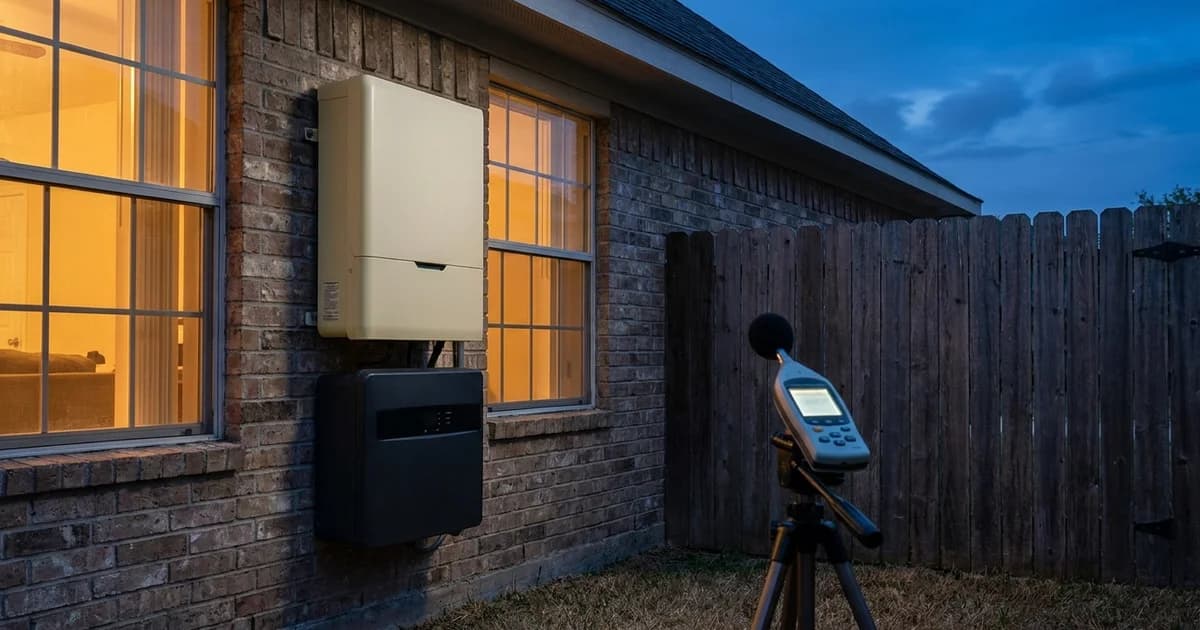
"How loud is a home battery" is a fair question that almost never gets a usable answer. Most of what circulates online is a decibel number with no measurement distance attached, which makes it meaningless. This post does the opposite. It gives you figures traceable to manufacturer datasheets, explains why distance changes everything, and then walks through the part that actually decides whether you can install where you want: the City of Houston noise ordinance and your deed restrictions.
Key Takeaways
- Published home battery datasheets list operating noise as low as under 30 dBA at 1 meter, with passive convection cooling and no fan (Enphase IQ Battery 5P datasheet, 2025).
- A decibel figure without a stated distance is unusable. In a free field, sound pressure drops about 6 dB every time distance doubles (OSHA Technical Manual).
- Houston caps sound received on residential property at 65 dB(A) daytime and 58 dB(A) nighttime, measured at the receiving property line.
What actually makes noise in a home battery system?
Two things make sound in a battery installation: the thermal management that keeps cells and power electronics inside their operating window, and the magnetic components inside the inverter. Some products handle cooling with fans. Others do it passively. The Enphase IQ Battery 10C datasheet, for example, lists "Cooling: Natural convection" alongside an operating noise figure of under 33 dBA at 1 meter (Enphase, 2025).
Here's the honest version most sales pages skip. A battery at rest makes essentially nothing. It becomes audible only when it's working hard, when ambient temperature is high, or both. In Houston, that combination has a name: a July afternoon at full output with the outdoor unit sitting in direct sun.
The inverter contributes a second sound, and it's a different character. Transformers and inductors can produce a faint electrical hum at line frequency and its harmonics. It's low in level but tonal, which means people notice it at levels where broadband fan noise would disappear into background.
Our finding: the complaints installers hear are almost never about loudness. They're about tonality and time of day. A 35 dBA hum outside a bedroom window at 2 a.m. generates more calls than a 50 dBA condenser at noon.
What do the datasheets actually say, and at what distance?
Manufacturer datasheets that publish a noise figure state it at 1 meter. Enphase lists "Operating noise @1 m <30 dBA maximum" for the IQ Battery 5P and "@1 m <33 dBA" for the IQ Battery 10C (Enphase IQ Battery 5P datasheet, 2025). Those are maximum values, not typical ones, and they apply at roughly three feet from the enclosure.
Move away from the unit and the number falls fast. OSHA's Technical Manual states the principle plainly: in a free field, "the sound pressure level decreases 6 dB, on a Z-weighted (i.e., unweighted) scale, each time the distance from the point source is doubled" (OSHA, Technical Manual Section III Chapter 5: Noise).
Run that math on a 33 dBA figure at 1 meter. At 2 meters you're near 27 dB. At 4 meters, near 21 dB. At a property line 8 meters away, the equipment is well below the ambient sound of a suburban Houston street. Real yards aren't free fields, and fences and walls reflect, so treat this as a first approximation rather than a prediction.
The perception side matters too. The decibel scale is logarithmic, so the arithmetic is not intuitive. The National Institute on Deafness and Other Communication Disorders puts it this way: "An increase of 10 dB seems about twice as loud to your ears, but it's actually 10 times more intense, or powerful" (NIDCD). A 10 dB gap between two products is a much bigger deal than a 3 dB gap, even though both look small on paper.
A datasheet number with no distance attached tells you nothing. Neither does a number quoted at 1 meter compared against one quoted at 23 feet. That mismatch is the single most common error in battery versus generator noise comparisons, and it usually flatters whichever product the page is selling.
How does a battery compare with a condenser, a generator, and conversation?
Normal conversation runs 60 to 70 dBA (NIDCD, Noise-Induced Hearing Loss). A battery quoted under 33 dBA at 1 meter sits far below that. For context on the hazard end of the scale, NIOSH flags 85 dBA and above as the level where hearing protection matters (CDC/NIOSH), which no home battery approaches.
Now the two comparisons people actually want, handled honestly.
Air conditioner condensers. Houston's ordinance gives residential AC units their own carve-out: sound from an air conditioning unit is excepted if it does not exceed 65 dB(A) on residential property or 75 dB(A) on nonresidential property, measured from the receiving property line (Houston Code of Ordinances, Chapter 30). That threshold is a legally binding comparator. A manufacturer-neutral dBA figure at a stated distance for a typical residential condenser is not published by a source I could verify, so I'm not quoting one. Condenser sound is usually rated as sound power in bels, which is a different quantity from the sound pressure your neighbor hears.
Standby generators. The widely repeated "generators run 65 to 100 dB" range circulates without a stated distance and without a traceable datasheet behind it. I'm not going to repeat it here. Home standby manufacturers publish sound output at 23 feet under a stated load, and that figure cannot be compared with a battery figure quoted at 1 meter without correcting for distance first. For the fuel, fumes and livability side of that argument, see why Houston homeowners are leaving generators behind and the full battery versus generator comparison for Texas. The cost picture for a Houston standby generator is a separate matter again.
What does the City of Houston noise ordinance actually allow?
Houston Code of Ordinances Chapter 30 sets hard numbers. Under Sec. 30-5, it's unlawful to make a sound beyond your property lines that exceeds 65 dB(A) during daytime hours or 58 dB(A) during nighttime hours for residential property receiving it, and 68 dB(A) at all times for nonresidential property (Chapter 30, Ord. No. 2011-874).
Three details in that sentence do most of the work.
The limit applies to the receiving property, not yours. The measurement is taken at the property where the sound arrives. Your neighbor's lot line is the test point, not your equipment wall.
Nighttime is the binding case. Sec. 30-1 defines daytime hours as 8 a.m. to 10 p.m. and nighttime hours as 10:01 p.m. to 7:59 a.m. The 58 dB(A) night limit is 7 dB tighter than the day limit. Since 10 dB reads as roughly double the loudness, 7 dB is a meaningful step down, not a rounding difference.
Measurement is specified. Sec. 30-6 requires a Type 1 or Type 2 calibrated sound level meter using A-weighting and slow meter response, per ANSI S1.4-1984/85A. A phone app reading is not an enforcement measurement, and neither is a datasheet claim.
Citation capsule: The City of Houston limits sound received on residential property to 65 dB(A) during daytime hours and 58 dB(A) during nighttime hours, measured at the receiving property line with a calibrated Type 1 or Type 2 meter on A-weighting and slow response (Houston Code of Ordinances, Chapter 30, Secs. 30-5 and 30-6, Ord. No. 2011-874).
Put a datasheet figure of under 33 dBA at 1 meter against a 58 dB(A) night limit measured at a property line several meters away and the ordinance is not the obstacle. Deed restrictions usually are.
Where do deed restrictions and Texas Property Code Chapter 202 fit?
This is the part that decides real projects. Texas Property Code Sec. 202.010 says a property owners' association "may not include or enforce a provision ... that prohibits or restricts a property owner from installing a solar energy device," and that any such provision is void (Tex. Prop. Code Sec. 202.010).
The definition is the hinge. Sec. 202.010 borrows "solar energy device" from Texas Tax Code Sec. 171.107, which covers a system designed primarily to produce power by collecting and transferring solar-generated energy, and which includes a mechanical or chemical device able to store solar-generated energy for later use (Tex. Tax Code Sec. 171.107). A battery charged by your own solar array fits that description. A battery installed with no solar at all is a weaker fit, and you should not assume the statute carries you.
Even where the statute applies, an association keeps real ground. It may withhold approval if it determines in writing that the proposed placement "substantially interferes with the use and enjoyment of land by causing unreasonable discomfort or annoyance to persons of ordinary sensibilities." Noise is exactly the argument an association would make there. A measured figure at the shared property line, taken with a proper meter, is the cleanest way to close that argument before it starts.
Bring the datasheet, the placement drawing, and the ordinance thresholds to the architectural review committee together. Our walkthrough of getting battery backup approved by a Texas HOA covers the submission packet in detail.
Where should the unit go?
Placement decides more of the acoustic outcome than the product spec does. Three rules cover most Houston lots: put distance between the enclosure and the nearest neighbor's bedroom window, avoid a narrow side-yard corridor between two masonry walls where reflections build, and keep the unit out of direct afternoon sun so thermal management runs less often.
Indoors versus outdoors is the bigger question, and it turns on heat, code, and access as much as sound. We handle that fully in indoor versus outdoor battery installation in Houston. For system sizes and what each configuration includes, see the plan lineup.
Or call Eos at 833-989-3737 to talk through your setup with an installer.
Frequently Asked Questions
How many decibels is a home battery?
Manufacturer datasheets that publish the figure state it at 1 meter. Enphase lists under 30 dBA for the IQ Battery 5P and under 33 dBA for the IQ Battery 10C, both as maximum values (Enphase, 2025). Any figure quoted without a distance should be treated as unusable.
Does a home battery have a cooling fan?
It depends on the product. Some batteries use fans for thermal management, and some are passively cooled. The Enphase IQ Battery 10C datasheet lists cooling as natural convection (Enphase, 2025). Ask for the datasheet line, not a salesperson's description.
Will a battery violate the Houston noise ordinance?
On the published numbers, no. Houston caps sound received on residential property at 65 dB(A) daytime and 58 dB(A) nighttime at the receiving property line (Chapter 30). A unit rated under 33 dBA at 1 meter falls well below that once distance is accounted for, since level drops about 6 dB per doubling of distance (OSHA).
Can my HOA reject a battery on noise grounds?
It can try. Texas Property Code Sec. 202.010 voids blanket prohibitions on solar energy devices, but an association may still withhold approval in writing where placement causes "unreasonable discomfort or annoyance to persons of ordinary sensibilities" (Tex. Prop. Code Sec. 202.010). A measured reading at the shared property line usually settles it.
Sources
- Houston Code of Ordinances, Chapter 30 (Noise and Sound Level Regulation), Ord. No. 2011-874, Secs. 30-1, 30-5, 30-6 and 30-16, retrieved 2026-09-08, https://nonoise.org/lawlib/cities/ordinances/Houston,%20Texas.pdf
- Enphase Energy, IQ Battery 5P Data Sheet (DSH-00010), retrieved 2026-09-08, https://enphase.com/download/iq-battery-5p-data-sheet
- Enphase Energy, IQ Battery 10C Data Sheet, retrieved 2026-09-08, https://enphase.com/download/iq-battery-10c-data-sheet
- U.S. Department of Labor, OSHA Technical Manual, Section III Chapter 5: Noise, retrieved 2026-09-08, https://www.osha.gov/otm/section-3-health-hazards/chapter-5
- National Institute on Deafness and Other Communication Disorders, How Loud Is Too Loud?, retrieved 2026-09-08, https://www.nidcd.nih.gov/health/how-loud-too-loud
- National Institute on Deafness and Other Communication Disorders, Noise-Induced Hearing Loss, retrieved 2026-09-08, https://www.nidcd.nih.gov/health/noise-induced-hearing-loss
- CDC / NIOSH, Noise and Hearing Loss, retrieved 2026-09-08, https://www.cdc.gov/niosh/noise/about/noise.html
- Texas Property Code Sec. 202.010, Regulation of Solar Energy Devices, retrieved 2026-09-08, https://texas.public.law/statutes/tex._prop._code_section_202.010
- Texas Tax Code Sec. 171.107, definition of "solar energy device" referenced by Prop. Code Sec. 202.010, retrieved 2026-09-08, https://texas.public.law/statutes/tex._tax_code_section_171.107