Standby Generator Cost in Houston: What You'll Actually Pay

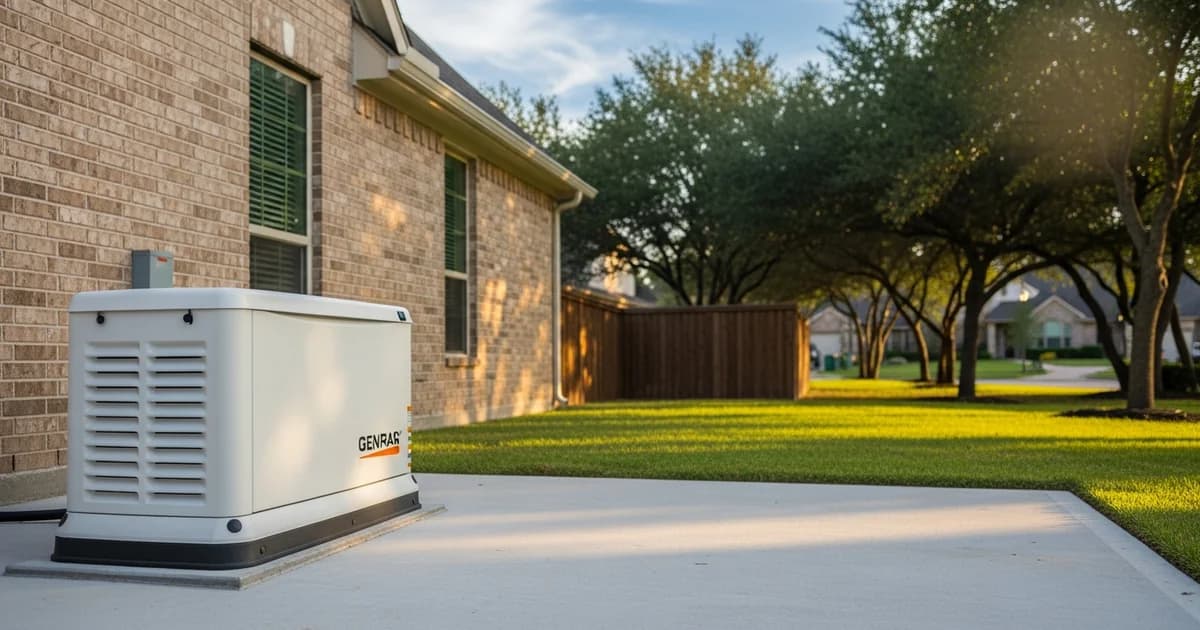
Hurricane Beryl made landfall in July 2024 and left 2.2 million CenterPoint customers without power, the longest restoration effort in the utility's history (Texas Tribune, July 2024). Houston generator installers went from available to booked 6-to-12 months out almost overnight. Homeowners who finally got quotes found the real price was far higher than expected. The unit is just the beginning. Permits, gas line work, a transfer switch, annual maintenance contracts, and fuel costs during actual outages all stack up quickly.
This post breaks down what a standby generator actually costs in Houston, what 10-to-20-year ownership looks like, and why a growing number of Houston homeowners are choosing battery backup instead.
Key Takeaways
- Standby generator installation in Houston costs $7,000-$20,000+ depending on size and gas line work (HomeAdvisor, 2025)
- Running a natural gas generator for a week costs roughly $316 in fuel -- diesel runs $1,155 for the same period (Generator Supercenter, 2024)
- Over 20 years, a propane generator totals ~$91,319 vs. ~$60,961 for battery backup -- a $30,000 difference (EnergySage, 2025)
- Texas leads the U.S. in power outages: 263 events from 2019-2023 (Governing/DOE, 2024)
- Battery backup adoption jumped from under 12% to 28% of new solar installs in a single year (SEIA via ABC17 News, 2025)
How Much Does a Standby Generator Cost in Houston?
Standby generator installation in Houston typically costs $7,000-$15,000 for a mid-size unit (10-20 kW). Whole-home systems capable of running central AC run $15,000-$20,000 or more installed, according to HomeAdvisor (April 2025). Houston's local labor rates, permit fees, and gas line requirements push the high end above $20,000 for larger homes.

Unit Cost by System Size
Generator pricing starts with the unit itself, before any installation work. A 10 kW system runs $7,000-$10,000 installed, which is enough for essential circuits but not central air conditioning. A 20 kW system runs $12,000-$18,000 and handles most Houston homes. A 24+ kW whole-home system costs $18,000-$25,000 or more once all site work is included.
What Houston Adds to the Base Price
Several line items push Houston quotes higher than the national average. Harris County permit fees run $200-$500. If your gas meter doesn't already have adequate capacity near the install pad, a gas line extension adds $500-$2,000. An automatic transfer switch -- required for a true standby setup -- adds $1,500-$3,000 installed. Houston electricians and plumbers command higher hourly rates than the national average, adding further to labor costs.
There's also a placement consideration specific to dense Houston neighborhoods. Houston's noise ordinance limits generator sound levels, which means setback requirements from property lines can limit where a unit gets placed. Tight lots in areas like Bellaire or Meyerland may require longer conduit and gas line runs, which adds cost.
Citation capsule: Standby generator installation in Houston typically costs $7,000-$20,000 depending on system size and site requirements, with larger whole-home systems capable of running central air conditioning reaching $20,000 or more once permits, gas line work, and automatic transfer switch installation are included, according to HomeAdvisor (April 2025).
What Are the Ongoing Costs of a Standby Generator?
Beyond installation, plan for $300-$700/year in scheduled maintenance and $1.88-$6.85/hour in fuel during actual outages, according to EcoFlow (2024) and Generator Supercenter (2024). Ten-year ownership costs range from $5,400 to $18,300 depending on service tier and fuel type, and those numbers assume average outage frequency nationally -- not Houston's.
Annual Maintenance Costs
Every standby generator needs a yearly maintenance visit: tune-up, oil change, coolant check, and load test. Professional service contracts in Houston typically run $300-$700 per year. Skip this and you risk the generator failing to start exactly when you need it. Over 10 years, that's $3,000-$7,000 before you've bought a drop of fuel.
Fuel Cost per Hour of Operation
Fuel costs vary significantly by type. Natural gas runs $1.88/hour for a typical 20 kW unit. Propane costs $2.83/hour. Gasoline runs $2.63/hour for portable-to-standby setups. Diesel is the most expensive at $6.85/hour. Texas natural gas currently runs $16.51 per thousand cubic feet as of January 2026, per the U.S. Energy Information Administration (March 2026). That's the benchmark for all the natural gas calculations here.
What a 7-Day Outage Actually Costs in Fuel
Run the numbers for a Beryl-length outage and the fuel bill becomes concrete. Seven days on natural gas costs approximately $316. Propane runs to $476 for the same period. Gasoline comes in at $441. Diesel is the hardest hit at $1,155 for a single week without power.
The Long-Term Picture
Add a repair reserve of $500-$2,000 over 10 years for parts and unexpected service calls. Then factor in replacement at year 15-20: another $7,000-$15,000 to start the cycle over. The 10-year ongoing cost estimate (excluding that eventual replacement) runs $5,400-$18,300 according to EcoFlow (2024-2025).
Citation capsule: Running a 20 kW natural gas standby generator for seven days costs approximately $316 at current Texas natural gas rates of $16.51 per thousand cubic feet, according to Generator Supercenter (2024) and the U.S. Energy Information Administration (2026). Propane or diesel systems cost $476 to $1,155 for the same seven-day period.
Houston Has More Power Outages Than Any Other U.S. State
Texas recorded 263 power outages between 2019-2023, more than any other U.S. state, according to Governing using U.S. Department of Energy data (March 2024). In 2024 alone, U.S. customers averaged 11 hours of interruptions -- nearly double the prior decade's average -- with 80% caused by major weather events (U.S. EIA, 2025).

Beryl 2024: A Benchmark Event
Hurricane Beryl was a clear demonstration of what extended Houston outages look like in practice. More than 2.2 million CenterPoint customers lost power. Half a million customers were still without electricity a full week later (Texas Tribune, July 2024). The storm's human cost was severe, with at least 22 deaths attributed to the outage, underscoring how critical reliable backup power is for vulnerable Houston households. CenterPoint's restoration timeline became a focal point for state regulators and residents alike.
Why Houston's Outage Rate Changes the Math
The national average outage calculation doesn't apply to Houston homeowners. Texas leads the country in outage frequency, meaning a Houston generator runs significantly more hours per year than one in, say, Denver or Portland. More runtime means more fuel, more oil changes, and more wear on the engine. A generator that makes financial sense for a homeowner in a low-outage region may look very different on a 10-year spreadsheet for a Katy or Pearland household.
So what happens when outage frequency keeps climbing? The U.S. Department of Energy projects that outage hours nationwide could increase 100-fold by 2030 without major infrastructure investment (U.S. DOE via ABC17 News, 2025). For Houston, already at the top of the outage frequency chart, that trajectory makes fuel and maintenance costs more important, not less.
Citation capsule: Texas recorded 263 power outages between 2019 and 2023, more than any other U.S. state, according to Governing analysis of U.S. Department of Energy data (March 2024). Hurricane Beryl alone left 2.2 million CenterPoint customers without power in July 2024 -- the largest outage in the utility's history -- with 500,000 still without power a full week later.
Standby Generator vs. Battery Backup: The Full Cost Comparison
Over 20 years, a propane standby generator costs approximately $91,319 total, versus roughly $60,961 for a comparable battery backup system -- a $30,358 difference -- according to EnergySage (2025). Upfront, the two options are surprisingly close: generators run $7,000-$20,000 installed, while a home battery system runs $9,000-$18,000 installed.
Side-by-Side Comparison
| Factor | Standby Generator | Home Battery Backup |
|---|---|---|
| Equipment + installation | $7,000-$20,000 | $9,000-$18,000 |
| Fuel cost (per week of outage) | $316-$1,155 | $0 |
| Annual maintenance | $300-$700 | Minimal |
| 10-year ongoing cost estimate | $5,400-$18,300 | Near zero |
| Noise level | 65-70 dB | Silent |
| HOA/setback restrictions | Often applicable | Rarely applicable |
| Grid interaction | Cannot charge from grid | Charges from grid off-peak |
The Zero-Fuel Advantage
Battery backup costs nothing to run during an outage. Zero fuel. No phone calls to confirm propane delivery. No worrying whether the natural gas line stays pressurized if a broader disaster disrupts supply. The cost of a battery backup system during a week-long outage is exactly the same as during a one-hour outage: nothing.
The non-obvious angle is that generators impose an "outage tax." Fuel and maintenance costs spike exactly when Houston homeowners are already absorbing storm damage repair bills, tree removal costs, and insurance deductibles. Battery backup has zero marginal cost during an outage, regardless of how long it runs. That asymmetry matters most in Houston, where outages cluster around major storms that hit household budgets from multiple directions simultaneously.
About the 20-Year Comparison
The EnergySage 20-year model for battery backup includes a solar system paired with the battery. Eos installs battery-only systems, which carry a lower upfront cost ($9,000-$18,000). The zero-fuel advantage still applies fully to a battery-only setup: every hour of an outage costs nothing in fuel, whether or not solar is involved. Battery-only systems do rely on the grid for recharging between outages, while a solar-paired system recharges independently.
Citation capsule: Over 20 years, a propane standby generator costs approximately $91,319 in total, compared to roughly $60,961 for a battery backup system with solar, a difference of $30,358, according to EnergySage (2025). The gap is driven primarily by fuel and electricity costs: battery systems have zero fuel cost, while a generator running on propane costs $476 per week during an outage.
Why Houston Homeowners Are Choosing Battery Backup Instead
Battery backup adoption alongside new solar installations jumped from less than 12% in 2023 to 28% in 2024 -- a near-tripling in a single year -- according to the Solar Energy Industries Association (SEIA, cited by ABC17 News, October 2025). Post-Beryl, demand for silent, fuel-free backup power accelerated sharply in Houston.

What Houston Homeowners Actually Say
The reasons Houston homeowners cite for switching aren't complicated. No fuel to store or source after a storm. Silent operation -- no 65-70 dB hum running at 2am when the neighborhood is trying to sleep. No exhaust fumes. And critically, no HOA variance required. Battery systems work for townhomes, zero-lot-line properties, and neighborhoods where a generator would violate deed restrictions or setback rules.
Houston homeowners who lived through Beryl described the practical difficulty of sourcing natural gas or propane during extended outages, particularly when supply disruptions and delivery delays hit some areas hard. A battery system sidesteps that entirely. There's nothing to source, nothing to schedule, and nothing to run out of. You charge before the storm and draw down during it.
The Beryl Effect on Lead Times
After Beryl, generator installers in Houston were quoting 6-to-12-month backlogs. Battery system installations, while also in higher demand, generally had shorter lead times. Homeowners who decided after Beryl often had to wait nearly a year for a generator appointment. Some chose battery backup simply because it was available sooner.
The DOE's projection that outage hours could increase 100-fold by 2030 without major infrastructure investment (U.S. DOE via ABC17 News, 2025) suggests this isn't a one-time post-storm surge in demand. The underlying problem -- an aging grid facing more intense weather -- isn't going away.
Citation capsule: Battery backup adoption alongside new residential solar installations rose from less than 12% in 2023 to 28% in 2024, according to the Solar Energy Industries Association (SEIA), cited by ABC17 News in October 2025. That near-tripling in a single year reflects the growing recognition that battery systems offer fuel-free, silent backup power without the logistics of storing and sourcing propane or natural gas.
Is a Standby Generator Worth It in Houston in 2025?
For most Houston homeowners, a standby generator is worth it compared to having nothing at all. But when compared honestly to battery backup, the 20-year cost difference of roughly $30,000 and the zero-fuel, zero-noise advantage make a generator a harder case to justify for typical suburban homes.
When a Generator Still Makes Sense
Generators remain the better fit in specific situations. Very large homes over 4,000 square feet with 400-amp service may need more kWh capacity than current battery systems can cost-effectively deliver. Heavy 3-phase loads, rural properties far from utility infrastructure, and commercial buildings needing 24/7 uptime are all cases where a generator's continuous runtime advantage justifies the ongoing costs.
When Battery Backup Wins
For most Houston suburbs, battery backup is the stronger option. The Woodlands, Katy, Sugar Land, Pearland, League City -- these are neighborhoods with HOA rules, tight lots, and homeowners who don't want a generator running at 2am. Battery backup is also a natural fit for EV owners who already think of electricity as their primary energy source, for homeowners with existing solar, and for anyone who simply doesn't want to manage fuel logistics during a storm.
What about running both? Some homeowners do install a generator and a battery system together. It's viable for medical equipment or life-safety loads that require continuous power across an extended multi-week scenario. For most Houston households, though, it's a level of redundancy that rarely justifies the combined cost.
The non-obvious angle: generators impose an "outage tax." Fuel and maintenance costs spike exactly when Houston homeowners are already absorbing storm damage, tree removal, and deductibles. Battery backup has zero marginal cost during an outage, no matter how long it runs. That asymmetry matters most in Houston, where outages cluster around major storms that hit household finances from multiple directions at once.
How to Get an Accurate Quote in Houston (Without Overpaying)
Generator installation quotes in Houston vary by $5,000-$8,000 for the same job depending on the installer. Getting three competitive quotes is standard practice for any major home installation, and that advice applies equally to battery backup systems. The gap between the highest and lowest quote for identical work is often large enough to fund a year's worth of maintenance contracts.
Questions to Ask a Generator Installer
Before signing anything, get clear answers on the following. What kW size is right for your specific load list -- and how did they calculate that? Is the gas line work included in the quoted price, or is it a separate line item? Who pulls the permit? Is it an automatic transfer switch or a manual one? What does the annual maintenance contract cost, and what does it cover?
Questions to Ask a Battery Backup Installer
For battery quotes, the key questions are different. What kWh capacity does the system provide, and what loads does it cover? Is the system wired for whole-home backup or backed-up circuits only? Is the installation done by the company's own crew or a subcontractor? What's the warranty on both the battery and the installation labor?
Why Permits Matter in Texas
Don't skip this one. Unpermitted generator or battery installations can complicate home sales under Texas TREC disclosure requirements. If an inspector flags an unpermitted electrical installation, you'll be negotiating repairs during a transaction. Always confirm the installer pulls the permit, and confirm the final inspection closes before you make the last payment.
Frequently Asked Questions
How much does it cost to install a standby generator in Houston?
Standby generator installation in Houston typically costs $7,000-$20,000 depending on system size, with mid-size 10-20 kW units in the $7,000-$15,000 range and whole-home systems exceeding $20,000 once permits ($200-$500), gas line work ($500-$2,000), and automatic transfer switch installation ($1,500-$3,000) are included (HomeAdvisor, 2025).
How long can a standby generator run during a Houston power outage?
A natural gas standby generator can run continuously as long as gas supply holds -- potentially weeks. Propane units are limited by tank size, typically 1-7 days on a standard 250-500 gallon tank. Fuel costs accumulate the entire time: $316 for a week on natural gas, $476 on propane, per Generator Supercenter (2024).
What is the difference between a standby generator and a battery backup?
A standby generator burns fuel (natural gas, propane, or diesel) to produce electricity continuously during an outage. A battery backup stores electricity in advance and discharges silently with no fuel. Generators offer unlimited runtime tied to fuel supply; batteries offer limited stored capacity but zero ongoing fuel cost and no noise or exhaust.
Does a standby generator add value to a home in Texas?
Backup power systems generally add perceived value for buyers in Texas, given the state's outage frequency. Generators do add a tangible selling point, particularly in Houston. However, unpermitted installations can trigger disclosure requirements and complicate sales under Texas TREC rules, offsetting any value gain. A permitted, maintained system is the only kind that adds value cleanly.
Are home battery backups reliable enough to replace a generator in Houston?
For most outages, yes. A properly sized battery system handles a typical 12-48 hour Houston outage well. For Beryl-length events lasting 7-10 days, a battery-only system has limited runtime without recharging from the grid. Pairing a battery with solar improves that significantly. For multi-week worst-case scenarios, a battery-plus-solar system or a hybrid battery-and-generator setup offers the strongest coverage.
The Bottom Line: Houston Generator Math vs Battery Math
Standby generators are not a bad product. They're a proven one. But the full picture -- $7,000-$20,000 to install, $300-$700/year in maintenance, $316-$1,155 per week in fuel during outages, and a replacement bill in year 15-20 -- is a different number than the unit price on an installer's website.
Here's what this comparison actually shows:
- Standby generator installation in Houston: $7,000-$20,000+
- Annual ongoing costs: $1,000-$1,800/year in fuel and maintenance
- 20-year total: ~$91,319 for a propane generator vs. ~$60,961 for battery backup with solar
- Houston leads the U.S. in power outages -- making fuel and maintenance costs a bigger long-term factor here than almost anywhere else in the country
- Battery backup adoption jumped from 12% to 28% of new solar installations in a single year nationally
If you're comparing generator quotes in Houston, run the battery backup numbers at the same time. It takes about 15 minutes and could change the math significantly.