After the Storm: Inspecting and Restarting a Home Battery Safely

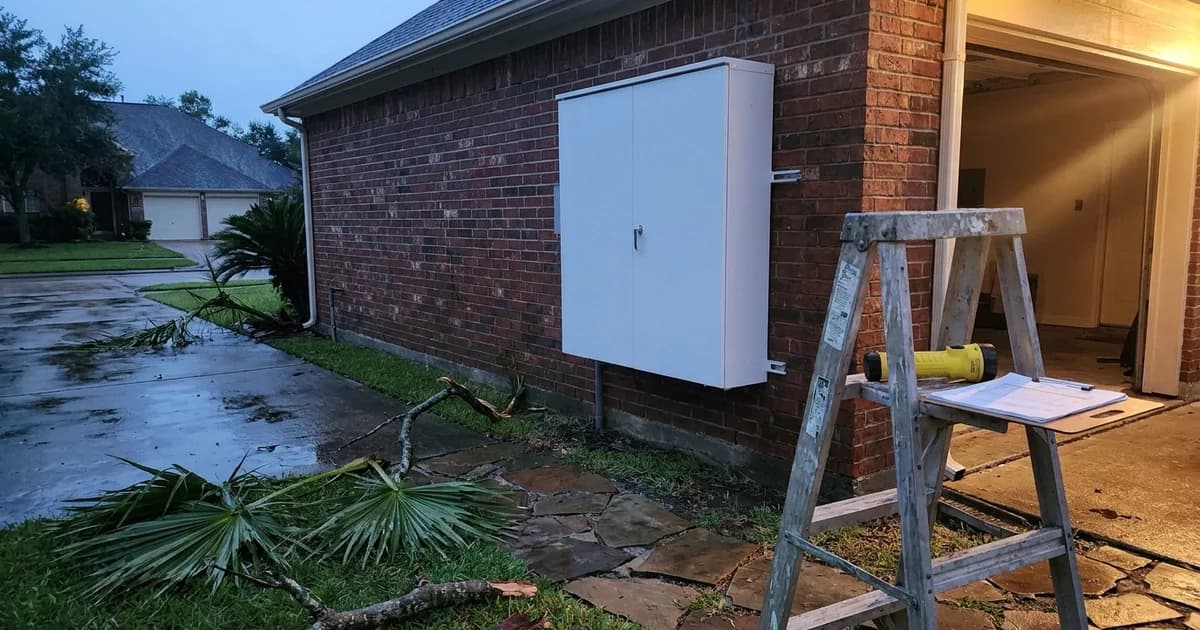
The first 48 hours after a Gulf storm are when people make the worst electrical decisions of the season. The street is wet, the power flickers back, and the instinct is to flip everything on and see what survived. With a home battery on the wall, that instinct needs a short checklist behind it.
This post is a decision tree, not an installation manual. It tells you which situation you are in, what the public safety agencies say to do, and where your installer takes over. Your manufacturer's manual always outranks anything written here.
Key Takeaways
- FEMA says wiring or equipment that was submerged needs a licensed electrician's inspection before it returns to service (FEMA, Guidance for Turning the Power Back On).
- Dry and undamaged is the only branch where a restart per the manual is reasonable.
- Smell, heat, swelling, popping or hissing means stop, move away and call 911 (NFPA).
- Photograph everything before you touch it.
What Should You Check First After a Hurricane?
Before you look at the battery, look at the house. Ready.gov tells returning residents not to touch electrical equipment that is wet or while standing in water, and to turn off electricity at the main breaker only if it is safe to do so (Ready.gov, Hurricanes). The same page warns that downed or underground lines can electrically charge floodwater.
So the first check is about you, not the battery. Is the ground around the equipment wet? Is there standing water in the garage? If the answer to either is yes, stop there. Do not wade in to reach a panel or a disconnect.
The CDC gives the same instruction in plain terms: if you would have to stand in water to reach the main power switch, call an electrician to turn it off (CDC, Natural Disasters Safety). That rule applies to your battery disconnect too. A switch you cannot reach dry is a switch you do not touch.
Once the area is dry and you can see clearly, work through the tree below. Use a flashlight rather than a candle. FEMA says no open flames indoors during inspection.
The Decision Tree: Which Situation Are You In?
There are four branches. Pick the one that matches what you see, and take the most cautious branch if two apply. This is the part people skip, and it is the part that matters.
Branch 1: Dry and undamaged
Walk the area and look at the enclosure, the cabinet door, the conduit, the wall mount and the disconnect. Everything should be dry, intact, and exactly where it was. No dents, no cracked housings, no stained or wet insulation, no debris against the unit.
If that describes what you see, the manufacturer's manual governs the restart. Follow its sequence, and do not improvise one from a forum post. We are not going to print a generic restart procedure here, because the correct order differs by product and by how your system was configured at install. If the manual is not at hand, your installer can send the right page.
One more point: grid restoration is its own event. We cover what happens on your service when power returns in the restoration surge post. Ready.gov's advice there is simple. Disconnect appliances and electronics, because power can return with momentary surges or spikes (Ready.gov, Power Outages).
Branch 2: Wind or debris damage, no water
A tree limb through the garage wall, a dented cabinet, a conduit pulled off the wall, a cracked disconnect. Do not restart.
Nothing in the public guidance gives homeowners a method to judge structural damage to a battery or its wiring. FEMA's position is that a licensed electrician inspects and repairs equipment, and that the work is approved by the local building inspector, before it is energized again (FEMA). Leave the system off, photograph the damage, and call your installer.
Branch 3: Any water contact with the enclosure or wiring
Water on the cabinet, a high water line on the wall, wet conduit, a flooded garage floor that reached the unit. Do not energize it. Do not "let it dry out and try it."
FEMA says that if wiring, receptacles or equipment were submerged, a licensed electrician must inspect them before they return to service. It adds that in most cases wiring that touched salt water will need to be removed and replaced (FEMA). Along the coast, that line is not academic.
The Electrical Safety Foundation International makes the same point from another angle: keep power off until an electrician has inspected your system (ESFI, Flood Electrical Safety).
For lithium batteries specifically, the U.S. Fire Administration says to notify your local fire department if you believe lithium-ion batteries were exposed to flooding in your home or garage, and to disconnect them from chargers (USFA, Lithium-Ion Battery Safety After Flooding). A wall-mounted system cannot be moved like an e-bike, so the practical step is to call your installer and the fire department, and let them direct what happens next. Where water can reach a battery in the first place is covered in the flood elevation post.
Branch 4: Smell, heat, swelling, popping or hissing
This one is not a call to your installer first. It is an evacuation.
NFPA lists the warning signs of a failing lithium-ion battery as odor, change in color, too much heat, change in shape, leaking or odd noises. Its instruction is to stop using the battery and, if it is safe to do so, move away from anything that can catch fire and call 9-1-1 (NFPA, Lithium-Ion Battery Safety). USFA adds that if batteries emit a cloud of smoke or gases, or make a popping or hissing sound, you should move to a safe distance and notify the fire department (USFA).
Get everyone out. Do not open the cabinet, do not spray it with a hose, and do not go back for anything. Call 911 from outside, then your installer. How these systems are tested and where they may be mounted is covered in the fire safety and UL 9540A post.
What Doesn't a Public Source Tell You to Do?
Here is what we are deliberately leaving out. No federal or standards-body guidance we could find gives homeowners a reliable at-home test for whether a flooded or storm-hit residential battery is safe. There is no published "wait 24 hours and it's fine" rule, and we won't invent one.
That is why the tree defers so often. The honest version of this advice is short: dry and undamaged, follow the manual. Anything else, a qualified person looks first.
The same goes for numbers. We are not quoting any share of post-storm battery failures or any restart success rate, because we could not find a public figure we trust. If someone offers you one, ask for the source.
Installation standards matter here too. NFPA 855 is the standard for installing stationary energy storage systems, and it is the reason your installer should be able to explain where and how the system was mounted (NFPA 855). If you are unsure how yours was installed, ask.
How Do You Document Storm Damage Without Making It Worse?
Keep this part short and practical. Ready.gov advises documenting property damage with photographs and contacting your insurance company for assistance (Ready.gov, Hurricanes).
For a battery, that means photos of the enclosure, the wall around it, any water line, and the disconnect, taken before anyone moves or opens anything. Add the serial label if it is legible without touching the unit. Write down the time the power went out and the time it came back.
Photograph first, then call. Our insurance claims documentation guide walks through what Houston homeowners should gather, and what a standard claim does and does not cover.
When Should You Call the Installer?
Call in three cases: any damage, any water contact, or any doubt. If you cannot tell which branch you are in, you are in the cautious one.
Have this ready when you call: your address, the system model if you know it, which branch you think you are in, and your photos. That lets the installer decide whether to schedule an inspection, walk you through a restart, or tell you to keep it off.
One last habit. Do not connect a generator to your home's wiring to "help" the battery restart. FEMA says generators used to power a house should not be connected until all compromised wiring has been disconnected or replaced, and the CDC warns against connecting generators without approved automatic-interrupt devices (FEMA, CDC).
Or call Eos at 833-989-3737 to talk through your setup with an installer.
If you want to be ready before the next storm instead of after it, the Storm Mode preparation guide covers what to do before landfall, and our plans overview shows how systems are built.
Frequently Asked Questions
Can I restart my home battery right after the power comes back?
Only if it is dry and undamaged, and only by following your manufacturer's manual. If the enclosure or wiring touched water, FEMA says a licensed electrician must inspect it before it returns to service (FEMA).
What if only the garage floor flooded, not the battery?
Treat it cautiously. If water reached the unit, its wiring or its disconnect, you are in the water-contact branch, and the system stays off until an electrician and your installer have looked at it. If water stayed clearly below everything, call your installer and describe it.
What are the warning signs of a damaged lithium battery?
NFPA lists odor, change in color, too much heat, change in shape, leaking and odd noises. If you see or hear any of them, stop using the battery, get to safety and call 9-1-1 (NFPA).
Should I call the fire department about a flooded battery?
USFA says to notify your local fire department if you believe lithium-ion batteries were exposed to flooding in your home or garage (USFA). Call your installer as well, so the system is not touched until both have weighed in.
Does my homeowners policy cover storm damage to a battery?
That depends on your policy and the cause of the loss, and we can't answer it for you. Document first, then call your insurer, and see our claims documentation guide for what to gather.