What a Home Battery Backup Will Not Power (And Why That Is Fine)

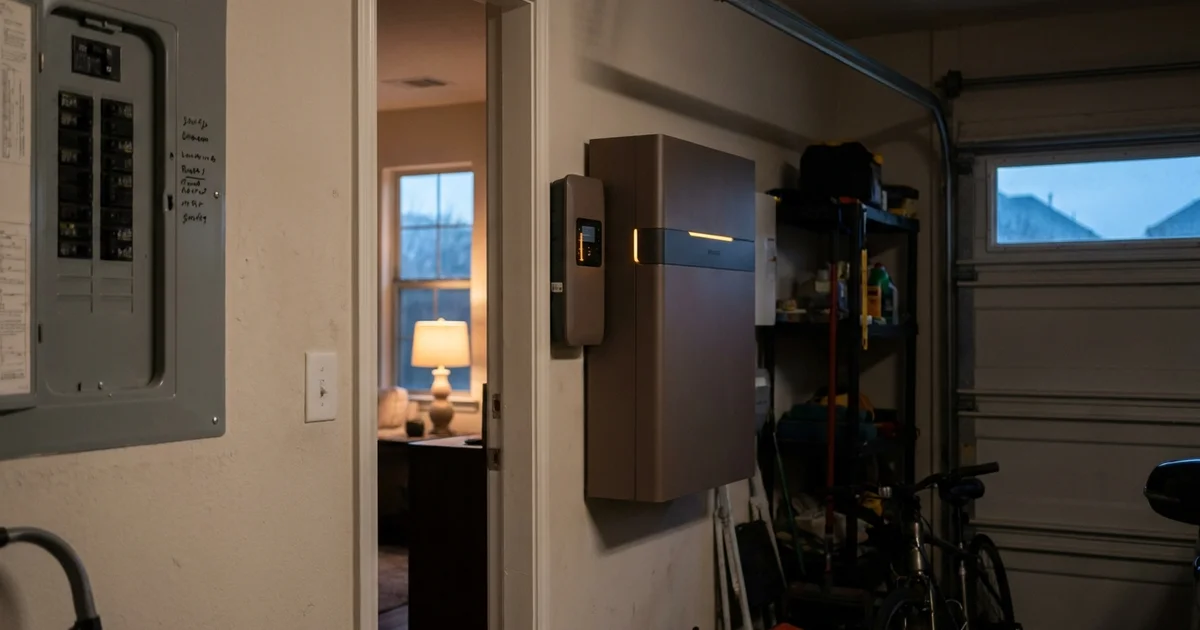
Most complaints after a battery install are not about hardware. The system did what it was configured to do, and the owner expected something else. Sales pages describe what a battery can do. Very few describe what it will not do, so expectations get set by marketing and corrected by the first outage.
Here is the honest list: six loads that usually do not make the plan, and the one distinction that explains them all.
Key Takeaways
- A home battery does not fail to power your whole house. It is designed not to. A partial plan buys far more outage hours.
- Kilowatt-hours buy hours. Kilowatts decide what runs at the same instant. Confusing the two causes most disappointment.
- An Eos controller gives 11.5 kW continuous and 17.1 kW surge. That ceiling does not move when you add modules.
- Off the list: pool heating, a second AC zone, the range at full draw, EV charging at full rate, workshop gear, long water-heater recovery.
- Level 2 EV charging runs 2.9 to 19.2 kW (U.S. Department of Energy Alternative Fuels Data Center), so it is cut first.
What will a home battery not power during an outage?
Six loads, in almost every Houston install: pool heating and full pool circulation, a second air conditioning zone, an electric range with several elements and the oven going, electric vehicle charging at full rate, workshop and welding equipment, and an electric water heater on a long recovery cycle. Each one is a large continuous draw, a long heating load, or both.
They are not excluded for being luxuries. They are excluded for being physically large. A backup plan is a budget of kilowatts, and these six spend most of it.
"Will not" is not "cannot." Several can run on battery power, briefly, if you pick them over something else. What the system will not do is carry them alongside everything else for a real outage.
The chart below is circuit arithmetic, not measured draw. Where an appliance nameplate is missing, wattage is amperage times voltage, and large appliance circuits in U.S. homes run at 240 volts. A circuit's continuous capacity is its breaker rating times 240 times 0.8, because the National Electrical Code sizes overcurrent protection at 125% of a continuous load, which caps a standard breaker at 80% (NFPA, NFPA 70, National Electrical Code, Section 210.20(A)). A 50 amp range circuit is 9.6 kW. A 60 amp charging circuit is 11.5 kW, the whole output of one controller.
What is the difference between kilowatt-hours and kilowatts in backup?
Kilowatt-hours measure stored energy, which sets how many hours you get. Kilowatts measure how fast energy can leave the system, which sets how much runs at the same instant. Most buyers shop only the first number.
The Eos hardware shows the split. Each battery module holds 9 kWh nominal and 8.76 kWh usable. Each smart controller delivers 11.5 kW continuous and 17.1 kW surge. Continuous output is a property of the controller, not of the stack behind it.
So stacking modules buys a longer outage, not a bigger one. A fifth module adds 8.76 kWh of runtime and zero extra kilowatts.
Nearly every disappointed owner compared capacity across quotes, took the biggest number, and never asked about the ceiling. See
and .Why is partial backup usually the right answer, not a compromise?
Partial backup produces the most outage hours from a given stack, so it is the engineering answer, not the budget answer. Back up every circuit and every circuit competes for the same stored energy. The fastest route to being dark on day three is full comfort on day one.
Houston sets the target. In July 2024, Hurricane Beryl knocked out power to roughly 2.2 million CenterPoint customers at peak, and more than 1 million were still out days later (Houston Public Media, Houston power outages after Hurricane Beryl). Heat indices ran 100 to 106 F through the restoration (NWS Houston/Galveston, Post Tropical Cyclone Report: Beryl). The goal there is not eight comfortable hours. It is several livable days, and those two goals build different circuit lists.
Check the arithmetic. Three modules give 26.28 kWh usable at 8.76 kWh each. Divide by average draw.
| Backup scope | Assumed average draw | Hours from 26.28 kWh |
|---|---|---|
| Critical core only | 1.5 kWh per hour | about 17 hours |
| Critical core plus one cycled AC zone | 2.7 kWh per hour | about 9 hours |
| Whole house, lived in normally | 4.5 kWh per hour | about 5 hours |
Those are planning assumptions, not measurements. The ratio is the point: the same hardware covers three times as long when the list is disciplined. See
.Code allows for it. Section 702.4(A)(2) of the 2023 National Electrical Code lets an optional standby system either supply the full automatically connected load or use an energy management system that keeps the connected load within the capacity of the source (North Carolina Office of State Fire Marshal, Optional Standby Systems, Stand-Alone Systems, and Energy Storage Systems).
What happens if you exceed the continuous output?
Nothing dramatic, and nothing damaging. The system protects itself. It sheds load or trips the affected circuits, you turn something off, and you reset. That is designed behavior, not a failure.
Two tiers govern it. Brief spikes are covered by the 17.1 kW surge rating, which exists so motors can start. Sustained draw above 11.5 kW is not.
Motor starting explains the rest. NEMA Design B induction motors, common in residential compressors and pumps, draw locked-rotor current several times running current for a fraction of a second at start (NEMA, ANSI/NEMA MG 1, Part 12).
Our finding from the field: the trip people report is almost never a drained battery. It's two large loads starting inside the same second. A smart panel handles it before you notice. See
.
Which loads realistically do not make the critical list?
Six, item by item, reason first.
Pool heating and full circulation. In 2018, an Energy Information Administration analysis of household end uses found that among homes with a pool pump, the pump alone consumes 8% of the electricity used each year, against 1% across all U.S. homes (U.S. Energy Information Administration, Residential energy survey estimates for 20 new end uses). Reduced circulation can be worth keeping for water quality. Heating is not.
A second air conditioning zone. In 2020, air conditioning accounted for about 19% of the electricity used in U.S. homes, and the South census region led the country at 93% of households using it (U.S. Energy Information Administration, How much electricity is used for air conditioning?; Nearly 90% of U.S. households used air conditioning in 2020). One zone, sized to a room the family can occupy, is the Houston answer.
Electric range at full draw. A 50 amp, 240 volt range circuit is 9.6 kW. One element or a countertop appliance is fine. Every element plus the oven is most of a controller.
EV charging at full rate. As of 2026, U.S. Department of Energy figures put residential Level 2 equipment at 2.9 to 19.2 kW, with most home units operating at up to 30 amps and delivering 7.2 kW (U.S. Department of Energy Alternative Fuels Data Center, Electric Vehicle Charging Stations). A reduced rate on a scheduled window is the workable version.
Workshop and welding equipment. High instantaneous draw on a duty cycle, no continuity benefit. Not a backup load in any configuration.
Electric water heater on long recovery. Water heating is a year-round load, not a seasonal one. In 2020, water heating, lighting, and refrigeration together accounted for 25% of total annual home energy use in the United States (U.S. Energy Information Administration, Use of energy explained: Energy use in homes). A 30 amp element on recovery is 5.8 kW of continuous draw. Short recovery windows work. Continuous availability does not.
How do you convert a wish list into a load list?
Write down every load you want, put a wattage next to each, and total the ones that would run at the same moment. If that total nears 11.5 kW, you are holding a wish list. Four steps do the conversion.
- Inventory. Every load you would miss, including the ones you would only miss at 2 a.m.
- Attach wattages. Read nameplates first. Where one is missing, use amperage times voltage.
- Mark continuous or intermittent. A refrigerator cycles. A water heater on recovery does not.
- Rank by livability, not comfort. What survives: refrigeration, one AC zone, internet and a few outlets, medical equipment, water where a well or sump is involved.
A site survey redoes this with measured panel data, and the planner collects the same inputs first.
Why is an oversized wish list the main cause of post-install disappointment?
Because expectations get set before the load calculation and never revised after it. The hardware performs to spec. The mental model does not, and nobody notices until the grid drops.
The pattern shows up in nearly every site survey. A homeowner reads their wish list back with a wattage beside each line, reaches the third item, and starts removing things unprompted. That conversation costs twenty minutes. Skipping it costs a callback.
Every load added to a plan is subtracted from runtime. An installer who agrees to back up everything is selling the outcome you will complain about later.
Or call Eos at 833-989-3737 to talk through your setup with an installer.
Frequently asked questions
Can a home battery power my whole house?
For short periods, yes, as long as simultaneous draw stays under 11.5 kW continuous per controller. It's rarely what an installer recommends in Houston, because it shortens runtime sharply. In a multi-day event, hours beat comfort.
What happens if I turn on too much at once?
The system sheds load or trips the affected circuits. Nothing is damaged. You turn something off and reset. Brief spikes are absorbed by the 17.1 kW surge rating, which exists for motor starting. Sustained draw above 11.5 kW triggers it.
Can I charge my EV during an outage?
At a reduced rate on a scheduled window, sometimes. At full Level 2 rate, no. Residential Level 2 equipment runs 2.9 to 19.2 kW per the U.S. Department of Energy Alternative Fuels Data Center, and most home units draw 7.2 kW.
Does adding more batteries let me run more at once?
No. More modules add hours, at 8.76 kWh usable each. Continuous output is set by the controller at 11.5 kW and does not change with stack size. If a load will not start today, a larger battery will not start it tomorrow.
The bottom line
Kilowatt-hours buy hours, kilowatts buy simultaneity, and confusing them is the root of nearly every complaint. Six loads reliably come off the list. Load shed is designed behavior, not a fault. Partial backup is the output of the runtime math, not a compromise.
A system that says no to three things and runs three days beats one that says yes to everything and quits before dinner.
Sources
- U.S. Department of Energy Alternative Fuels Data Center, Electric Vehicle Charging Stations, retrieved 2026-08-19, https://afdc.energy.gov/fuels/electricity-stations
- U.S. Energy Information Administration, How much electricity is used for air conditioning?, retrieved 2026-08-19, https://www.eia.gov/tools/faqs/faq.php?id=1174
- U.S. Energy Information Administration, Nearly 90% of U.S. households used air conditioning in 2020, retrieved 2026-08-19, https://www.eia.gov/todayinenergy/detail.php?id=52558
- U.S. Energy Information Administration, Residential energy survey estimates for 20 new end uses, retrieved 2026-08-19, https://www.eia.gov/todayinenergy/detail.php?id=36412
- U.S. Energy Information Administration, Use of energy explained: Energy use in homes, retrieved 2026-08-19, https://www.eia.gov/energyexplained/use-of-energy/homes.php
- NFPA, NFPA 70, National Electrical Code, Section 210.20(A), retrieved 2026-08-19, https://www.nfpa.org/codes-and-standards/nfpa-70-standard-development/70
- NEMA, ANSI/NEMA MG 1, Part 12, retrieved 2026-08-19, https://www.nema.org/docs/default-source/standards-document-library/mg-1-part-12-watermark.pdf
- North Carolina Office of State Fire Marshal, Optional Standby Systems, Stand-Alone Systems, and Energy Storage Systems (2023 Electrical Code interpretation, Section 702.4(A)(2)), retrieved 2026-08-19, https://www.ncosfm.gov/electrical/articles-702-705-706-710-optional-standby-systems-stand-alone-systems-energy-storage-systems/open
- Houston Public Media, Houston power outages after Hurricane Beryl, retrieved 2026-08-19, https://www.houstonpublicmedia.org/articles/news/hurricane/2024/07/08/492833/houston-power-outages-hurricane-beryl-centerpoint/
- NWS Houston/Galveston, Post Tropical Cyclone Report: Beryl, retrieved 2026-08-19, https://www.weather.gov/media/hgx/TropicalEventSummary/PSHHGX_2024AL02_Beryl_Summary.pdf
Lin Zeri leads marketing at Eos Backup and Battery, which installs home battery backup systems across the Houston metro. Equipment ratings reflect Eos residential specifications as of August 2026. Circuit and runtime figures here are planning estimates; your numbers come from a site survey at the panel.