Westchase and the Energy Corridor Battery Backup: Mostly Renters, Mostly Apartments, So Who Decides?

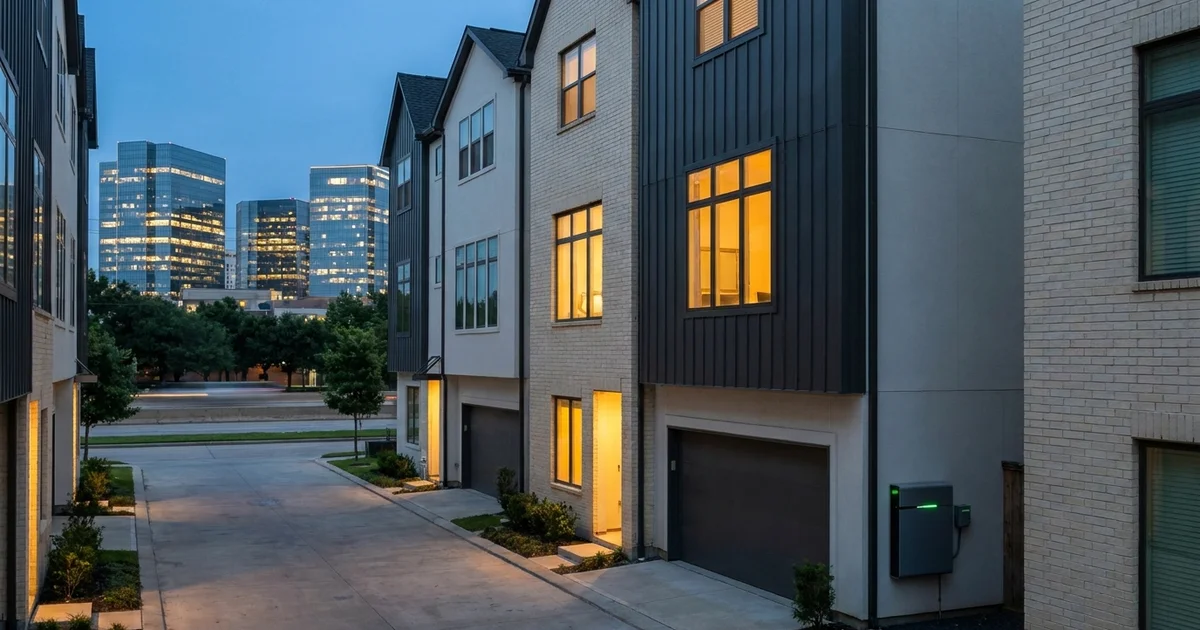
When people picture battery backup in Houston, they picture a detached house with a garage and a homeowner who owns the wall. West Houston around Westchase and the Energy Corridor does not fit that picture well. The census numbers show a part of town where the person living in the home often cannot decide to install a battery at all.
I wrote this guide around that fact. I started with a different assumption, that this area is mostly townhomes, and the data did not support it. So this post covers who decides, what each kind of resident can actually do, and which claims I could not verify.
Key Takeaways
- In ZIP 77042, about 74 percent of occupied homes are rented. In ZIP 77077 it is about 63 percent (U.S. Census Bureau, ACS 2020-2024 5-year, via Census Reporter).
- Detached single-family homes are about 18 percent of housing units in 77042 and about 33 percent in 77077. Buildings with 5 or more units are about 67 percent and 55 percent.
- A hardwired battery needs the person who controls the wall and the panel. For a renter, that is the landlord.
- I could not verify office-park load, utility territory for specific streets, or flood status for Westchase, so I left them out.
What does west Houston housing actually look like?
I used the two ZIP codes that sit over this part of the city, 77042 and 77077, as a proxy. ZIP codes do not follow neighborhood lines, so treat the numbers as the area, not your block. The figures come from the Census Bureau's 2020-2024 American Community Survey, pulled through the Census Reporter API (Census Reporter, tables B25003 and B25024).
| ZIP 77042 | ZIP 77077 | |
|---|---|---|
| Housing units | 21,410 | 33,004 |
| Renter-occupied | 13,351 of 18,122 (74%) | 17,412 of 27,830 (63%) |
| Detached single-family | 3,806 (18%) | 10,734 (33%) |
| Attached single-family (includes townhomes) | 795 (4%) | 1,344 (4%) |
| 2 to 4 units | 2,254 (11%) | 2,776 (8%) |
| 5 to 9 units | 2,402 (11%) | 2,808 (9%) |
| 10 or more units | 12,016 (56%) | 15,278 (46%) |
Percentages are my own arithmetic from the Census counts, rounded.
The headline is the apartment share. In 77042, 5,484 units sit in buildings of 50 or more units alone. The townhome premise I started with is thin: attached single-family homes are about 4 percent of units in both ZIPs. Townhomes exist here, but they are not what defines the area.
Who decides whether a battery goes in?
That depends on which row of the table you live in, and it changes the whole conversation.
A detached house owner controls the wall, the panel and the budget. This is the simplest case, and it is roughly one home in six in 77042 and one in three in 77077. Sizing and placement are the only questions. Our 1,500 sq ft sizing guide is a good starting point.
A townhome owner has a smaller envelope and tighter placement rules, plus an association. Our townhome and patio home guide covers the side-yard clearance problem, why the party wall is off limits, and when the honest answer is no.
A condo owner owns the airspace but usually not the exterior wall or the electrical risers. That means an association conversation first. See how to get a yes from a Texas HOA.
A renter cannot hardwire anything. Permanent wiring, a wall mount and a permit all need the property owner. That is the majority of households in these ZIP codes, and it is the plain reason a lot of residents here will never be Eos customers directly.
A property manager or owner has the authority, but an apartment community is a different product from a house. Our multi-family guide explains common-area systems, fire code review and cost splitting.
What can a residential system carry, and where does it stop?
Eos residential plans are sized for a single home. Per our plan specs, the Essential plan has one battery module with 8.76 kWh of usable capacity and delivers up to 6 hours of backup at minimal load. The Plus plan has two modules and 17.52 kWh usable, up to 12 hours at minimal load. Every residential plan uses one controller rated for 11.5 kW continuous and 17.1 kW surge (Essential plan, all plans).
For a one- or two-bedroom unit or a townhome, that is usually enough for the refrigerator, Wi-Fi, lights, device charging and a stretch of cooling. It is not designed to run a floor of an office building, a building elevator or a whole apartment complex.
This matters in an area known for office parks. A residential battery does nothing for a nearby office tower's load. If you manage a commercial or multi-tenant property, the right path is an engineered assessment of your own critical loads: elevators, life-safety systems, refrigeration, IT. Eos publishes commercial tiers on the plans pages, but the sizing, electrical gear and fire-marshal review of a commercial site is an engineering project, not a plan-card choice.
What did I check about the flood and grid story?
I looked for three things people tend to say about this part of town.
Reservoirs. Barker Reservoir is owned by the U.S. government and operated by the U.S. Army Corps of Engineers together with Addicks Reservoir, on Buffalo Bayou in Harris and Fort Bend Counties, to prevent downstream flooding in the City of Houston (Texas Water Development Board). During the 2017 flood, the Harris County Flood Control District said the controlled releases "added to the out-of-banks flooding in neighborhoods along Buffalo Bayou," and that flooding on streets behind the reservoirs came from water rising in the reservoirs themselves (HCFCD, August 29, 2017). I could not confirm from a primary source how any specific Westchase street fared, so I won't say. Our Memorial Villages guide covers the bayou context, and our flood elevation guide covers where a battery can sit.
Utility. CenterPoint says it serves nearly 2.8 million metered customers in the Greater Houston area (CenterPoint Energy). That page does not list streets, so I can't tell you from public data which blocks of Westchase are on its lines. Your bill names your delivery company.
Office load. The Energy Corridor District and Westchase District sites I fetched did not give usable figures for jobs, square footage or electrical demand, so I am not quoting any.
How do you decide, step by step?
The right first step depends on who you are.
- Renters: ask your landlord whether the property has any plan for outage backup. A portable power station is a different product from a hardwired system, and neither of us should oversell it.
- Condo and townhome owners: read your declaration for what it says about exterior equipment, then read the placement rules in our townhome guide.
- Detached homeowners: open the panel door, read the main breaker number, and see our panel connection guide for how the critical-load subpanel works.
- Property managers: list the loads you cannot lose in an outage, then ask for an engineer to assess them.
What did I leave out on purpose?
- Which streets lose power most often. I found no neighborhood-level outage data I could verify.
- How old the housing is. Our Alief, Mission Bend and Westchase guide already covers it, and I did not want to repeat it.
- Office park demand. No usable public figures from the sources I could load.
- Flood status of your lot. It depends on your address and elevation.
- Install timelines and prices. They vary by site and live on the plans pages.
If a neighborhood guide gives you confident numbers on any of these without naming a source, ask where they came from.
For the broader storm picture, see our Houston power outage preparedness guide. If you are near the western edge of the city, our Katy outage history is next door.
Or call Eos at 833-989-3737 to talk through your setup with an installer.
Frequently asked questions
Is Westchase mostly townhomes?
No, not by the Census numbers for the surrounding ZIP codes. Attached single-family homes are about 4 percent of units in both 77042 and 77077, while buildings with 5 or more units are about 67 percent and 55 percent (Census Reporter, ACS 2020-2024). ZIP codes are only a proxy for the neighborhood.
Can I install a home battery if I rent in west Houston?
Not a hardwired one without the property owner's approval. A fixed battery involves wiring, a wall mount and usually a permit, all of which need the owner. Ask your landlord, or see our multi-family guide to share with them.
Can a home battery power an office?
A residential system is sized for one home. For a commercial site with elevators, life-safety systems or sustained load, the sizing is an engineering assessment. The Eos plans pages list commercial tiers, but they need a site review.
Does a battery protect against flooding?
No. It keeps power on after the grid fails. It does not stop water, and placement matters in flood-prone areas. See our flood elevation guide.