V2H Equipment Guide: Bidirectional Chargers and Inverters Explained (2026)

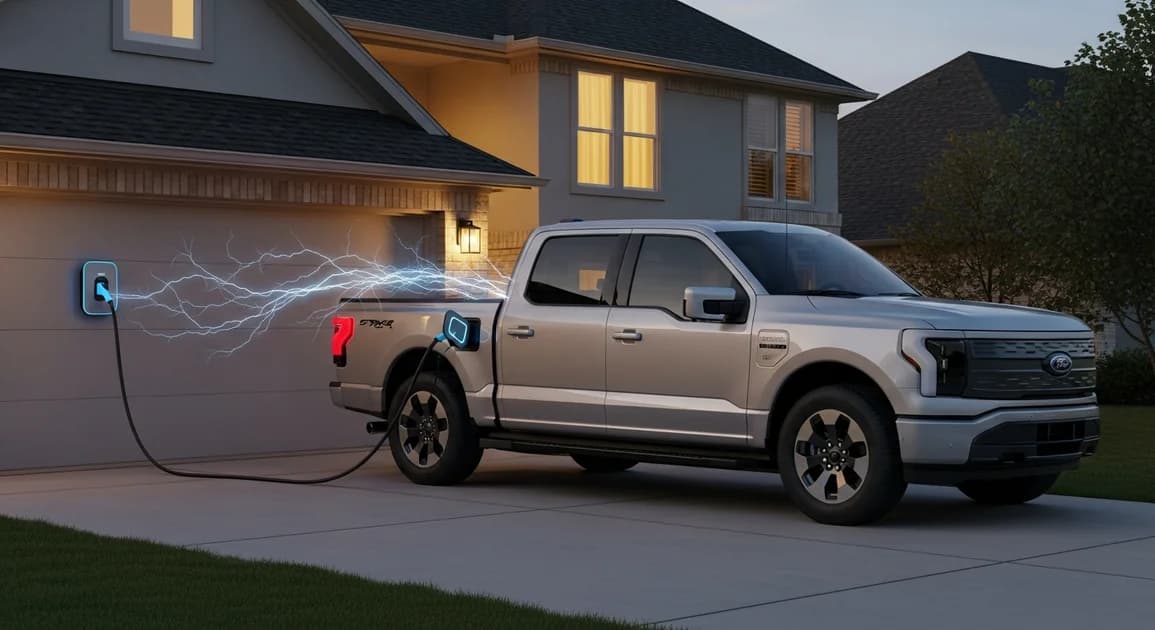
In 2024, U.S. electricity customers averaged 11 hours without power -- nearly double the prior decade's norm (EIA, 2025). Hurricane Beryl alone cut power to 2.6 million Texas customers in a single storm. If you drive an EV, you may already own enough battery capacity to outlast that kind of outage several times over. The catch? A regular charging cable won't do it. You need specific hardware to route power from your car to your home.
This guide breaks down exactly what that hardware is, how the inverter fits in, which products exist, and when a dedicated home battery makes more sense.
Key Takeaways
- A bidirectional charger converts your EV's DC battery power into 240V AC for your home panel -- a standard Level 2 charger can't do this
- Every V2H setup needs three things: a bidirectional EVSE, a transfer switch, and a compatible EV. Total installed cost: $5,000-$15,000 (EnergySage, 2025)
- V2H systems deliver 9.6-19.2 kW continuous power depending on the system
- Only about 14 of 70 U.S. EV models support true V2H as of 2026 (Recharged, 2026)
- If your car isn't home when the outage hits, V2H provides zero backup
What Makes a Charger "Bidirectional"?
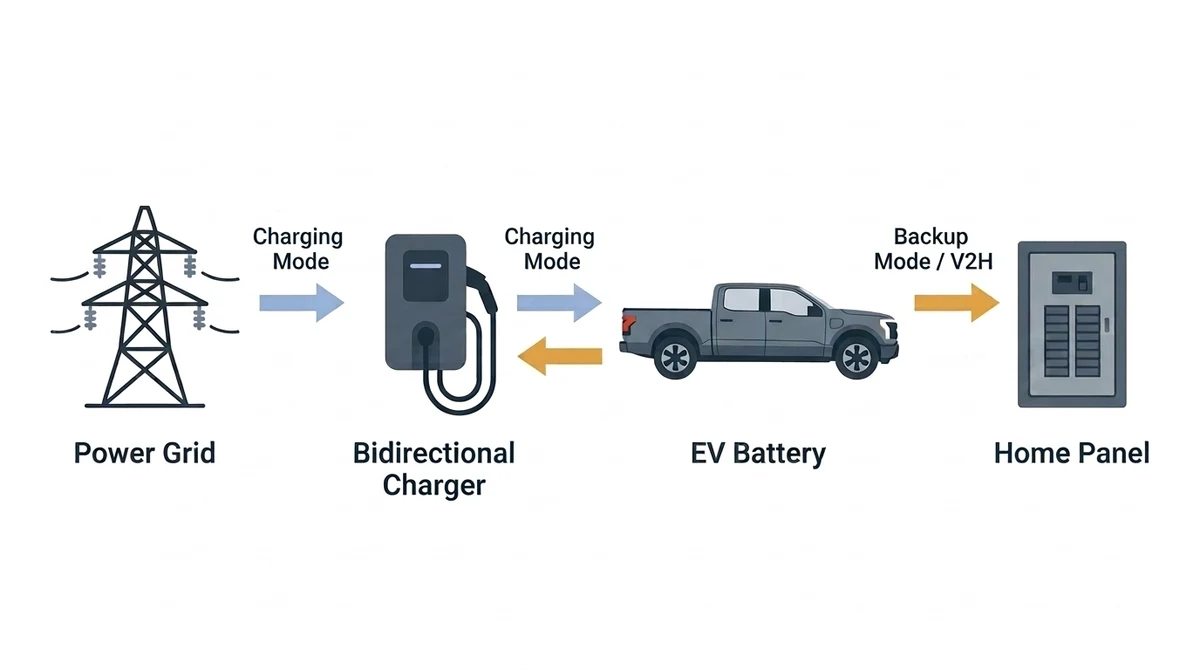
A standard Level 2 charger is a one-way valve. Grid power flows in, battery charges up, done. A bidirectional charger adds a return path. DC power stored in your EV can flow back out through the charger unit, and an inverter built into that unit converts it to 120/240V AC -- the kind your home panel actually runs on.
That inverter-inside-the-charger design trips up a lot of buyers. With solar, the inverter is a separate box on the wall. With V2H, the inversion happens inside the charging station itself, which is why the whole unit is sometimes called a bidirectional EVSE (Electric Vehicle Supply Equipment) rather than just a charger.
Port compatibility matters here too. Your EV must support bidirectional charging through its specific connector: CCS Combo 1 with ISO 15118-20 protocol (most Ford, GM, Hyundai/Kia models), CHAdeMO (Nissan Leaf older models), or Tesla's NACS with Powershare firmware. A charger designed for one protocol won't work with another vehicle.
As of 2026, roughly 14 of 70 U.S. EV models support true V2H -- not V2L (portable outlet) or V2G (grid export), but full panel-level home backup through a dedicated bidirectional charger (Recharged, 2026).
V2H vs. V2G vs. V2L: Why the Label Matters
The acronym you're shopping for determines which hardware you need and what utility approvals apply.
V2L (Vehicle-to-Load) uses a built-in 120V outlet on the EV to run individual appliances -- a fan, a phone charger, a portable light. No special charger needed. Most EVs with "bidirectional" in their marketing copy actually only do V2L, which won't power your home panel.
V2H (Vehicle-to-Home) routes power through a bidirectional EVSE and into your electrical panel via a transfer switch. This is what lets you run your HVAC, refrigerator, and lights during an outage. It's what this guide covers.
V2G (Vehicle-to-Grid) exports power to the utility grid for compensation. In Texas, ERCOT currently requires all EV grid exports to flow through aggregator-managed virtual power plant programs. Individual homeowners can't enroll directly, and retail V2G credit programs aren't expected to be widely available until 2026-2027. Texas V2G pilots currently pay $200-$800 per year, compared to $1,500-$2,800 in California.
For near-term backup value, V2H is the target. V2G is a future benefit, not a reason to buy a bidirectional charger today.
What Three Components Does a V2H System Require?
Every working V2H setup needs three pieces. Miss any one and the system doesn't function.
1. Bidirectional charger (EVSE)
This is where the DC-to-AC conversion happens. The main products available in the U.S. as of 2026:
- Ford Charge Station Pro (FCSP): Required for F-150 Lightning and Mustang Mach-E Rapid Charge V2H. Bundled with new vehicles; replacement cost around $1,300-$1,500.
- Tesla Universal Wall Connector with Powershare: Hardware costs $1,990; installation typically $1,800-$2,200. Required for Cybertruck V2H. Incompatible with non-Tesla vehicles.
- GM Energy V2H Bundle: Includes the Home Integration System plus charger. Total installed cost $10,000-$13,000. Supports Silverado EV, Equinox EV, Blazer EV, and Sierra EV.
- Wallbox Quasar 2: A third-party bidirectional charger compatible with CHAdeMO vehicles. Hardware around $6,500 before installation.
2. Transfer switch
This isolates your home from the grid during a backup event, which is required both for safety and for utility compliance. Options range from a manual transfer switch ($300-$600 in parts) to an automatic transfer switch ($1,000-$2,500 installed) to a smart panel like Span or Lumin ($3,000-$4,500 installed) that can also intelligently manage which circuits get power.
3. A compatible EV
The vehicle must support the bidirectional protocol your charger uses. Buying the charger first and hoping your EV works is a common mistake. Check your vehicle's specifications before purchasing any hardware.
Complete V2H system installed cost ranges $5,000 to $15,000 depending on the vehicle brand and charger type (EnergySage, 2025).
How Much Power Do These Chargers Actually Deliver?
Not all bidirectional chargers output the same continuous wattage. That number determines what loads you can run at the same time.
Here's the constraint most V2H guides skip: a 9.6 kW system like the Ford FCSP can comfortably run lights, a refrigerator, internet, and a window AC unit. It may struggle to run a 5-ton central air conditioning system (which draws 3.5-5 kW on its own) alongside a water heater, dryer, or other large appliances simultaneously. If your Texas home has a large central AC unit, confirm your system's output matches your actual load before installation.
Most V2H systems deliver 9.6-11.5 kW of continuous output. GM Ultium-based vehicles with the full Energy bundle reach 19.2 kW, which handles whole-home loads more comfortably.
How Long Will Your EV Power the House?
Duration comes down to two numbers: your home's daily consumption and the usable capacity of your EV's battery.
The average U.S. home uses 899 kWh per month, or about 30 kWh per day (EIA, 2024). Texas homes run higher because of air conditioning, but in backup mode -- where you're running essentials only -- 30 kWh per day is a reasonable planning figure.
One important detail most guides leave out: EV manufacturers recommend not discharging the battery below 20% reserve to protect long-term battery health. So a Ford F-150 Lightning with a 131 kWh total pack has roughly 98 kWh of recommended usable backup capacity, not the full number on the spec sheet.
What does this mean in practice? An F-150 Lightning running just your essentials could outlast Hurricane Beryl's average 11-hour outage more than seven times. A Tesla Cybertruck extends that to roughly four full days.
When Does a Stationary Battery Make More Sense?
V2H has two hard limits, and both matter for Texas homeowners.
Your car has to be home. If a major storm hits while you're at work or your EV is at a dealership for service, your V2H system provides zero backup. Stationary battery systems are always present, always connected, and can switch to backup mode in under 20 milliseconds -- without any coordination with a vehicle.
Driving range goes down. If a hurricane evacuation is ordered after you've already used your EV's battery for 48 hours of home backup, you're leaving with a partially depleted pack. That's a real risk in coastal Texas, where evacuation routes can be congested and charging stations may be unavailable.
There's also the battery longevity question. A University of Michigan study published in Nature Energy (December 2025) found that V2H can cut lifetime EV charging costs by 40-90%, saving $2,400-$5,600 over the vehicle's life (EurekAlert, 2025). But the study also notes that frequent deep discharge cycles may affect long-term battery capacity -- a tradeoff the OEM marketing materials don't highlight prominently.
The practical conclusion for many Texas homeowners is that V2H and a stationary battery aren't competing products. They're complementary. A stationary system handles instant switchover and covers outages when the EV is away. The EV's large capacity extends runtime for multi-day events.
Frequently Asked Questions
Do I need a special charger for V2H?
Yes. A standard Level 2 charger sends power in only one direction and cannot export from your EV to your home. You need a bidirectional EVSE specifically designed for V2H, plus a transfer switch. Total installed cost ranges from $5,000 to $15,000 depending on your vehicle and charger model (EnergySage, 2025).
Does using V2H void my EV warranty?
OEM-designed systems -- Ford Charge Station Pro, Tesla Powershare hardware, and the GM Energy bundle -- are built for V2H use and covered under their factory warranties. Third-party chargers like the Wallbox Quasar 2 may not be covered under your EV's powertrain warranty. Review your vehicle's warranty documentation before choosing a third-party unit.
Is V2H legal in Texas?
Yes. V2H (home backup only, no grid export) is legal in Texas and does not require utility approval or ERCOT enrollment. V2G (selling power back to the grid) is a different matter: ERCOT currently requires grid exports to be managed through aggregator programs. As of 2026, no direct residential V2G enrollment is available in most Texas service territories.
Can any EV use a bidirectional charger?
No. Your vehicle must support bidirectional charging through its specific connector and protocol. About 14 U.S. EV models qualify as of 2026, including the Ford F-150 Lightning, Tesla Cybertruck, GM Ultium EVs (Silverado EV, Blazer EV, Equinox EV, Sierra EV), Hyundai Ioniq 5 and 6, Kia EV6 and EV9, and Nissan Leaf (CHAdeMO, older models).
What to Do Next
The right V2H setup depends on which EV you drive, how much backup time you need, and whether your home can stay protected when the car is away.
If you own a compatible EV and your main goal is extending backup duration for multi-day Texas storms, a bidirectional charger and transfer switch installation is worth evaluating. If you don't own a V2H-capable EV, or you want backup power that works regardless of whether your car is parked, a stationary home battery system is the more reliable foundation.
Eos installs home battery backup systems across the Houston area, and can help you evaluate both options for your specific home and load.
For a broader look at how V2H technology works from the vehicle side, the complete V2H explainer covers the full picture. And if you're deciding between V2H and a dedicated battery system, the V2H vs. Powerwall comparison walks through costs, capacity, and the availability tradeoff in detail.