V2H Explained: Use Your EV as Home Battery Backup (2026)


Your electric vehicle is sitting in the driveway right now with 60 to 80 kWh of stored energy. That's enough to power your home's essentials for three to five days. Most EV owners have no idea. The vehicle-to-home (V2H) market is projected to grow from $93.6 million in 2024 to $532.6 million by 2032, a 24.3% compound annual growth rate.
Meanwhile, U.S. electricity customers averaged 11 hours without power in 2024, nearly double the prior decade's norm. And there are now roughly 6.5 million registered EVs on American roads. That's an enormous amount of battery capacity just parked in garages.
This guide covers everything you need to know about V2H: what it is, how it works, which EVs support it, what the full setup costs, and how to pair it with a stationary battery for the most reliable home backup possible.
Key Takeaways
- V2H (vehicle-to-home) lets your EV's battery power your house during an outage. A 60-80 kWh EV battery holds 3-5 days of essential home backup
- The V2H market is projected to grow from $93.6M (2024) to $532.6M by 2032 at 24.3% CAGR
- About 14 EV models support V2H in the U.S. as of 2026, including Ford F-150 Lightning, Tesla Cybertruck, GM EVs, Hyundai, Kia, and Nissan
- Equipment costs range from $1,990 (Tesla Powershare) to $7,299 (GM Energy Bundle) before installation
- V2H works best paired with a stationary home battery for instant switchover plus deep EV capacity for multi-day outages
What Is V2H (Vehicle-to-Home)?
V2H lets an electric vehicle discharge its battery to power a home through a bidirectional charger. The global V2H market is projected to reach $532.6 million by 2032, up from $93.6 million in 2024. It's the fastest-growing segment of a broader technology family called V2X.
V2X stands for "vehicle-to-everything," an umbrella term for any technology that moves stored energy from an EV battery to an external destination. There are four main types, and they're often confused with each other.
V2H (Vehicle-to-Home) sends energy from your EV into your home's electrical panel through a bidirectional charger and transfer switch, powering your circuits just like grid electricity. This is the type most homeowners care about.
V2G (Vehicle-to-Grid) pushes energy back to the utility grid during peak demand, letting you earn credits or payments from your utility company. It requires grid-tied equipment and utility approval to operate.
V2L (Vehicle-to-Load) uses a simple adapter to run small devices directly from your EV's built-in outlet, but it cannot supply your home's wiring. Think of it as a portable power station rather than a backup system.
V2B (Vehicle-to-Building) is the commercial-scale version of V2H, designed for offices and warehouses rather than single-family homes.
Here's the common misconception: V2L is not V2H. If your EV has a 120V outlet, that's V2L. It can charge a phone or run a portable heater. But it can't power your home's HVAC, refrigerator, or lighting circuits. V2H requires a bidirectional charger that converts DC battery power to AC household power and feeds it through your main panel.
The global V2X bidirectional charger market is expected to grow from $1.03 billion in 2026 to $4.1 billion by 2036. That growth signals a wave of cheaper, more accessible equipment in the coming years.
How Does V2H Work?
A bidirectional charger converts your EV's DC battery power to AC household power, then feeds it through a transfer switch into your home's electrical panel. The Ford F-150 Lightning, for example, delivers 9.6 kW through its Intelligent Backup Power system, enough to run an average U.S. home for up to three days on a single charge.
The process is straightforward, but it requires three pieces of equipment working together.
The Equipment Chain
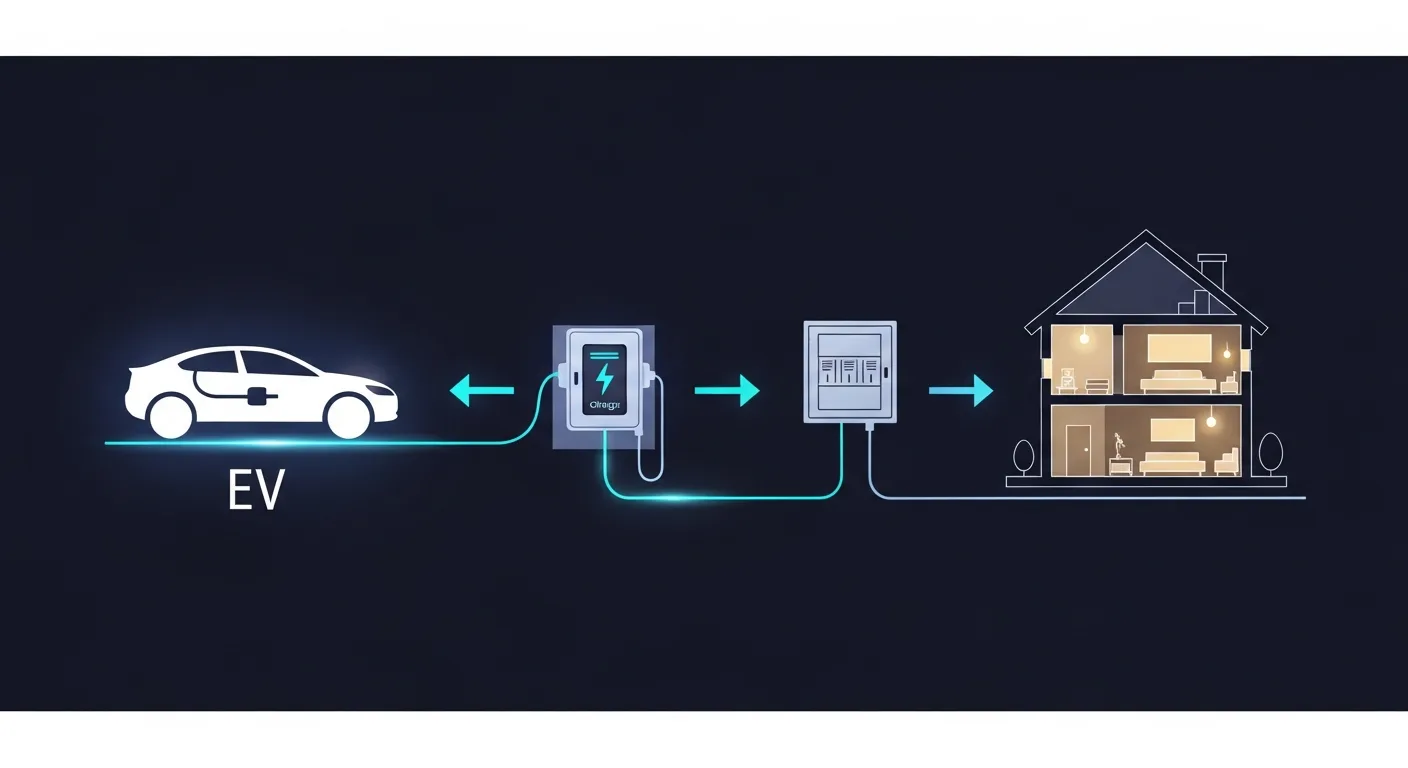
Every V2H setup has three parts: a bidirectional charger, a transfer switch, and your main electrical panel. Each plays a distinct role in getting stored energy from your vehicle into your home's wiring. For a detailed breakdown of each component, costs, and which charger works with your specific vehicle, see the V2H equipment and bidirectional charger guide.
The bidirectional charger is the core component. Unlike a standard Level 2 charger that only pushes electricity into your EV, a bidirectional unit can also pull energy out and convert it from DC to AC. Think of it as a two-way bridge between your car's battery pack and your household circuits.
The transfer switch sits between the charger and your electrical panel, preventing backfeed. Without it, your EV's output could flow into the grid and create a serious hazard for utility repair crews. Every building code requires one.
Your main electrical panel distributes the converted energy to your home's circuits, just as it does with grid electricity. Some setups feed the whole panel, while others route energy only to a dedicated subpanel for critical loads like the refrigerator, sump pump, and lighting.
Automatic vs. Manual Switchover
Not all V2H systems respond the same way when the grid drops, and the difference matters more than most buyers expect.
Automatic systems detect the outage and begin discharging your EV within seconds, with the transfer switch flipping on its own. Ford's Intelligent Backup Power and GM's V2H Bundle both offer this hands-free approach, and you might not even notice the grid went down.
Manual systems require you to start the discharge process yourself, either through a phone app or by physically connecting your vehicle to the charger. This adds a delay of several minutes, which matters if you rely on medical equipment or security systems that cannot tolerate any interruption in supply.
If instant switchover matters to you, consider pairing V2H with a stationary home battery. The battery handles the first seconds of an outage while the V2H system spins up. More on that pairing strategy later.
Which EVs Support V2H in 2026?
About 14 EV models sold in the U.S. now support vehicle-to-home capability. GM alone sold 246,000+ V2H-capable vehicles in 2025, making it one of the top two EV sellers in the country. But support varies widely by manufacturer, output power, and required equipment.
Here's what's available right now.
| Vehicle | Battery (kWh) | V2H Output (kW) | Est. Home Backup |
|---|---|---|---|
| Chevy Silverado EV | 200 | 10.2 | Up to 21 days (rationed) |
| Ford F-150 Lightning (ER) | 131 | 9.6 | Up to 3 days (10 rationed) |
| Tesla Cybertruck | ~123 | 11.5 | Up to 3 days |
| Cadillac Lyriq / Optiq | ~102 | 19.2 | 2-3 days |
| Kia EV9 | 99.8 | 9.6 | 2-3 days |
| Hyundai Ioniq 5/9 | 77-84 | 9.6 | 1.5-2 days |
| Nissan Leaf (2022+) | 40-62 | 6-7 | 1-2 days |
Ford
Ford was first to market with integrated V2H in the U.S., shipping the F-150 Lightning with a built-in bidirectional inverter. Pair it with Ford's Charge Station Pro and Home Integration System, and you have full automatic backup that activates without any manual steps. The Extended Range model's 131 kWh battery can run an average home for about three days at normal usage, or stretch to 10 days if you ration carefully to essentials only.
GM
GM's lineup includes the Chevy Silverado EV, Equinox EV, Blazer EV, Cadillac Lyriq, and Cadillac Optiq. All use the Ultium platform. GM sold over 246,000 V2H-capable vehicles in 2025, making it one of the top two EV sellers in the country. The Silverado EV's 200 kWh battery is the largest available, offering up to 21 days of rationed backup at roughly 5.3 kWh per day. That's not a typo. The Cadillac models push 19.2 kW, the highest output of any consumer V2H system.
Citation Capsule: About 14 EV models support V2H in the U.S. as of 2026. GM alone sold 246,000+ V2H-capable vehicles in 2025, with batteries ranging from 40 kWh (Nissan Leaf) to 200 kWh (Chevy Silverado EV). Home backup durations range from 1-2 days to 21 days depending on the vehicle and load management.
Hyundai, Kia, and Genesis
Hyundai's 800-volt platform enables fast two-way charging across the Ioniq 5, Ioniq 6, and upcoming Ioniq 9. Kia offers the EV6 and the larger EV9, which packs a 99.8 kWh battery. Genesis rounds out the group with the GV60 and GV70 Electrified. All three brands deliver 9.6 kW of output, and the 800V design handles the DC-to-AC conversion more efficiently than older 400V systems.
Tesla Cybertruck
Tesla's Powershare system enables V2H on the Cybertruck only, delivering 11.5 kW of output and even supporting vehicle-to-vehicle charging with other Teslas. At $1,990, it's the cheapest V2H hardware on the market by a wide margin. But there's an important asterisk that catches many Tesla owners off guard.
Nissan
Nissan pioneered V2H back in 2012 in Japan with the original Leaf, making it the first automaker to bring vehicle-to-home technology to market. The newer Leaf models (2022+) support bidirectional charging in the U.S. with compatible third-party chargers, though battery sizes remain modest at 40 to 62 kWh. Output tops out around 6-7 kW, which is enough to sustain essential loads but won't run a full home comfortably. See how the Nissan Leaf handles V2H in practice, including the CHAdeMO adapter requirement.
Which Popular EVs Do NOT Support V2H?
This is where buyers get surprised. The Tesla Model 3, Model Y, Model S, and Model X do not support V2H, despite Tesla holding the largest EV market share in the country. Only the Cybertruck has bidirectional capability, and Tesla has not confirmed plans to add it to other models.
Rivian R1S and R1T also lack V2H, though they do offer V2L outlet-based charging for small devices. They cannot feed your home's electrical panel through a transfer switch.
The Chevy Bolt doesn't support bidirectional charging either, since it predates GM's Ultium platform. If your EV isn't on the compatibility list above, V2L adapters for individual devices remain your only option during an outage.
How Long Can an EV Power Your Home?
A typical EV with a 70 kWh battery can power essential home loads for three to five days, or a full home for roughly 10 to 17 hours. The average U.S. household consumes about 29.6 kWh per day. Your actual runtime depends on what you choose to power and how aggressively you ration.
Essential Loads vs. Full Home
"Essential loads" typically means your refrigerator, lights, phone chargers, Wi-Fi router, and maybe a sump pump. That adds up to roughly 10-15 kWh per day for most homes. At that rate, a 70 kWh EV battery (using 80% of its capacity) lasts about four days.
"Full home" means everything: HVAC, electric stove, water heater, washer, dryer. That's 25-30+ kWh daily. A 70 kWh battery runs dry in under a day. Most V2H owners run essential loads only and stretch their backup dramatically.
The 20% Floor
You don't want to drain your EV to zero. Most V2H systems let you set a minimum charge level, typically 20%. This reserves enough range to drive to a charging station or evacuate if needed.
So a 70 kWh battery actually provides about 56 kWh of usable backup. A 131 kWh F-150 Lightning gives you roughly 105 kWh. Plan your backup math using 80% of total capacity.
Real-World Proof: Hurricane Case Studies
Theory is one thing. Hurricanes are another. Here's what happened when real EV owners faced multi-day outages.
Hurricane Beryl (2024): A Kia EV6 owner in Houston powered home devices for roughly a week. After 16-17 hours of continuous use, the battery was still at 92%. That's because V2L for small loads draws very little power.
Hurricane Helene (2024): A Kia EV6 powered a window AC unit for 68 hours straight, dropping the battery from 88% to 42%. That's nearly three full days of cooling from a single vehicle.
These aren't lab tests. They're real families staying comfortable during real disasters, relying on nothing more than their car's battery. Both examples used V2L, the simpler outlet-based approach. With a proper bidirectional charger and transfer switch, the results would be even stronger, supplying the entire home rather than individual devices.
Citation Capsule: A typical EV with a 70 kWh battery can supply essential home loads (refrigerator, lights, Wi-Fi, phone charging) for 3-5 days. The average U.S. household consumes 29.6 kWh per day, but essential-only usage drops to 10-15 kWh daily. During Hurricane Helene in 2024, a Kia EV6 ran a window AC for 68 continuous hours.

What Does V2H Cost?
A complete V2H setup costs $4,000 to $15,000 installed depending on your vehicle and equipment choice. Tesla Powershare hardware runs $1,990. Ford's Home Integration System is $3,895. GM's V2H Bundle costs $7,299.
Citation Capsule: A complete V2H installation costs $4,000-$15,000 depending on equipment. Tesla Powershare hardware is $1,990, Ford's Home Integration System runs $3,895, and GM's V2H Bundle costs $7,299 before installation.
Equipment Costs by Manufacturer
Prices vary significantly. Tesla's Powershare at $1,990 is the entry point, but it only works with the Cybertruck. Ford's system at $3,895 includes the Charge Station Pro and Home Integration System. GM's bundle at $7,299 includes the charger, transfer switch, and installation coordination.
Third-party bidirectional chargers from companies like Wallbox and dcbel are also entering the market. Prices typically fall between $4,000 and $6,000 for hardware alone.
Installation and Permits
Expect to pay $1,500 to $4,000 for installation, depending on your home's electrical setup. Older homes may need a panel upgrade. Every jurisdiction requires permits for the transfer switch. Some areas also require utility notification.
Installation typically takes one to two days. The permit process can add two to six weeks depending on your local building department.
Utility Rate Structures That Help V2H Pay Off
Some Texas utilities offer time-of-use rate structures where electricity costs more during peak demand hours and less overnight. A V2H setup can charge the EV battery overnight at low rates and discharge to the home during peak hours, saving money each month independent of any outage. Check with your retail electric provider on the time-of-use plans available in your service area.
How V2H Compares to a Home Battery or Generator
Here's the cost picture side by side:
- V2H setup: $4,000-$15,000 installed
- Whole-home battery (e.g., Tesla Powerwall 3): $9,000-$18,000 installed
- Stationary generator: $10,000-$25,000 installed (plus fuel costs)
V2H is generally the cheapest option if you already own a compatible EV. But it has a trade-off: your car must be plugged in at home when the outage hits. A stationary battery is always ready.
Can V2H and a Home Battery Work Together?
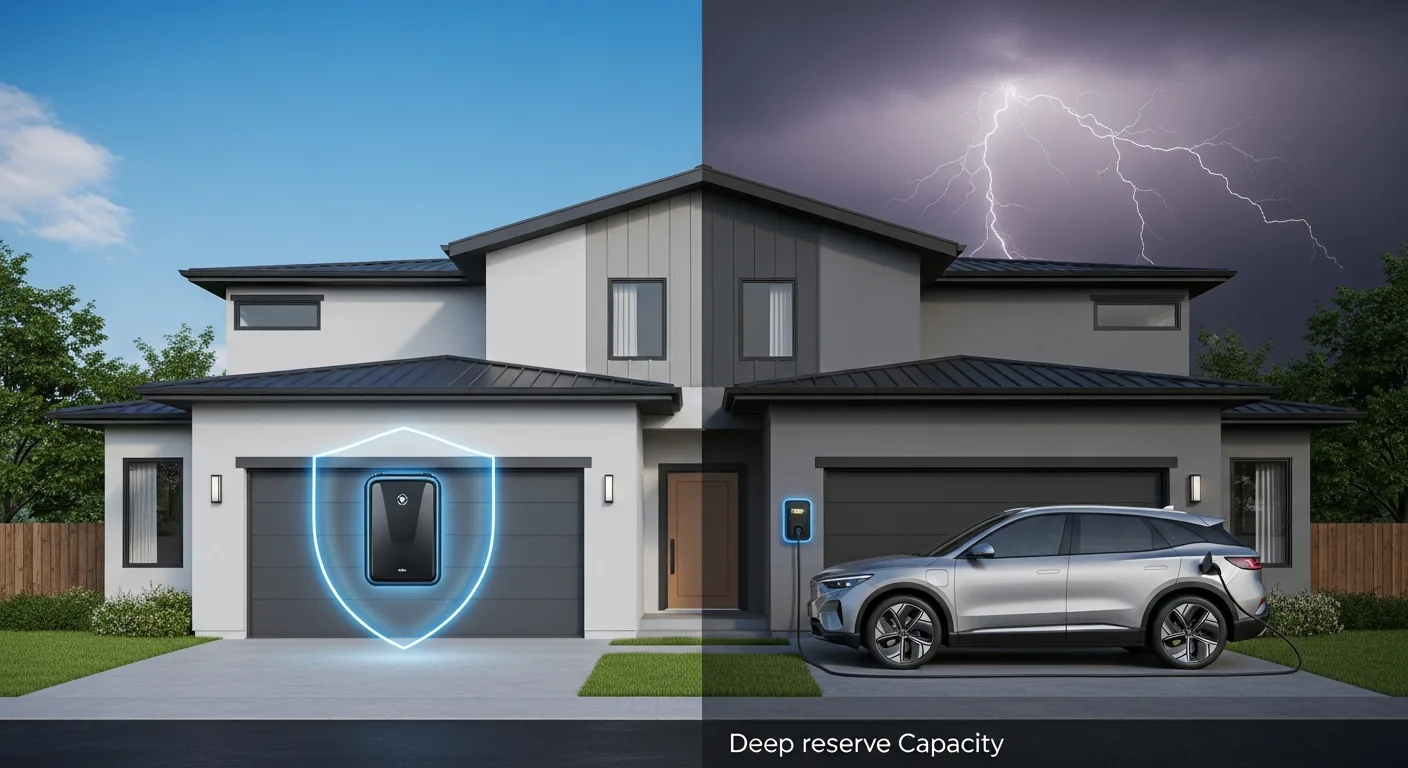
The average longest outage hit 12.8 hours in early 2025, up from 8.1 hours in 2022. Outages that long need both instant response and deep reserve, which is what a V2H-plus-battery setup delivers. The battery switches on in 20 milliseconds. The EV adds days of stored energy. Together they cover gaps that neither system handles alone.
Why V2H Alone Isn't Enough
V2H has two weak spots that matter in practice. First, your car must be home and plugged in when the outage strikes. If you're commuting or on a road trip, your reserve disappears with you.
Second, switchover isn't instant on most V2H configurations. There's a delay of several seconds to a few minutes while the system detects the outage and begins discharging. That gap is long enough to reset clocks, drop Wi-Fi connections, and interrupt medical equipment that requires continuous supply.
Why a Home Battery Alone Has Limits
A typical home battery stores 10 to 15 kWh, which covers essential loads for roughly a day or two if you're careful about rationing. For the short outage that lasts a few hours, that capacity is more than sufficient.
But multi-day outages are increasingly common, and a standalone home battery won't sustain your family through a three-day ice storm or a week-long hurricane recovery. The math simply doesn't work when daily essential consumption runs 10-15 kWh.
How V2H + Battery Work Together
The hybrid approach is simple. Your stationary battery handles instant switchover, less than 20 milliseconds, so you never notice the grid dropped. It powers your home while the V2H system activates.
Once V2H kicks in, the EV's much larger battery takes over the heavy lifting. A 13.5 kWh home battery plus a 70 kWh EV gives you over 80 kWh of combined capacity. That's a week of essential-load backup.
Eos installs both stationary batteries and V2X modules, which means both layers can be configured as a single integrated system.
Does V2H Affect Battery Life and Warranty?
V2H causes modest additional battery degradation, roughly 1.8% extra annual capacity loss per a 2024 review in MDPI Energies. However, a University of Delaware V2G program showed no significant degradation over five-plus years of regular bidirectional cycling.
Citation Capsule: V2H adds roughly 1.8% annual battery degradation according to a 2024 MDPI Energies review, but real-world data from the University of Delaware's V2G program found no significant degradation over five years of bidirectional use.
Warranty Coverage
This is the question that stops most buyers. The good news: major manufacturers explicitly cover V2H use under warranty.
Ford, GM, Hyundai, and Kia all warrant their EV batteries for 8 years or 100,000 miles, and their warranty language does not exclude bidirectional charging when using approved equipment. Nissan covers V2H use in markets where it's officially supported.
If a manufacturer sells you V2H hardware, they're standing behind the battery. Always confirm in writing with your dealer, but the trend is clear: OEMs are embracing V2H, not penalizing it.
Battery Degradation in Practice
That 1.8% annual figure sounds concerning until you put it in context alongside normal wear. Most EV batteries already degrade 2-3% per year from routine driving and charging alone, so V2H adds only a modest increment on top of what's already happening. Over an eight-year warranty period, the practical difference is between roughly 82% remaining capacity without V2H and 80% with it.
Will you notice two percentage points of capacity after eight years? Almost certainly not. Your EV will still drive fine, still hold enough charge for daily commuting, and still function as a home backup system well beyond the warranty period.
Safety Standards
All UL-listed V2H equipment includes automatic disconnect protection, also called anti-islanding, which prevents your system from sending energy into downed utility lines where it could electrocute repair crews. This safety feature is built into every certified charger and transfer switch, and it's a non-negotiable code requirement.
The National Electrical Code (NEC) governs V2H installation requirements across the country, so a licensed electrician familiar with bidirectional systems should handle every project from start to finish.
How Do You Get Started with V2H?
There are now 6.5 million EVs on U.S. roads, and V2H gear starts under $2,000. The barrier to entry has never been lower. You need three things to get started: a compatible EV, a two-way charger matched to your vehicle, and a qualified installer.
Step 1: Check your EV's compatibility. Review the table above and confirm your vehicle supports V2H. Then find out which charger your manufacturer recommends, since mixing brands can void coverage.
Step 2: Get a home assessment. An installer will look at your main panel, check whether you need an upgrade (common in homes under 200 amps), and plan where the transfer switch goes.
Step 3: Pick your equipment. Choose between factory hardware from Ford, GM, or Tesla and third-party options like Wallbox or dcbel. Decide whether automatic or manual switchover matters to you.
Step 4: Schedule the install. Permits take two to six weeks in most areas. The installation itself is usually a one- or two-day job, and your installer will test the full system by simulating a grid outage before signing off.
Frequently Asked Questions
Can a Tesla do vehicle-to-home?
Only the Tesla Cybertruck supports V2H through Tesla's Powershare system, delivering 11.5 kW of output. The Model 3, Model Y, Model S, and Model X do not support bidirectional charging. Tesla has not announced plans to add V2H to these models. Powershare hardware costs $1,990 before installation.
How long can an EV power a house?
A 70 kWh EV battery can power essential home loads for three to five days. The average U.S. home uses 29.6 kWh per day. Running only essentials (refrigerator, lights, Wi-Fi) cuts daily usage to 10-15 kWh, dramatically extending runtime.
Does V2H damage my EV battery?
V2H adds roughly 1.8% extra annual degradation. That's modest compared to normal aging. Ford, GM, Hyundai, and Kia all maintain their standard 8-year, 100,000-mile battery warranties for V2H use with approved equipment.
What equipment do I need for V2H?
You need three things: a bidirectional charger compatible with your EV ($1,990-$7,299), a transfer switch to prevent backfeed, and professional installation ($1,500-$4,000). Total costs range from $4,000 to $15,000 depending on your vehicle and home's electrical setup.
Is V2H cheaper than a home battery?
Generally yes. V2H costs $4,000-$15,000 installed, while a whole-home battery system runs $9,000-$18,000. However, a stationary battery provides instant switchover and doesn't require your car to be home. Many homeowners choose both.
Can I use V2H and still drive my car?
Yes, but not simultaneously. When your EV powers your home, it can't be driven. Set a minimum charge floor of 20% so you always have enough range to reach a charging station. Most V2H systems let you configure this limit through an app.
What is V2G and how is it different from V2H?
V2G (vehicle-to-grid) sends your EV's stored energy back to the utility grid during peak demand hours. You can earn credits or payments from your utility. V2H sends power only to your home. V2G requires utility enrollment and grid-tied equipment, while V2H works independently during outages.
The Bottom Line on V2H
V2H turns an asset you already own into one of the most capable home backup systems available today. With 14 compatible models on the market, equipment starting under $2,000, and batteries large enough to sustain a household for days, this technology is no longer theoretical.
The trend is accelerating on every front: more automakers are adding bidirectional capability to new models, charger prices are falling as competition increases, and utility V2G programs are expanding into new states. By 2032, the V2H market is expected to reach $532.6 million, and early adopters are already proving the concept through hurricanes, ice storms, and everyday outages across the country.
The strongest setup pairs V2H with a stationary home battery, giving you instant switchover from the battery and days of deep reserve capacity from your EV.