V2H vs Powerwall: Which Home Backup Is Right for You?

U.S. electricity customers lost an average of 11 hours of power in 2024, nearly twice the prior decade's average. That trend isn't improving. A Department of Energy report warns blackout hours could increase 100-fold by 2030 as aging plants close faster than new capacity comes online.
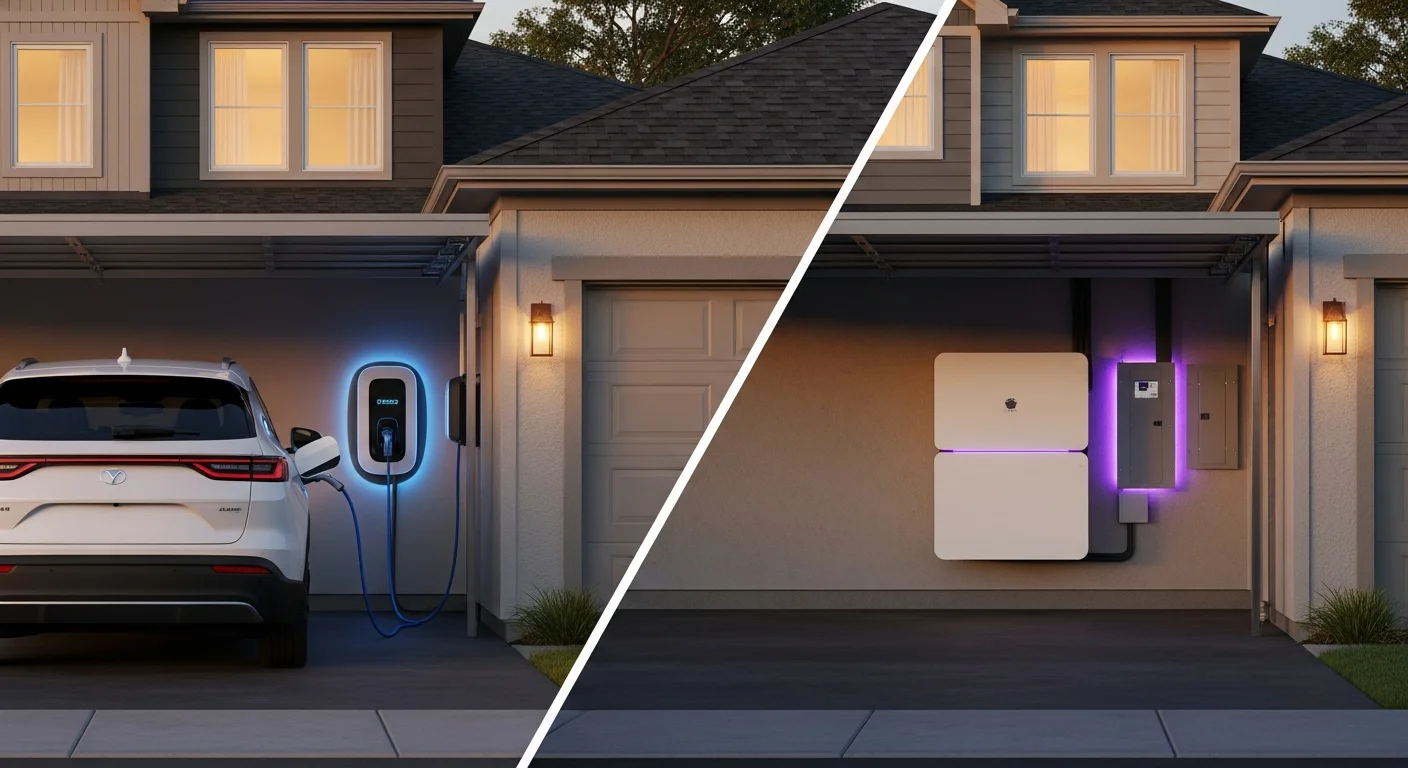
So homeowners are shopping for backup. The two strongest contenders right now are a dedicated wall battery like the Tesla Powerwall 3 and your electric vehicle's own battery via V2H (Vehicle-to-Home). Both keep the lights on, but they differ dramatically in cost, capacity, and one critical tradeoff: availability. This guide compares them head to head so you can pick the right fit.
Key Takeaways
- V2H uses your EV's 60-100 kWh battery for home backup at roughly $6,500-$9,000 installed, about half the cost of a Powerwall 3
- A Tesla Powerwall 3 stores 13.5 kWh and costs $14,500-$18,000 installed
- V2H wins on capacity and cost; Powerwall wins on always-on reliability
- The hybrid approach (small home battery plus V2H) covers both bases and is the option most comparison guides miss
What Is V2H and How Does It Compare to a Powerwall?
More than 220,000 homes worldwide already use V2H-enabled charging systems. Vehicle-to-Home technology turns your EV's battery into a backup power source. A bidirectional charger converts DC power from the car into AC power for your house. A transfer switch isolates your home from the grid during an outage and routes that energy safely to your panel. For a full breakdown of V2H hardware options, power ratings, and charger compatibility by vehicle, see the V2H hardware and bidirectional charger guide.
The Tesla Powerwall 3 takes a different approach. It's a dedicated 13.5 kWh lithium-ion battery bolted to your garage wall, paired with a gateway that manages the switchover automatically. It charges from the grid or solar and sits ready around the clock.
Here's the core difference: a typical EV stores 4 to 7 times more energy than a single Powerwall 3. A Kia EV9 holds 99.8 kWh. A Ford F-150 Lightning holds 131 kWh. The Chevy Silverado EV tops 200 kWh in some trims. You're sitting on a massive battery every time you park in the driveway. V2H simply lets you use it.
But here's the catch: Tesla's wall battery doesn't go anywhere. It doesn't matter if someone drives to Costco or both cars are at work. The dedicated unit stays home and stays ready. That's the fundamental tradeoff, and everything else flows from it.
How Much Does V2H Cost vs. a Powerwall in 2026?
A complete V2H system runs $6,500-$9,000 installed in 2026, while a single Tesla Powerwall 3 costs $14,500-$18,000 installed. That's roughly a $7,000-$8,000 gap for equipment that, in many cases, delivers far more backup capacity.
Here's where the money goes. A Powerwall 3 unit costs $8,000-$11,000 for hardware alone. Installation labor averages around $6,100. That covers electrical work, permitting, and the Tesla Gateway. A bidirectional EV setup is simpler: the charger costs $4,000-$8,000 depending on brand, plus a transfer switch and install labor.
Specific examples bring it into focus. The Ford Charge Station Pro runs about $3,895 for hardware alone. The GM Energy V2H Bundle (charger plus enablement kit) lands around $6,000-$8,000 before installation. The Wallbox Quasar 2, one of the few brand-agnostic bidirectional chargers, falls in a similar range.
Want multiple Powerwalls? Each expansion unit adds $5,900. Three Powerwalls to approach EV-level capacity would cost $27,000+ before labor. That's where V2H's cost advantage becomes hard to ignore.
V2H vs Powerwall 3: Installed Cost Breakdown (2026)
| Item | Cost |
|---|---|
| V2H Equipment | $4,000-$8,000 |
| V2H Install | $2,500-$3,000 |
| PW3 Equipment | $8,000-$11,000 |
| PW3 Install | ~$6,100 |
| V2H Total | $6,500-$9,000 |
| PW3 Total | $14,500-$18,000 |
Source: SmartEnergyUSA, EnergySage, Solar Reviews, 2026
How Long Can V2H and Powerwall Keep Your Home Running?
A Ford F-150 Lightning with its 131 kWh battery can power a typical American home for up to three days on a single charge. A Tesla Powerwall 3, at 13.5 kWh, lasts roughly 12-16 hours depending on how aggressively you manage loads. The capacity gap is enormous.
The F-150 isn't even the biggest option. The Chevy Silverado EV packs up to 200 kWh in its largest configuration. That's nearly 15 times the energy of a single Tesla wall battery. Even a mid-range EV like the Hyundai Ioniq 5, at 77.4 kWh, stores about 5.7 Powerwalls' worth of energy.
How does that translate to real hours? At the average U.S. home consumption of roughly 1.2 kW per hour on essential loads:
- Hyundai Ioniq 5 (77.4 kWh): ~2.5 days
- Kia EV9 (99.8 kWh): ~3.5 days
- Ford F-150 Lightning (131 kWh): ~4.5 days
- Chevy Silverado EV (200 kWh): ~7 days
- 1 Powerwall 3 (13.5 kWh): ~11 hours
- 2 Powerwalls (27 kWh): ~22 hours
- 3 Powerwalls (40.5 kWh): ~34 hours
The Powerwall 3 does deliver 11.5 kW of continuous power, a big jump from the Powerwall 2's 5 kW, and hits 97.5% round-trip efficiency. It's a well-engineered product. But you'd need roughly 10 units ($60,000+) to match the raw capacity of a single F-150 Lightning. That math doesn't work for most households.
Backup Capacity: V2H-Capable EVs vs Powerwalls (in kilowatt-hours)
- Silverado EV: 200 kWh
- F-150 Lightning: 131 kWh
- Kia EV9: 99.8 kWh
- Hyundai Ioniq 5: 77.4 kWh
- 3 Powerwalls: 40.5 kWh
- 2 Powerwalls: 27 kWh
- 1 Powerwall: 13.5 kWh
Source: Inside EVs, Tesla, manufacturer specifications, 2025-2026
Reliability and Availability: The Critical Tradeoff
The Powerwall's biggest advantage isn't capacity or cost. It's that it's always home. When a storm rolls in at 2 a.m. and the grid drops, Tesla's wall battery is bolted to your garage, fully charged, ready to kick in automatically. Your EV? It might be at work, at the airport long-term lot, or on a road trip.
This isn't a minor detail. It's the single most important factor in choosing between vehicle-to-home backup and a dedicated wall battery. If you commute daily and your household has only one EV, there are predictable windows when your car can't protect you.
That said, V2H adoption is growing fast. According to Business Research Insights, 53% of new EV buyers opted for V2H compatibility in 2025, up from 42% in 2023. Buyers are clearly thinking about backup when they choose an EV.
So who should pick what? Here's a quick decision framework:
V2H makes more sense if you:
- Work from home or are retired (car is reliably parked)
- Own a two-EV household (one car always home)
- Want maximum capacity on a smaller budget
- Already own a V2H-capable vehicle
Powerwall makes more sense if you:
- Commute daily with your only vehicle
- Live in a region with unpredictable weather events
- Want zero-thought, always-on backup
- Plan to pair with rooftop solar for daily cycling
What about both? That's where the smartest option lives, and it's the one most comparison guides skip entirely.
Which EVs Support V2H in 2026?
Roughly 14 of about 70 U.S. EV models support some form of bidirectional power as of 2026. That number is growing every quarter, but it's still the minority. Before you plan around V2H, confirm your vehicle actually supports it.
GM (Ultium platform) has gone the furthest. GM standardized V2H across its entire Ultium lineup, making every new GM EV V2H-ready with the optional GM Energy V2H Bundle. That includes the Chevy Silverado EV, Chevy Equinox EV, Chevy Blazer EV, Cadillac Lyriq, and GMC Hummer EV. The bundle includes a bidirectional charger and a 200-amp enablement kit.
Ford pioneered the space with the F-150 Lightning and its Intelligent Backup Power system. Ford's setup delivers up to 9.6 kW to a home through the Ford Charge Station Pro or compatible Sunrun installation.
Hyundai and Kia offer V2H on the Ioniq 5, Ioniq 6, and Kia EV9 through third-party bidirectional chargers like the Wallbox Quasar 2.
Nissan was the original V2H pioneer with the Leaf's CHAdeMO-based system, and the Ariya continues support.
Tesla has announced V2H capability (branded "Powershare") for the Cybertruck, with broader rollout details still emerging for Model 3 and Model Y.
What about charger options? The main choices in 2026 are the Wallbox Quasar 2 (works with multiple brands), the Ford Charge Station Pro, the GM Energy V2H Bundle, and the upcoming Enphase bidirectional charger expected later in 2026.
U.S. EVs with V2H Support (2026) -- 14 of 70 models
V2H-Capable Brands:
- GM (Ultium lineup)
- Ford (F-150 Lightning)
- Hyundai (Ioniq 5, 6)
- Kia (EV9)
- Nissan (Leaf, Ariya)
- Tesla (Cybertruck)
Source: Inside EVs, EcoFlow, manufacturer announcements, 2025-2026
V2H + Home Battery: The Hybrid Strategy Most Guides Miss
The vehicle-to-home market is projected to hit $6.24 billion by 2031, growing at a 32.7% CAGR. But for many homeowners, the smartest move isn't choosing one or the other. It's combining both.
Here's how the hybrid approach works. A smaller wall battery (5-10 kWh) stays permanently connected and handles the immediate switchover when the grid drops. It keeps essential loads running: refrigerator, lights, Wi-Fi, security system. No exceptions. Then, when your EV is home and plugged in, bidirectional charging kicks in with its full 60-200 kWh reserve for extended outages or whole-home coverage.
Why does this matter? Because it eliminates the Powerwall's biggest advantage (always-on availability) without paying $15,000+ for a full-size unit. A 5-10 kWh battery plus a V2H setup might cost $10,000-$14,000 total, less than a single Powerwall, while providing both guaranteed baseline backup and massive extended capacity.
Our take: When we install V2H modules alongside smaller wall batteries, homeowners get the best of both worlds: always-on essential coverage from the dedicated unit, plus days of full-home backup when the EV is parked. It's the configuration competitors don't talk about because they only sell one or the other. We install both.
This hybrid setup is especially smart for households where:
- One partner commutes and the other works from home
- You live in a hurricane or wildfire zone with multi-day outage risk
- You want solar cycling benefits from the home battery and outage protection from V2H
The Eos V2X module is designed for exactly this kind of configuration, bridging your EV's battery with your home's electrical system alongside an existing or new whole house battery for solar.
Making the Right Choice for Your Home
Every backup decision comes down to your household's daily pattern. We've installed hundreds of systems across both categories, and the conversation always starts with the same question: is your car reliably parked at home when you need backup most?
Here's a quick summary of where each option wins:
| Factor | V2H | Powerwall 3 | Hybrid |
|---|---|---|---|
| Installed cost | $6,500-$9,000 | $14,500-$18,000 | $10,000-$14,000 |
| Capacity | 60-200 kWh | 13.5 kWh | 5-10 kWh + EV |
| Backup duration | 2-7 days | 12-16 hours | Always-on + days |
| Always available | Only when car is home | Yes | Yes |
| Solar cycling | Limited | Yes | Yes (home battery) |
If you already own a V2H-capable EV and work from home, vehicle-to-home alone is the highest-value option. You're turning an asset you already own into a backup system at roughly half the cost of a dedicated wall battery. If you need guaranteed coverage regardless of where the car is, the Powerwall's always-on reliability is hard to beat. And if you want the best of both? The hybrid approach closes every gap.
Eos installs home batteries, V2X modules, and hybrid configurations. Get a free backup assessment to find the right setup for your home.
Looking for more context? See how battery backup stacks up against other whole house generator alternatives, or read our guide to the best battery backup for your home.
Frequently Asked Questions
Can V2H completely replace a Powerwall?
Yes, if your V2H-capable EV is reliably parked at home. A Ford F-150 Lightning delivers 131 kWh of backup capacity versus the Powerwall's 13.5 kWh. That's nearly 10 times the energy at roughly half the installed cost. The only scenario where it falls short is if the car isn't home during an outage.
How much does V2H cost compared to a Powerwall in 2026?
V2H systems run $6,500-$9,000 installed, while a Tesla Powerwall 3 costs $14,500-$18,000 installed.
Does Tesla support V2H?
Tesla's "Powershare" feature enables V2H on the Cybertruck. Broader rollout to Model 3 and Model Y is expected but hasn't been fully confirmed. For now, Ford, GM, Hyundai, and Kia offer more mature V2H options with wider charger compatibility.
Is V2H safe for my EV battery?
Yes. Modern bidirectional chargers manage charge and discharge cycles carefully to minimize degradation. Most EV manufacturers warranty their batteries for 8-10 years or 100,000 miles regardless of V2H use. The cycling from occasional backup use is minimal compared to daily driving.
What happens if my car isn't home during a power outage?
Your home has no V2H backup until the car returns and plugs in. This is the strongest argument for the hybrid approach: a small home battery ($3,000-$5,000) covers essential loads immediately, while V2H handles extended outages when the car is available. It's also why two-EV households have a natural advantage: one car is almost always home. Learn more about preparing for outages in our power outage survival kit guide.