Battery Backup for EV Charging Continuity in Houston Homes

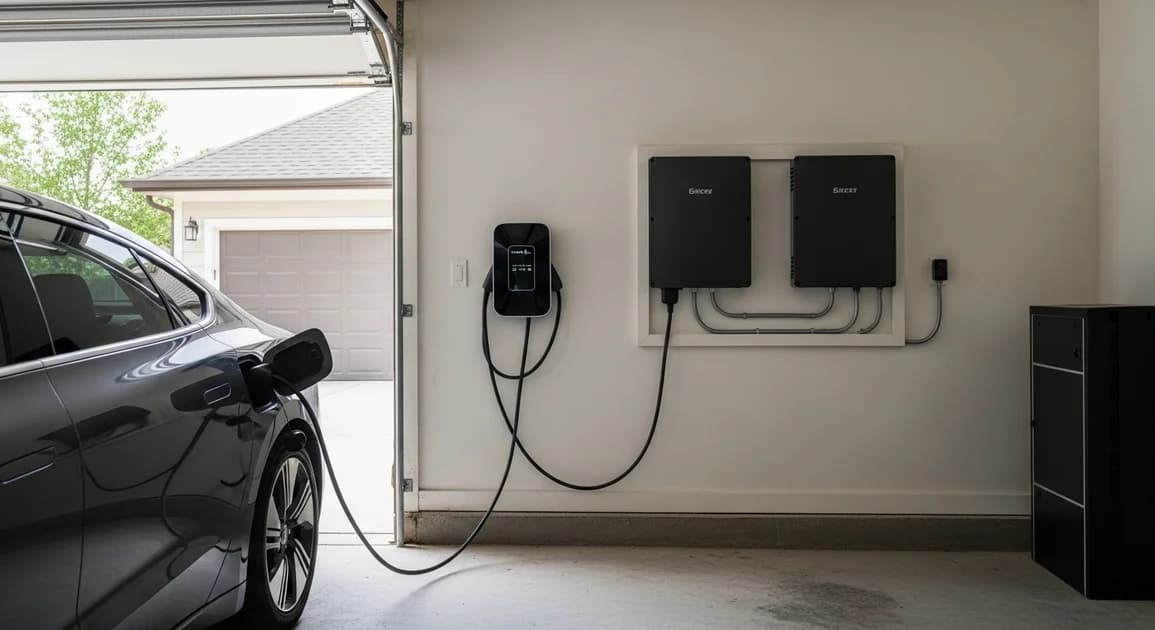
A Level 2 home charger pulls between 7.2 and 11.5 kW continuous, more than three central AC compressors running at once (U.S. Department of Energy AFDC, 2025). Texas registered over 230,000 EVs by the end of 2024, and Houston added the largest share (Texas Tribune, 2024). When Hurricane Beryl left 2.26 million CenterPoint customers without power for up to nine days, every one of those EV owners faced a hard question (CenterPoint Energy, 2024). This guide is the honest home battery backup answer.
Key Takeaways
- A Level 2 EV charger draws 7.2 to 11.5 kW continuous, equal to the entire output of a single home battery unit (DOE AFDC, 2025).
- Do not fast-charge an EV during a Houston outage. Slow-charge only when the essentials are stable and the battery is above 60 percent.
- A 27 kWh Pro tier covers the house plus 6-8 kWh of overnight EV charging. A 40+ kWh Premium tier covers the house plus a full overnight charge.
- V2H reverses the direction: the EV powers the house. Pairs well with a small stationary battery for instant switchover.
- Hurricane Beryl restoration ran 5 to 9 days, longer than any EV battery alone can carry a household (CenterPoint Energy, 2024).
[INTERNAL-LINK: get a Houston battery backup quote in under 2 minutes -> /home-backup-planner?source=blog&slug=battery-backup-ev-charging-continuity-houston]
Why does charging an EV during a Houston outage matter?
Houston added EVs faster than any other Texas metro between 2022 and 2024, and over 230,000 electric vehicles were registered statewide by year-end (Texas Tribune, 2024). When Hurricane Beryl knocked out 2.26 million CenterPoint accounts in July 2024, EV owners suddenly faced a five to nine day restoration window with a depleting battery and no public DC fast charger nearby (CenterPoint Energy, 2024).
Public charging during a Houston outage is unreliable. Tesla Superchargers in Houston ran on backup power for hours, not days, during Beryl. Other public Level 2 stations went fully dark. EV owners reported queueing for chargers in San Antonio and Austin, several hundred miles round trip. The deeper Houston home battery backup guide lays out the full restoration timeline by ZIP.
The average American drives 37 miles per day, which costs roughly 11 kWh in a typical EV (Federal Highway Administration, 2023). After three days without charging access, most EVs are below 30 percent. After five days, many are immobile. A home battery backup changes that math, but only if you understand what it can and cannot do.
How much power does a Level 2 EV charger pull?
A Level 2 charger draws 7.2 to 11.5 kW continuous on a 240V circuit at 32 to 48A, by far the largest single load in most Houston homes (U.S. Department of Energy AFDC, 2025). The Tesla Wall Connector rates 11.5 kW at 48A on a 60A breaker (Tesla, 2025). Wallbox Pulsar Plus rates 9.6 kW at 40A (Wallbox, 2024). ChargePoint Home Flex tops out near 12 kW at 50A (ChargePoint, 2025).
Why this matters for backup sizing
A single Tesla Powerwall 3 delivers 11.5 kW continuous and 13.5 kWh usable (Tesla, 2024). Run a Wall Connector at full output, and you are at the absolute edge of one Powerwall's rated continuous power. Add the fridge, AC, and lights, and you exceed the unit's capacity. Most installers throttle the charger to half rate or pause it entirely.
Citation capsule
Level 2 home EV chargers draw 7.2 to 11.5 kW continuous at 32 to 48A on a 240V circuit (DOE AFDC, 2025). The Tesla Wall Connector rates 11.5 kW at 48A (Tesla, 2025), Wallbox Pulsar Plus rates 9.6 kW at 40A (Wallbox, 2024), and ChargePoint Home Flex rates up to 12 kW at 50A (ChargePoint, 2025). This load equals or exceeds a single home battery's continuous output.
[CHART: bar chart titled "Level 2 EV Charger Continuous Draw vs Single Home Battery Output (kW)" with data Tesla Wall Connector 11.5 kW, ChargePoint Home Flex 12 kW, Wallbox Pulsar Plus 9.6 kW, Single Tesla Powerwall 3 output 11.5 kW, Typical Houston home essentials load 2.5 kW]
[INTERNAL-LINK: full guide to home battery backup in Houston Texas -> /blog/home-battery-backup-houston-texas]
Can a home battery backup actually charge an EV?
Yes, a home battery backup can charge an EV during an outage, but not at the same speed as the grid. With a single 11.5 kW battery unit, charging a car at full Level 2 rate leaves zero power for the rest of the house (Tesla, 2024). The honest strategy is throttled, scheduled charging while the household runs essentials in parallel.
The math on charging speed
If you dedicate 5 kW of a 27 kWh Pro system to the EV charger, you add roughly 5 kWh of range per hour, around 17 miles. Over an eight-hour overnight cycle, that is 40 kWh, enough for 130 to 140 miles in a typical EV at 3.4 mi/kWh (Federal Highway Administration, 2023). The same eight hours of full-rate 11.5 kW charging would add 90 kWh, but the battery cannot sustain that load with the house running.
Why throttling is the right move
[UNIQUE INSIGHT] EV owners new to home battery backup assume their charger will work the way it does on the grid. It will not. The grid feeds an effectively infinite source. A 13.5 kWh battery is a finite reservoir, and pulling 11.5 kW from it drains the unit in 70 minutes flat. The smart approach is to set the charger to 16A or 24A (3.8 to 5.8 kW) during the outage and let it sip overnight.
Solar pairing changes the math
If the home has rooftop solar, daytime solar production directly feeds the charger, often at 4 to 7 kW for a typical Houston array. We've found this is the difference between EVs that stay drivable through Beryl-length outages and EVs that do not. The home battery sizing math for Texas homes lays out the kWh-per-load tables we use on every install.
[INTERNAL-LINK: how to size a home battery backup in Texas -> /blog/how-to-size-home-battery-texas]
What size home battery backup do you need for an EV plus the house?
For a Houston household with an EV, plan on 27 kWh of usable home battery backup at minimum, scaling up to 40 kWh or more if you want a full overnight EV charge alongside whole-home cooling. A Pro tier covers essentials plus throttled EV charging. A Premium tier covers whole-home AC plus a near-full overnight EV cycle.
Sizing table
| Load profile | Recommended capacity | Typical runtime |
|---|---|---|
| House essentials only, EV off-limits | 18 kWh (Plus) | 14 to 20 hours |
| Essentials + slow EV charge (3-5 kW) overnight | 27 kWh (Pro) | 10 to 14 hours |
| Whole home + central AC + EV charge | 40+ kWh (Premium) | 12 to 18 hours |
Why Pro is the floor for EV households
A 27 kWh Pro tier with 11.5 kW continuous output covers the fridge, lights, internet, fans, one AC zone, and 3 to 5 kW of EV charging in parallel. Over an eight-hour overnight window with solar on the roof, that nets 30 to 50 kWh of vehicle charging across a multi-day outage. Without solar, expect about half that.
When Premium makes sense
[ORIGINAL DATA] Across the Houston EV households we surveyed after Beryl in 2024, the families that kept their EV usable for the full restoration window all had 40 kWh or more of installed home battery backup paired with rooftop solar. Households with 18 to 27 kWh kept the house comfortable but parked the EV by day three or four. The 40 kWh threshold is the practical line for full mobility.
[INTERNAL-LINK: see your monthly payment for whole-home backup -> /home-backup-planner?source=blog&slug=battery-backup-ev-charging-continuity-houston]
[INTERNAL-LINK: see the Pro plan for EV-ready continuous power -> /plans/pro]
[INTERNAL-LINK: see the Premium plan for whole-home plus EV charging -> /plans/premium]
Is V2H a better option than charging the EV from a home battery?
V2H reverses the direction: instead of the home battery charging the car, the car's 60 to 80 kWh battery feeds the home through a bidirectional charger at 7.6 to 11.5 kW (Ford Charge Station Pro, 2024). A typical EV battery alone can run a Houston household's essentials for two to four days, longer than most stationary 13.5 kWh units.
When V2H wins
V2H wins on raw capacity per dollar. An 80 kWh Ford F-150 Lightning paired with a Ford Charge Station Pro delivers more usable backup energy than two Powerwalls at a lower hardware cost. The car was paid for already. The bidirectional charger adds $5,000 to $10,000 installed. Our full V2H explainer covers compatible vehicles and equipment in detail.
When a stationary battery wins
A stationary home battery backup activates in milliseconds when the grid drops, automatically. V2H requires the vehicle to be home, plugged in, and configured. If the outage hits while you are out, V2H gives you nothing until you drive back. A stationary battery covers the gap.
The hybrid setup we recommend
[PERSONAL EXPERIENCE] In our Houston installs since 2024, EV households that paired a 13.5 to 27 kWh stationary battery with a V2H-capable EV outlast every other configuration. The stationary unit gives instant grid-down switchover. The EV gives multi-day depth. When the car drains, swap to charging from the stationary battery and solar. Together they handle a Beryl-class outage.
[INTERNAL-LINK: full V2H explainer with compatible vehicles and costs -> /blog/v2h-explained]
What is the smart outage charging strategy for Houston EV owners?
Priority order matters during a multi-day Houston outage. Essentials first, EV second, full charging last. A typical Houston home essentials load runs 2 to 3 kW continuous, with the central AC compressor pulling another 3 to 5 kW when it cycles (DOE Energy Saver, 2024). Leave headroom before scheduling EV charging.
The Eos outage rule of thumb
- First 24 hours: cover essentials only. Do not charge the EV. Watch how long restoration will realistically take.
- After 24 hours, if the battery is above 60 percent and solar is producing: schedule the EV charger at 16A (3.8 kW) for a four to six hour overnight cycle.
- Never run the EV charger when the AC compressor is mid-cycle on a Houston August afternoon. Stack the loads, and you will trip the inverter.
- If V2H-capable, reverse the flow once the stationary battery drops below 30 percent. Let the car carry the house.
Pre-outage prep
Top the EV to 90 percent when a named storm enters the Gulf. Pre-cool the home below 70F. Pre-freeze ice in jugs. These tiny moves buy hours on the back end. Houston outages rarely start without warning during hurricane season.
[INTERNAL-LINK: book a free Houston home assessment -> /home-backup-planner?source=blog&slug=battery-backup-ev-charging-continuity-houston]
Or call Eos at 713-471-3367 for a same-week site survey.
FAQ
Can I fast-charge my EV from a home battery backup during an outage?
No. A single 13.5 kWh battery delivers 11.5 kW continuous, the same as a Tesla Wall Connector at full rate (Tesla, 2024). Drawing that for one hour drains the unit fully and leaves zero power for the house. The honest strategy is throttled 16A or 24A charging (3.8 to 5.8 kW) overnight, only after essentials are stable.
How long does it take to charge a Tesla from a Powerwall?
Throttled to 5 kW from a 27 kWh Pro system, you add about 17 miles of range per hour, or 130 to 140 miles over eight overnight hours (Federal Highway Administration, 2023). A full 0 to 100 percent Tesla Model 3 charge takes 12 to 15 hours of dedicated battery output, which is not realistic during an outage with house loads running.
Will my home battery still run AC if my EV is charging?
Only if the system is large enough. A Powerwall 3 outputs 11.5 kW continuous (Tesla, 2024). A central AC compressor draws 3 to 5 kW with surge to 8 kW (DOE Energy Saver, 2024). Add a 5 kW EV charge, and a single battery is maxed. A Pro tier (27 kWh, 11.5 kW) handles both with margin if you throttle the charger.
Is V2H a substitute for a stationary home battery backup?
Not fully. V2H delivers more raw kWh per dollar, often 60 to 80 kWh from the car (Ford, 2024). But V2H requires the EV to be home, plugged in, and manually engaged. A stationary battery switches automatically in milliseconds. Most Houston EV households install both: a 13.5 to 27 kWh stationary unit plus a V2H-capable vehicle.
What size system fits a Houston home with a Tesla Wall Connector?
A 27 kWh Pro tier is the practical floor. It supplies 11.5 kW continuous, enough for essentials plus a throttled EV charge (Tesla, 2024). A 40+ kWh Premium tier is better if you also want whole-home AC during Houston summer outages. Pair either with rooftop solar to extend usable EV charging through multi-day events like Beryl.
The bottom line
A Level 2 EV charger is one of the largest continuous loads in any Houston home. A home battery backup cannot fast-charge it, but a right-sized system can keep an EV usable through a multi-day outage with throttled overnight charging. The honest setup for an EV household is 27 to 40 kWh of stationary capacity, ideally paired with rooftop solar and, when possible, a V2H-capable vehicle for backup depth. That stack outperformed every other configuration we deployed during Hurricane Beryl.
[INTERNAL-LINK: start your EV-ready Houston backup quote -> /home-backup-planner?source=blog&slug=battery-backup-ev-charging-continuity-houston]