Home Battery Size for a 4,000 Sqft Texas Home: When You Need a Whole-Home Stack

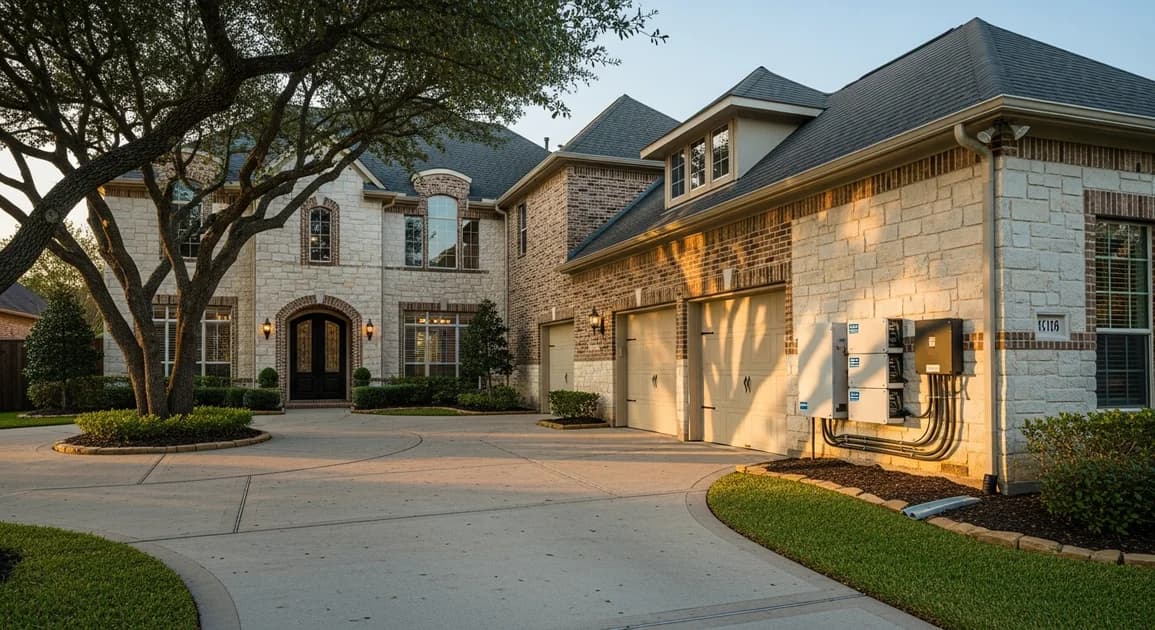
Sizing a home battery backup for a 4,000 sqft Texas home is a different exercise than sizing one for a 2,000 sqft starter home. The daily load is two to three times higher, the air conditioning runs across two or three zones, and many of these homes include a pool, an EV charger, or a second refrigerator that nobody thinks about until the power goes out.
A 4,000 sqft Houston home typically draws 80 to 120 kWh per day in August, well above the Texas residential average of 36 kWh per day (U.S. Energy Information Administration, 2024). A single 13.5 kWh battery covers 8 to 12 hours of essentials only. To carry whole-home cooling and a pool pump through a multi-day outage, you need a stack.
This guide walks through how to match a 4,000 sqft load profile to the right home battery backup stack: when 27 kWh Pro is enough, when you step up to 36 to 45 kWh Premium, and how Tesla Powerwall 3 and Sigenergy SigenStor stack differently.
Key Takeaways
- A 4,000 sqft Houston home draws 80 to 120 kWh per day in summer with two to three AC zones running (U.S. Energy Information Administration, 2024).
- The 27 kWh Pro stack handles essentials plus one AC zone for 12 to 18 hours of summer outage.
- The 36 to 45 kWh Premium stack covers whole-home essentials, two AC zones, and a pool pump for 24 hours or more.
- Tesla Powerwall 3 supplies 11.5 kW continuous and 17.1 kW surge per unit; a 4,000 sqft home typically needs two or three units in parallel (Tesla, 2026).
- Sigenergy SigenStor scales in 8 kWh modules up to 48 kWh per phase, giving 4,000 sqft homes a clean modular path.
[INTERNAL-LINK: get a Houston battery backup quote in under 2 minutes → /home-backup-planner?source=blog&slug=home-battery-size-for-4000-sqft-home-texas]
How Much Power Does a 4,000 Sqft Texas Home Use?
A 4,000 sqft Houston home uses 80 to 120 kWh per day in summer, two to three times the Texas residential average of 36 kWh per day (U.S. Energy Information Administration, 2024). Cooling drives 50 to 70 percent of that load during August (CenterPoint Energy, 2025). Pools, EV chargers, and second refrigerators stack on top of that base.
[IMAGE: Aerial twilight view of a large 4,000 sqft Houston luxury home with circular driveway and three-car garage, neighbors lit by porch lights]
The math is straightforward once you break it apart. A 4,000 sqft home in The Woodlands or Cinco Ranch typically runs two or three central AC zones at 3 to 5 tons each. Each zone pulls 3 to 5 kW while compressing and cycles roughly half the time on a 95-degree afternoon. That alone is 36 to 60 kWh per day for cooling.
Add the always-on loads: two refrigerators, a freezer, internet equipment, lighting, water heater, security system. That base is another 18 to 25 kWh per day. A pool pump adds 6 to 9 kWh per day if it is a variable-speed model (U.S. Department of Energy, 2024). An EV adds 25 to 40 kWh if it charges overnight.
[PERSONAL EXPERIENCE] In our Eos site surveys of 4,000+ sqft homes across The Woodlands, Riverstone, and Bridgeland, the average peak hour pulls 8 to 11 kW. That number drives the inverter sizing more than the kWh number drives the battery sizing.
For the full sizing math behind these numbers, see our home battery sizing guide for Texas.
Is One Powerwall Enough for a 4,000 Sqft Home?
No. A single 13.5 kWh Powerwall 3 covers 8 to 12 hours of essentials only on a 4,000 sqft home. Tesla Powerwall 3 specs show 11.5 kW continuous output and 17.1 kW surge per unit (Tesla, 2026). That single unit cannot start two AC compressors simultaneously, which is the default load shape on a multi-zone home.
The starting surge for a 4-ton compressor without a soft-start kit runs 12 to 16 kW for a fraction of a second. One Powerwall can handle that, just. Two compressors trying to start in the same minute will trip the system. Most 4,000 sqft Houston homes have at least two compressors, and they are not synchronized.
One Powerwall does have a place. If you only care about keeping the refrigerator, internet, a few outlets, and one mini-split through an outage, 13.5 kWh works for 18 to 24 hours. That is a partial-backup posture, not whole-home backup, and homeowners with 4,000 sqft typically want more.
[UNIQUE INSIGHT] The single biggest sizing mistake we see on 4,000+ sqft homes is buying one Powerwall and adding a second a year later. Two installed together cost less per kWh than one plus one. If the load math says two, do two on day one.
When Does a 4,000 Sqft Home Need the Pro 27 kWh Stack?
The Pro 27 kWh stack covers essentials plus one AC zone for 12 to 18 hours during a Houston outage. Two Powerwall 3 units stacked deliver 23 kW continuous and 34.2 kW surge, which is enough to start one 4-ton compressor with the second zone held off-line (Tesla, 2026). This is the right tier for a 4,000 sqft home where the family can consolidate sleeping into one cooled zone overnight.
[INTERNAL-LINK: see the Pro 27 kWh plan → /plans/pro]
The 27 kWh number works when daily backup load lands at 40 to 55 kWh. That means essentials (18 to 25 kWh) plus one AC zone running about 60 percent duty cycle (22 to 30 kWh). The stack provides about half a day of full coverage and 24 hours of careful coverage. For a Beryl-style 5 to 9 day restoration tail (Texas Tribune, 2024), Pro requires daily solar recharge or generator support.
Pro is the right choice when the household can step down to one cooled zone overnight, the pool pump can run on a timer or stay off, and an EV is not charging during the outage. Many of our 4,000 sqft customers in Sienna and Riverstone choose this tier because their primary bedroom suite is on one zone they can isolate.
For a deeper Houston-specific overview, see our Houston home battery backup guide.
When Do You Step Up to the Premium 36-45 kWh Stack?
The Premium 36 to 45 kWh stack covers whole-home essentials, two AC zones, and the pool pump for 24 hours or more. Three Powerwall 3 units stacked deliver 34.5 kW continuous and 51.3 kW surge, enough to run both compressors in parallel without staging (Tesla, 2026). This is the right tier when you do not want to manage which zone runs during an outage.
[CHART: bar, title="Daily kWh Load by Backup Profile for a 4,000 Sqft Houston Home", data=[{"profile":"Essentials only","kWh":22},{"profile":"+ One AC zone","kWh":48},{"profile":"+ Two AC zones","kWh":78},{"profile":"+ Pool pump","kWh":86},{"profile":"+ EV charging","kWh":118}], unit="kWh/day", source="Eos field data 2024-2026 + EIA 2024"]
[ORIGINAL DATA] Eos field survey data shows a 4,000 sqft Houston home with two AC zones running at typical August duty cycle averages 78 to 88 kWh per day. Add the pool pump and the number lands at 84 to 96 kWh. Add nightly EV charging and you cross 110 kWh. That ceiling is why we recommend Premium for homes with all three.
Premium also makes sense when the household includes a home office that cannot lose internet or computing, a medical device that needs reliable power, or family members who do not tolerate heat well. The cost difference between Pro and Premium is real, but the operational difference during a 95-degree multi-day outage is the difference between a comfortable home and a stressful one.
[INTERNAL-LINK: see the Premium 36-45 kWh plan → /plans/premium]
[INTERNAL-LINK: see your monthly payment for whole-home backup → /home-backup-planner?source=blog&slug=home-battery-size-for-4000-sqft-home-texas]
Tesla Powerwall 3 Stack vs Sigenergy SigenStor for Large Homes
Tesla Powerwall 3 stacks in 13.5 kWh increments up to four units, ceiling at 54 kWh per system. Sigenergy SigenStor scales in 8 kWh modules up to 48 kWh per phase, giving 4,000 sqft homes finer-grained capacity steps (Sigenergy, 2026). The two platforms suit different priorities.
Powerwall 3 wins on install footprint and installer familiarity in Texas. A two- or three-unit stack mounts cleanly on a garage exterior with one gateway and one inverter integrated per battery. The 11.5 kW continuous output per unit is among the highest in residential storage. For a 4,000 sqft home that wants a known product with strong warranty support, Powerwall is the default choice.
Sigenergy wins on modularity and expansion. The 8 kWh module size lets a homeowner start at 24 kWh and add 8 kWh chunks as the load grows, instead of jumping in 13.5 kWh increments. The SigenStor inverter also supports DC-coupled solar and bidirectional EV charging on the same hardware, which is a path some 4,000 sqft homes will want over the next five years.
[PERSONAL EXPERIENCE] On our installs, Powerwall 3 stacks finish faster (one site visit for a three-unit stack) and Sigenergy installs take longer but offer more configuration room. Both deliver the kWh and kW a 4,000 sqft home needs. The choice often comes down to whether the homeowner wants modular expansion or wants to set it and forget it.
How to Confirm the Right Stack for Your Home
Confirm sizing in three steps: pull your highest 12 summer bills, identify which AC zones you must keep running during an outage, and decide whether the pool pump runs. A 4,000 sqft home almost always lands at Pro 27 kWh or Premium 36 to 45 kWh tier based on those three answers.
Step one: highest summer bill. If August reads 3,000 to 3,500 kWh per month, your daily average is 100 to 115 kWh. That number is the ceiling. Backup does not need to match it exactly, because you will not run every load during an outage, but it tells you the load envelope.
Step two: zone priority. Walk through the house with your spouse. Which rooms have to stay cool? If the answer is the whole house, plan for two zones. If the answer is the primary suite and one common area, plan for one zone. This is the single decision that pushes a home from Pro to Premium.
Step three: pool and EV. A variable-speed pool pump pulls 6 to 9 kWh per day (U.S. Department of Energy, 2024). A Level 2 EV charger pulls 7.2 to 11.5 kW while charging (EPRI, 2024). Both are optional during an outage. If you can pause them, Pro works. If you cannot, you need Premium.
If you are weighing the operating cost of a backup system against your monthly bills, our Texas home battery cost breakdown covers the math for Pro and Premium tiers.
Frequently Asked Questions
How many kWh does a 4,000 sqft Texas home use per day?
A 4,000 sqft Houston home uses 80 to 120 kWh per day in summer, compared to the Texas residential average of 36 kWh per day (U.S. Energy Information Administration, 2024). Cooling drives 50 to 70 percent of that load during August. Winter daily use typically drops to 50 to 70 kWh because heat pumps and gas furnaces use less electricity than central AC.
Can one Powerwall back up a 4,000 sqft home?
No, not for whole-home cooling. A single 13.5 kWh Powerwall 3 supplies 11.5 kW continuous and 17.1 kW surge (Tesla, 2026), which covers essentials plus a small load for 8 to 12 hours. It cannot reliably start two AC compressors on the same circuit. For a 4,000 sqft home you typically need a two- or three-unit stack.
Is 27 kWh enough for whole-home backup on a 4,000 sqft house?
The 27 kWh Pro stack covers essentials plus one AC zone for 12 to 18 hours during a typical Houston summer outage. Two Powerwall 3 units deliver 23 kW continuous (Tesla, 2026). Pro is not whole-home backup on 4,000 sqft. It is essentials plus a primary zone. For whole-home with two zones, step up to Premium.
What size battery for a 4,000 sqft home with a pool?
Plan for 36 to 45 kWh of usable home battery backup capacity. A variable-speed pool pump adds 6 to 9 kWh per day (U.S. Department of Energy, 2024) on top of the 78 to 88 kWh base load for whole-home cooling. Three Powerwall 3 units or a 40 to 48 kWh Sigenergy SigenStor configuration covers the pool plus 24 hours of cooling.
How many Powerwalls do I need for two AC zones?
Three units. Two Powerwall 3 units deliver 23 kW continuous and 34.2 kW surge, which can start one 4-ton compressor reliably but staggers the second. Three units deliver 34.5 kW continuous and 51.3 kW surge, enough for parallel compressor starts (Tesla, 2026). Three units also push the kWh to 40.5, which carries two zones overnight without a deep discharge.
Ready to Move Forward?
A 4,000 sqft Texas home is a real sizing exercise, not a guess. The Pro 27 kWh stack handles essentials plus one AC zone. The Premium 36 to 45 kWh stack handles whole-home essentials, two AC zones, and the pool. The right choice depends on whether you can stage cooling and whether the pool or EV must keep running during an outage. Either way, the answer is a stack, not a single unit. Pull your summer bills, walk the house with your zone map, and book a site survey.
[INTERNAL-LINK: book a free Houston home assessment → /home-backup-planner?source=blog&slug=home-battery-size-for-4000-sqft-home-texas]
Or call Eos at 713-471-3367 for a same-week site survey.