Kemah and Seabrook Battery Backup: Living on the Waterfront Side of the Bay

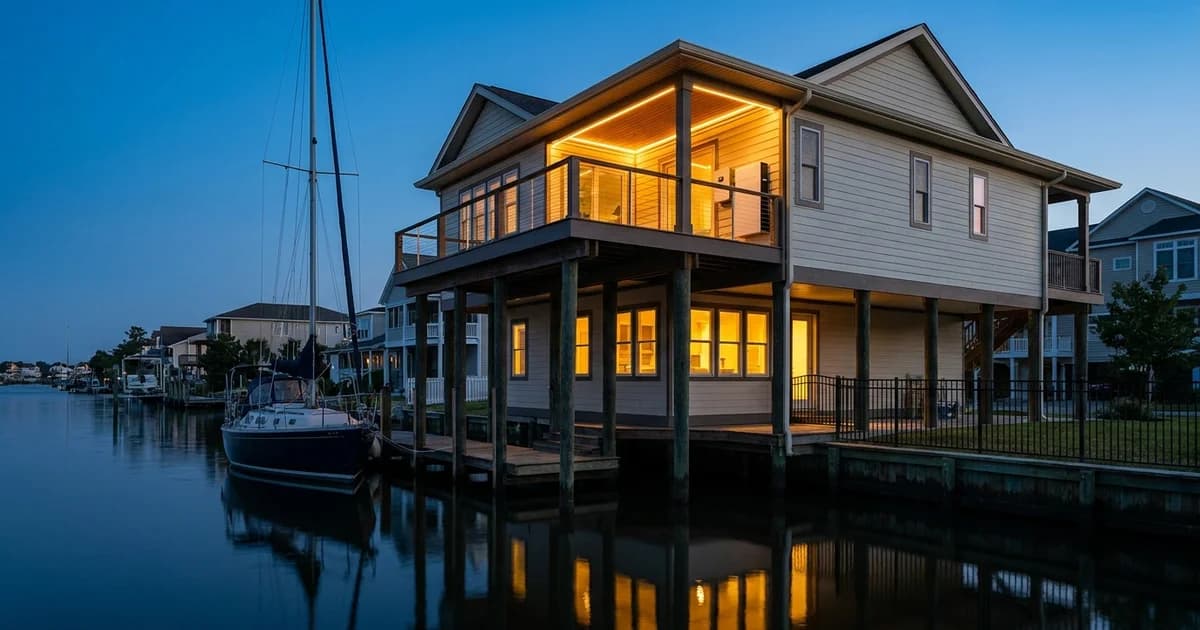
On most Houston lots, deciding where a home battery goes is a conversation about garage wall space. In Kemah and Seabrook it is a conversation about elevation, and the number that governs it is printed on a federal flood map rather than a product datasheet. Both cities regulate the height of the equipment that serves your house, not just the height of the house itself.
That single rule reorders the whole install. It decides whether your ground floor is usable, whether the meter wall works, and in some cases whether the system ends up on a deck landing eight feet in the air. Here is how the waterfront side of Galveston Bay actually works.
Key Takeaways
- Kemah and Seabrook both require new and substantially improved structures to be built at least 18 inches above the base flood elevation, and Kemah applies that same height to equipment servicing the building (City of Kemah, 2026).
- Federal floodplain rules require electrical and mechanical service equipment to be elevated or designed so floodwater cannot enter it (eCFR, 44 CFR 60.3).
- An enclosed ground floor under an elevated home is limited to parking, storage and building access, which rules it out as a battery room.
- Your lot type, not your zip code, sets the answer: elevated waterfront, canal slab, or older inland slab.
What actually decides where a battery can go on a Kemah or Seabrook lot?
The base flood elevation does, and both cities add height on top of it. Kemah requires all new and substantially improved structures to be built at least 18 inches above the base flood elevation, and states plainly that "the elevation requirement also extends to all equipment servicing the building, such as an air conditioning unit or ductwork" (City of Kemah, 2026). Seabrook adopted the same 18 inch freeboard in November 2016 (City of Seabrook, 2026).
A battery system is equipment servicing the building. So is the inverter, the smart panel, and the disconnect. In practice the mounting height is not something an installer negotiates on site. It is fixed by your property's base flood elevation plus the city's freeboard, and it is documented on an elevation certificate.
Federal rules sit underneath the local ones. Under 44 CFR 60.3, new construction and substantial improvements must have electrical, heating, ventilation, plumbing and air conditioning equipment "designed and/or located so as to prevent water from entering or accumulating within the components during conditions of flooding" (eCFR). FEMA's own definition of mechanical equipment for flood insurance rating purposes covers service equipment elevation directly (FEMA).
Start by pulling your flood zone and base flood elevation from the FEMA Flood Map Service Center (FEMA MSC). Kemah's current maps are dated August 15, 2019. Zones in both cities range from VE along the open bay shoreline to AE across the canals and X further inland, and the zone changes the answer as much as the number does.
What did Hurricane Ike prove about this stretch of shoreline?
That the design flood here is not theoretical. In September 2008, the National Weather Service Houston/Galveston office put storm surge on Galveston Island and the west side of Galveston Bay at 10 to 15 feet, with the single highest water mark of 17.5 feet recorded roughly ten miles inland in Chambers County (NWS Houston/Galveston). Kemah and Seabrook sit on that west shore.
FEMA's post-storm Mitigation Assessment Team then documented the results building by building. Its report on Ike in Texas and Louisiana records a townhouse on the western Galveston Bay shoreline in Seabrook damaged by wave action and debris, and a Kemah house later raised for compliance (FEMA P-757, 2009).
The same report contains the finding that matters most for backup power. Facilities with equipment and utilities at ground level "tended to sustain flood damage to these support systems that either prohibited post-Ike resumption of operations, or delayed or reduced operational capabilities" (FEMA P-757, 2009). A battery mounted low does not just get destroyed. It stops being backup at the exact hour you need it.
The grid side was no gentler. CenterPoint Energy reported that of its 2.26 million metered customers, 1.99 million were without power after Ike made landfall (CenterPoint Energy, 2008).
Why your ground floor is a flood enclosure, not a garage
Because the federal rules say so. On an elevated home, the enclosed area below the lowest floor is permitted only if its use is limited to parking of vehicles, building access, or storage, and it has to be built with flood damage-resistant materials and fitted with flood openings that let water in and out automatically (FEMA Technical Bulletin 1, 2021).
Read that list again. Battery storage is not on it. Neither is a utility room, a mechanical closet, or a conditioned equipment nook. The bottom of each flood opening must sit no higher than one foot above the adjacent grade, which means the space is designed to fill with water on purpose.
The materials rule closes the door the rest of the way. FEMA Technical Bulletin 2 limits what may be installed below the base flood elevation to materials capable of withstanding direct and prolonged contact with floodwater without significant damage (FEMA Technical Bulletin 2, 2025). Lithium battery cabinets and inverters do not qualify.
So on an elevated Kemah or Seabrook home, the equipment wall is upstairs. Usually that means a deck landing, an exterior wall at living level, an elevated mechanical platform, or a stair-accessed alcove built above the required height. It is a design decision made before the quote, not after.
Three lot types in Kemah and Seabrook, three different answers
The housing stock here is not one thing, and that is what splits the install. Kemah counts roughly 1,019 housing units in the 2024 American Community Survey five-year estimates (Census Reporter, 2024), and they span three very different builds.
Elevated waterfront and pier and beam homes
These are the properties directly on the bay or on the outer canal runs, often in VE or high AE zones. The battery goes at living level, full stop. The practical questions become how far the run is from the meter, whether the deck framing carries a wall-mounted cabinet, and where the smart panel lands relative to the existing service.
Canal lots with a garage at grade
This is the trickiest group. The house may be elevated while an attached garage or a slab addition sits at grade, and owners assume the garage wall is available because it looks like a garage anywhere else. If that space is a below-BFE enclosure, it is not available. Seabrook's own elevation program describes severe repetitive loss as something that "usually occurs when a home is built below BFE" (City of Seabrook, 2026), and the remedy is elevation, not tolerance.
Older slab homes further inland
Off the water, in X zones and lower AE areas, the job looks much more like a standard Bay Area install: garage wall or a protected exterior mount, with height driven by the elevation certificate rather than by a second story.
One caveat applies to all three. Marine air corrodes outdoor enclosures regardless of height, so stainless and corrosion-rated hardware belongs on the spec sheet here. We covered that in depth for the neighboring corridor in our Clear Lake and Webster coastal considerations guide.
How much backup does a waterfront home here actually need?
Enough to run air conditioning through a multi-day restoration, not just a fridge overnight. Every Eos system uses the same smart controller rated for 11.5 kW continuous output with 17.1 kW surge, which is what lets a condenser start without a generator-style stumble. Capacity is what changes between tiers.
For a typical elevated bay home with a full kitchen, one or two AC zones, and a well pump or lift station on the same panel, the Pro plan is the usual landing spot. If the property is a second home you leave during evacuations, the priority shifts: keep the fridge, security, network and dehumidification alive unattended for days rather than powering a full household. The planner walks through both cases.
If your storm plan involves a boat as well as a house, our post on marina and boat storage backup power covers the dock side, and the Galveston coastal hurricane guide covers island-specific evacuation staging.
What to have ready before the site visit
Three documents shorten this from weeks to days. Pull your elevation certificate if one exists, note your FIRM panel and flood zone from the FEMA map center, and take a photo of your meter and main panel with something in frame for scale.
If you do not have an elevation certificate, say so early. Both cities' floodplain administrators keep certificates on file for permitted construction, and Seabrook makes them available for review at the Building Department. Knowing that number before design starts is the difference between one site visit and three.
Or call Eos at 833-989-3737 to talk through your setup with an installer.
Frequently asked questions
Can I put a home battery in the ground floor of an elevated Kemah house?
No. Under FEMA Technical Bulletin 1, an enclosed area below the lowest floor of an elevated building is limited to parking, building access and storage, and it must have flood openings that admit water automatically (FEMA, 2021). Battery equipment belongs above the required elevation.
How high does the equipment have to be mounted in Seabrook?
Seabrook has required 18 inches of freeboard above the base flood elevation in all regulatory flood zones since November 2016 (City of Seabrook, 2026). Your specific mounting height is the base flood elevation plus that freeboard, confirmed against your property's elevation certificate.
What flood zone are Kemah and Seabrook in?
Both cities contain a mix. Open bay frontage generally falls in VE, the coastal high hazard zone with wave action, canal and near-shore lots in AE, and inland areas in X. Look up your exact parcel on the FEMA Flood Map Service Center (FEMA). Kemah's current maps are dated August 15, 2019.
How much of the housing stock here is elevated versus slab?
A parcel-level breakdown of elevated versus slab-on-grade homes in Kemah and Seabrook is not published by either city or by the Census Bureau, so any percentage quoted for it is an estimate. The reliable answer for your property is its own elevation certificate.
Does a battery survive a storm surge like Ike?
Only if it is above the water. FEMA's assessment after Ike found that ground-level equipment and utilities repeatedly failed in ways that delayed or prevented restart (FEMA P-757, 2009). Elevation is the survival factor, and it happens to also be the legal requirement.
The short version
On the waterfront side of Galveston Bay, elevation is the spec. Get your base flood elevation, add the 18 inches both cities require, and design the equipment wall down from that line to the meter rather than the other way around. Do it once and the system is still there after the water leaves.
For the Highway 3 and NASA Road 1 corridor just inland, see our Webster service area page.
Sources
- City of Kemah, Flood Protection Information, retrieved 2026-09-08, https://kemahtx.gov/767/Flood-Protection-Information
- City of Seabrook, Development Requirements, retrieved 2026-09-08, https://www.seabrooktx.gov/333/Development-Requirements
- City of Seabrook, Home Elevation Program, retrieved 2026-09-08, https://www.seabrooktx.gov/844/Home-Elevation-Program
- FEMA, Flood Map Service Center, retrieved 2026-09-08, https://msc.fema.gov/portal/home
- eCFR, 44 CFR 60.3 Flood plain management criteria for flood-prone areas, retrieved 2026-09-08, https://www.ecfr.gov/current/title-44/chapter-I/subchapter-B/part-60/subpart-A/section-60.3
- FEMA, Technical Bulletin 1: Requirements for Flood Openings in Foundation Walls and Walls of Enclosures, retrieved 2026-09-08, https://www.fema.gov/sites/default/files/documents/fema_flood-openings-technical-bulletin_20210607.pdf
- FEMA, Technical Bulletin 2: Flood Damage-Resistant Materials Requirements, retrieved 2026-09-08, https://www.fema.gov/sites/default/files/documents/fema_tb_2_flood_damage-resistant_materials_requirements_01-22-2025.pdf
- FEMA, Mitigation Assessment Team Report: Hurricane Ike in Texas and Louisiana (FEMA P-757), retrieved 2026-09-08, https://www.fema.gov/sites/default/files/2020-08/fema757.pdf
- FEMA, Glossary: Mechanical Equipment, retrieved 2026-09-08, https://www.fema.gov/about/glossary/mechanical-equipment
- National Weather Service Houston/Galveston, Tropical Cyclone Climatology 2000s, retrieved 2026-09-08, https://www.weather.gov/hgx/hurricanes_climatology_2000s
- CenterPoint Energy, Begins Power Restoration and Damage Assessment Following Hurricane Ike, retrieved 2026-09-08, https://www.globenewswire.com/en/news-release/2008/09/14/384673/6258/en/CenterPoint-Energy-Begins-Power-Restoration-and-Damage-Assessment-Following-Hurricane-Ike.html
- Census Reporter, Kemah, TX profile (ACS 2024 5-year), retrieved 2026-09-08, https://censusreporter.org/profiles/16000US4838776-kemah-tx/