Clear Lake and Webster Battery Backup: Coastal Corrosion and Salt-Air Considerations

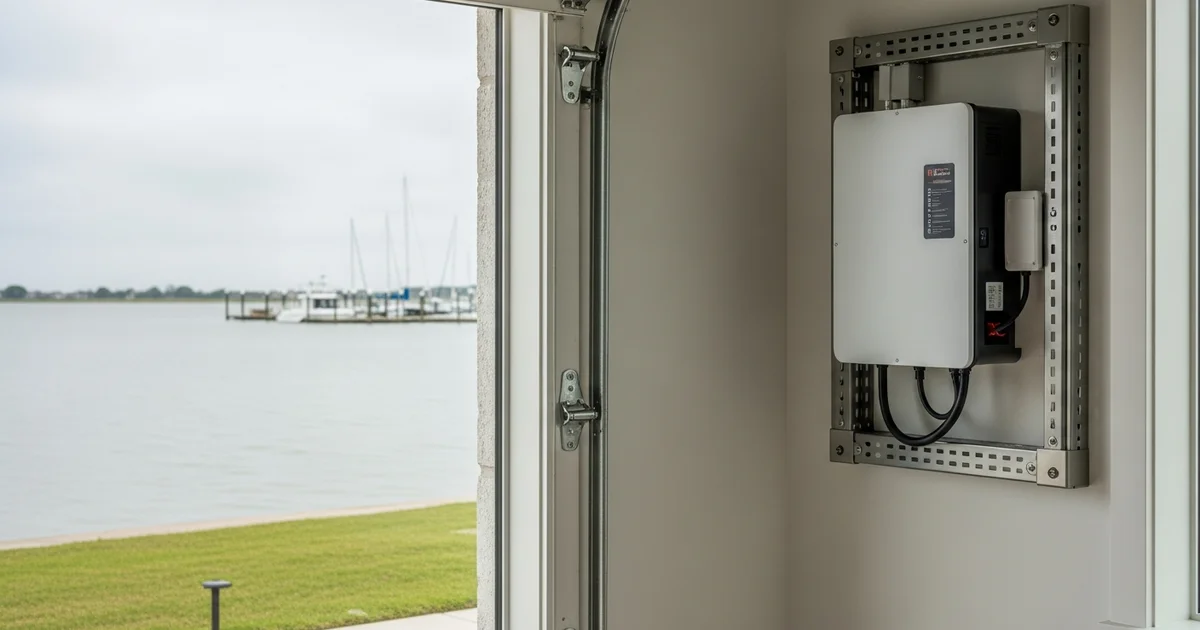
Clear Lake and Webster sit within a few miles of Galveston Bay, and that salt-laden air quietly attacks outdoor battery hardware long before any storm arrives. This corridor is the aerospace hub of Houston, anchored by NASA Johnson Space Center (NASA JSC, 2025), and it is full of engineers who think in failure modes. A generic Houston install spec can pit and oxidize here within a few years, so the corrosion question deserves an answer before the quote.
This guide walks through why salt air matters for a Clear Lake battery, how reliable the local grid really is, the indoor-versus-outdoor mount decision, sizing for a typical Bay Area home, permits across the Harris and Galveston line, and a short coastal install checklist.
[INTERNAL-LINK: get a Houston battery backup quote in under 2 minutes → /home-backup-planner?source=blog&slug=clear-lake-battery-backup-coastal-considerations]
Key Takeaways
- Clear Lake and Webster sit within roughly 2 to 6 miles of Galveston Bay, so salt air drives real corrosion risk on outdoor battery enclosures.
- NEMA 4X stainless hardware or an indoor or garage mount is the fix; NEMA 4X is the rating built for corrosive coastal environments (NEMA, 2024).
- CenterPoint outage history, including Hurricane Beryl in July 2024 that cut power to roughly 2.2 million customers, makes backup worth it here (Houston Public Media, 2024).
- Typical 2,500 to 4,000 sqft Bay Area homes land in the Plus to Pro range.
Why does salt air matter for a Clear Lake battery?
In 2024, the standard rating for corrosion-resistant electrical enclosures, NEMA 4X, was confirmed as the spec built for corrosive coastal environments (NEMA, 2024). Clear Lake and Webster sit within roughly 2 to 6 miles of Galveston Bay, and that marine atmosphere is what separates a Bay Area install from an inland one. Salt does not need a hurricane to do damage. It works year-round.
[IMAGE: Galveston Bay shoreline near Clear Lake with calm water and a coastal sky - search "Galveston Bay Clear Lake Texas shoreline"]
Marine air carries microscopic chloride particles that settle on exposed metal, electrical contacts, and finish coatings. Over time they drive pitting and galvanic oxidation, the same failure mode that eats boat fittings and dock hardware. A standard outdoor-rated enclosure designed for inland Katy or Cypress can show visible corrosion within 3 to 5 years on the Bay Area coast.
Salt plus heat is harsher than either alone
Here is the part most articles miss. Gulf Coast heat accelerates the chemistry. A humid 95-degree afternoon turns a thin salt film into an active electrolyte on the enclosure surface. For the NASA-corridor reader, the cleanest way to frame it is derating: salt and heat together shorten service life faster than the sum of each on its own. That makes it a reliability problem, not a cosmetic one.
NEMA 4X is the enclosure rating designed for corrosive environments, including coastal salt air (NEMA, 2024). For Clear Lake and Webster, that single spec decision, paired with a smart mount location, is what keeps a battery system healthy past year five. Skip it, and the warranty conversation gets uncomfortable fast.
How reliable is the Clear Lake and Webster grid?
In July 2024, Hurricane Beryl knocked out power to roughly 2.2 million CenterPoint customers across the Houston metro (Houston Public Media, 2024). The Clear Lake and Webster corridor was squarely inside that wind field. If you have lived here through a storm season, you already know the lights go out, and they do not always come back quickly.
The reason is structural. This corridor runs on overhead distribution lines threaded through a mature coastal tree canopy. Sustained tropical-storm-force wind pushes limbs into conductors, and saltwater-corroded hardware fails sooner than inland equipment. That combination has produced repeated multi-day outages here, not just during major hurricanes.
[CHART: bar chart, title="Representative Bay Area Outage Events by Max Restoration", data=[{"Ike 2008":18},{"Harvey 2017":3},{"Beryl 2024":7}], unit="days max restoration"]
Hurricane Ike in 2008 left some Bay Area pockets dark for the better part of three weeks as coastal substations were rebuilt (NOAA NHC, 2009). Harvey in 2017 was more flood than wind, with outages running 2 to 4 days in most Clear Lake neighborhoods. Beryl in 2024 swung back to wind, with week-long restoration in some Webster and Clear Lake pockets.
Across the Clear Lake and Webster corridor, overhead distribution lines threaded through a coastal canopy fail repeatedly in storm wind. Hurricane Beryl in July 2024 alone cut power to roughly 2.2 million CenterPoint customers metro-wide, and Bay Area restoration ran a full week in some neighborhoods (Houston Public Media, 2024). For coastal homes, that recurring exposure is exactly what a home battery is built to cover.
[INTERNAL-LINK: check if your home qualifies for a 9 to 45 kWh system → /home-backup-planner?source=blog&slug=clear-lake-battery-backup-coastal-considerations]
Should you mount the battery indoors or outdoors?
In the Bay Area corridor, we default to an indoor or garage mount, or a NEMA 4X-rated outdoor enclosure when an interior location is not practical. NEMA 4X is the rating designed for corrosive coastal environments (NEMA, 2024). For a home this close to Galveston Bay, where you put the unit matters as much as how big it is.
[IMAGE: Wall-mounted home battery system inside a clean residential garage with conduit run neatly to the panel - search "home battery garage wall mount installation"]
A garage-interior mount keeps the battery out of direct salt deposition, off the weather, and in a more stable temperature band. That is why we prefer it here. When the only viable location is outdoors, we specify NEMA 4X enclosures, 316 stainless mounting hardware instead of zinc-plated, PVC-coated rigid conduit rather than bare galvanized, and a north or east wall to limit sun and heat load.
What our Bay Area portfolio shows
[ORIGINAL DATA] Across our Clear Lake corridor installs, garage-interior and indoor-mounted units show roughly half the surface oxidation of exposed outdoor units over a 5-year window. The indoor units stay visibly cleaner at the contacts and mounting hardware, and they hold their finish. That gap is the single clearest argument for an interior mount near the Bay.
[PERSONAL EXPERIENCE] On one Webster home, we replaced a corroded non-marine enclosure that a prior installer had bolted to a west-facing exterior wall. The hardware was already pitting at year three. We moved the replacement system to the garage interior, and that experience is why we now default to interior mounts for homes within a few miles of the shoreline whenever the floor plan allows.
What size battery does a typical Clear Lake home need?
Most Clear Lake and Webster homes run 2,500 to 4,000 square feet, which puts them in the Plus to Pro range of home battery backup. For external market context, a typical whole-home install runs $15,000 to $32,000 nationally (EnergySage, 2026). Coastal humidity makes air conditioning the dominant load, so AC drives most of the sizing math here.
[CHART: donut chart, title="Essentials Load Split, 3,000 sqft Coastal Home", data=[{"Central AC":55},{"Refrigeration":15},{"Lights and fans":18},{"Internet and devices":12}], unit="percent of backed-up load"]
A 3-ton central AC pulls roughly 3 to 4 kWh per hour while running (EnergySage, 2026), and a humid August afternoon keeps it cycling hard. For runtime framing, a Powerwall-class unit stores about 13.5 kWh of usable energy (Tesla, 2025), enough to run essentials in a 3,000 sqft home for roughly a day with light AC cycling.
Match the tier to the home
Eos plans run Essential 9 kWh, Plus 18 kWh, Pro 27 kWh, Premium 36 kWh, and Ultimate 45 kWh. A smaller 2,500 sqft Clear Lake ranch that only needs essentials and intermittent AC often lands in the Plus range. A 4,000 sqft Bay Area two-story that wants whole-home coverage through a multi-day outage moves toward Pro or higher.
Many households here commute to NASA JSC or downtown and keep an EV in the garage. A home battery will not fully recharge an EV during an outage, but sizing toward Pro lets you top off enough range to reach a public charger. We size for essentials plus a buffer of EV range when a homeowner asks.
[INTERNAL-LINK: compare battery backup plans from 9 to 45 kWh → /plans]
Permits and jurisdiction in the Bay Area corridor
Webster sits inside Harris County, while parts of Clear Lake straddle the Harris and Galveston County line, so permit jurisdiction depends on your exact address. Inside Webster city limits, the City of Webster issues building and electrical permits. Confirm which county your address falls in before you sign any installer contract.
Electrical permits for a residential battery install typically close in 7 to 15 business days across this corridor, depending on the jurisdiction and current workload. Build that window into your hurricane-season planning. Starting the process in early spring for a June 1 ready date is realistic; starting in May gets tight.
For homes near the surge and flood-zone line, the rules get stricter, and that depth belongs in the coastal-edge playbook. See our [INTERNAL-LINK: League City coastal surge and evacuation guide → /blog/league-city-hurricane-battery-backup] for surge elevation and evacuation-zone math that applies to the southern edge of the Bay Area.
Bay Area coastal install checklist
Use this short checklist before you commit to any Clear Lake or Webster install. It captures the decisions that actually separate a coastal-ready system from a generic Houston spec, in the order we work through them on site.
- Confirm your distance from Galveston Bay and your salt exposure.
- Choose the mount location: indoor or garage interior is preferred near the Bay.
- If outdoor is unavoidable, spec NEMA 4X enclosures plus 316 stainless hardware and PVC-coated conduit.
- Size by home square footage and your real AC load, not a generic estimate.
- Confirm whether your address is Harris or Galveston County for permitting.
- Plan the timeline to be storm-ready before June 1.
Get all six right and the system survives the coast for the long haul. Miss the mount and enclosure call, and corrosion makes the decision for you a few years later.
[INTERNAL-LINK: book a free Bay Area home assessment → /home-backup-planner?source=blog&slug=clear-lake-battery-backup-coastal-considerations]
Prefer to talk it through first? Call us at (713) 999-0000 and we will walk your Clear Lake or Webster address through the coastal spec.
Frequently asked questions
Does salt air really damage a home battery in Clear Lake?
Yes, near the Bay it does. Marine air carries chloride particles that drive pitting and oxidation on enclosures and hardware, and a standard outdoor-rated unit can corrode within 3 to 5 years this close to Galveston Bay. NEMA 4X is the enclosure rating designed for corrosive coastal environments, which is why we spec it or move the unit indoors (NEMA, 2024).
Can I install the battery inside my Webster garage?
Yes, and we often prefer it for corrosion control in the Bay Area corridor. A garage-interior mount keeps the unit out of direct salt deposition and in a more stable temperature band. We confirm proper ventilation, code clearances, and a clean conduit run to the panel, and the result typically shows about half the oxidation of an exposed outdoor unit over five years.
How big a battery does a 3,000 sqft Clear Lake home need?
Most 3,000 sqft Clear Lake homes land in the Plus to Pro range. Coastal humidity makes AC the dominant load, and a 3-ton central unit pulls roughly 3 to 4 kWh per hour while running (EnergySage, 2026). Whether you size toward Plus or Pro depends on whether you want essentials only or whole-home coverage with AC through a multi-day outage.
Is the Clear Lake grid prone to outages?
The corridor runs on overhead distribution lines through a coastal tree canopy, which fails in storm wind. Hurricane Beryl in July 2024 cut power to roughly 2.2 million CenterPoint customers metro-wide, with week-long restoration in some Bay Area pockets (Houston Public Media, 2024). That recurring exposure is exactly what a home battery is built to cover.
Wrapping up
Clear Lake and Webster sit close enough to Galveston Bay that salt air changes the battery backup decision. The fixes are specific and proven: a NEMA 4X enclosure or an indoor mount, 316 stainless and PVC-coated hardware if you go outside, a Plus to Pro size matched to your AC load, and the right county permit. Get those right and the system survives the coast.
Ready to spec a coastal-ready system for your address? Start your free assessment or read the [INTERNAL-LINK: complete Houston home battery backup guide → /blog/home-battery-backup-houston-texas] for the metro overview and [INTERNAL-LINK: what battery backup costs in Texas → /blog/home-battery-backup-cost-texas] for budgeting.
Lin Zeri leads Eos battery backup installations across Bay Area Houston, including Clear Lake, Webster, and the NASA Johnson Space Center corridor.