Houston Heights Battery Backup: Historic District Rules and 1920s Wiring

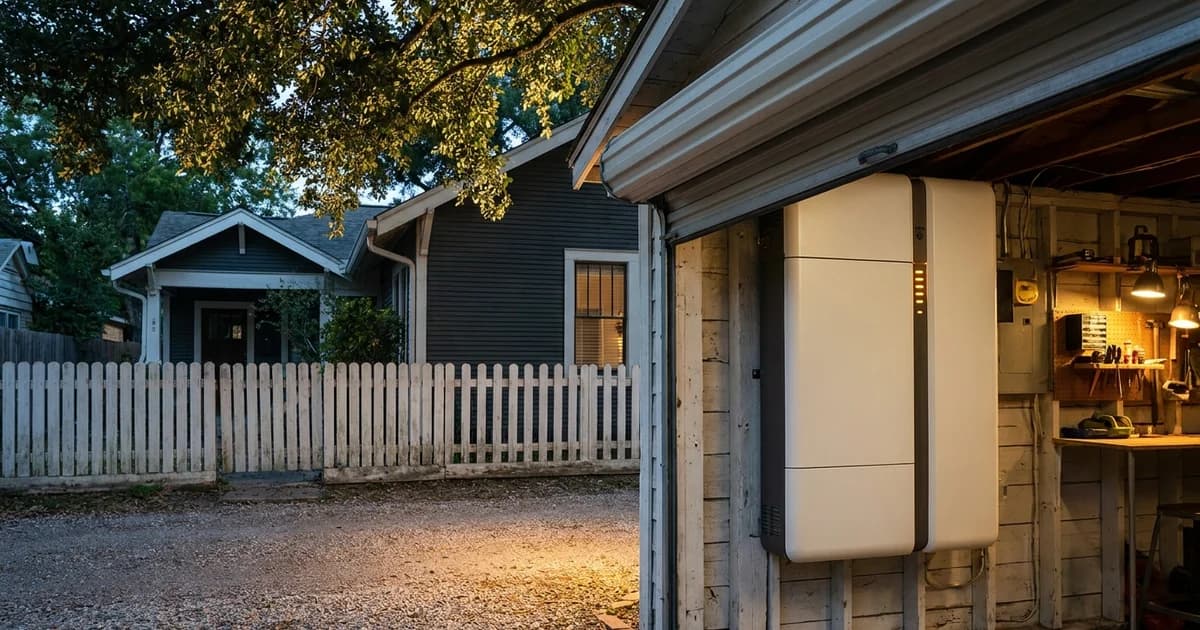
Most Houston battery guides never mention the one thing that can actually gate an install inside the Loop: a design review by a city commission. In the Heights, exterior alterations to a property in a City-designated historic district require a Certificate of Appropriateness (City of Houston, Historic Preservation Manual: Certificate of Appropriateness, 2026). That is not an HOA. It is an ordinance, and it applies street by street.
The good news is that the rule bites on what the public can see, and a home battery is one of the easiest pieces of equipment to keep out of sight.
Key Takeaways
- The Heights holds three separate City-designated districts: Houston Heights West (December 2007), East (February 2008), and South (June 2011), so your answer depends on your block (City of Houston, Historic Preservation Manual, 2026).
- A Certificate of Appropriateness covers exterior work. Ordinary maintenance and repair does not require one, and minor alterations can be approved administratively by the Planning and Development Department.
- Texas Property Code Chapter 202 restrains property owners' associations, not cities. A municipal historic ordinance is a different legal animal (Texas Property Code Sec. 202.010).
- The oak canopy that makes the Heights beautiful is also why its feeders drop. In a 2026 peer-reviewed outage study, 46% of the trees that failed showed no visible defect beforehand (Arboriculture & Urban Forestry, 2026).
Does a Heights battery install need a Certificate of Appropriateness?
It depends entirely on whether the equipment is visible from outside. Alterations to the exterior of a property in a City-designated historic district require a Certificate of Appropriateness, generally issued through review by the Houston Archaeological and Historical Commission, while ordinary maintenance and repair does not (City of Houston, Historic Preservation Manual: Certificate of Appropriateness, 2026).
That single distinction drives the whole project. A battery cabinet on an interior garage wall changes nothing about the exterior of the house. A cabinet bolted to the front-facing wall of a 1920s bungalow, in view of the sidewalk, is exterior work on a contributing structure and gets read as such.
The city also runs a lighter path. For certain minor alterations that do not affect the historic character of the building, a Certificate of Appropriateness may be approved administratively by the Planning and Development Department within a few days, and applications are filed online through the Historic Preservation Tracker (City of Houston, Historic Preservation Manual, 2026). Ask about that path before assuming you are headed to a commission agenda.
One number nobody has: the city does not publish a count of Certificates of Appropriateness issued for battery or backup equipment specifically. If an installer quotes you a Heights approval rate for batteries, ask where it came from.
Which Heights streets are actually inside a historic district?
Three districts, three different designation dates, and plenty of Heights addresses in none of them. Houston Heights West was designated in December 2007, Houston Heights East in February 2008, and Houston Heights South in June 2011 (City of Houston, Historic Preservation Manual: Historic Districts, 2026). City Council adopted dedicated design guidelines for all three on July 25, 2018 (City of Houston, Historic Preservation Design Guidelines for the Houston Heights, 2018).
Roughly: West sits between Ashland and Yale around West 11th to West 16th, East runs from Heights Boulevard to Oxford between West 11th and West 20th, and South runs from West 11th down toward West 4th. Those are orientation lines, not legal boundaries. Pull your own address on the city map before you plan anything.
There is a second layer that confuses people. The Houston Heights was listed on the National Register of Historic Places in 1983 as a historic multiple resource area (Houston Heights Association, 2026). A National Register listing is honorific for a private owner doing private work. The City ordinance is the one with a review attached.
Where should the battery go on a Heights lot?
Out of view from the public right of way. That is the practical rule, and on a Heights lot it is usually easy, because the neighborhood was platted with alleys and detached garages sitting at the back of deep, narrow lots.
Three placements work in descending order of simplicity. Inside the detached garage, on an interior wall. Inside the house, in a utility room or mudroom. On a rear or side exterior wall screened from the street by the house itself or existing fencing. Each step down that list adds visibility, and visibility is what the review is about.
What we see in the field: on Heights bungalows the constraint is rarely the ordinance. It is the run. A detached garage at the alley can sit 60 to 80 feet from the meter and panel on the house, which turns a clean afternoon of work into a trenching and conduit conversation. Decide the location with your electrician before you decide it with the commission.
Two more things belong in that conversation: how the battery ties into your existing service, and whether the panel can host it at all. Our walkthrough of how a battery connects to your electrical panel covers the connection side, and Houston's permit sequence is laid out in the home battery permit guide for Houston.
Does the Texas solar law force the city to approve it?
No, and this is the most common misread in the neighborhood. Texas Property Code Section 202.010 says a property owners' association may not include or enforce a dedicatory instrument provision that prohibits or restricts a property owner from installing a solar energy device (Texas Property Code Sec. 202.010). The section governs associations. It does not speak to a city ordinance.
So a Heights homeowner can face both, one, or neither: a municipal historic review because of the district, and a private deed restriction or association rule because of the subdivision paperwork on the title. They are separate approvals with separate decision makers. If your property has an association, our post on HOA approval for battery backup in Texas walks that side.
There is also a definitional wrinkle worth knowing. Chapter 202 borrows its definition of "solar energy device" from the Tax Code, which covers a system designed primarily to produce power by collecting and transferring solar-generated energy, and includes a mechanical or chemical device able to store solar-generated energy for use in the production of power (Texas Tax Code Sec. 171.107). A battery charged by rooftop solar fits that language comfortably. A standalone battery that only charges from the grid is a harder argument, and no Texas appellate decision squarely settles it.
What 1920s bungalow wiring means for the install
Heights housing stock is early twentieth century: Victorian and craftsman bungalow architecture across the three districts (Houston Heights Association, 2026). Homes of that vintage carry three recurring conditions that shape a battery project more than the historic review does.
First, legacy knob and tube segments. Many Heights houses were rewired decades ago, some only partially, and a partial rewire tends to surface during a load calculation rather than during a walkthrough. No public dataset reports how many Heights homes still have live knob and tube circuits, so treat any percentage you hear as a guess.
Second, undersized service. A 100 amp service, or smaller, is still common on unrenovated bungalows, and it constrains what a backup system can be tied into without a service upgrade. That decision has its own guide: home battery on a 100 amp panel in Houston.
Third, the detached garage. It solves the visibility question and creates the distance question at the same time.
For sizing, the honest framing is load first, capacity second. A Plus tier system pairs 18 kWh of storage with a single controller rated 11.5 kW continuous and 17.1 kW surge, which is what handles an air conditioner's startup draw rather than just its running draw. On an older Heights service, the surge number often matters more than the kilowatt-hours.
Why the canopy is both the charm and the outage
The Heights is shaded by mature oaks, and mature trees are a primary driver of distribution outages. Tree contact with power lines is a leading cause of electric power outages and has contributed to past regional blackouts (Federal Energy Regulatory Commission, 2026).
The 2026 retrospective in Arboriculture & Urban Forestry examined 1,104 tree-caused outages at a mid-Atlantic utility, with 844 complete records analyzed. Trunk failures accounted for 53.7% of them, oaks caused 22.4% of the outages, and 46% of the failed trees showed no visible defect before failing (Arboriculture & Urban Forestry, 2026). That last figure is the one that matters to a homeowner: a healthy-looking oak over a Heights alley line is not a safe bet.
Utility trimming helps and does not solve it. CenterPoint reports trimming or clearing vegetation along more than 8,000 miles of distribution lines in higher-risk areas since August 2024 (CenterPoint Energy, 2026). Nationally, U.S. customers averaged about five and a half hours of interruption in 2022, of which roughly two hours came outside major events (U.S. Energy Information Administration, 2023). Storm days are the tail that hurts.
The sequence that works in the Heights
Confirm the district first, then the placement, then the panel. In that order, because each answer narrows the next.
- Look up your address against the three district boundaries on the city map.
- Choose an interior or screened location, and photograph the sightline from the sidewalk.
- Have the load calculation and service size checked before any design is drawn.
- Ask the Planning and Development Department whether your scope needs a Certificate of Appropriateness at all, and whether it qualifies for administrative approval.
- Run the city electrical permit and utility interconnection on the normal track.
Most Heights projects end at step four with a short answer, because nothing exterior changed.
Or call Eos at 833-989-3737 to talk through your setup with an installer.
Frequently asked questions
Is every Houston Heights address in a historic district?
No. The City designated three districts inside the broader neighborhood: West in December 2007, East in February 2008, and South in June 2011 (City of Houston, Historic Preservation Manual, 2026). Plenty of Heights-area addresses sit outside all three and face no historic review.
Does an indoor battery need a Certificate of Appropriateness?
The review applies to exterior alterations to properties in a designated district, and ordinary maintenance and repair is excluded (City of Houston, 2026). Equipment inside a garage or utility room does not alter the exterior. Confirm your specific scope with the Planning and Development Department before install day.
Can the city reject a battery the way an HOA can?
They apply different law. Texas Property Code Section 202.010 limits what a property owners' association may restrict on solar energy devices, and it does not govern municipalities (Texas Property Code). A city historic review judges exterior appropriateness, not equipment type.
Will 1920s wiring stop the project?
Rarely by itself. The usual blockers are service capacity and the condition of existing branch circuits, both of which show up in a load calculation. A 100 amp service can often host a battery with the right interconnection method, and a service upgrade is a known, priced path rather than a surprise.
Sources
- City of Houston Planning and Development, Historic Preservation Manual: Certificate of Appropriateness, retrieved 2026-09-08, https://www.houstontx.gov/planning/HistoricPres/HistoricPreservationManual/certofapp.html
- City of Houston Planning and Development, Historic Preservation Manual: Historic Districts, retrieved 2026-09-08, https://www.houstontx.gov/planning/HistoricPres/HistoricPreservationManual/hist_dist.html
- City of Houston Planning and Development, Historic Preservation Design Guidelines for the Houston Heights, retrieved 2026-09-08, https://houstontx.gov/planning/frontpage/HistoricPres/Design-Guidelines-Heights.html
- Houston Heights Association, Historic District, retrieved 2026-09-08, https://houstonheights.org/neighborhood/historic-district/
- Texas Property Code Sec. 202.010, Regulation of Solar Energy Devices, retrieved 2026-09-08, https://texas.public.law/statutes/tex._prop._code_section_202.010
- Texas Property Code Sec. 202.010 annotations, retrieved 2026-09-08, https://codes.findlaw.com/tx/property-code/prop-sect-202-010/
- Texas Tax Code Sec. 171.107, definition of solar energy device, retrieved 2026-09-08, https://texas.public.law/statutes/tex._tax_code_section_171.107
- Federal Energy Regulatory Commission, Transmission Line Vegetation Management, retrieved 2026-09-08, https://www.ferc.gov/transmission-line-vegetation-management
- Musick et al., An Analysis of Electric Distribution Tree-Caused Outages, Arboriculture & Urban Forestry, 2026, retrieved 2026-09-08, https://auf.isa-arbor.com/content/early/2026/06/17/jauf.2026.016
- CenterPoint Energy, Community Progress Tracker announcement, February 2026, retrieved 2026-09-08, https://www.centerpointenergy.com/en-us/about-us/news/2026/february/centerpoint-energy-acts-on-customer-and-community
- U.S. Energy Information Administration, U.S. electricity customers averaged five and one-half hours of power interruptions in 2022, retrieved 2026-09-08, https://www.eia.gov/todayinenergy/detail.php?id=61303