What LFP Costs You: Weight, Size and Wall Space for a Houston Home Battery

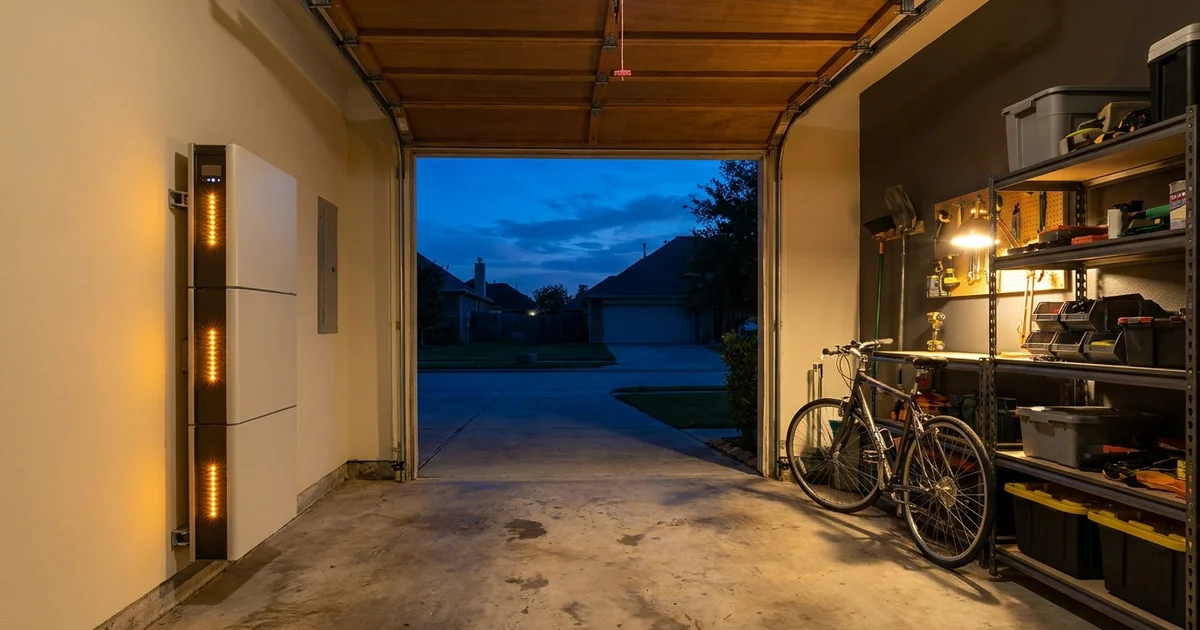
Most posts about LFP versus NMC are about what LFP gains: a wider thermal margin and more cycles. We have written those posts ourselves. This one is about the other side of the ledger, because every chemistry choice costs something, and in a garage the cost shows up as kilograms and wall space.
I'll keep to what I could verify. The numbers below come from a published engineering review and from manufacturer datasheets, and where the Eos 9 kWh module's own figures are not published on our site, I say so instead of guessing.
Key Takeaways
- LFP cells hold less energy per kilogram and per liter than the best NMC cells. A widely cited review lists LFP cells at about 120 to 131 Wh/kg, against 130 to 241 Wh/kg for the NMC cells in the same table (Ding et al., 2019).
- On a garage wall that gap becomes weight and size you can measure. A published Sigenergy datasheet lists a LiFePO4 8 kWh module at 70 kg and 767 x 270 x 260 mm (Sigenergy datasheet).
- Cell-level density tables overstate the problem for a stationary battery, because you pay for the gap once, in wall space, not on every mile.
- Chemistry is only one part of the footprint. Always ask for the exact module's weight and dimensions before the site visit.
What are LFP and NMC, and what does "energy density" mean?
LFP is lithium iron phosphate (LiFePO4). NMC is lithium nickel manganese cobalt oxide. Both are lithium-ion, and both can power a home. They differ in the cathode, and the cathode sets how much energy fits in a given mass and volume.
Energy density comes in two forms. Gravimetric density is watt-hours per kilogram, which tells you how heavy the battery is. Volumetric density is watt-hours per liter, which tells you how big it is. A home battery buyer cares about both: one decides who can lift the module, the other decides how much of the wall it takes.
How big is the gap between LFP and NMC cells?
Real, but smaller and messier than marketing implies. A peer-reviewed review of automotive lithium-ion batteries lists cell and pack figures side by side (Ding et al., Electrochemical Energy Reviews, 2019, full text via OSTI). In its table:
| Cell | Wh/kg | Wh/L |
|---|---|---|
| LFP (A123 pouch) | 131 | 247 |
| LFP (BYD prismatic) | 120 | 220 |
| NMC (VW e-Golf prismatic) | 130 | 215 |
| NMC (LG Chem pouch, Chevrolet Bolt) | 186 | 393 |
| NMC (LG Chem pouch, Renault Zoe 2017) | 241 | 466 |
Two readings of that table are honest. The best NMC cell on the list holds roughly twice the energy per kilogram and per liter of the LFP cells. But the weakest NMC cell on the same list, the e-Golf prismatic, is no denser than LFP. "NMC is denser" is true of a cell design, not of the chemistry in every format.
Two cautions. These are automotive cells from 2008 to 2017, so newer LFP designs likely do better, and I did not find a current residential-cell comparison from a primary source. And the review itself notes that LFP's low volumetric density suits it better to heavy-duty uses than to portable electronics and cars, where volume matters most, while still seeing a market for it in power supply systems "owing to its low cost and long cycle life" (Ding et al., 2019). A garage wall is the second kind of use.
What does that look like on a garage wall?
A datasheet gives you a measurable answer. Sigenergy's published sheet for its 5 and 8 kWh modules lists the 8 kWh unit as LiFePO4, 8.06 kWh nominal, 70 kg, 767 mm wide, 270 mm high and 260 mm deep, IP66, installable floor-standing or wall-mounted (Sigenergy datasheet). That is about 8.7 kg per nominal kWh.
For comparison, Tesla's Powerwall 3 datasheet lists 130 kg and 1,099 x 609 x 193 mm for 13.5 kWh, floor or wall mount (Tesla Powerwall 3 datasheet). That works out to roughly 9.6 kg per kWh. Do not read that as a chemistry verdict: the Powerwall 3 includes an integrated inverter and solar inputs, and the Sigenergy module is battery only. Per-kWh weights across different products are not like for like.
The practical point is simple. At roughly 70 kg a module is not something one person carries up a ladder, so the mounting method, the base and the wall structure are part of the job, not an afterthought.
What about the Eos 9 kWh module? The repo and our plan pages state 9 kWh nominal and 8.76 kWh usable per module (Essential plan). Weight and dimensions for the 9 kWh model are not published on our site, and the only figures I could fetch for the Sigenergy family are the 8 kWh sheet above. Ask your installer for the current datasheet for the exact module on your quote, and treat the 70 kg figure as an indication, not a spec.
Why does the density gap matter less in a house?
Because you pay it once. An electric vehicle hauls its battery mass over every mile, so a denser cell makes the car lighter and more efficient every day. A home battery sits on a wall. Extra kilograms cost you nothing per day. They cost you a stronger mounting, a heavier lift on install day, and a few more centimeters of wall.
Wall space is the part the plan structure helps with. Per our plan specs, extra capacity comes from stacking more modules vertically on the same wall, with one controller rated for 11.5 kW continuous and 17.1 kW surge (plan specs). The Essential plan has one module with 8.76 kWh usable and up to 6 hours at minimal load, Plus has two modules with 17.52 kWh usable and up to 12 hours, and Pro has three with 26.28 kWh usable and up to 18 hours. A taller stack uses height, not floor area, which is the scarce thing in a two-car garage with bikes, shelves and a freezer.
If your garage is already full, read our guide to batteries on a detached garage, shed or ADU for what changes when the equipment cannot go on the main house wall.
What do you get in return for the extra mass?
Three things, each covered in more depth elsewhere, so here is the short version.
- Cycle life. In published Sandia cycling tests, LFP cells lasted far more equivalent full cycles to 80 percent capacity than NMC cells. Our degradation guide walks through the study and the numbers. A home battery cycles on the same wall for a decade or more, so this is the trait that earns the weight.
- Thermal margin. LFP reaches thermal runaway later than NMC in published testing, though LFP is not immune. Our fire safety guide has the standards, the sources and the caveats. That matters in a garage that shares a wall with the house.
- No cobalt. NMC and NCA contain cobalt, and LFP does not. The same Ding review notes that cobalt brings "toxicity, high price, and limited production," with about half of cobalt reserves and production concentrated in the Democratic Republic of the Congo and Zambia. The flip side, per a U.S. Department of Energy supply chain report, is that LFP is of little value to recyclers (DOE Grid Energy Storage Supply Chain Deep Dive). We cover that in home battery recycling in Texas.
What does the Eos module use?
LFP. Our comparison data states that Eos systems use lithium iron phosphate chemistry, and Sigenergy's published datasheet for the module family lists LiFePO4 (Sigenergy datasheet). The same sheet lists an operating range of minus 20 to 55 degrees Celsius for the 5 and 8 kWh modules. How a battery behaves in sustained garage heat is a separate question with its own answer in our Houston heat derating guide, and I am not going to fold it into a chemistry argument.
If you are comparing brands rather than chemistries, our brand comparison for Texas puts the major systems side by side.
What did we leave out on purpose?
- A single "LFP is X percent lighter or heavier" figure for residential modules. Published numbers are cell-level and automotive, and the residential products differ in what they include.
- Current cell-level densities for 2026 LFP and NMC. The review I could fetch is from 2019, and the sources that gave newer figures were vendor blogs. I'd rather give you an older number I can cite than a newer one I cannot.
- Weight and dimensions of the Eos 9 kWh module. Not published on our site. Ask for the datasheet.
- Cost-per-kWh figures by chemistry. I did not find a primary source I could fetch for 2026.
What to do next
- Measure the wall: width, height from slab, and what is behind it. A tall stack needs clear height, not just floor area.
- Ask for the weight and dimensions of the exact module and any base or bracket.
- Ask what the wall is made of and how the installer plans to carry the load.
- Decide what else has to stay on that wall: panel, water heater, shelving.
Or call Eos at 833-989-3737 to talk through your garage with an installer.
Frequently asked questions
Is LFP always heavier than NMC for the same kWh?
Not in every product. In the cell data from Ding et al., LFP cells hold 120 to 131 Wh/kg while NMC cells range from 130 to 241 Wh/kg, so the best NMC cells are lighter per kWh and some NMC cells are not (Ding et al., 2019). At the module level the enclosure, cooling and electronics also count.
Does LFP take more wall space than NMC?
At the cell level, usually yes for the densest NMC designs. For a finished home battery, the answer depends on the product, so compare datasheet dimensions rather than the chemistry label.
Is a 70 kg battery safe to hang on a garage wall?
That is a question for the installer and the wall, not for the chemistry. Sigenergy lists both floor-standing and wall-mounted installation for its modules (Sigenergy datasheet). Ask how your install will be supported.
Is LFP worth the extra weight?
For a battery that sits on a wall for a decade, the cycle life and thermal margin are the reasons most manufacturers use it. See our degradation guide and fire safety guide for the evidence.