How Much Capacity Will Your Home Battery Lose in 10 Years?

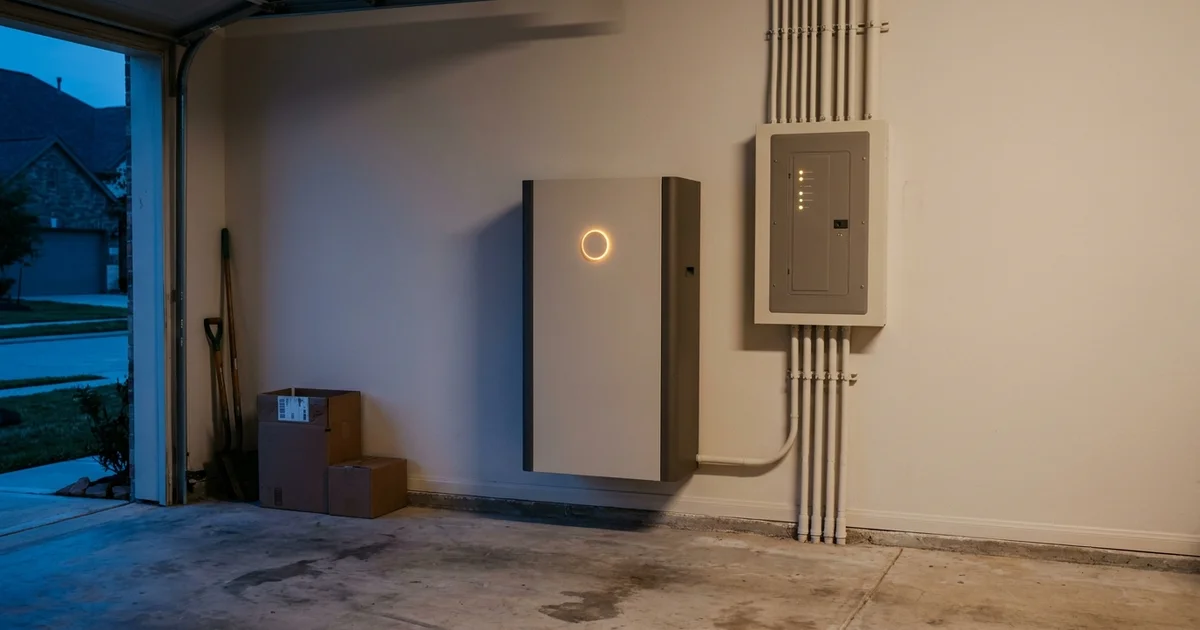
Most people arrive at this question with an electric car in their head. They've read that EV packs wear out from charging and discharging, so they assume a home battery works the same way: more cycles, faster decline. For a backup battery in Houston, that instinct points at the wrong mechanism entirely. Your battery spends almost every hour of its life sitting still, at some state of charge, at some temperature, doing nothing. That idle time is what wears it down. Here's what the aging research actually says, how warranties encode it, and how to size a system so year ten still works.
Key Takeaways
- Lithium batteries age two ways: cycle aging from use and calendar aging from simply existing. A backup-only system in Houston is dominated by the second one.
- Sandia's multi-year cycling study found LFP cells reached 80% capacity after 2,500 to 9,000 equivalent full cycles, versus 200 to 2,500 for NMC (Preger et al., Journal of The Electrochemical Society, 2020).
- Eos guarantees at least 70% capacity retention through year 10, and plans around 85% to 90% in normal use.
- Size for the runtime you want in year ten, not the runtime on install day.
What Actually Makes a Home Battery Lose Capacity?
Two mechanisms, running at the same time. Cycle aging comes from charging and discharging: lithium moves, electrodes expand and contract, particles crack. Calendar aging happens whether you touch the battery or not, driven mainly by growth of the solid electrolyte interphase, a resistive film on the anode that permanently consumes usable lithium as it thickens.
The second one surprises people. In 2022, a physics-based SEI model validated across 62 automotive cells and 28 aging protocols found that the operating window, meaning the voltage and state of charge the cell sits in, had the largest effect on SEI growth, while the applied current was almost negligible (von Kolzenberg et al., "A four parameter model for the solid-electrolyte interphase to predict battery aging during operation," Journal of Power Sources, 2022). Where the cell rests matters more than how hard you push it.
The two mechanisms aren't independent, either. A 2026 electrochemical-thermal degradation model showed calendar and cycle aging competing and reinforcing each other depending on temperature, rest state of charge, and depth of discharge, producing sub-linear, linear, or accelerating fade curves from the same hardware (Madabattula, "Linking Calendar and Cycle Ageing in Lithium-Ion Batteries," 2026). That's why a single "X% per year" number is a fiction. The rate depends on how the battery lives.
Why a Houston Backup Battery Ages by the Calendar, Not the Cycle Counter
Run the arithmetic on cycles and the picture flips. In 2024, U.S. electricity customers averaged 11 hours without power, the worst year in a decade, with about 80% of those hours coming from major weather events (U.S. Energy Information Administration, December 2025). Excluding major events, the annual average has sat near two hours for years (EIA, November 2021).
So a backup-only battery in a normal year might see a handful of partial discharges. Call it five or ten equivalent full cycles annually. Over a decade, that's maybe 100 cycles against an LFP cell rated in the thousands. The cycle counter will never be the thing that ends this battery's life. Meanwhile the calendar runs 8,760 hours a year, every year, at whatever charge level and whatever temperature your garage happens to be.
That reframing changes what you should care about. Not "how many times will I use it," but "what conditions does it sit in between uses."
How Warranties Actually Express Degradation
A storage warranty is three numbers, not one. There's a term in years. There's a capacity retention percentage you're guaranteed at the end of that term. And there's usually a throughput cap, expressed in total kWh delivered or total cycles. Whichever limit you hit first ends the coverage. A homeowner comparing "10 years" against "10 years" without reading the other two numbers is comparing nothing.
Eos systems carry a 10-year manufacturer warranty on the battery, controller, and smart panel, with a guaranteed floor of 70% capacity retention at year 10. Internally we plan around 85% to 90% retention in normal residential backup service, because the throughput a backup-only system accumulates is so far below what the cells are rated for. The 70% figure is the contractual floor, not the expectation.
Here's the part worth underlining: for a backup system, the throughput cap is almost decorative. You will not discharge enough energy in ten years to approach it. The term and the retention percentage are the numbers that govern. If a competing warranty pairs a long term with a throughput cap low enough that heavy daily cycling would blow through it, that tells you the product was priced for a different use case than yours.
For the full component-level specs behind these systems, including usable capacity per module and controller output, see the specifications page or browse the plan tiers. If you want the mechanics of filing when something does go wrong, we covered that in the home battery warranty claim process.
LFP vs NMC: Why Chemistry Matters More at Year Ten Than Year Two
Sandia National Laboratories cycled commercial 18650 cells for roughly three years across three chemistries, three state of charge windows (40 to 60%, 20 to 80%, 0 to 100%), several discharge rates, and temperatures from 15 to 35 °C. Cells reached 80% of original capacity after 2,500 to 9,000 equivalent full cycles for LFP, 200 to 2,500 for NMC, and 250 to 1,500 for NCA (Preger et al., Journal of The Electrochemical Society, 2020). The full cycling dataset is published openly (Battery Archive, Sandia study), which is rare and worth something when you're evaluating claims.
Two years in, the chemistries look similar. A residential system that has done 200 cycles hasn't stressed either one. By year ten the gap is the whole story, and it widens further at depth: the Sandia team reported that for every cell in the study, the rate of capacity fade increased as depth of discharge increased, with NMC and NCA more sensitive to full 0 to 100% cycling than LFP.
Eos systems use LFP. That's the reason. Not because it wins a spec sheet on day one, but because it degrades more gracefully across the window a Texas homeowner actually lives in.
What the Homeowner Actually Controls
Three levers, each tied to a mechanism rather than a marketing claim.
State of charge at rest. This is the big one for a backup system, because rest is nearly all it does. A 2025 physics-based analysis of long-term storage simulated 36 months at fixed conditions and found SEI thickness reaching 308.6 nm at 55 °C and 90% state of charge versus 38.0 nm at 25 °C and 10% state of charge, with electrolyte conductivity loss of 22.86% versus 2.5% across those same endpoints (Asiri et al., RSC Advances, 2025). A backup battery has to sit high to be useful, so you can't drop to 10%. But a reserve setting of 80 or 90% instead of a hard 100% buys you real margin at almost no cost in outage coverage.
Thermal environment. Houston makes this concrete. The July normal daily maximum at Bush Intercontinental is 94.5 °F with a normal daily minimum of 75.7 °F over the 1991 to 2020 period (NOAA National Weather Service, Houston/Galveston). An unconditioned garage runs hotter than that in the afternoon. Since LFP capacity fade in the Sandia study increased with temperature across the tested range, siting matters: shaded wall, interior or conditioned space where possible, clearance for airflow. NREL's residential storage modeling reached the same conclusion from the systems side, finding significant variation in battery life driven by use case, climate, and chemistry together, and flagging thermal management as a lever for extending life (Mishra et al., Applied Energy, 2020).
Depth of discharge floor. During an actual outage you'll use what you need. But if you ever run the system in a daily cycling mode, a floor that avoids repeated 0 to 100% swings measurably slows fade, per the Sandia depth of discharge result above. Our post on how often a Houston home battery actually gets used walks through both operating modes.
What 10 to 20 Percent Capacity Loss Actually Means for Backup
It means shorter runtime. That's it. A degraded battery is not a dead battery, and this is where the EV framing does the most damage to people's expectations.
Work an example with published Eos specs. Each battery module is 9 kWh nominal, 8.76 kWh usable, and delivers roughly 6 hours at minimal household load. A three-module system starts at 26.28 kWh usable and about 18 hours at minimal load. At the 70% contractual floor, that same system still delivers roughly 18.4 kWh and about 12 to 13 hours. At the 85 to 90% we actually plan around, you're looking at roughly 15 to 16 hours in year ten. Controller output doesn't degrade the way capacity does, so you keep 11.5 kW continuous and 17.1 kW surge for starting the air conditioner.
The honest planning move, and the one we push in every design conversation: size for year ten, not year one. If 12 hours of coverage is what your family needs during a summer outage, don't buy the system that delivers exactly 12 hours on install day. Buy the one that still delivers 12 hours after a decade of Houston summers. The step up is usually one module, and it costs far less than discovering the gap during a hurricane in 2036. For a runtime-by-tier breakdown, see how long home battery backup lasts in Texas.
Or call Eos at 833-989-3737 to talk through your setup with an installer.
Frequently Asked Questions
How much capacity does a home battery lose per year?
There's no single honest number, because the rate depends on temperature, resting state of charge, and depth of discharge rather than elapsed time alone (Madabattula, 2026). Eos guarantees a floor of 70% retention at year 10 and plans around 85% to 90% in normal backup service.
Does leaving my battery at 100% charge damage it?
It accelerates calendar aging. Modeled over 36 months, storage at 90% state of charge and high temperature produced roughly eight times the SEI thickness of low-charge, moderate-temperature storage (Asiri et al., RSC Advances, 2025). A reserve target of 80 to 90% keeps outage readiness while easing that stress.
Is LFP really better than NMC for a home battery?
Over a ten-year horizon, yes. Sandia measured 2,500 to 9,000 equivalent full cycles to 80% capacity for LFP versus 200 to 2,500 for NMC (Preger et al., 2020). LFP was also less sensitive to full 0 to 100% cycling.
Will Houston heat wreck my battery?
It shortens life at the margin rather than causing sudden failure. July normals at Bush Intercontinental average a 94.5 °F daily high (NWS Houston/Galveston), so siting and airflow matter. Routine care is covered in our Houston battery maintenance guide.
Do I need to replace the battery at year 10?
Almost never. The warranty term ends at year 10, but the hardware keeps working with reduced runtime. LFP cells rated for thousands of cycles will have seen a few hundred at most in backup-only service, so the practical limit is calendar aging, and that curve is gradual.
Sources
- Preger, Y. et al., "Degradation of Commercial Lithium-Ion Cells as a Function of Chemistry and Cycling Conditions," Journal of The Electrochemical Society 167, 2020, retrieved 2026-09-08, https://iopscience.iop.org/article/10.1149/1945-7111/abae37
- Battery Archive, "Sandia National Laboratories Study Overview," retrieved 2026-09-08, https://batteryarchive.org/snl_study.html
- Asiri, M. et al., "Impact of temperature and state-of-charge on long-term storage degradation in lithium-ion batteries," RSC Advances, 2025, retrieved 2026-09-08, https://pmc.ncbi.nlm.nih.gov/articles/PMC12219620/
- von Kolzenberg, L. et al., "A four parameter model for the solid-electrolyte interphase to predict battery aging during operation," Journal of Power Sources 539, 2022, retrieved 2026-09-08, https://arxiv.org/abs/2112.13671
- Madabattula, G., "Linking Calendar and Cycle Ageing in Lithium-Ion Batteries through Consistent Parameterisation of an Electrochemical-Thermal-Degradation Model," 2026, retrieved 2026-09-08, https://arxiv.org/abs/2604.09217
- Mishra, P. P. et al., "Analysis of degradation in residential battery energy storage systems for rate-based use-cases," Applied Energy 264, National Renewable Energy Laboratory, 2020, retrieved 2026-09-08, https://www.osti.gov/biblio/1603260
- U.S. Energy Information Administration, "Hurricanes in 2024 led to the most hours without power in the United States in 10 years," December 2025, retrieved 2026-09-08, https://www.eia.gov/todayinenergy/detail.php?id=66744
- U.S. Energy Information Administration, "U.S. electricity customers experienced eight hours of power interruptions in 2020," November 2021, retrieved 2026-09-08, https://www.eia.gov/todayinenergy/detail.php?id=50316
- NOAA National Weather Service Houston/Galveston, "Houston IAH Normals/Means/Extremes, July," 1991-2020 normals, retrieved 2026-09-08, https://www.weather.gov/hgx/climate_iah_normals_jul