What Happens to a Home Battery at End of Life? Recycling and Disposal in Texas

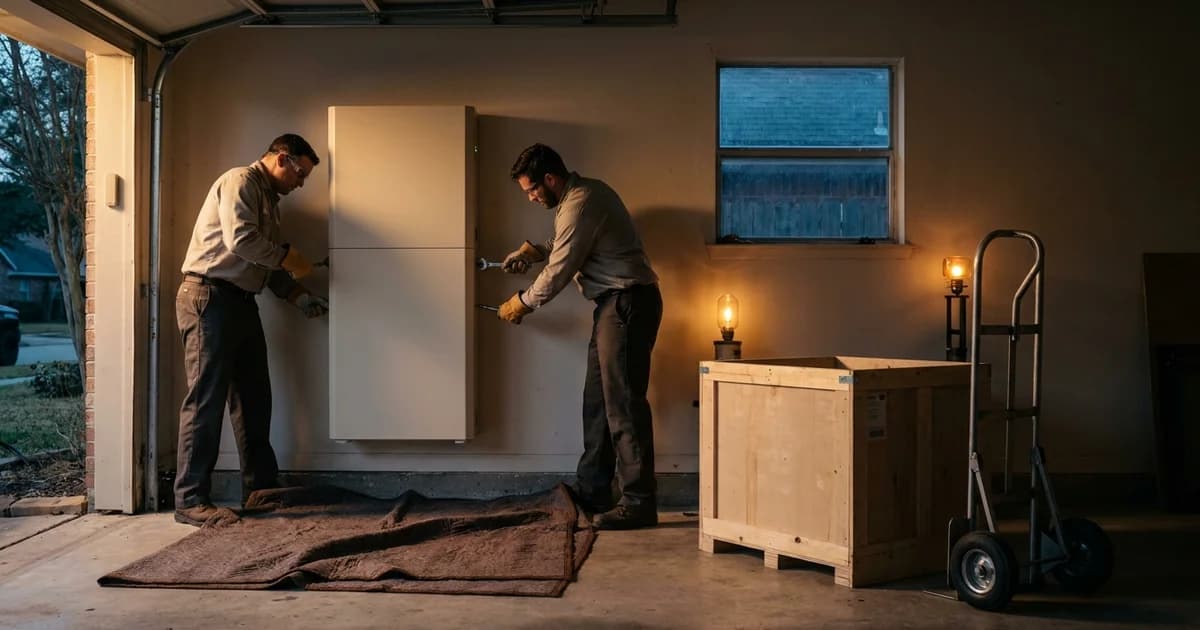
Ask an installer what happens to your battery in year fifteen and watch for the pause. It is a fair question, and the honest answer is more interesting than most brochures suggest. A home battery rarely dies in a dramatic way. It fades, and eventually the math says replace it. What happens after that is governed by federal and Texas waste rules almost no homeowner has read, plus one contract clause that almost nobody checks before signing.
Key Takeaways
- The EPA is explicit: "Do not place the waste lithium batteries in the household trash or in curbside recycling bins" (EPA, 2026).
- Home batteries that count as hazardous waste can be handled under the universal waste rules in 40 CFR Part 273, adopted in Texas as 30 TAC Chapter 335, Subchapter H (TCEQ, 2026).
- Most systems get retired on capacity or on economics, not on catastrophic failure.
- Damaged or defective lithium batteries are regulated in transport under 49 CFR 173.185 and banned from aircraft, so removal is not a weekend project.
- Get the take back commitment in writing before you sign the install contract.
What does end of life actually mean for a home battery?
In 2025, a review published in iScience put the average service life of lithium iron phosphate batteries at 8 to 10 years (iScience, "Recycling and reuse of lithium iron phosphate battery multi-component and sustainability assessment: A review", 2025). That figure covers vehicle packs, which cycle far harder than a wall-mounted home unit does. Still, it sets the honest frame: end of life is a capacity threshold, not a funeral.
Here is the correction most buyers need. A home battery is normally retired for one of two reasons. Either it has faded below the capacity you actually need on an outage night, or a replacement costs less per usable kilowatt-hour than continuing to nurse the old one. Neither of those is failure. The unit usually still works on the day it comes off the wall.
That distinction changes the question you should be asking a salesperson. Not "how long will it last," which invites a number nobody can guarantee, but "what is the retirement path, and who owns it." For how capacity actually declines over a decade in Texas heat, see our breakdown of home battery degradation over ten years. If the unit is still healthy and you are simply leaving the house, the conversation is different again: read what happens to a home battery when you move.
Can you throw a home battery in the trash in Texas?
No. The EPA's guidance is unambiguous: "Li-ion batteries and devices containing these batteries should NOT go in household garbage or recycling bins" and "SHOULD be taken to separate recycling or household hazardous waste collection points" (EPA, Used Lithium-Ion Batteries, 2026). The reason is fire. A cell that gets crushed in a collection truck or in sorting equipment can ignite, and those fires have been climbing across the country.
There is a wrinkle worth understanding. Federally, waste generated during normal household activity falls under a household exclusion, so a homeowner is not technically a regulated hazardous waste generator. The EPA still recommends against trash disposal anyway (EPA, Lithium-Ion Battery Recycling FAQ, 2026). And that exclusion evaporates the moment a contractor removes the unit for you, because the contractor is a business.
In May 2023 the EPA issued a memorandum clarifying how the universal waste and hazardous waste recycling rules apply to lithium-ion batteries (Florida DEP summary of the USEPA memorandum, 2023). The practical takeaway: most lithium-ion batteries in use today are likely hazardous waste on ignitability and reactivity, and they can be managed under the streamlined universal waste standards in 40 CFR Part 273 rather than the full hazardous waste rules.
One detail catches people out. A handler may manage a broken or damaged battery as universal waste only if the damage does not breach an individual cell casing (40 CFR 273.13). A swollen or punctured module leaves the easy path immediately.
How Texas layers on top
Texas adopts the same framework. TCEQ confirms that hazardous waste batteries may be managed as universal waste under 40 CFR Part 273 and 30 TAC Chapter 335, Subchapter H (TCEQ, Managing Universal Waste, 2026). Handlers who accumulate 5,000 kg, about 11,000 pounds, or more must register with the EPA and obtain an EPA identification number, while smaller handlers face no registration or permit requirement (TCEQ, Managing Electric Vehicle Batteries, 2026). Facilities that send or receive batteries for recycling also file notification forms under 30 TAC 335.6.
Universal waste can generally be stored for a year before it has to move (EPA, Universal Waste, 2026). That is why a legitimate removal crew does not need to rush your battery to a facility the same afternoon, and why "we will hold it at our shop" is a normal answer rather than a red flag.
Who actually takes a wall-mounted home battery?
Three parties, in descending order of usefulness. The manufacturer, through a take back or stewardship commitment. A permitted recycler or hazardous waste facility that handles high energy formats. And your installer, who is the one who physically gets it off the wall.
National collection networks exist and they are real. The organization formerly known as Call2Recycle, now operating as The Battery Network, lists more than 20,000 battery drop-off locations across North America and runs distinct programs for e-bike, high energy, EV, and damaged or defective batteries (The Battery Network, 2026). What their public pages do not spell out is a weight limit or an acceptance rule for residential stationary storage modules at ordinary retail drop-off sites, so treat that as unverified until you call and ask. A hardware store counter bin is built for AA cells and drill packs, not for a 100-pound wall module.
Consumer drop-off sites around Houston follow the same logic. City Environmental Service Centers accept household rechargeable batteries from residents who can show proof of a Houston address, but a stationary storage module pulled off a wall by a contractor is a different waste stream entirely.
Verify take back in the contract, before you buy
This is the part almost nobody does, and it is the highest-leverage advice in this article. A take back promise on a marketing page is not a commitment. Get it into the document you sign.
What we see in competing quotes. Among the proposals homeowners bring us for a second opinion, end of life language is the clause most often missing. Warranty terms are almost always spelled out. Removal and disposal responsibility usually is not.
Four questions to put to any installer in writing:
- Who removes the unit at end of life, and at whose cost? Get the party named. "The manufacturer" is not somebody you can call in year fourteen.
- Where does the battery physically go? Ask for the destination type: a permitted recycler, a universal waste handler, or a manufacturer return channel. Ask whether you get a receipt or a bill of lading.
- Does the obligation survive a company change? Manufacturers get acquired and installers close. Ask what happens to the commitment if either does.
- Who handles it if the unit is damaged? Damaged modules fall out of the streamlined universal waste path and cost more to move. Settle that now.
If an installer cannot answer those four in writing, that tells you something about how they will behave in year ten too. The same instinct applies to service: our guide to the home battery warranty claim process covers who you call first when something fails mid-life, and our Houston battery maintenance guide covers the checks that keep coverage intact in between.
What actually happens inside the recycling process?
Retired packs are discharged, disassembled, and then either shredded into a mixed powder for chemical recovery or processed directly to recover cathode material. For lithium iron phosphate specifically, the economics are genuinely hard. The 2025 iScience review reports that "the global recycling efficiency for LFP batteries stagnates at approximately 10%, and 90% of valuable materials remain unutilized," with lithium as the highest-value recovery target and iron and phosphorus contributing little on their own (iScience, 2025).
That is the uncomfortable flip side of LFP's safety advantage. The chemistry that makes it a good fit for a garage wall, no cobalt and no nickel, is also the chemistry that leaves a recycler the least to sell. Recovery rates should improve as processes mature. Nobody should buy a battery today on the assumption that it will be profitable to recycle in 2041.
Second life is the other pathway. Modules that keep structural integrity and useful residual capacity can be redeployed into less demanding applications, and that is an active research area (iScience, 2025). Be skeptical of anyone who describes it as a mature consumer option. Reliable public figures for how much retired residential storage in the United States actually reaches a second-life application do not appear to exist, and we are not going to invent one. Testing state of health module by module costs real money, and that cost is what keeps most second-life work at pilot scale.
Why you cannot haul it off yourself
Transport is the hard stop. Under 49 CFR 173.185, lithium cells and batteries that are damaged or defective "may be transported by highway, rail or vessel only," are prohibited from aircraft, and must be packed in non-metallic inner packaging surrounded by non-combustible, non-conductive, absorbent cushioning inside an approved outer container marked "Damaged/defective lithium ion battery." Paragraph (d) of the same section provides a narrower allowance for cells and batteries moved by motor vehicle to a permitted storage facility, a disposal site, or for recycling.
Read that list again and notice what it implies. Compliant transport of a suspect module needs specified packaging, specified marking, and a shipper who knows the rules. A pickup bed and a ratchet strap are not on the list. This is the concrete reason end of life removal belongs to your installer rather than to you, and the reason the contract questions above are worth more than any line in the warranty.
What this means before you buy
Plan for a system you will not resent in year twelve. Size it correctly the first time, since an undersized battery gets retired early for reasons that have nothing to do with the cells. Buy from a company that will still answer the phone. And ask the four contract questions while you still have leverage, which is before the deposit clears, not after. Comparing capacity tiers side by side helps here, and our plan lineup lays out usable capacity against runtime. If you are shopping a home that already has a battery installed, the same questions apply: our guide to buying a house with battery backup in Texas walks through the transfer paperwork.
Or call Eos at 833-989-3737 to talk through your setup with an installer.
Frequently Asked Questions
Is a home battery hazardous waste in Texas?
Most lithium-ion batteries in use today are likely hazardous waste on ignitability and reactivity, and TCEQ allows those that qualify to be managed as universal waste under 40 CFR Part 273 and 30 TAC Chapter 335, Subchapter H (TCEQ, 2026). A homeowner sits inside the household exclusion. A contractor removing the unit does not.
Can I put a home battery module in curbside recycling?
No. The EPA states directly that waste lithium batteries should not go in household trash or curbside recycling bins, because crushed cells start fires in trucks and sorting facilities (EPA, 2026). Take back through your installer or a permitted recycler is the correct route.
How long can a retired battery sit before it has to be recycled?
Universal waste can generally be accumulated for one year before it must move to a destination facility (EPA, 2026). That gives a legitimate removal crew room to consolidate a load, so a short holding period at an installer's shop is normal rather than suspicious.
Does LFP chemistry get recycled profitably today?
Not yet, at scale. The 2025 iScience review reports global LFP recycling efficiency stalling near 10 percent, with roughly 90 percent of valuable material unrecovered (iScience, 2025). Lithium is the value driver, while iron and phosphorus contribute little on their own.
Who pays to remove a battery at end of life?
Whatever your contract says. There is no default answer in Texas law, which is exactly why the removal and disposal clause needs to be named and priced in the document you sign, alongside the warranty terms and the service commitment.
Sources
- U.S. Environmental Protection Agency, "Lithium-Ion Battery Recycling Frequently Asked Questions," retrieved 2026-09-08, https://www.epa.gov/hw/lithium-ion-battery-recycling-frequently-asked-questions
- U.S. Environmental Protection Agency, "Used Lithium-Ion Batteries," retrieved 2026-09-08, https://www.epa.gov/recycle/used-lithium-ion-batteries
- U.S. Environmental Protection Agency, "Universal Waste," retrieved 2026-09-08, https://www.epa.gov/hw/universal-waste
- Texas Commission on Environmental Quality, "Managing Universal Waste," retrieved 2026-09-08, https://www.tceq.texas.gov/permitting/waste_permits/ihw_permits/ihw_universal_waste.html
- Texas Commission on Environmental Quality, "Managing Electric Vehicle Batteries," retrieved 2026-09-08, https://www.tceq.texas.gov/permitting/waste_permits/ihw_permits/managing-electric-vehicle-batteries
- Legal Information Institute, "40 CFR 273.13, Waste management," retrieved 2026-09-08, https://www.law.cornell.edu/cfr/text/40/273.13
- Legal Information Institute, "49 CFR 173.185, Lithium cells and batteries," retrieved 2026-09-08, https://www.law.cornell.edu/cfr/text/49/173.185
- Florida Department of Environmental Protection, "USEPA Lithium Battery Recycling Regulatory Status Update and FAQ," May 2023 memorandum, retrieved 2026-09-08, https://floridadep.gov/waste/permitting-compliance-assistance/documents/usepa-lithium-battery-recycling-regulatory-status
- Wang et al., "Recycling and reuse of lithium iron phosphate battery multi-component and sustainability assessment: A review," iScience, 2025, retrieved 2026-09-08, https://pmc.ncbi.nlm.nih.gov/articles/PMC12804622/
- The Battery Network (formerly Call2Recycle), retrieved 2026-09-08, https://batterynetwork.org/