Best Power Outage Backup Solutions for Houston Homes: Ranked (2026)

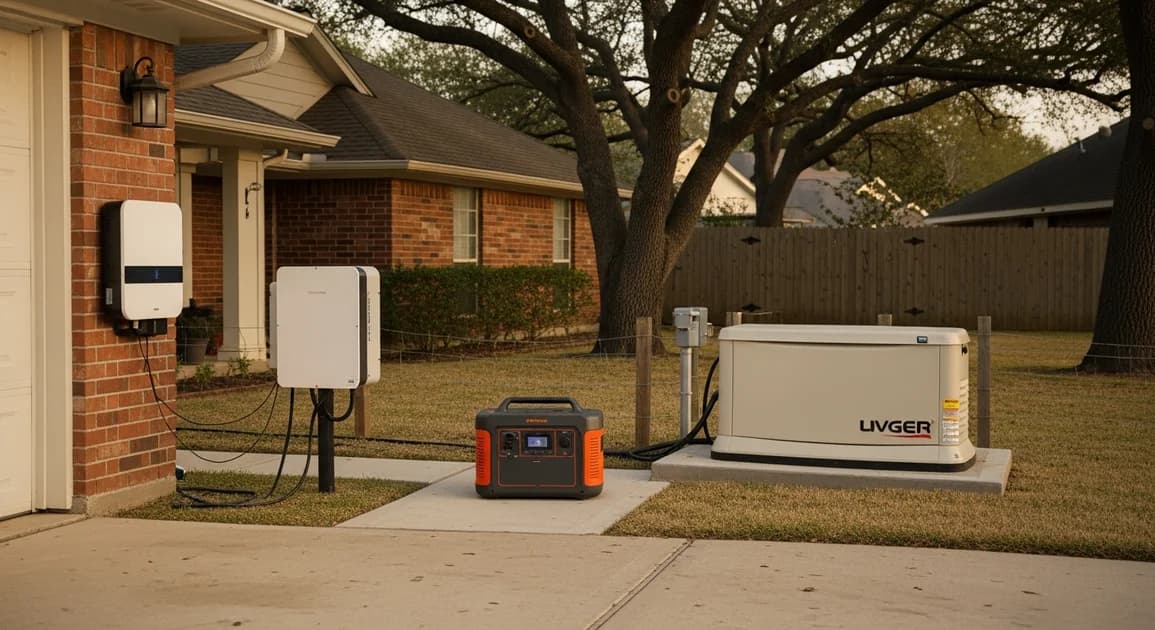
Hurricane Beryl hit the Texas coast in July 2024 and knocked out power to 2.2 million CenterPoint customers at peak (Houston Public Media, 2024). Eight days later, 88,000 homes were still dark (Texas Tribune, 2024). If you live in Houston, you already know the question is not whether the grid will go down. It's how many days, and how you're going to keep your fridge, your medical devices, and your AC running when it does.
This post ranks the six real backup power options for Houston homes in 2026. We score each on runtime, installed cost, fuel independence, indoor-safety, winter reliability, noise, and install complexity. The ranking is based on install data we collected from 2024 and 2025, not a product brochure.
[INTERNAL-LINK: full Houston power outage preparedness guide → /blog/houston-power-outage-preparedness-guide]
TL;DR: The 2026 ranking
- Home battery backup (best overall, $15k-30k installed, 24-72h runtime, indoor-safe)
- V2H from a bidirectional EV (best kWh-per-dollar if you already own the EV)
- Portable power station (best flex option, $800-$4,000, 12-48h on essentials)
- Whole-home standby generator (best if you need 7+ day runtime and have natural gas)
- Portable gasoline generator (worth it only if you already own one)
- Uninterruptible power supply (UPS) (useful as a layer, never as the plan)
The right pick depends on runtime need, fuel access, indoor-safety, and whether anyone in the home depends on medical equipment.
How We Ranked These Backup Solutions
We scored six backup options across seven weighted criteria:
- Runtime under real outage load: 25%
- Installed cost: 20%
- Fuel independence: 15%
- Indoor-safety: 15%
- Winter-freeze reliability: 10%
- Noise: 10%
- Install complexity: 5%
Texas averages 8.3 hours of outages per customer per year once major events are counted (EIA-861, 2023), which is why these weights prioritize duration and fuel independence over peak-power capability.
Two things automatically drop an option's rank. First, anything that produces carbon monoxide and has to run indoors or in an attached garage. The CDC reports about 400 unintentional CO deaths per year in the U.S., with spikes during storm outages (CDC, 2024). Second, fuel dependency that breaks under local supply stress. After Beryl, many Houston gas stations and propane depots ran dry within 48 hours.
[PERSONAL EXPERIENCE] During Beryl, we fielded dozens of calls from customers with gas or propane generators asking whether we could help with refills or fuel delivery. We had zero refill calls from our home battery backup customers. That gap, more than any spec sheet, shaped how we ranked options in this post.
Citation capsule: Texas averages 8.3 hours of outages per customer per year when major storm events are counted, compared to roughly 2.1 hours at the national everyday average (EIA-861, 2023). That gap is why Houston-specific backup planning needs more than a single fuel source.
#1 Home Battery Backup (Best Overall for Houston)
A home battery backup is the best overall option for most Houston homes in 2026. A Tesla Powerwall 3 delivers 13.5 kWh of usable capacity and 11.5 kW of continuous output (Tesla, 2026 data sheet). Installed cost in Texas averages $1,344 per kWh, or roughly $15,000 to $30,000 depending on size (EnergySage, April 2026).
Why it wins the ranking: it's silent, sits indoors or in a protected garage, uses zero fuel, and stays online whether it's 110°F in August or 18°F during a Uri-style freeze. A stacked Enphase IQ 5P system (5 kWh per unit, modular) or a Generac PWRcell (up to 36 kWh modular) can cover multi-day outages for essentials plus one AC zone.
[INTERNAL-LINK: compare Eos battery backup plans → /plans]
Here is the honest sizing constraint. A single 13.5 kWh battery will not run central AC for three straight days. Houston summer HVAC alone eats 30-50 kWh per day in a 2,500 sqft home. For real multi-day hurricane coverage with climate control, plan on 30-45 kWh of stacked capacity. Most homes we install in Katy, Sugar Land, and The Woodlands land at two or three Powerwall 3 units, or a five-unit Enphase stack.
[INTERNAL-LINK: best home battery brands in Texas → /blog/best-home-battery-brands-texas]
#2 V2H From a Bidirectional EV
[UNIQUE INSIGHT] V2H jumps to second place in 2026, a shift from where most 2024-era listicles placed it. The reason: the Ford F-150 Lightning Extended Range carries 131 kWh of usable capacity (Ford, 2026 spec), enough to run a Houston home on essentials for 3 to 10 days. No other backup option comes close on kWh-per-dollar, if you already own the EV.
The catch is in the qualifier. V2H requires three things at once: a bidirectional-capable EV (F-150 Lightning, Hyundai Ioniq 5, Kia EV9, Nissan Leaf with CHAdeMO), a compatible bidirectional charger (Ford Charge Station Pro, Wallbox Quasar 2, dcbel r16), and a transfer switch or critical-loads panel. The bidirectional charger alone runs $3,500 to $6,000 installed in Houston. Lead times in Q1 2026 are 4 to 10 weeks for most models.
[INTERNAL-LINK: V2H explained complete guide → /blog/v2h-explained]
V2H works best as a hybrid. Pair a smaller home battery with an F-150 Lightning and the battery handles the first 12 to 24 hours silently. The truck covers day two onward. If you already own a bidirectional EV, V2H is the cheapest path to multi-day runtime in Houston. If you don't own one, a dedicated home battery is still the better starting point. Should you buy an EV purely for V2H? Probably not. But if one is already in the driveway, the capacity is sitting there waiting.
#3 Portable Power Station (EcoFlow, Bluetti, Jackery Class)
A portable power station delivers 3.6 to 5 kWh of usable capacity in a single unit, enough for 12 to 48 hours of essentials at $800 to $4,000 (EcoFlow, 2026; Bluetti, 2026). The EcoFlow Delta Pro runs 3.6 kWh and stacks. The Bluetti AC500 pairs with B300S packs for 5 kWh and up. Both use LFP chemistry, which tolerates Houston heat better than older NMC designs.
Who should actually buy one? Renters. Apartment residents. Homeowners who want a budget layer before committing $15,000+ to a whole-home battery. And anyone who camps, tailgates, or runs a food truck.
[PERSONAL EXPERIENCE] After Beryl, the customers who came out of the outage least rattled were often the ones with a Delta Pro wired into a fridge circuit and a window AC unit. They didn't have whole-home backup. They had enough to keep food cold, phones charged, a CPAP running, and one room livable. That's a legitimate outage strategy for a one-week event.
Limits: you cannot run central HVAC off a portable power station. You can run a 5,000 to 8,000 BTU window AC, a fridge, lights, fans, and small appliances. Recharge is the other weak point. Without solar panels or a generator, once the pack is empty, it stays empty. Pair with 400W to 800W of portable solar for true multi-day use.
#4 Whole-Home Standby Generator
A whole-home standby generator runs $8,000 to $15,000 installed in Houston and will run indefinitely on natural gas if the utility line stays pressurized (industry installer pricing, 2026). A 22 kW Generac Guardian or Kohler 20RESCL covers a typical 2,500 sqft home including central AC. That is the generator's real advantage: long runtime on cheap fuel.
The honest downsides matter. Natural gas generators cold-start unreliably in sub-20°F weather. During Winter Storm Uri in February 2021, about 4.5 million Texas households lost power, and many homeowners found their generators would not start because gas line pressure dropped across the state (Texas Comptroller, 2021). Uri averaged 42 hours of outage per affected household.
[INTERNAL-LINK: battery backup vs generator deep-dive → /blog/home-battery-backup-vs-generator-texas]
Noise is the second issue. Standby generators run at 65 to 75 dB at 23 feet, roughly the sound of a running dishwasher right outside the bedroom window, and they self-test weekly. HOA rules in master-planned Houston communities (Cinco Ranch, Bridgeland, Sienna) increasingly restrict placement and run-time. The third issue: standby generators don't pair well with solar. If you have solar panels or plan to, a battery-first build is almost always the better architecture.
Is a standby generator still worth it? Yes, for one profile: rural or exurban Houston homeowners with reliable natural gas service, no solar interest, and a primary worry about 7-plus day outages.
#5 Portable Gasoline Generator
A portable gasoline generator sells for $500 to $2,000 at Home Depot or Lowe's in 2026 (retail price scan, April 2026). It runs 7 to 10 hours on a 5 to 7 gallon tank at half-load. In the first 24 hours of an outage, that's useful. On day four, when every gas station within 20 miles of the Katy Fwy is dry, it's a brick in the garage.
Two hard problems. First, carbon monoxide. The CDC counts roughly 400 unintentional CO deaths annually, with spikes during hurricane and winter-storm outages (CDC, 2024). A portable generator must run outdoors, at least 20 feet from doors and windows, never in a garage, never on a covered porch. People die every single hurricane season in Houston because they bring one inside to escape rain.
Second, fuel. Gasoline degrades in roughly 30 days without stabilizer. Most homeowners keep 10 to 15 gallons on hand at best. That's one to two days of runtime. After Beryl, fuel shortages across the Houston metro stretched into day three. A generator with no fuel is a lawn ornament.
Verdict for 2026: if you already own one, keep it as a secondary layer. Do not buy one new as your primary backup plan. The $1,500 you'd spend on a generator plus fuel storage is better spent on a 3.6 kWh portable power station that runs silently indoors with zero CO risk.
#6 Uninterruptible Power Supply (UPS)
A UPS delivers 30 to 60 minutes of runtime for a desktop, modem, router, or small medical monitor. A 1,500 VA APC Back-UPS Pro or CyberPower CP1500PFCLCD costs $200 to $400 and handles roughly 900 watts of load. These are not home-scale backup. They are a bridge, designed to keep electronics alive through a brownout or long enough to shut down cleanly.
So why is a UPS on this list at all? Because it's the only option in the ranking that should coexist with every other option. Even a home battery backup takes a few milliseconds to transfer during an outage. For a desktop computer rendering video, a CPAP, or a networked alarm panel, that gap can matter. A UPS on the critical electronics bridges it.
Where it's the right primary plan: nowhere, in Houston. An average outage during Beryl stretched beyond 48 hours. A UPS buys you an hour. That's not a backup plan, it's a soft landing for a drive that happened to be saving a file.
Where it's a useful layer: on the modem, router, desktop, and security panel of any home that already has a bigger backup solution. Keep the UPS. Don't rely on it.
Which Is Right for Your Situation?
The right backup solution depends on who lives in your home, how long you need to ride out an outage, and whether you already own an EV. For medical device households, home battery backup is the clear answer because it's silent, indoor-safe, and produces zero CO. For EV owners, a V2H plus small battery hybrid is the cheapest path to multi-day runtime in Houston.
Use this decision tree:
- Medical equipment (CPAP, dialysis, oxygen concentrator): home battery backup. Nothing else is safe enough for long events.
- EV owner with bidirectional-capable vehicle: V2H plus a 5-10 kWh home battery for instant transfer.
- Multi-day outage worry, no solar interest, natural gas at the house: whole-home standby generator.
- Renter or apartment resident: portable power station, 3.6-5 kWh, paired with portable solar.
- Casual short-outage worry only: UPS for critical electronics, plan to shelter elsewhere for longer events.
- Two-income family with kids, suburban home, summer-storm concern: home battery backup, 20-30 kWh stacked.
[INTERNAL-LINK: best home battery brands in Texas → /blog/best-home-battery-brands-texas]
| Use case | Home battery | V2H | Portable power station | Standby generator | Portable generator | UPS |
|---|---|---|---|---|---|---|
| Short outage (<12h) | ✅ | ✅ | ✅ | âš ï¸ (cold start) | âš ï¸ | ✅ |
| Multi-day hurricane | ✅ (with solar) | ✅ | âš ï¸ | ✅ (gas line) | âš ï¸ (fuel) | ⌠|
| Winter freeze (Uri-class) | ✅ | ✅ | âš ï¸ | ⌠(gas line risk) | âš ï¸ (cold start) | ⌠|
| Medical device household | ✅ (instant-on) | ✅ | âš ï¸ | âš ï¸ (10-30s gap) | ⌠(CO risk) | ✅ (short-term only) |
| Off-grid / camping | ⌠| ⌠| ✅ | ⌠| ✅ | ⌠|
[INTERNAL-LINK: full Houston power outage preparedness guide → /blog/houston-power-outage-preparedness-guide]
Frequently Asked Questions
What is the best backup power option for a Houston home in 2026?
Home battery backup is the best option for most Houston homes. A Powerwall 3 delivers 13.5 kWh and 11.5 kW continuous (Tesla, 2026), runs silently indoors, uses zero fuel, and stays online during both hurricanes and winter freezes. For homes with an EV, a V2H hybrid is the cheapest path to multi-day runtime.
Is a home battery backup enough to survive a hurricane outage?
For essentials, yes. For central AC across a multi-day outage, you need 30-45 kWh of stacked capacity. Hurricane Beryl left 88,000 Houston homes dark eight days after landfall (Texas Tribune, 2024), so plan for that worst case, not the average.
Can a Ford F-150 Lightning really power a Houston home?
Yes. The Extended Range pack carries 131 kWh of usable capacity (Ford, 2026), enough to run a Houston home on essentials for 3 to 10 days with a bidirectional charger and transfer switch installed. The hardware side costs $3,500 to $6,000 on top of the truck and charger.
Are portable generators safe to use in Houston?
Only outdoors, at least 20 feet from doors and windows, never in garages or on covered porches. The CDC reports roughly 400 unintentional CO deaths nationally per year, with spikes during outages (CDC, 2024). Houston hospitals see CO poisoning cases every single hurricane season.
How much does a whole-home battery cost in Houston?
Installed cost in Texas averages $1,344 per kWh, putting most whole-home systems at $15,000 to $30,000 depending on capacity and unit count (EnergySage, April 2026). A single Powerwall 3 lands near the low end. A three-unit stack or 20+ kWh Enphase build lands near the high end.
What size home battery do I need for a Houston summer outage?
Plan on 20-30 kWh of usable capacity for a 2,500 sqft home that wants fridge, lights, internet, and one AC zone across a multi-day event. HVAC alone pulls 30-50 kWh per day in August. A 9 kWh unit runs a Houston home on essentials for roughly 6 hours without HVAC.
Conclusion
For a Houston home in 2026, the ranking holds: home battery backup first, V2H from a bidirectional EV second, portable power station third, standby generator fourth, portable generator fifth, UPS last. The right pick for your home depends on medical needs, EV ownership, fuel access, and how many days of runtime you actually need. The Beryl install data keeps pointing at the same conclusion: fuel-free, indoor-safe, silent backup wins Houston outages.
[INTERNAL-LINK: see if your home qualifies for a backup solution → /home-backup-planner]