Commercial Battery Backup for Texas Businesses: The Complete Guide

When Hurricane Beryl crossed Houston on July 8, 2024, more than 2.2 million CenterPoint customers lost power, and Texas businesses absorbed billions in losses across food service, medical practices, multi-tenant property, and small manufacturing (Texas Tribune, 2024). What we see on commercial site surveys after every major event is the same pattern. Owners who tried to scale up a residential setup to cover a restaurant or a medical suite ran into a wall: wrong voltage class, undersized inverter, no fire marshal package, no path to ERCOT participation.
The residential playbook does not scale. Commercial battery backup is a different product, with different code, different economics, and different timelines. This pillar guide covers what Texas owner-operators actually need to plan, budget, and decide.
Key Takeaways
- Hurricane Beryl caused billions in Texas commercial losses in July 2024 (Texas Tribune, 2024).
- Commercial battery backup runs at 277/480V three-phase, not the 240V split-phase residential class.
- Typical fully loaded installed cost: $600 to $1,400 per kWh, depending on project size and complexity.
- Houston commercial permitting and fire marshal review take 4 to 12 weeks; full project lead time is 3 to 6 months.
- Revenue stacks across demand-charge avoidance, outage avoidance, ERCOT 4CP avoidance, and demand response.
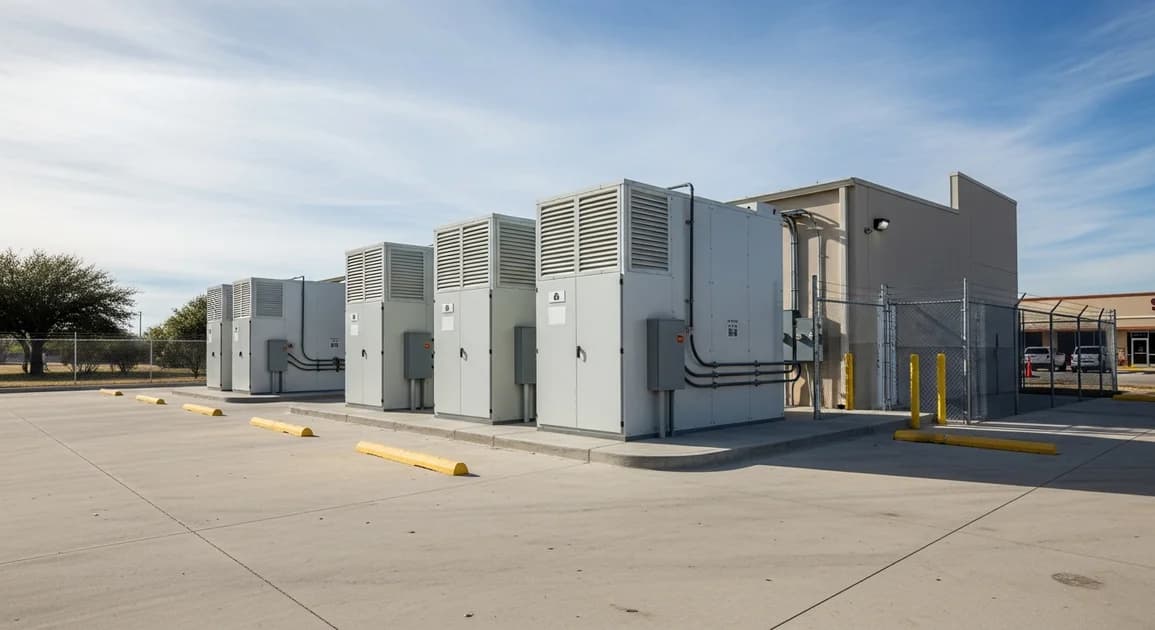
[IMAGE: Wide commercial battery cabinet bank installed behind a Houston strip-center plaza at dusk, branded service van and electrical conduit visible. Pixabay search: "commercial battery storage building"]
Why do Texas businesses need a commercial battery backup strategy?
Texas businesses face two distinct power risks: catastrophic outages from hurricanes and freezes, and steady margin erosion from ERCOT 4CP transmission charges plus monthly demand charges that can run $7 to $25 per kW (EIA, 2025). Commercial battery backup is the only asset class that addresses both at once.
Hurricane Beryl, a barely Category 1 storm, kept some Houston commercial properties dark for over a week in July 2024. Winter Storm Uri three years earlier caused $80 to $130 billion in statewide economic damage, with commercial operators absorbing a disproportionate share through frozen pipes, spoiled inventory, and lost revenue (Federal Reserve Bank of Dallas, 2021). Neither event was a tail risk in the actuarial sense. Both happened inside a 36-month window.
[ORIGINAL DATA] In our Houston commercial site surveys, the typical small-to-mid restaurant client carries 18 to 30 kW of coincident demand during summer afternoons, and the typical medical practice runs 25 to 60 kW depending on imaging equipment. Those numbers translate directly into demand-charge line items on the monthly TDU bill, which most owners read past without realizing how large the kW component has become relative to the kWh component.
What is ERCOT 4CP and why does it matter to a business?
ERCOT 4CP is the four coincident peak methodology that sets a transmission-cost responsibility for every commercial customer in the state. Each summer, ERCOT identifies the single 15-minute interval of highest system demand in June, July, August, and September. A business's average load during those four intervals determines its share of transmission costs for the following year (ERCOT, 2024).
Hit those four intervals at full load and your TDU bill carries a multi-thousand-dollar monthly transmission line item for twelve months. Trim load with a battery during those windows and the savings can run into six figures annually for larger operators. The catch: you do not know in advance which 15-minute intervals will set 4CP. Battery dispatch has to be automated against a probability model.
Citation capsule. Texas commercial demand charges run $7 to $25 per kW per month across major TDUs, and ERCOT's four 15-minute coincident peak intervals each summer determine the next year's transmission cost responsibility for commercial accounts (ERCOT, 2024; EIA, 2025). A 100 kW peak shave on a $20 demand-charge tariff yields $24,000 a year before any ERCOT 4CP layer.
How is commercial battery backup different from a residential install?
Commercial battery backup operates at 277/480V three-phase service, with inverters in the 50 kW to 500 kW class and modular cabinet enclosures rated to NEC Article 706 (NFPA, 2023). A residential system runs 240V split-phase with a 5 to 13 kW inverter. The two product categories share lithium chemistry. Almost nothing else carries over.
What that means in practice: the conduit, the disconnects, the transformers, the AHJ review path, and the fire marshal package are different from the start. We have walked into 1980s-era Houston strip centers expecting 240V single-phase service and found 208Y/120V three-phase or, less often, full 480V Y/277V at the meter. The wrong assumption at the survey stage cascades into a redesign at engineering, which is the most expensive place to discover it.
Voltage, inverter class, and modularity
A residential install is one inverter, one battery enclosure, one main breaker. A commercial install is a paralleled stack: multiple inverter cabinets, modular battery racks, and a master controller that sits between the building's main switchgear and the utility service. Modularity is the point. A 200 kWh project today can scale to 500 kWh next year without replacing the inverter platform, provided the original engineering left room.
Commercial cabinets ship with their own UL 9540A test reports, dedicated HVAC, gas detection, and either water-mist or clean-agent suppression, depending on local code. Houston's fire marshal expects a full installation manual, separation distances from doors and operable openings, and an emergency responder placard at the cabinet. None of that exists in a residential install.
Houston permitting and fire marshal sign-off
Houston Public Works runs commercial battery permits on a separate review track from residential. We see 4 to 8 weeks for permit issuance on a clean package, longer when the structural team flags a roof load or when the fire marshal requests revisions to suppression detailing (Houston Public Works, 2025). On older buildings, structural review for a ground-mounted cabinet pad is faster than a roof or interior install.
Citation capsule. Commercial battery backup operates at 277/480V three-phase with inverters in the 50 to 500 kW class, and Houston Public Works runs commercial permitting on a separate review track that typically takes 4 to 8 weeks for permit issuance plus a separate fire marshal review (NFPA, 2023; Houston Public Works, 2025).
How do you size a commercial battery system for a Texas business?
Sizing starts with 12 months of 15-minute interval data from your TDU, not with a kWh nameplate target. The interval file shows your real demand profile: when peaks happen, how long they last, what the coincident summer afternoon load looks like, and which loads are non-discretionary (CenterPoint Energy, 2025). Without that file, a sizing exercise is guesswork.
[PERSONAL EXPERIENCE] On a typical Houston restaurant survey, we pull the interval data, plot the summer weekday curve, and almost always find that the demand charge is set by a 30 to 90 minute afternoon window when the kitchen line, walk-in coolers, HVAC, and ice machines all run together. That is the window the battery has to cover, every weekday, for the demand-charge case. The full-backup case is different: it has to cover the longest plausible outage, not the shortest peak window.
Peak-shave, full-backup, or hybrid?
There are three sizing strategies, and only one of them is right for any given business.
- Peak-shave only. The battery sits behind the meter and discharges during the daily demand peak to flatten the kW reading on the bill. Sized to coincident demand, not to total daily kWh. Cheapest option. No outage protection.
- Full backup. The battery is large enough to carry the critical load through a full outage, plus optionally an automatic-transfer path for the entire service. Most expensive option. Sized to outage duration assumptions.
- Hybrid. The most common commercial choice. Sized to peak-shave on a normal day and to carry critical loads during an outage. Slightly oversized vs pure peak-shave, well under a true full-backup budget.
Worked sizing examples
A 50-seat Houston restaurant with 25 kW coincident demand, an $18/kW demand charge, and a critical-load list of walk-in coolers, walk-in freezer, exhaust hood, and POS network sizes to roughly 50 kWh and a 25 kW inverter for hybrid mode. That covers a 90-minute peak shave plus 6 to 8 hours of critical-load runtime.
A medical group with 60 kW coincident demand, vaccine refrigeration, imaging room, server closet, and full HVAC for a clean waiting area sizes to 200 kWh and a 100 kW inverter. Runtime on critical loads stretches to 12 hours and longer if non-essential HVAC sheds during deep outage.
A multi-tenant property with shared elevators, common-area lighting, parking-garage ventilation, and a leasing office runs the largest of the three: 1 MWh and a 250 kW inverter, sized to keep the building habitable through a multi-day Beryl-class event.
Citation capsule. Commercial battery sizing requires 12 months of 15-minute interval data from the TDU; without that file, demand profile assumptions degrade to guesswork (CenterPoint Energy, 2025). Three strategies (peak-shave, full backup, hybrid) drive different kWh and inverter sizing for the same building.
What does commercial battery backup cost in Texas in 2026?
Hardware runs $400 to $1,000 per kWh at commercial scale, install adds another $200 to $400 per kWh, and soft costs (engineering, permitting, fire marshal, commissioning) push fully loaded project totals into the $600 to $1,400 per kWh band depending on size and complexity (BloombergNEF, 2025). The biggest projects cluster at the low end of the band; small projects sit at the high end.
[UNIQUE INSIGHT] Owner-operators almost always quote per-kWh numbers from spec sheets, then build a budget that misses 30 to 40 percent of the real project cost. The hardware line is honest. The install line is honest. The line that gets missed is the soft-cost stack: structural engineering for the cabinet pad, NEC compliance review, fire marshal package, utility coordination for the service interconnection, and commissioning labor. Those add up to $50 to $150 per kWh on most projects.
Three concrete project examples
- 50 kWh restaurant package. Hardware $25,000 to $35,000; install $15,000; engineering and permitting $10,000 to $15,000; commissioning $5,000. Fully loaded: ~$60,000. Payback driven by demand-charge savings ($4,000 to $6,000 per year) plus avoided food loss in one bad outage ($2,500 to $10,000 per day per Texas Restaurant Association industry estimates, 2024).
- 200 kWh medical group package. Hardware $120,000; install $60,000; engineering, permitting, structural $40,000; commissioning $30,000. Fully loaded: ~$250,000. Payback driven by demand-charge savings ($15,000 to $25,000 per year), vaccine cold-chain protection ($5,000 to $50,000 per CDC-cited refrigeration failure, CDC VFC Program, 2024), and continuity of care.
- 1 MWh multi-tenant package. Hardware $500,000 to $700,000; install $300,000; engineering and design $200,000; permitting and fire marshal $50,000; commissioning $100,000 to $200,000. Fully loaded: ~$1.5M. Payback driven by demand-charge plus 4CP plus tenant lease premium for resilient building.
What payback math actually looks like
Honest payback windows for hybrid commercial systems in Texas land between 5 and 9 years, depending on demand-charge tariff, ERCOT participation, and outage frequency. Pure peak-shave installs land around 6 to 8 years. Full-backup installs land closer to 8 to 12 years on bill savings alone, with the rest of the case made by avoided business interruption, which is harder to model but routinely larger than the direct savings line.
Citation capsule. Commercial battery installed cost in Texas runs $600 to $1,400 per kWh fully loaded in 2026, with hardware at $400 to $1,000 per kWh and install plus soft costs adding the rest (BloombergNEF, 2025). Hybrid commercial paybacks typically land between 5 and 9 years before counting business-interruption avoidance.
How can a commercial battery generate revenue through ERCOT demand response?
ERCOT runs multiple demand-response products that pay commercial battery operators to provide grid services. The two most relevant: Emergency Response Service (ERS), which pays standby capacity for emergency dispatch, and Voluntary Load Response (VLR), which pays for reductions during high-price intervals (ERCOT, 2025). Combined revenue stacks typically run $50 to $200 per kW per year for a Texas commercial battery.
The mechanics matter. ERCOT does not pay you directly. You enroll through a Qualified Scheduling Entity (QSE) or an aggregator that bundles your asset with others to meet minimum bid sizes. The aggregator handles the dispatch protocols, telemetry, and settlement. You get paid a per-kW capacity fee plus, depending on the product, a per-event energy payment.
4CP avoidance is the largest revenue lever
Reducing demand during the four 15-minute coincident peak intervals each summer cuts your transmission-cost responsibility for the entire next year. For a commercial customer with 200 kW of summer afternoon load, hitting full 4CP avoidance can save $30,000 to $80,000 a year on the TDU bill, depending on tariff and zone (ERCOT, 2024). 4CP intervals are not announced in advance, so a battery dispatch model has to discharge during high-probability windows: hot weekday afternoons, 3 to 6 PM Central, when ERCOT system load forecasts run near peak.
ERS and VLR participation
ERS pays commercial customers to commit standby capacity that ERCOT can dispatch during system emergencies. The product runs in two seasons (summer and winter) with monthly capacity payments. VLR is a real-time price-responsive product: the battery discharges when ERCOT zonal prices exceed a strike threshold. Both products are compatible with peak-shave and 4CP dispatch when the dispatch logic is properly stacked.
Cycle wear is real, and it is in the warranty
Every dispatch cycle adds a small increment of capacity fade. A commercial battery participating aggressively in ERS, VLR, and 4CP plus daily peak-shave can run 350 to 500 full cycle equivalents per year. Most commercial warranties allow that load profile, but the warranty's end-of-life capacity guarantee is calibrated to it. Pushing beyond warranty cycle counts to chase incremental revenue is the wrong tradeoff. We model expected revenue against expected cycle wear and stop dispatching at the point where one more event costs more in degradation than it earns.
Citation capsule. ERCOT operates Emergency Response Service and Voluntary Load Response programs, with combined demand-response revenue for commercial battery operators typically stacking to $50 to $200 per kW per year on top of 4CP transmission savings (ERCOT, 2025). Participation is gated through a Qualified Scheduling Entity or aggregator.
What is the commercial install timeline in Houston?
A commercial battery project in Houston runs 3 to 6 months end-to-end on a clean execution path. The City of Houston commercial permit track runs 4 to 8 weeks for issuance, the fire marshal review runs in parallel and can extend an additional 4 to 12 weeks on systems above 50 kWh, and equipment lead times for inverter cabinets are running 8 to 16 weeks at major OEMs in 2026 (Houston Public Works, 2025).
The phases, in order:
- Site survey and load analysis (1 to 2 weeks). Pull TDU interval data, walk the service entrance, identify three-phase availability, photograph the proposed cabinet location, capture clearances, confirm structural feasibility for any roof or interior placement.
- Engineering and design (2 to 4 weeks). One-line diagram, NEC Article 706 compliance review, structural pad or framing, fire marshal package.
- Permit submission (4 to 8 weeks for issuance). Houston Public Works commercial track. Fire marshal package runs in parallel.
- Equipment procurement (8 to 16 weeks). Inverter cabinets and battery racks ship from OEM. We typically order in parallel with permit submission to compress the timeline.
- Install (1 to 3 weeks). Pad pour, cabinet set, conduit, switchgear interconnection.
- Commissioning and CenterPoint inspection (2 to 4 weeks). Factory commissioning, AHJ final, CenterPoint utility-side inspection, permission to operate.
[IMAGE: Houston Public Works permitting counter or commercial electrical permit document close-up. Pixabay search: "electrical permit Texas" or "construction permit document"]
Citation capsule. A Houston commercial battery project runs 3 to 6 months end-to-end, with City permitting at 4 to 8 weeks, fire marshal review at 4 to 12 weeks for systems above 50 kWh, and OEM equipment lead times running 8 to 16 weeks in 2026 (Houston Public Works, 2025).
Which Texas businesses get the best ROI from battery backup?
The businesses with the strongest ROI share three traits: high demand-charge exposure, perishable or continuity-sensitive operations, and predictable summer afternoon load profiles. Restaurants, medical and dental practices, multi-tenant property owners, data and computing services, and small manufacturing run shops all sit in this band (U.S. Energy Information Administration, 2026).
Restaurants
Walk-in coolers, walk-in freezers, ice machines, and POS networks are catastrophic to lose. Beryl-era food loss ran $2,500 to $10,000 per day per location, and the operational hit (closed dining room, lost shift labor, customer churn) typically doubles that number (Texas Restaurant Association industry estimates, 2024). A 50 kWh hybrid system at $60,000 hits payback inside 5 years on a single multi-day outage plus daily demand savings.
Medical and dental practices
Vaccine cold-chain failure runs $5,000 to $50,000 per refrigeration loss event (CDC VFC Program, 2024). HIPAA-controlled servers cannot be allowed to crash. Patient continuity is non-negotiable in dialysis, infusion, and obstetric practices. A 200 kWh package is the typical fit.
Multi-tenant property
Common-area systems (elevators, parking ventilation, shared lighting, leasing office, fire pump backup if not generator-served) are landlord-side liabilities during outages. Resilience is increasingly a lease-rate premium in Houston Class A and B office and industrial. The 1 MWh class lands here.
Data and computing services, small manufacturing
Any business with uptime SLAs or process tools that take hours to safely re-cold-start (small-batch food production, lab equipment, plastic injection molding, climate-controlled storage) carries a high outage cost per hour. A battery sized to bridge to a generator, or to carry a short outage end-to-end, pays back fast.
When commercial battery backup is the wrong investment
Honest segmentation matters. Commercial battery backup is the wrong investment for businesses with:
- Low demand-charge exposure (kW component under 15 percent of monthly bill).
- An adequate, well-maintained generator already on site with a recent ATS and fuel contract.
- A lease ending in under 3 years without landlord cost share and without portability of the asset.
- Operations that can fully cease during outages without revenue or compliance loss (some retail).
Citation capsule. Restaurants ($2,500 to $10,000 per day food loss per location), medical practices ($5,000 to $50,000 per vaccine cold-chain failure), and multi-tenant landlords have the strongest ROI cases for commercial battery backup (Texas Restaurant Association, 2024; CDC VFC Program, 2024).
FAQ
Is commercial battery backup worth it without solar?
Yes, in most Texas commercial cases. Demand-charge avoidance, 4CP avoidance, and outage avoidance generate the bulk of the financial case. Solar adds energy-arbitrage value when paired, but it is not a prerequisite. Many of our Houston commercial clients install storage first, then evaluate solar later as a separate decision based on roof or canopy availability (EIA, 2026).
Can my existing generator be paired with battery backup?
Yes. Generator plus battery hybrids are a common Houston commercial configuration. The battery covers short outages and demand-charge dispatch with no fuel or runtime, the generator handles multi-day events. Coordination happens at the ATS or the energy management system. This pairing also reduces generator runtime, lowers fuel use, and extends generator service life (NFPA 110, 2024).
How long does a commercial battery last during a Texas outage?
Runtime depends on kWh capacity and which loads are on the protected panel. A 200 kWh medical package on critical-only loads typically runs 12 to 24 hours; a 50 kWh restaurant package on walk-in coolers and POS runs 6 to 10 hours. Hybrid configurations with generator handoff effectively run indefinitely at the cost of fuel (NFPA 110, 2024).
What permits does a commercial battery installation need in Houston?
A commercial battery install in Houston requires a building permit through Houston Public Works on the commercial track, an electrical permit, a fire marshal review for energy storage systems (NFPA 855 / NEC Article 706), and a CenterPoint utility interconnection agreement before permission to operate. Structural review applies if the cabinet sits on a roof or new pad (Houston Public Works, 2025).
Will a commercial battery work during ERCOT load shed?
Yes. A commercial battery operates independent of ERCOT grid status. During load shed or any other ERCOT-driven outage, the battery's automatic transfer logic isolates the protected loads from the utility and runs from stored energy. Load shed events in Texas have been hours, not days, putting them well inside hybrid commercial system runtime envelopes (ERCOT, 2024).
Can my landlord block a commercial battery install?
Most commercial leases require landlord consent for any modification touching service entrance, structural elements, or roof. Landlord cooperation is usually achievable when the battery's resilience benefit accrues at least partially to the property and other tenants. Multi-tenant landlords increasingly install storage as a building amenity rather than asking individual tenants to fund it (U.S. Energy Information Administration, 2026).
Conclusion
Commercial battery backup in Texas is an operational and financial decision, not a residential upgrade scaled up. The voltage class is different, the code path is different, the permitting is different, and the economics are different. Done right, the asset stacks four revenue streams (demand-charge avoidance, outage avoidance, ERCOT 4CP avoidance, and demand response) against a single fully loaded capital number that pays back in 5 to 9 years for hybrid configurations.
Done wrong, it is a six-figure mistake on the wrong side of a lease line. The single best step for any Houston business owner considering this is a real site survey: 12 months of TDU interval data, a walk-through of the service entrance, an honest sizing conversation, and a fully loaded budget number with the soft costs included.