Battery Backup for Houston Pet Owners: Keep HVAC Running

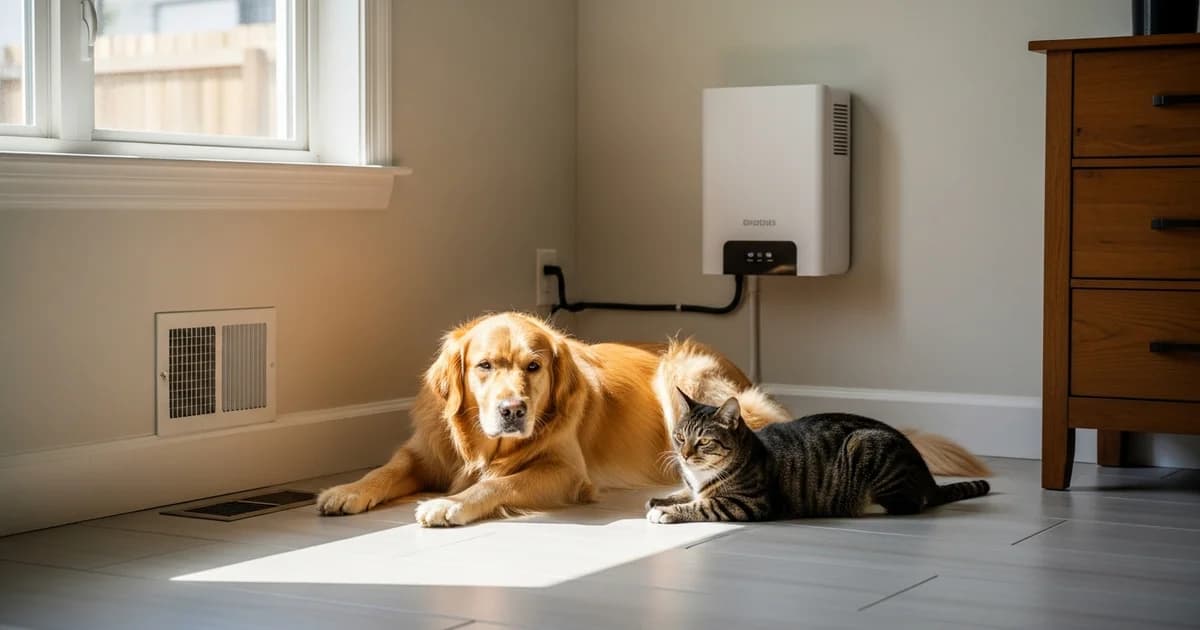
On a July afternoon, the inside of a closed Houston home can climb past 90F within two to three hours of losing the air conditioning. Your dog or cat cannot open a window, turn on a fan, or call for help. Heat is the deadliest weather hazard in the United States, killing more people each year than hurricanes or floods, and animals overheat faster than we do (CDC, 2024). When a summer outage hits while pets are home alone, that is not just discomfort. It is an animal-safety event. Here is the indoor heat threshold that matters, the air conditioning load you actually need to cover, and the battery size that keeps it running.
[INTERNAL-LINK: check if your home qualifies for a 9 to 45 kWh system → /home-backup-planner?source=blog&slug=battery-backup-pet-owners-hvac-continuity]
Key Takeaways
- Indoor temperatures above 85F put dogs and cats at heat-stress risk; flat-faced breeds and senior pets fail sooner.
- A single central AC zone draws roughly 1.5 to 3 kW running; covering it is the core sizing job.
- The Plus tier (18 kWh) cycles one AC zone through a typical Houston outage; the Pro tier (27 kWh) holds whole-home comfort longer.
- Feeders, electric pet doors, and small tanks draw very little and ride along on the backed-up circuits.
How hot is too hot indoors for dogs and cats?
Indoor temperatures above 85F start putting most dogs and cats into heat-stress territory, and flat-faced breeds, seniors, and thick-coated animals cross that line sooner. Dogs cool themselves almost entirely by panting, not sweating, so a hot, still room overwhelms them quickly. Cats hide distress well, which makes an overheating cat easy to miss until it is serious.
The danger is not a single number. It is a band. Below about 80F indoors, healthy pets are usually comfortable. Between 80F and 85F, watch closely. Above 85F, risk climbs fast, and above 90F a crated or senior animal can move from heat stress toward heat stroke in a short window.
Above 85F indoors, dogs and cats face real heat-stress risk, and flat-faced breeds, senior animals, and thick-coated dogs cross into danger several degrees sooner than a healthy young pet. Watch for heavy panting, drooling, lethargy, and bright red gums. A crated dog that cannot move to a cooler spot is the highest-risk case of all.
[INTERNAL-LINK: how to keep your home cool during a Houston outage → /blog/keep-house-cool-houston-power-outage]
Why is a Houston summer outage a real risk for pets?
A closed Houston home with no air conditioning climbs past 90F within two to three hours on a sunny summer afternoon, and the Gulf Coast heat index regularly tops 105F from June through September (NWS Houston/Galveston, 2024). When pets are home alone during work hours, they cannot evacuate, cannot find shade outside the house, and cannot ask anyone for water.
That is the part most outage-prep advice misses. People plan to relocate, drive to a cooling center, or stay with family. Pets stay put. If an afternoon storm or a strain on the ERCOT grid drops your power while you are at the office, the room your animals live in starts heating immediately.
Our finding: When we size systems for pet households in Houston, the deciding question is almost never the fridge. It is whether one AC zone can keep the room a crated dog lives in below 85F for the length of a summer outage.
Heat is the leading weather-related killer in the country, and pets share the same closed, warming room you would worry about for a child or an elderly relative (CDC, 2024). The difference is they have no way to act on the danger.
What AC load do you need to back up for pets?
A single central air conditioning zone or a mini-split typically draws roughly 1.5 to 3 kW while running, and that number, not the refrigerator, is what drives pet-safety sizing. A home battery does not run the AC compressor every second. It carries the cycling load: the unit kicks on, pulls the room back down, then rests.
Here is the insight most pet owners miss. You usually do not need to back up the whole four-ton central system. Backing up a single zone, or one mini-split serving the room where pets stay, is cheaper and stretches runtime dramatically. Plenty of households oversize out of fear, paying for whole-home cooling capacity when one cool room would keep their animals safe through any realistic outage.
The smart panel makes this practical. It prioritizes the circuits you choose, so the pet-room AC zone, the fridge, and the Wi-Fi stay powered while non-essential loads drop off automatically. Our controllers also handle the AC startup surge, which can spike to roughly 17 kW for a few seconds when a compressor kicks on.
[INTERNAL-LINK: see your monthly payment for whole-home backup → /home-backup-planner?source=blog&slug=battery-backup-pet-owners-hvac-continuity]
Which battery size keeps pets cool through an outage?
For a single backed-up AC zone, the Plus tier (18 kWh) cycles it through a typical Houston outage; for whole-home comfort that holds longer, the Pro tier (27 kWh) is the better fit. At a cycling load near 2 kW, more usable capacity simply means more hours before the battery needs to recharge from the grid.
The Plus tier uses two battery modules for 18 kWh nominal capacity and a single controller, enough to keep one zone running while covering the fridge and essentials. The Pro tier adds a third battery module for 27 kWh, which is the system most homeowners pick when they want whole-home comfort rather than one cool room.
For one backed-up AC zone, the Plus tier (18 kWh) cycles it through most Houston outages, while the Pro tier (27 kWh) holds whole-home comfort for a longer stretch. Houston outages most often run a few hours, and either tier covers that window with room to spare for a single cool room.
[INTERNAL-LINK: how home battery backup works in Houston → /blog/home-battery-backup-houston-texas]
[INTERNAL-LINK: see the Plus 18 kWh plan for zone AC backup → /plans/plus]
What about feeders, pet doors, and tanks?
Automatic feeders, electric pet doors, and water fountains draw very little power, so they ride along on the backed-up circuits with no real impact on runtime. Most smart feeders run on internal batteries or pull only a few watts. An electronic pet door and a recirculating water fountain are similarly light loads.
That means you can keep your routine intact during an outage. The feeder still dispenses on schedule, the cat door still works, and fresh water keeps flowing, all while the bigger job, the AC zone, gets the lion's share of the battery.
Small fish or reptile tanks are a different case, with their own temperature and circulation needs that deserve a dedicated plan. If you keep an aquarium or a reptile enclosure, the load math and the survival timelines are specific enough to warrant their own walkthrough.
[INTERNAL-LINK: battery backup for home aquariums and reptile tanks → /blog/battery-backup-home-aquarium-reptile-tanks]
How do you set up a system for a pet household?
Put the pet-room AC zone, automatic feeders, and Wi-Fi cameras on the backed-up critical circuits so the smart panel prioritizes them automatically when the grid drops. That single choice is what turns a battery into real protection for animals that cannot help themselves.
Add a pet camera on the backed-up Wi-Fi so you can check the room temperature and see your animals from your phone during an outage. When grid power returns, the system recharges automatically, so you are ready for the next outage without lifting a finger.
One safety note that matters more for pets than people. Never run a fuel-burning generator in a closed garage or any enclosed space where animals are. Carbon monoxide affects pets quickly, and they cannot leave. A wall-mounted battery runs silently indoors with zero exhaust, which removes that risk entirely.
[INTERNAL-LINK: get a Houston battery backup quote in under 2 minutes → /home-backup-planner?source=blog&slug=battery-backup-pet-owners-hvac-continuity]
Prefer to talk it through? Call our Houston team and we will size a system around your pets and your AC.
Frequently Asked Questions
How hot is too hot indoors for a dog or cat?
Indoor temperatures above 85F put most dogs and cats at heat-stress risk, and flat-faced breeds, senior pets, and thick-coated dogs cross into danger several degrees sooner. Heat is the deadliest US weather hazard, killing more people yearly than floods or storms (CDC, 2024). Animals overheat faster because they cool by panting.
How long can a home battery run my AC for my pets?
A single AC zone draws roughly 1.5 to 3 kW while cycling, so runtime depends on your battery size. At a 2 kW load, the Plus tier (18 kWh) runs one zone plus essentials for roughly 8 to 9 hours, and the Pro tier (27 kWh) extends that to about 13 hours, comfortably past most Houston outages.
What size battery backup do I need for pets in Houston?
For a single backed-up AC zone, the Plus tier (18 kWh, two battery modules) cycles it through a typical Houston outage. For whole-home comfort that holds longer, the Pro tier (27 kWh, three modules) is the better fit. A closed Houston home passes 90F within two to three hours without AC (NWS Houston/Galveston, 2024).
Can I leave pets home during a Houston power outage with battery backup?
Yes, if the pet-area AC zone sits on the backed-up critical circuits and you can monitor the room with a Wi-Fi camera. The smart panel keeps that zone, the fridge, and your Wi-Fi running automatically when the grid drops, holding the room below the 85F heat-stress threshold while you are away.
The bottom line for Houston pet owners
Summer outages are an animal-safety event, not just an inconvenience, because pets cannot evacuate a room that climbs past 90F in a few hours. Three things keep them safe:
- The threshold that matters is 85F indoors, with flat-faced and senior pets failing sooner.
- Sizing comes down to one AC zone at roughly 1.5 to 3 kW, not the whole house.
- The Plus tier (18 kWh) cycles one zone through a typical outage; the Pro tier (27 kWh) holds whole-home comfort longer, and low-draw extras like feeders ride along for free.
You do not need to oversize out of fear. Back up the room your animals live in, keep a camera on it, and the next outage becomes a non-event.
[INTERNAL-LINK: get a fixed-price install quote for your address → /home-backup-planner?source=blog&slug=battery-backup-pet-owners-hvac-continuity]
Sources
- CDC, About Extreme Heat, retrieved 2026-06-09, https://www.cdc.gov/heat-health/about/index.html
- National Weather Service Houston/Galveston, retrieved 2026-06-09, https://www.weather.gov/hgx/
- Eos Backup and Battery field sizing data, 2026