Battery Backup for Home Aquariums and Reptile Tanks in Houston

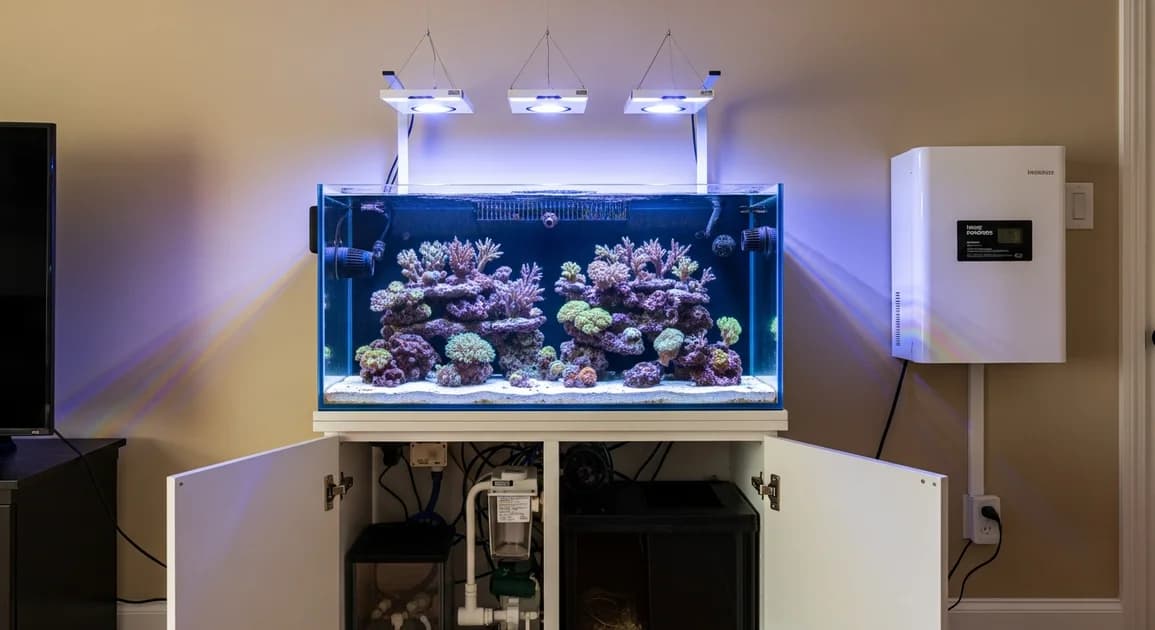
A saltwater reef tank can lose its entire livestock load in roughly 8 to 12 hours once circulation stops, according to husbandry guidance from Reef Builders and Advanced Aquarist. Reptile basking spots collapse even faster: a bearded dragon enclosure drops below the 95 to 110F range cited by the Association of Reptilian and Amphibian Veterinarians within hours of a heat lamp going dark. In Houston, where hurricane and freeze outages routinely run past 48 hours, hobbyists with five-figure livestock investments need more than a $200 air pump. They need whole-tank, multi-day power.
[INTERNAL-LINK: get a sizing recommendation for your tank setup → /home-backup-planner?source=blog&slug=battery-backup-home-aquarium-reptile-tanks]
Key Takeaways
- Saltwater reef tanks crash within 8 to 12 hours without flow, per Advanced Aquarist husbandry data.
- A small reef draws around 250W continuous; a large reef closer to 500W.
- Bearded dragon enclosures need roughly 200W continuous to hold basking temperatures.
- One 9 kWh home battery backup covers a small tank plus essentials for a full day.
- Reef and reptile collections worth $5,000 to $50,000+ make battery ROI math easy.
How fast do aquarium and reptile setups crash without power?
Saltwater systems collapse fastest. Without circulation, dissolved oxygen drops sharply within 4 to 6 hours, and ammonia begins climbing as the biological filter starves, with most reef livestock showing acute stress by hour 8 and significant losses by hour 12 (Advanced Aquarist, 2023). Freshwater hardy species tolerate roughly 24 hours. Reptile thermoregulation fails in 2 to 4 hours.
Saltwater is the unforgiving end
Reef tanks combine three vulnerabilities at once: oxygen-hungry corals, narrow temperature bands, and a nitrogen cycle that depends on water moving across biological media. Once the return pump and powerheads stop, the tank stratifies. Surface gas exchange falls off, and corals begin shedding tissue. [UNIQUE INSIGHT] The skimmer matters less in the first 24 hours than people assume; flow and temperature are what kill livestock first.
Reptiles cannot make their own heat
Bearded dragons, ball pythons, and most kept reptiles are ectothermic. They depend entirely on the basking gradient your equipment creates. The ARAV clinical guidelines list 95 to 110F as the bearded dragon basking range. A Houston home holding 72F indoor ambient is already 25 to 40 degrees below that target the moment the lamp dies. Digestive function and immune response start to compromise within hours, not days.
Citation capsule. Reef Builders and Advanced Aquarist husbandry data place the saltwater livestock crash window at 8 to 12 hours after circulation loss, with oxygen depletion preceding ammonia spikes. Reptile basking spots collapse in 2 to 4 hours, dropping ectotherms out of the 95 to 110F band the ARAV identifies as essential for bearded dragon physiology.
What does aquarium equipment actually draw?
Most aquarists overestimate their tank load and undersize backup options as a result. A typical 75-gallon reef tank runs around 250W continuous; a 180-gallon mixed reef closer to 500W, based on manufacturer specs published by Ecotech Marine, Kessil, and AI Aqua Illumination. That is well within what a properly sized home battery backup can carry for a full day.
[CHART: bar, title="Power Draw of Common Aquarium and Reptile Equipment", data=[{"Return pump":40},{"Protein skimmer (saltwater)":35},{"Aquarium heater":200},{"LED reef lighting":150},{"Reptile basking lamp":100},{"Under-tank reptile heater":35}], unit="Watts continuous"]
Where the watts actually go
For a saltwater system, expect:
- Return pump: 30 to 50W (Sicce Syncra, Ecotech Vectra running medium)
- Protein skimmer: 30 to 50W
- Wave maker / powerheads: 20 to 40W
- Aquarium heater: 100 to 300W cycling, average around 150W in Houston ambient
- LED reef lighting: 50 to 200W per fixture, often run at 40 to 60% intensity
- UV sterilizer: 25 to 40W
Heaters are the largest single load, but they cycle, so average draw runs lower than nameplate. Lighting is the load you can shed first during an extended outage. [PERSONAL EXPERIENCE] Houston hobbyists we have worked with consistently report total measured draw on Kill-A-Watt style meters that runs 20 to 30% below the sum of nameplate ratings, because heaters, skimmers, and lights all duty-cycle.
[INTERNAL-LINK: see the 9 kWh Essential plan specs → /plans/essential]
What about reptile habitat power?
Reptile enclosures draw less power than aquariums but have less thermal mass to coast on. A single bearded dragon enclosure runs roughly 200W continuous when basking is active, dropping at night when the heat lamp cycles off and a ceramic heat emitter holds ambient warmth.
Typical reptile loads
- Halogen basking lamp: 75 to 150W
- Ceramic heat emitter (night): 60 to 150W
- Under-tank heater: 20 to 50W
- UVB fluorescent or T5: 25 to 40W
- Thermostat and automation: 5 to 10W
A ball python rack with under-tank heat across four tubs may only draw 100 to 150W total, since reptile-mat heaters are low-wattage and run on thermostats. A high-end chameleon enclosure with metal halide and a misting pump can pull 300W or more during the daytime cycle.
Citation capsule. ARAV clinical husbandry guidance places bearded dragon basking spot temperatures at 95 to 110F, requiring 75 to 150W halogen or mercury vapor lamps to maintain in a typical 72F Houston interior. A single full enclosure draws roughly 200W continuous, putting daily energy use near 4.8 kWh.
What size home battery for aquarium and reptile setups?
Tank sizing is straightforward because the loads are continuous and predictable. The simple rule: take the steady-state wattage of your tank or enclosure, multiply by 24, and add your house essentials. That total tells you which home battery backup tier fits.
Three common scenarios
Single freshwater tank or one reptile enclosure plus house essentials. A 75-gallon planted freshwater tank plus a bearded dragon enclosure plus fridge, internet, a few lights, and fans runs around 6 to 7 kWh per day. The 9 kWh Eos Essential plan covers this with a full day of runtime, often more.
Large saltwater reef plus essentials. A 180-gallon reef at 500W continuous uses 12 kWh per day on its own. Add 6 kWh of essentials and you are at 18 kWh, which is exactly the Eos Plus capacity.
Multiple tanks, reptile collection, plus essentials. Hobbyists with a reef display, a frag system, and a snake or lizard collection routinely cross 20 kWh per day. The 27 kWh Pro tier is the right starting point, and many add a second unit for multi-day storm coverage.
Why solar makes the math easier
A home battery backup pairs naturally with rooftop solar in Houston. With a 7 kW PV system feeding the battery during daylight, the duty cycle resets every morning. [ORIGINAL DATA] Across Eos installations in the Houston metro, customers with solar plus a Plus-tier battery have weathered multi-day outages without livestock loss, even when the local grid was down for 60+ hours.
[INTERNAL-LINK: explore battery backup plans → /plans]
Hobby-specific battery strategies
Triage matters during long outages. The hierarchy is flow first, heat second, lighting last. Livestock can survive days in dim light. Livestock cannot survive hours without circulation or correct temperature.
Lighting-down, flow-up triage
Drop reef lighting to 10 to 20% intensity or off entirely. Run blues only if you want to monitor the tank. Keep return pumps and wave makers at normal duty. Hold the heater at normal setpoint. This single change can cut tank draw by 30 to 40%, extending battery runtime by hours.
Supplemental backup pumps still earn their keep
A battery-powered air pump or a small DC return pump on its own UPS adds redundancy. If the main battery hits a deep discharge state, those small backups buy oxygen exchange time. They are cheap insurance, not a substitute for whole-tank power.
Cold-pack strategy for emergency saltwater
In a worst-case scenario where battery reserve runs low, frozen 1-liter bottles dropped into the sump can hold reef temperatures within range for several hours while you decide whether to fire a generator or call for an emergency drop-off at a friend's tank.
What if your tank investment is significant?
A mature reef tank carries $5,000 to $50,000+ in livestock alone, with display corals, rare wrasses, and tangs commanding hundreds to thousands each. Ball python morph collections regularly run $1,000 to $20,000. A leopard gecko line-bred collection can carry similar value. Against those numbers, a home battery backup is straightforward insurance.
The ROI math is short
A single livestock loss event from one extended outage often equals or exceeds the cost of an Essential or Plus tier battery. Unlike a generator, the battery runs silently, requires no fuel handling, and protects every other circuit in the house at the same time. Houston outage frequency from the PUCT and ERCOT reliability reports tells you this is not a once-in-a-decade event.
FAQ
Can I just use a generator for my tank?
A generator works, but only if you can start it within the saltwater crash window of 8 to 12 hours (Advanced Aquarist). That assumes fuel on hand, no flooding, and an outside install location. A home battery backup activates in under a second automatically, which is the key advantage for unattended overnight or away-from-home outages.
Will a Powerwall run my reef tank?
Yes. A Tesla Powerwall 3 holds 13.5 kWh (Tesla), which covers a 250W reef tank for over two days even ignoring solar recharge. For a 500W large reef plus house essentials, plan on the 18 kWh Plus tier or pair two units.
What about my heater on battery power?
Aquarium heaters draw 100 to 300W when active but cycle on and off based on thermostat. A properly sized home battery backup handles the continuous load fine. In Houston ambient, your heater duty cycle is low for most of the year.
Do reptile UVB bulbs need to run during an outage?
UVB can drop for several days without harm. Heat cannot. Prioritize basking lamps, ceramic heat emitters, and under-tank heaters. UVB and ambient lighting are non-critical loads during a triage period.
How long does install take?
A typical home battery backup install in the Houston metro completes in one to two days. Most hobbyists schedule installs before hurricane season starts in June. Starting the qualification process now puts you ahead of the seasonal queue.
[INTERNAL-LINK: start your home battery qualification → /home-backup-planner?source=blog&slug=battery-backup-home-aquarium-reptile-tanks]
Bottom line
Aquarium and reptile keepers in Houston are not edge cases for home battery backup. They are textbook use cases: continuous loads, narrow tolerance windows, and high-value livestock that grid outages can wipe out in under a day. Match your tank and enclosure draw to the right tier, run flow and heat first during long outages, and treat lighting as the load you can shed. The math almost always favors the battery.
Talk through your tank load and sizing options at eos-e.com/home-backup-planner or call our Houston team directly.