Battery Backup for Houston Event Venues: A Wedding Does Not Get a Second Take

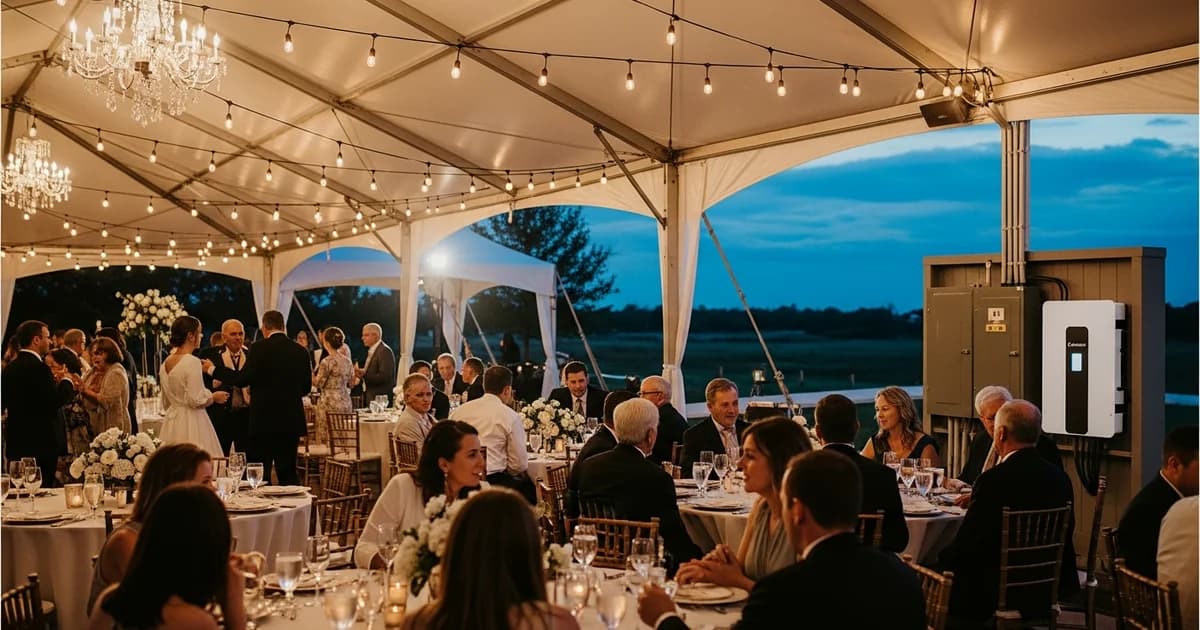
October is the most popular wedding month in America, holding roughly 17 percent of ceremonies in recent seasons (The Knot Real Weddings Study, 2025). In Houston, every one of those October Saturdays sits inside Atlantic hurricane season, which runs June 1 through November 30 (NOAA National Hurricane Center, 2026).
That overlap creates a risk no other event business carries. A conference can slip a week. A corporate mixer can move to the hotel next door. A wedding books one venue, one caterer, one photographer, and one Saturday. If the hall goes dark at 5:45 p.m., there is no second take.
A note on the case below. The venue described in this article is a composite scenario, not a single real client. The load figures reflect ranges we see in Houston-area event-space site surveys, and the wedding budget figures come from published market data. Names, locations, and contract amounts are illustrative.
TL;DR. A Houston wedding for 150 to 200 guests books at $28,644 to $35,010 (The Wedding Report, 2025), and October, the peak wedding month, sits entirely inside hurricane season. A zoned 60 to 150 kWh battery keeps the vows, the reception AC, and the catering line running silently through an outage that a rented diesel generator can only cover with noise, fumes, and event-day fuel runs.
Key Takeaways
- A Houston wedding for 150 to 200 guests represents a $28,644 to $35,010 single-day contract (The Wedding Report, 2025).
- Hurricane Beryl left about 2.2 million Houston-area customers without power in July 2024, with restoration stretching past a week for many (Houston Public Media, 2024).
- A 100 to 300 guest event space peaks at 20 to 50 kW, and AC alone accounts for 15 to 40 kW of that.
- A zoned 100 kWh battery carries a 20 kW protected event load for roughly 4 to 5 hours, enough to finish any reception.
[INTERNAL-LINK: get a fixed-price install quote for your address → /home-backup-planner?source=blog&slug=battery-backup-houston-event-venues-wedding]
What happens when a wedding venue loses power mid-event?
The cascade is fast. When Hurricane Beryl hit in July 2024, about 2.2 million Houston-area customers lost power, and many waited more than a week for restoration (Houston Public Media, 2024). At a booked venue, the damage starts in the first minute, not the first day.
Minute 1. The music stops mid-song, the AV rack drops, and the hall goes silent except for 200 people asking what happened. In a Houston September, the AC compressors are off and the room starts warming immediately.
Minute 30. Warming trays cool below serving temperature. The bar's ice supply becomes finite. Restrooms lose ventilation. The photographer is shooting by phone flashlight.
Hour 2. Guests in formalwear start leaving a 90-degree room. The couple's families start asking about refunds.
Then comes the paperwork. Most venue contracts carry a force majeure clause that shields the operator from refund liability in a grid failure, but disputes happen anyway. In one reported consumer-law dispute, a couple contested a $6,500 venue fee plus about $1,400 in electric add-ons, a photo booth and cold-spark machines, that never ran during a blackout (JustAnswer consumer-law Q&A, 2024). That was a reported dispute, not a verdict, and that is exactly the point: even when the contract holds, the fight itself costs the venue.
[UNIQUE INSIGHT] Force majeure protects the contract, not the reputation. The clause may excuse the refund, but it does not excuse the one-star review, the crying-bride video that travels, or the planner who quietly stops recommending the room. A blackout during vows is uninsurable reputation damage, and that is the real line item battery backup protects.
Why is this a Houston-specific problem?
Because the wedding calendar and the storm calendar are the same calendar. Peak Atlantic hurricane activity centers on September 10, and the season does not close until November 30 (NOAA National Hurricane Center, 2026). October alone hosts roughly 17 percent of U.S. weddings, with September close behind (The Knot, 2025). The entire fall booking peak sits inside the risk window.
And Houston's grid record makes the window concrete. Beryl took out 2.2 million customers in July 2024. Two months earlier, the May 2024 derecho knocked out power to nearly a million customers across the metro (Texas Tribune, 2024). Two grid-scale outages in one calendar year, each with restoration measured in days, not hours. A venue running 30 to 40 events a year in this market is not asking whether a booked Saturday will ever coincide with an outage. It is asking when.
For the broader commercial picture across industries, our [INTERNAL-LINK: commercial battery backup pillar guide → /blog/commercial-battery-backup-texas-businesses]
How much power does an event venue actually need?
A 100 to 300 guest Houston event space peaks at roughly 20 to 50 kW, and air conditioning dominates that number at 15 to 40 kW, based on the composite load profiles from our Houston-area site surveys. AV and sound systems run 2 to 5 kW. Catering warming and refrigeration add 3 to 8 kW. String and architectural lighting, the part guests actually photograph, needs only 1 to 3 kW.
[ORIGINAL DATA] Those ranges come from the load walk we run when we survey Houston event spaces, and they surprise most operators in the same way: the emotional loads are tiny and the comfort load is enormous. The DJ rig, the uplights, and the warming trays together draw less than a fifth of what the AC draws in September. Three hundred guests in formalwear generate meaningful heat on their own, so a hall that loses cooling in a Gulf Coast summer becomes unusable in under an hour even if every light stays on.
That imbalance is why "back up everything" is the wrong spec. The right move is partial-backup zoning: put the ceremony and reception zone on the battery and let the rest of the building shed. In a typical zoning plan, the battery carries the AV rack, the architectural and string lighting, catering refrigeration and warming, and one dedicated AC zone serving the event hall. Back-of-house offices, secondary halls, landscape irrigation, and exterior signage drop until the grid returns. Zoning cuts the protected load from 50 kW to roughly 20 kW, which cuts the battery size, and the budget, by more than half.
[INTERNAL-LINK: check if your venue qualifies for a 60 to 150 kWh system → /home-backup-planner?source=blog&slug=battery-backup-houston-event-venues-wedding]
Battery vs. rented diesel generator: which fits a wedding venue?
For a wedding, the battery wins on the four things the couple actually notices: silence, air, continuity, and reliability of supply. Towable diesel rental sets in the event class typically publish noise specs in the 70 to 85 dB(A) range at load, and 85 dB(A) is the level where OSHA's workplace hearing-conservation requirements begin (OSHA occupational noise standard, 2026). That is the soundtrack running behind the vows and every toast. A battery cabinet is near silent.
| Factor | Battery system | Rented diesel generator |
|---|---|---|
| Noise during vows and toasts | Near silent | Typically 70 to 85 dB(A) at load |
| Exhaust on the terrace | None | Diesel fumes, placement-dependent |
| Transfer when the grid drops | Instant, no blackout gap | Startup gap, minutes of darkness |
| Event-day logistics | None, always charged | Delivery, fueling, refueling runs |
| Staffing | Unattended | Operator or on-call tech |
| Photo and video audio | Clean | Engine drone on every clip |
The transfer gap deserves emphasis. A rental generator only starts after the grid fails, which means the ceremony goes dark first. A battery with an automatic transfer arrangement rides through so fast the band barely notices between songs. The catering loads mirror what we found in the same math we ran for Houston restaurants: refrigeration and warming are steady, manageable loads that batteries carry easily.
Where does a generator still earn its place? Multi-day resilience. A Beryl-class week is longer than any practical battery. Venues that host multi-day programming, or that want to sell hurricane-proof booking guarantees, pair the battery with a small natural gas generator: battery for the event hours, generator for the long tail.
The composite case: a 200-guest venue on a Beryl-season Saturday
Run the scenario. A converted-warehouse venue inside the Loop has a 200-guest wedding booked for an October Saturday, a $30,000 contract in line with Houston's $28,644 to $35,010 market range for that guest count (The Wedding Report, 2025). A storm-related feeder outage hits at 4 p.m. The ceremony is at 6.
Without backup. The hall is 88 degrees by 5:30. The ceremony happens by window light, the amplified vows do not happen at all, and catering starts triaging food safety. Guests leave before the first dance. The venue keeps the deposit under force majeure and spends the next year answering the reviews. What did the clause actually save?
With a zoned 100 kWh battery and 50 kW inverter. The transfer happens between songs. The protected zone, one AC circuit, AV, catering, and the lighting, never blinks. The photographer's timeline does not change. Most guests learn the grid failed when they walk to their cars past dark streetlights.
[PERSONAL EXPERIENCE] When we walk Houston event spaces, the owner's first question is almost always about the hardware, and the question that actually decides the project is calendar math. A venue running 35 events a year is exposed on 35 dates, and per-event losses compound the way we documented in what an outage hour costs a Texas business. One saved Saturday protects a $30,000 contract plus the referral chain behind it.
On cost: commercial systems in the 100 kWh class run roughly $100,000 to $130,000 installed in the current market, per industry storage cost tracking (Wood Mackenzie US Energy Storage Monitor, 2025). For Eos configurations and current program structure, see our commercial battery systems for Houston businesses.
How do you size battery backup for an event venue?
Most Houston venues land between 60 and 150 kWh, depending on hall size, the AC tonnage on the protected zone, and the runtime target. The anchor number: a 100 kWh battery carries a zoned 20 kW event load for roughly 4 to 5 hours, enough to finish any reception that has already started.
The sizing walk has three steps:
- Meter the peak. Pull twelve months of interval data or submeter a September event weekend. Real peaks, not nameplate sums.
- Zone the circuits. Decide what rides through (event-hall AC zone, AV, catering, architectural lighting) and what sheds (back-of-house, secondary spaces, exterior loads).
- Set the runtime target. Four to five hours covers a single event. Multi-day coverage means a generator-hybrid design, not a bigger battery.
There is a weekday payoff too: the same battery can shave demand charges and earn grid-program revenue between events, the strategy we covered in how Texas businesses join virtual power plants.
[INTERNAL-LINK: book a free Houston venue assessment → /home-backup-planner?source=blog&slug=battery-backup-houston-event-venues-wedding]
Prefer to talk it through first? Call us at +1 833-989-3737 and we will walk your event calendar and load profile over the phone.
FAQ
What happens if the power goes out at a wedding venue?
The AC, AV, and lighting drop instantly, and in a Houston summer the hall becomes unusable within about an hour. During Hurricane Beryl in 2024, some 2.2 million Houston-area customers lost power for days (Houston Public Media, 2024), so a mid-event outage can outlast the entire reception.
Is the venue liable for a power outage during a wedding?
Usually not for refunds, if the contract carries a force majeure clause covering utility failure. Liability is contract-dependent, and disputes still arise over add-ons that never ran, as in one reported case involving a $6,500 venue fee plus $1,400 in electric extras. Reviews and reputation are never covered by the clause.
How much backup power does a 200-guest venue need?
Plan around a 20 to 50 kW peak, with AC accounting for 15 to 40 kW of it, based on composite Houston site-survey ranges. With partial-backup zoning that protects the event hall only, most 200-guest venues need 60 to 150 kWh of storage paired with a 50 kW class inverter.
Why use a battery instead of a generator at a wedding?
Because the couple can hear a generator. Diesel rental sets typically run 70 to 85 dB(A) at load, right at OSHA's hearing-conservation threshold, while a battery is near silent, produces no exhaust, transfers instantly with no blackout gap, and needs no event-day fuel deliveries or standby operator.
Can a battery run air conditioning for a whole reception?
Yes, with zoning. A 100 kWh battery carries a protected 20 kW zone, one event-hall AC circuit plus AV, catering, and lighting, for roughly 4 to 5 hours. That covers a full ceremony and reception. Whole-building AC across every zone would need several times the storage and rarely makes financial sense.
The bottom line
A Houston event venue sells certainty on a date nobody can move. Force majeure protects the deposit, and nothing in the contract protects the reviews, the planner relationships, or the referral chain that fills next year's calendar. In a market where the two biggest wedding months sit inside hurricane season, a zoned battery is reputation insurance that also happens to shave the utility bill between events.
Start with the load walk, zone the circuits, and size for the hours that matter. One saved Saturday makes the argument better than any brochure.
[INTERNAL-LINK: get a fixed-price venue backup quote in under 2 minutes → /home-backup-planner?source=blog&slug=battery-backup-houston-event-venues-wedding]
Sources
- Houston Public Media, "CenterPoint: 2 million still without power in aftermath of Hurricane Beryl," retrieved 2026-07-30, https://www.houstonpublicmedia.org/articles/news/energy-environment/2024/07/12/494289/centerpoint-2-million-still-without-power-in-aftermath-of-hurricane-beryl/
- The Knot Real Weddings Study, "Fall Is the Most Popular Wedding Season," retrieved 2026-07-30, https://www.theknot.com/content/fall-most-popular-wedding-season
- The Wedding Report, Houston TX wedding cost estimate, retrieved 2026-07-30, https://wedding.report/index.cfm/action/wedding_cost.estimate/budgetid/D233F192-F5F4-9B5E-19313E17C72D779A
- NOAA National Hurricane Center, "Tropical Cyclone Climatology," retrieved 2026-07-30, https://www.nhc.noaa.gov/climo/
- Texas Tribune, "Houston storm deaths and power outage damage," retrieved 2026-07-30, https://www.texastribune.org/2024/05/16/texas-storm-deaths-houston-power-outage-damage/
- JustAnswer, consumer-protection law Q&A on a wedding venue power outage dispute, retrieved 2026-07-30, https://www.justanswer.com/consumer-protection-law/vk0gh-wedding-venue-power-outage-issues.html
- OSHA, "Occupational Noise Exposure," retrieved 2026-07-30, https://www.osha.gov/noise
- Wood Mackenzie, "US Energy Storage Monitor," retrieved 2026-07-30, https://www.woodmac.com/research/products/power-and-renewables/us-energy-storage-monitor/