Battery Backup for Houston Hotels and Motels

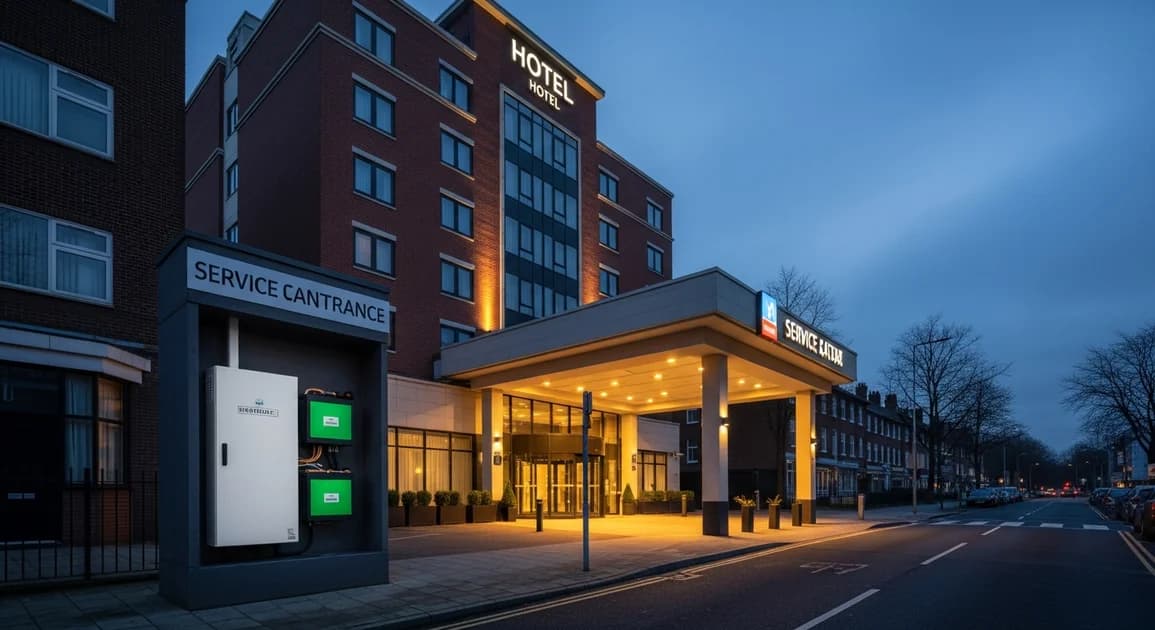
Battery Backup for Houston Hotels and Motels: Guest Safety Through Any Outage
A hotel is a 24-hour promise of safety and shelter, which makes a Houston outage a serious problem. Guests, some elderly or traveling with medication, sit in rooms losing air conditioning during a Texas summer. The front desk cannot encode a key, the elevators stop, and the emergency lights carry only enough charge to guide people out. A hotel that goes dark risks guest safety and its reputation at once. Here is what backup can realistically protect.
Key Takeaways
- Emergency egress lighting must stay illuminated for at least 90 minutes after power is lost (NFPA 101 via Consulting-Specifying Engineer), which is a life-safety floor, not full continuity.
- Adults 65 and older are most at risk in extreme heat, and above the mid-90s, electric fans do not prevent heat illness (CDC), so AC is a guest-safety load.
- Hurricane Beryl left about 2.2 million CenterPoint customers without power on July 8, 2024 (Houston Public Media, 2024), with about 226,000 still out eight days later in 90-degree heat (Texas Tribune, 2024).
- Electricity is the dominant fuel in lodging buildings (EIA CBECS, 2018), so a full hotel is a large aggregate load.
- Honest sizing: one controller protects segmented critical loads. A whole hotel means multiple controllers or a large commercial design.
[INTERNAL-LINK: get a commercial backup quote for your hotel → /home-backup-planner?source=blog&slug=battery-backup-houston-hotels-motels]
Can a battery keep a Houston hotel safe and open in an outage?
Yes, for a segmented set of critical loads, sized to the property. A properly designed system can hold the front-desk property-management system and key encoder, elevator recall to a landing, hallway and emergency lighting, fire and life-safety systems, walk-in refrigeration, and a right-sized common-area cooling zone. That keeps guests safe and the hotel functioning. What one small unit will not do is cool every guest room and run every elevator at once, which is a large, multi-controller job.
That honesty shapes the design. We back the loads that keep guests safe and the desk working first, then scale for more. It keeps the promise the hotel makes to the people staying there.
Why a hotel outage is a guest-safety issue, not just discomfort
Because a hot hotel can be genuinely dangerous for vulnerable guests. The CDC notes that adults 65 and older are the most likely to suffer or die in extreme heat, and that once temperatures pass the mid-90s, electric fans will not prevent heat illness (CDC). A guest in a room without air conditioning has no cooler space to move to unless the hotel provides one.
Beryl showed exactly this environment. During that outage, temperatures sat in the 90s with a heat index near triple digits (Texas Tribune, 2024). For a hotel full of travelers, keeping at least some cooled, safe space running is a duty of care, not an amenity.
What keeps working in an outage, and what stops
Less than owners expect, and some pleasant surprises. Guest-room key-card locks are usually battery-powered at the door, so they generally keep working through a building outage, and keys already issued still open rooms. What stops is the front desk's ability to encode new keys, because the property-management system and card encoder run on building power. A battery keeping the front desk alive means you can still check guests in.
Life-safety systems are code-anchored but limited. Under NFPA 101, the Life Safety Code, means-of-egress emergency lighting must stay illuminated for at least 90 minutes after power is lost (Consulting-Specifying Engineer), and exit signs and fire alarms are also life-safety loads. That is enough to evacuate safely, not to run a hotel. Continuity is a separate job.
Where a hotel's power actually goes
Across many loads, which is why a full hotel is large. Electricity is the dominant fuel in lodging buildings, with water heating and space heating among the largest end uses (EIA CBECS, 2018). Cooling, lighting, and refrigeration each add more. In a Houston climate, cooling carries more weight than the national average, but the point holds: a whole hotel draws a lot, spread across many systems.
A composite look: a hotel through a multi-day outage
The following is a composite illustration, not a specific client, drawn from the loads we see at Houston lodging properties. Picture a mid-size hotel: a full house of guests, a front desk running the property-management system, elevators, hallway and emergency lighting, a breakfast kitchen with walk-in refrigeration, and central air across every floor. When the grid drops, all of it stops, and a lobby full of travelers looks to the front desk for answers.
With a battery system on a segmented critical plan, the hotel keeps the front desk encoding keys, an elevator reaching a landing, the hallways and exits lit, refrigeration cold, and a cooled common area or guest-floor zone available for vulnerable guests. Nobody is stranded in the dark, and the hotel keeps its promise instead of issuing refunds and apologies.
How much battery does a hotel need?
Usually a large system, and almost never one unit. Because electricity is the dominant fuel and a hotel spreads load across water heating, cooling, refrigeration, and more (EIA CBECS, 2018), backing an entire property is a big, segmented job. The realistic plan protects the critical and life-safety loads first, then scales across multiple controllers.
Here is the honest hardware picture. Our modular system uses 9 kWh nominal battery modules (8.76 kWh usable each), stacking to 45 kWh on one controller rated 11.5 kW continuous and 17.1 kW surge, with a 10-year warranty on the battery and controller. One controller carries a critical-loads plan: the front desk, egress lighting, and refrigeration. A whole hotel typically needs a commercial design in the 150 to 500 kWh range, with loads segmented across multiple controllers.
[INTERNAL-LINK: see commercial battery options and sizing → /plans/commercial]
The right first question is which systems must stay live, not how many kilowatt-hours. Our guide on [INTERNAL-LINK: commercial battery backup for Texas businesses → /blog/commercial-battery-backup-texas-businesses] walks through that load-priority process, and [INTERNAL-LINK: preparing for hurricane season with battery backup in Houston → /blog/hurricane-season-battery-backup-houston] covers the seasonal planning side.
Being the hotel that stays open
Reliability is reputation in hospitality. When the power failed during Beryl, some Houston-area properties became refuge: one small inn near the coast offered free rooms to displaced families and first responders and fed about 200 people (Texas Tribune, 2024). A hotel that stays cool, lit, and open during an outage earns trust that a dark competitor loses, and it keeps the bookings a closure would refund.
When we design for a Houston hotel, we start from guest safety and the front desk, then size up. A battery is silent, fuel-free, and instant, which suits an occupied building where a diesel generator in the parking area is a poor guest experience. For extended runtime a generator can be added. Our broader look at [INTERNAL-LINK: the cost of business interruption from a Texas power outage → /blog/business-interruption-power-outage-cost-texas] frames the stakes.
[INTERNAL-LINK: talk through a hotel backup plan → /home-backup-planner?source=blog&slug=battery-backup-houston-hotels-motels]
Prefer to talk it through? Call Eos at 713-207-2222 for a same-week Houston commercial site survey.
Frequently asked questions
Do hotel key-card locks work during a power outage?
Usually yes. Guest-room electronic locks are typically battery-powered at the door, so they keep working through a building outage, and keys already issued still open rooms. What stops is the front desk encoding new keys, since the property-management system and card encoder run on building power. A battery keeping the desk alive restores that.
Is losing AC in a hotel really a safety issue?
It can be, especially for older guests. The CDC notes adults 65 and older are most at risk in extreme heat, and that above the mid-90s, fans do not prevent heat illness (CDC). In a Houston summer outage, a cooled, safe space is a genuine guest-safety need.
How big a battery does a hotel need?
It depends on which loads you protect. A segmented critical-loads plan can start with one 45 kWh controller for the front desk, egress lighting, and refrigeration. A whole hotel typically needs a commercial design in the 150 to 500 kWh range across multiple controllers. We size it to your property.
Does emergency lighting mean my hotel is covered?
Only for evacuation. Emergency egress lighting must stay lit at least 90 minutes after power loss (NFPA 101 via CSE), which is a life-safety requirement to get guests out. It does not keep the front desk, elevators, or cooling running, which is what a continuity battery is for.
Is a battery better than a generator for a hotel?
Each has a role. A battery is silent, fuel-free, and instant, with runtime bounded by capacity, and it suits an occupied building better than a running engine. A generator adds longer runtime on fuel but brings noise, refueling, and exhaust. Many hotels use a battery for critical loads and add a generator for extended runtime.
This article is general information for Houston hotel and motel operators and reflects Eos specifications as of July 2026. The case is a composite illustration, not a specific client, and does not promise a specific runtime, safety outcome, or occupancy result. Confirm sizing, life-safety and elevator code, and permitting for your property with the appropriate professionals.