Battery Backup for Houston Grocery and Convenience Stores: Protecting Perishable Inventory

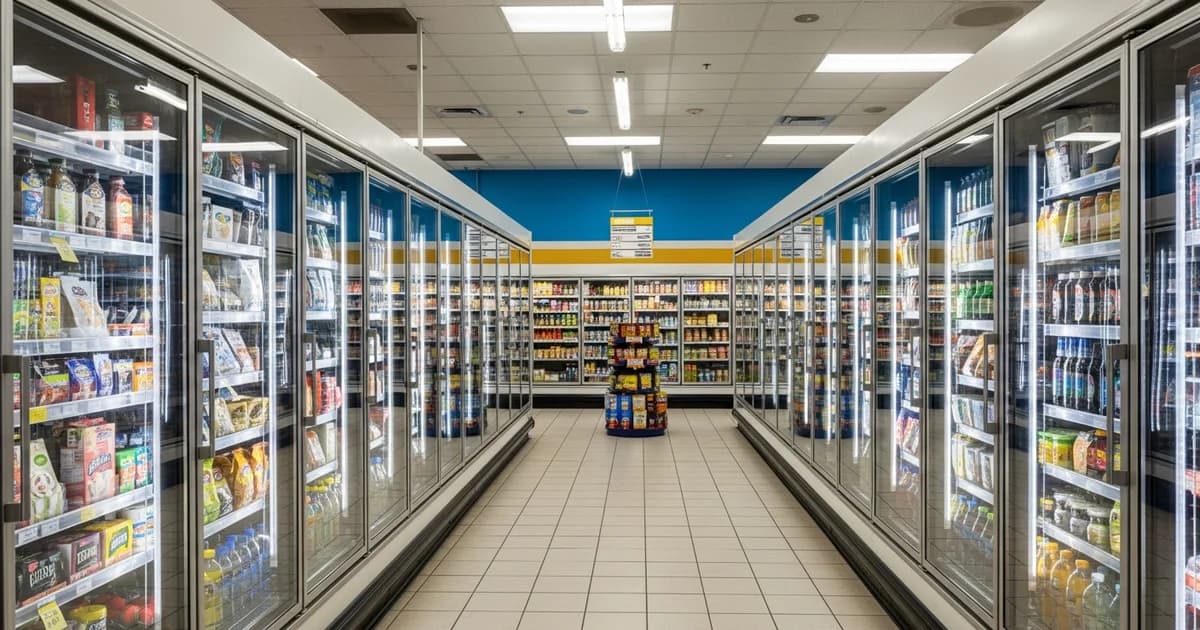
Refrigeration is up to 56% of a grocery store's electricity load, and that load sits directly on top of the most perishable asset the business owns (U.S. EIA, 2025). When the grid drops, the registers go dark and the inventory starts a countdown. The store described below is a composite scenario, not a single real client. The numbers reflect ranges we see in Houston-area grocery and convenience-store site surveys after Hurricane Beryl. The name, location, and revenue figures are illustrative.
Hurricane Beryl left more than 2.2 million Houston-area customers without power, many of them for days (Houston Public Media, 2024). Food retail watched perishables cross the FDA 4-hour spoilage line while the fuel pumps and POS went down. This post walks the load profile, the loss column, the sizing math from 60 to 250 kWh, and the payback for both a grocery store and a c-store. For the broader category context, see [INTERNAL-LINK: the complete guide to commercial battery backup in Texas -> /blog/commercial-battery-backup-texas-businesses].
TL;DR: Refrigeration is up to 56% of a supermarket's electrical load (U.S. EIA), and perishable inventory crosses the FDA 4-hour spoilage threshold fast once the grid drops. A composite Houston grocery store lost roughly $35,000 to $60,000 in inventory and revenue per Beryl-scale event. A 60 to 250 kWh commercial battery, sized to the refrigeration line-up, keeps coolers, freezers, POS, and fuel pumps running and protects the inventory that is the whole business.
[INTERNAL-LINK: get a fixed-price commercial backup quote for your store address -> /home-backup-planner?source=blog&slug=battery-backup-houston-grocery-convenience-stores]
The composite scenario: a 12,000 sq ft Houston neighborhood grocery
Our composite store walks into a Beryl-scale outage with roughly $35,000 to $60,000 of inventory and revenue at risk per event. It is an independent neighborhood grocery, 12,000 square feet of sales floor, sitting inside Beltway 8 in north Houston. For the c-store variant, we attach a small fuel island with four dispensers.
The refrigeration line-up is the heart of the building. One walk-in cooler, one walk-in freezer, a 24-foot run of open multi-deck dairy and deli cases, four reach-in glass-door cases, two frozen island freezers, and an ice merchandiser. On top of that sit four POS lanes, sales-floor and sign lighting, security cameras and a DVR, and full HVAC.
The utility profile lands around 38,000 to 55,000 kWh per month, with peak demand of roughly 70 to 110 kW and summer bills between $5,500 and $8,500. Before Beryl, this store had no backup at all, just surge protection. That is the posture we see on most Houston independent grocery surveys.
The Eos composite load profile breaks this store into refrigeration zones (walk-ins, reach-ins, open multi-deck cases, frozen islands) measured against POS, lighting, and HVAC. Most generic "battery for business" pages skip the retail-refrigeration load table entirely. That table is what decides the battery size, so we lead with it on every grocery survey.
How long can a grocery store keep food cold without power?
A closed walk-in cooler holds safe temperature for roughly 4 to 6 hours, but open multi-deck dairy and deli cases breach the FDA 40F line in just 1 to 2 hours because they leak cold continuously to the sales floor (FDA, 2024). The FDA rule is blunt: refrigerated perishables held above 40F for 4 hours or more must be discarded.
Here is the zone-by-zone reality for our composite store:
- Walk-in cooler: roughly 4 to 6 hours if kept closed
- Walk-in freezer: 24 to 48 hours if the door stays shut and it is full
- Open dairy and deli multi-deck cases: 1 to 2 hours, the first to fail
- Reach-in glass-door cases: 3 to 4 hours
- Frozen island freezers: 12 to 24 hours
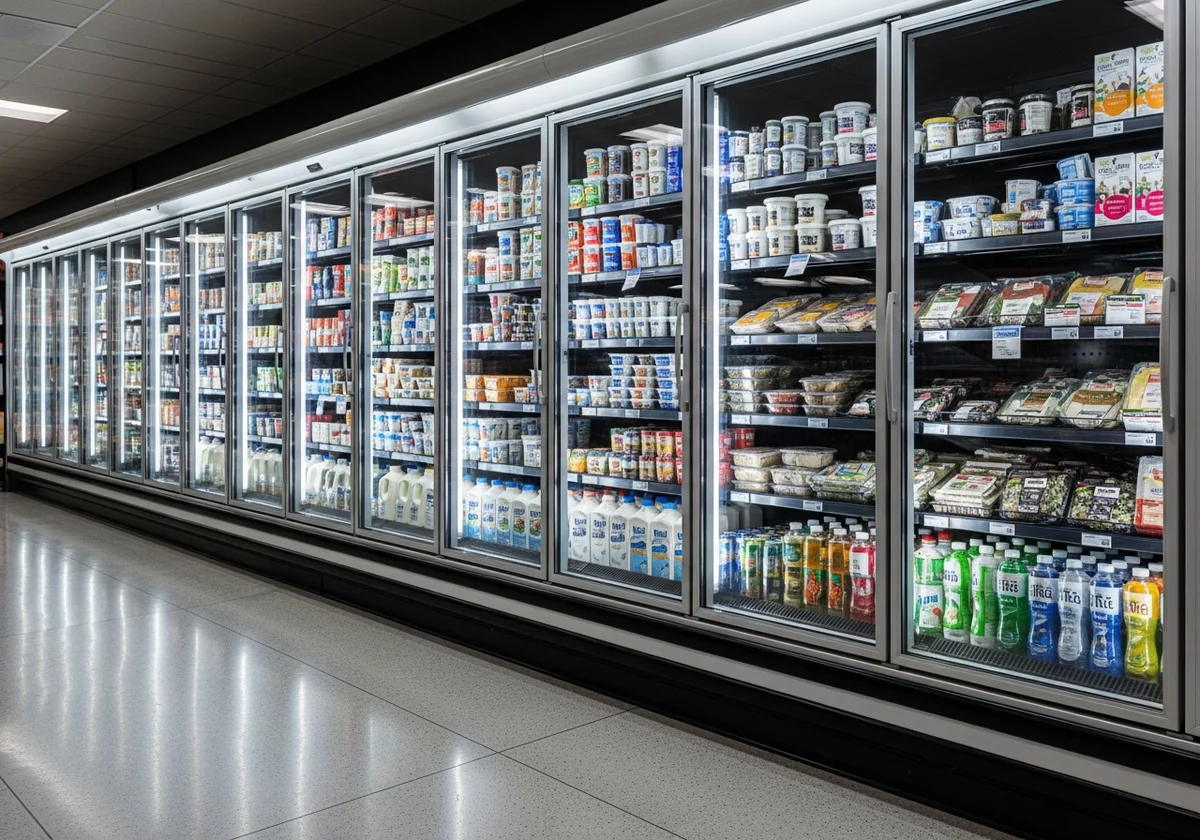
Lighting and refrigeration together account for roughly 80% of total supermarket electricity (EnergySense, University of Illinois, 2025). The open multi-deck cases breach the FDA 40F line in 1 to 2 hours, far faster than the walk-ins, which is why the deli and dairy column is almost always the first write-off in a Houston outage.
Our finding: When we survey Houston grocery stores, the open multi-deck dairy and deli cases, not the walk-ins, are usually the silent capacity killer. They leak cold to the sales floor continuously, so they breach first and they draw hardest to recover. Owners almost always guess the walk-in is the priority. It is not.
What did Hurricane Beryl actually cost the store in 2024?
Net per-event loss for the composite grocery runs roughly $35,000 to $60,000. The outage hit on July 8, 2024, and stretched 4 to 5 days for many north Houston ZIP codes. The damage rolls out on a timeline, not all at once.
In the first 0 to 2 hours, the open cases breach 40F and the dairy, deli, packaged meat, and prepared foods are written off first. By hour 4 to 12, the reach-ins and the walk-in cooler breach, taking produce and cold beverages. Between hour 24 and 48, the walk-in freezer thaws, and the frozen proteins and ice cream are gone.
The loss column for the grocery breaks down like this: perishable inventory write-off of $22,000 to $38,000, missed revenue of $10,000 to $18,000 across 4 to 5 days closed, labor paid during the closure of $4,000 to $6,000, and compressor short-cycle damage on restoration of $0 to $4,000. Insurance helps less than owners expect, since most food-spoilage sublimits reimburse only a fraction of the inventory.
For the c-store variant, add lost fuel sales while the pumps sit dark and the lost foot traffic that fuel normally drives. A Beryl-scale outage cost a composite Houston grocery $35,000 to $60,000 per event, and the inventory write-off alone is the largest single line. There is an inverse opportunity for fuel retailers, which we cover below. For the deeper per-day math across business types, read [INTERNAL-LINK: the per-day cost of business interruption from outages -> /blog/business-interruption-power-outage-cost-texas].
[INTERNAL-LINK: check what a Beryl-scale outage would cost your inventory, get a 2-minute estimate -> /home-backup-planner?source=blog&slug=battery-backup-houston-grocery-convenience-stores]
What load has to stay powered, and what can you shed?
The critical load for a grocery is the full refrigeration line-up plus POS and minimum lighting, typically 18 to 35 kW continuous. Everything else can ride reduced or stay off. Getting this split right is what keeps the battery sized to the job instead of to the whole building.
The critical column holds the walk-ins, the multi-deck cases, the reach-ins, the frozen cases, the refrigeration controls, the POS lanes, security, and minimum sales-floor and exit lighting. For a c-store, add the fuel dispensers and the dispenser controller plus the submersible turbine pumps (STP) in the tanks. Those are what actually move fuel.
The sheddable column is more flexible than owners assume: full HVAC comfort cooling can run at a reduced setpoint, decorative and full sign lighting can drop, the ice merchandiser can go off, and the back office can wait. One caution: refrigeration compressors pull a heavy inrush surge on startup, so sizing has to cover surge, not just the continuous draw.
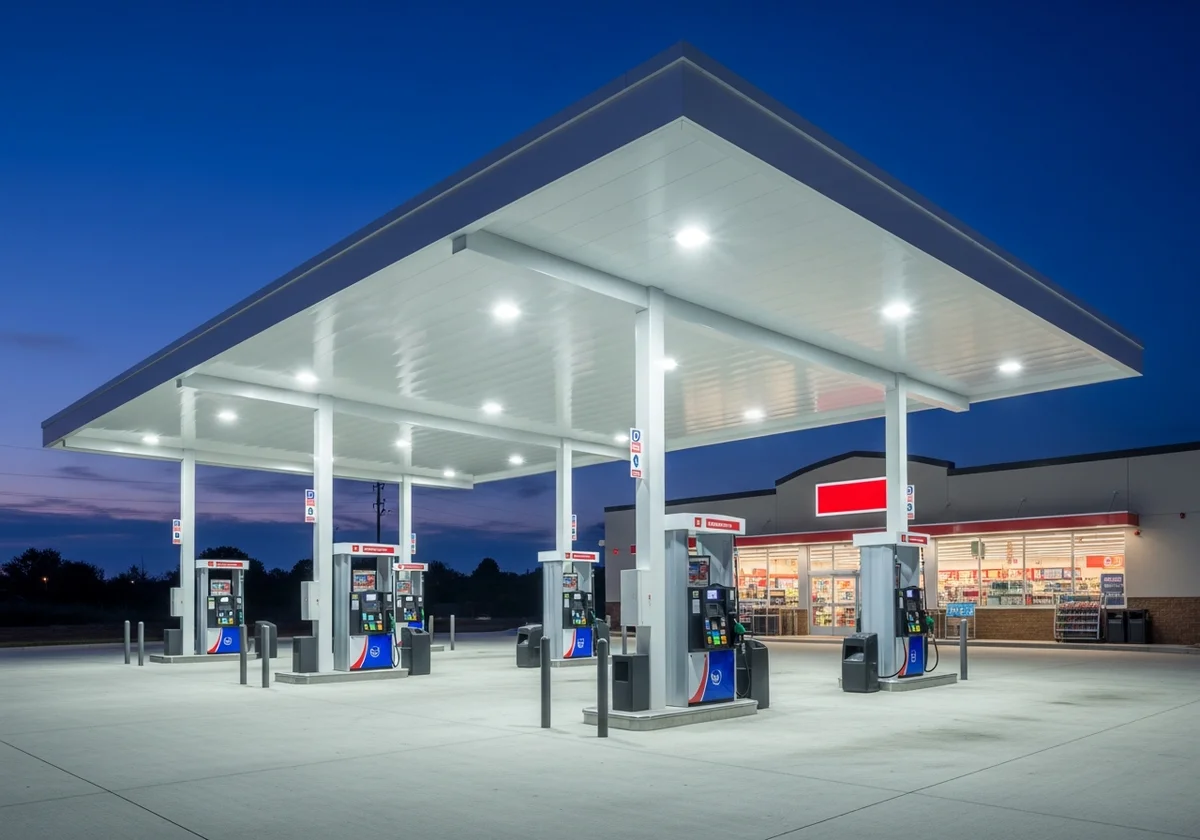
Refrigeration alone is up to 56% of a supermarket's electrical load, which is why the refrigeration line-up, not the lighting or HVAC, defines the backup job (U.S. EIA, 2025). Walk-in freezers rank among the highest single-equipment electricity users in any store, so they carry real weight in both the continuous and the surge calculation (Matador, 2024).
How big a battery does a grocery or c-store need?
Most Houston grocery and c-store refrigeration line-ups land in a 60 to 250 kWh commercial battery range, sized to the refrigeration zone count and the runtime target. The store's job, not a fixed box, sets the number. Three rough tiers cover the field.
A small c-store with reach-ins, two island freezers, POS, and pumps usually sizes to 60 to 100 kWh. A mid grocery with one walk-in cooler, one walk-in freezer, a multi-deck run, and reach-ins lands at 120 to 180 kWh. A larger market or a grocery-plus-fuel site with the full line-up and pumps runs 180 to 250 kWh.
The method is straightforward: sum the critical continuous load, multiply by the target runtime hours, then add surge headroom for compressor inrush. A worked example: 25 kW of critical continuous load times 8 hours equals 200 kWh for a full-day-of-daylight hold. For multi-day events, a hybrid with a generator lets you size the battery to the quiet-hours and peak-surge job and run the generator less.
Grocery and c-store refrigeration line-ups size to a 60 to 250 kWh commercial battery, scaling with the zone count rather than a fixed product box. Eos commercial systems are modular: the same 9 kWh building blocks stack from the Commercial Essential tier up through Commercial Plus and Commercial Pro into large multi-controller configurations. That means the system grows with the refrigeration line-up instead of forcing the store into a one-size box. See [INTERNAL-LINK: how commercial battery systems scale to your refrigeration line-up -> /plans/commercial].
How does the financial case work?
Per-event outage avoidance alone often justifies the system before any demand-charge math enters the picture. A composite grocery facing $35,000 to $60,000 of loss per multi-day event recovers a large share of the install cost on the first avoided Beryl-scale outage.
Stack the rest on top. Demand-charge avoidance peak-shaves the refrigeration and HVAC draw for monthly $/kW savings. ERCOT 4CP avoidance and demand-response participation add further revenue when the battery discharges during summer peak windows. For the deeper payback framework across business types, the [INTERNAL-LINK: business-interruption cost math for Texas operators -> /blog/business-interruption-power-outage-cost-texas] lays out the per-day and per-event modeling.
The c-store contrarian take: For many convenience stores, the fuel pumps, not the coolers, are the revenue load worth backing up. A powered pump during a regional outage turns the store into the only fuel source for miles. That reverses the loss column into a revenue spike, as displaced drivers from dark stations line up at the one site still pumping. The pump backup pays for itself on a single event.
We never invent an Eos dollar figure for the install, and the honest version is simpler. The per-event loss you already carry, plus demand-charge savings, plus the c-store fuel upside, is usually enough to pencil the system on ranges alone. For a parallel walkthrough in food service, see [INTERNAL-LINK: how the same math plays out for Houston restaurants -> /blog/battery-backup-restaurants-houston].
Frequently Asked Questions
How long can a grocery store keep food cold without power?
A closed walk-in cooler holds roughly 4 to 6 hours and a full walk-in freezer 24 to 48 hours, but open multi-deck dairy and deli cases breach the FDA 40F line in 1 to 2 hours (FDA, 2024). Perishables above 40F for 4 hours or more must be discarded.
How much does a convenience store lose during a power outage?
A composite Houston grocery loses roughly $35,000 to $60,000 per multi-day Beryl-scale event. That breaks down to $22,000 to $38,000 in perishable inventory write-off, $10,000 to $18,000 in missed revenue, plus labor and compressor repair. C-stores add lost fuel sales while the pumps sit dark.
Can a battery run a walk-in cooler and freezer?
Yes. A grocery's critical refrigeration load runs 18 to 35 kW continuous, and a 60 to 250 kWh commercial battery sized to the line-up holds it for a daylight cycle. Sizing must add surge headroom because compressors pull heavy inrush current on startup, not just steady-state draw.
Do gas station fuel pumps need backup power, and can a battery run them?
Fuel pumps need power for both the dispenser and the submersible turbine pump in the tank. A commercial battery runs them, and for many c-stores the pumps are the highest-value load to back up. During a regional outage, a powered pump turns the store into the only fuel source for miles.
Is a battery or a generator better for a grocery store?
For multi-day events, a hybrid usually wins. The battery covers quiet hours and compressor surge cleanly and silently, while a generator handles extended runtime. Sizing the battery to the peak-surge and quiet-hours job lets you run the generator less and protect the refrigeration line-up without diesel running around the clock.
The bottom line for Houston food retailers
The store described above is a composite scenario, not a single real client. The numbers reflect ranges we see in Houston-area grocery and convenience-store site surveys after Hurricane Beryl. The name, location, and revenue figures are illustrative.
The logic, though, is real in every survey: the perishable inventory is the business, refrigeration is the load, and an outage writes off both at once. A 60 to 250 kWh commercial battery sized to your refrigeration line-up protects the inventory and the registers, and for c-stores it keeps the pumps live. The per-event loss usually justifies the system before the demand-charge math even starts.
[INTERNAL-LINK: book a free Houston commercial site assessment for your store -> /home-backup-planner?source=blog&slug=battery-backup-houston-grocery-convenience-stores]
Call Eos to schedule a same-week grocery or c-store site survey and get your refrigeration line-up sized before the next storm.