Battery Backup for Houston Butcher Shops and Seafood Markets: The Case Under the Glass

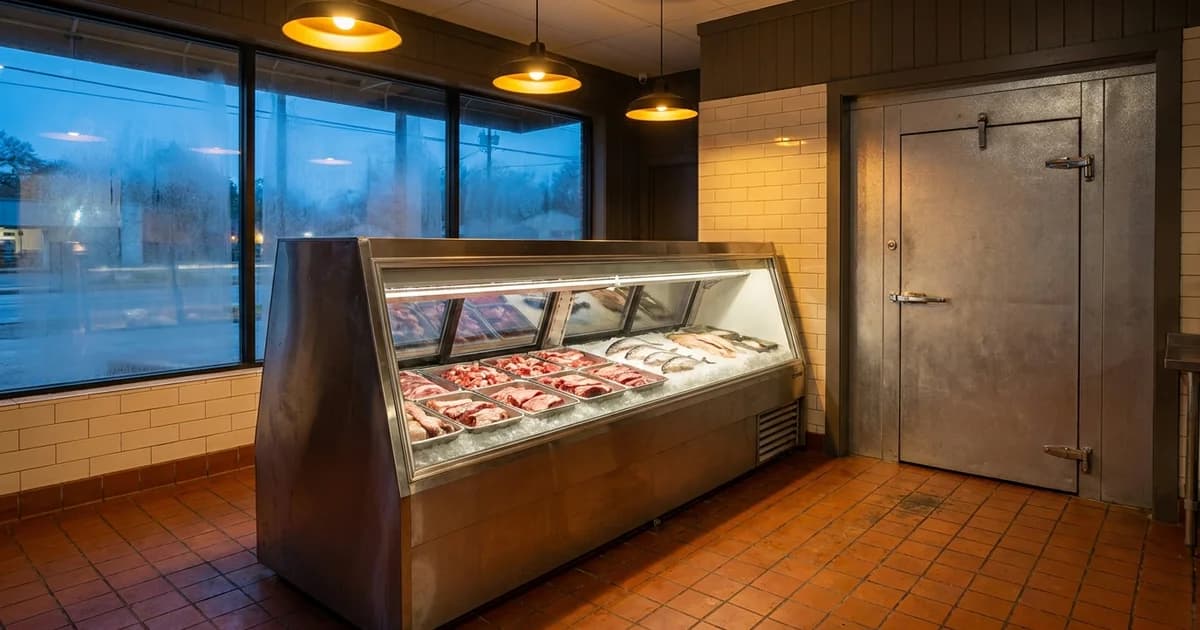
A butcher shop runs on a thin margin of temperature. When Hurricane Beryl came ashore on July 8, 2024, more than 2.6 million Texas customers lost electricity (The Texas Tribune, 2024). About 2.2 million of them were CenterPoint accounts, and roughly 207,000 were still dark on the eighth day (Houston Landing, 2024). For a meat market or a seafood shop, an outage that long is not an inconvenience. It is the entire case, most of the walk-in, and a conversation with the health department about when you're allowed to reopen.
This post is about where a battery genuinely helps a small protein retailer in Houston, and where it doesn't. The short answer is counterintuitive: the refrigeration you can see is the refrigeration you should give up first.
Key Takeaways
- Open front display cases lose 70 to 80 percent of their total heat load to air infiltration, against roughly 10 percent for cases with doors (U.S. Department of Energy, 2013).
- The walk-in, not the display case, is the asset worth backing up first.
- Houston food establishments must stop operating and notify the health department when an outage becomes an imminent health hazard (Houston Health Department).
- One Eos controller delivers 11.5 kW continuous and 17.1 kW surge, which covers a walk-in plus point of sale and lighting, not a full multi-case market.
Why the display case fails first and the walk-in doesn't
An open front case has no door, so it fights the room continuously. In 2013, the U.S. Department of Energy reported that for medium temperature, remote condensing open refrigerated display cases, infiltration loads make up 70 to 80 percent of the total case heat load, while a comparable case built with vertical glass doors sees infiltration account for only about 10 percent (U.S. Department of Energy, Guide for the Retrofitting of Open Refrigerated Display Cases with Doors, 2013).
Read that as an outage number instead of an energy number and it changes everything. A case that depends on continuous mechanical cooling to hold back a river of warm room air has almost no thermal inertia of its own. Cut the compressor and the air curtain collapses. A walk-in is the opposite: insulated panels, a gasketed door, a large thermal mass of cold product, and no deliberate opening to the sales floor.
Our finding: across the Houston food retail sites we've scoped, the sizing conversation almost always starts as "back up the store" and should end as "back up the walk-in and move the case into it." The display case is merchandising. The walk-in is inventory.
That reframing is the single most useful thing a butcher or fishmonger can take from this article, because it shrinks the load you have to carry from something like a whole storefront to something a single controller can realistically hold.
What the rules actually require when the power goes out in Houston
Cold holding for time and temperature control for safety food is 41°F (5°C) or less under Food Code section 3-501.16, the requirement the FDA restates in its retail food protection guidance (U.S. Food and Drug Administration). Texas adopts the same 41°F reference point for TCS food in its retail food rules (Texas DSHS, 25 TAC Chapter 228, Texas Food Establishment Rules).
The consumer guidance is blunter. Federal agencies advise that an unopened refrigerator holds food about 4 hours, a full freezer about 48 hours, and a half full freezer about 24 hours, with 40°F and 0°F as the safe thresholds (FDA; USDA Food Safety and Inspection Service). The Houston Health Department repeats the discard rule locally: throw out perishable food, including meat and fish, held above 40°F for 2 hours or more (Houston Health Department).
Then there's the part most operators only learn during a storm. Under City of Houston Food Ordinance Ch. 20.21.2(d), an emergency that might prevent TCS food from being held at required temperatures is an imminent health hazard, and an establishment experiencing one is required to cease operations and notify the Bureau of Consumer Health Services, then request approval before resuming (Houston Health Department). Backup power is not only about saving product. It's about whether the outage becomes a closure event at all.
None of this is legal or food safety advice. Your local health authority has the final word on your specific site.
A composite Houston butcher shop through a two-day outage
The following scenario is a composite built from typical small format Houston protein retail layouts. It does not describe any real customer, and no figures below are drawn from an actual client's books.
Picture a 2,800 square foot neighborhood meat and seafood market inside the Loop. One 16-foot open front service case with cut steaks, ground beef, and whole fish on ice. One reach-in of packaged product. One 8-by-10 walk-in cooler holding primals, and a small walk-in freezer. Two registers, a scale, a vacuum sealer, a bandsaw, and lights.
Hour one of an outage: the service case is already climbing. There's no door and no compressor, so warm room air moves straight through the display opening. Hour two: under the local discard rule, product sitting above 40°F for two hours is on the wrong side of the line.
Meanwhile the walk-in has barely moved, and the freezer has not moved at all. That's the asset with runway. A staff member who spends the first 30 minutes moving trays out of the case and into the walk-in has done more for the inventory than any amount of waiting for a truck to arrive.
Operators tell us the same thing after every Houston storm: the transfer plan was improvised, and the improvisation cost them an hour they didn't have. Sizing a battery around the walk-in only works if there's a written first-30-minutes procedure taped inside the office door.
Compressors are a sizing problem, not just a load problem
Refrigeration compressors draw far more current at startup than they do while running, and a backup system that can carry the running load but not the start will trip instead of protect. This is why continuous rating alone is a bad sizing input for any refrigerated business.
A single Eos Smart controller is rated at 11.5 kW continuous with 17.1 kW surge, and that surge headroom is what lets a walk-in compressor cycle on and off cleanly for as long as the battery lasts. Two controllers move that to 23 kW continuous and 34.2 kW surge, three to 34.5 kW and 51.3 kW. Sizing a protein retail site is really an exercise in counting how many compressors can ask to start at the same moment, then making sure the answer fits under the surge ceiling.
Sequencing helps. If the walk-in cooler, the walk-in freezer, and the reach-in are all staged to restart on a delay rather than simultaneously, the same hardware carries more refrigeration. That's a design decision made at install time, not something you improvise at 3 a.m.
For a broader view of how commercial sizing differs from a home install, our guide to commercial battery backup for Texas businesses covers the electrical side in more depth, and the cold storage warehouse guide covers what happens when refrigeration is the whole building rather than one room.
What one controller covers, and when a market needs more
Here's the honest answer, and it isn't "one battery does everything."
A single controller with the right battery capacity can realistically carry a walk-in cooler, a walk-in freezer, point of sale, network gear, and essential lighting through a long outage. That is the triage configuration: protect inventory, keep the registers alive if the health authority allows you to keep selling, and keep enough light for staff to work safely.
A full market that wants to keep multiple open front cases and the reach-in line running is a different project. Realistically that's a 40 to 120 kWh multi-controller build, sized by counting the actual compressor list rather than the square footage. Anyone who quotes a market that size from a floor plan alone hasn't looked at the load.
The middle path is the one most Houston shops end up choosing: back up the walk-ins and the registers, accept that the display case goes dark, and rehearse the transfer. Grocery and convenience operators run the same math on a bigger footprint, which we broke down in the grocery and convenience store guide. Restaurants face a variant of it with prep coolers instead of display cases, covered in the Houston restaurant guide.
Where to start if you run a meat or seafood counter
Start by making a list, not a purchase. Write down every compressor on the property, its nameplate rating, and whether the box it serves has a door. Cases without doors go in the "will be sacrificed" column. Walk-ins go in the "must hold" column. That single sheet of paper is most of a load study.
Then decide what "open" means to you during an outage. If your local health authority requires you to close, a battery's job narrows to inventory protection and reopening speed. If you can keep operating, the registers and lighting matter as much as the compressors.
Or call Eos at 833-989-3737 to talk through your setup with an installer.
Frequently asked questions
How long does refrigerated meat stay safe once the power goes out?
Federal guidance says an unopened refrigerator holds food about 4 hours and a full freezer about 48 hours, with 40°F as the safe threshold (FDA). An open front display case has no door, so it doesn't get the benefit of that assumption at all.
Should I back up the display case or the walk-in first?
The walk-in. Infiltration accounts for 70 to 80 percent of an open case's heat load versus roughly 10 percent for a doored case (U.S. Department of Energy, 2013), so the case is the most expensive thing in the store to keep cold and the least able to coast.
Do I have to close my Houston shop during a power outage?
If the outage prevents TCS food from being held at required temperatures, it is an imminent health hazard and the establishment must cease operations, notify the Bureau of Consumer Health Services, and get approval to resume (Houston Health Department). Confirm the specifics with your inspector.
Can one battery system run a whole seafood market?
Not usually. One controller at 11.5 kW continuous and 17.1 kW surge covers walk-ins plus registers and lights. A market keeping several open cases live is typically a 40 to 120 kWh multi-controller build, sized from the compressor list rather than floor area.
What temperature do the rules actually require?
Cold holding for TCS food is 41°F (5°C) or less under Food Code 3-501.16 (FDA), and Texas retail food rules use the same reference point (Texas DSHS).
Sources
All sources retrieved 2026-09-07.
- U.S. Department of Energy, Better Buildings Alliance, Guide for the Retrofitting of Open Refrigerated Display Cases with Doors, 2013, https://www1.eere.energy.gov/buildings/commercial/pdfs/cbea_open_case_retrofit_guide.pdf
- U.S. Food and Drug Administration, Food and Water Safety During Power Outages and Floods, https://www.fda.gov/food/buy-store-serve-safe-food/food-and-water-safety-during-power-outages-and-floods
- U.S. Food and Drug Administration, Program Information Manual: Retail Food Protection, Temperature Control of Cut Leafy Greens (cites Food Code 3-501.16), https://www.fda.gov/food/retail-food-industryregulatory-assistance-training/program-information-manual-retail-food-protection-recommendations-temperature-control-cut-leafy
- USDA Food Safety and Inspection Service, Keep Your Food Safe During Emergencies: Power Outages, Floods and Fires, https://www.fsis.usda.gov/food-safety/safe-food-handling-and-preparation/emergencies/keep-your-food-safe-during-emergencies
- Houston Health Department, Post-Disaster Food Safety, https://www.houstonhealth.org/services/permits/food-permits/post-disaster-food-safety
- Houston Health Department, Food Safety Tips Following Power Outages, https://www.houstonhealth.org/news/news-releases/food-safety-tips-following-power-outages
- Texas Department of State Health Services, FAQs Regarding Texas Food Establishment Rules, https://www.dshs.texas.gov/retail-food-establishments/general-faqs-retail-food-establishments/faqs-regarding-texas-food
- Texas Department of State Health Services, Texas Food Establishment Rules, 25 TAC Chapter 228, https://www.dshs.texas.gov/sites/default/files/foodestablishments/pdf/GuidanceDocs/TFER-2021_TAC-228_August-2021.pdf
- Houston Landing, CenterPoint reports 2 million customers restored, 2024, https://houstonlanding.org/centerpoint-reports-2-million-customers-restored-250000-still-without-power-for-8th-day/
- The Texas Tribune, Texas regulators launch investigation into CenterPoint, 2024, https://www.texastribune.org/2024/07/25/texas-power-grid-puc-centerpoint-hurricane-beryl/