Battery Backup for Houston Restaurants: How Beryl Reshaped the Calculus

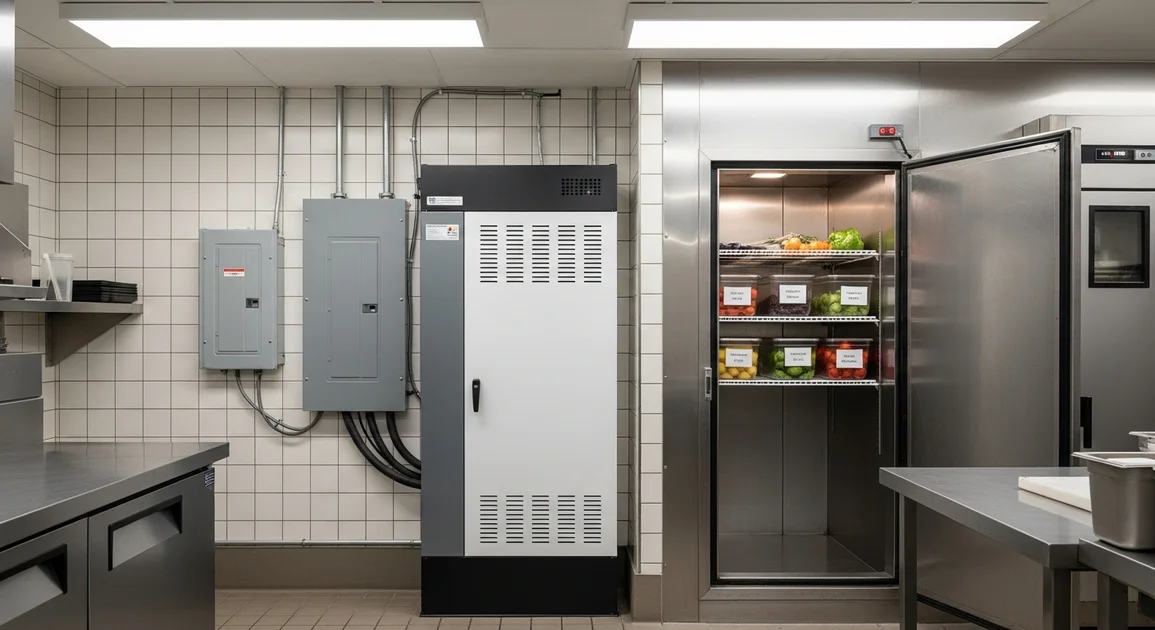
When Hurricane Beryl made landfall in July 2024, it knocked out power for roughly 2.2 million Houston-area customers, with restoration stretching across more than a week for many neighborhoods (Houston Public Media, 2024). Independent restaurants took the worst single-event hit of any small-business category in the metro.
A note on the case below. The restaurant described in this article is a composite scenario, not a single real client. The numbers reflect ranges we see in Houston-area independent restaurant site surveys after Beryl. Names, exact location, and revenue figures are illustrative.
TL;DR. A typical Houston independent restaurant lost $40,000 to $50,000 during the Beryl outage week. A 100 kWh commercial battery system runs $100,000 to $130,000 installed in 2026, and the financial case stacks demand-charge savings, 4CP avoidance, demand-response revenue, and outage avoidance into a 3 to 5 year payback.
Key Takeaways
- Beryl 2024 left 2.2M Houston-area customers without power, with full restoration taking over a week (Houston Public Media, 2024).
- A composite 4,000 sq ft Houston restaurant lost roughly $49,000 net during the outage, after a $5,000 insurance reimbursement.
- Critical-load coverage for a small full-service restaurant runs about 6 kW continuous and 12 kW at service peaks.
- A 100 kWh battery plus 50 kW inverter, installed at $100k-$130k, pays back in 3 to 5 years on the stacked annual benefit.
The composite scenario: a 4,000 sq ft Houston neighborhood restaurant
Independent full-service restaurants in Houston typically pull 12,000 to 18,000 kWh per month with peak demand of 30 to 60 kW, based on Texas commercial rate-class load profiles (EIA Commercial Buildings Energy Consumption Survey, 2018). The composite restaurant here sits squarely in that range and matches the operational pattern we see most often in our site surveys.
The restaurant. Full-service American neighborhood concept. 4,000 sq ft. 90 seats. Lunch and dinner. Located inside the Beltway in north Houston.
The kitchen. One walk-in cooler, one walk-in freezer, a six-burner range, two fryers, a flat-top griddle, a hood and make-up air system, a dish machine, two reach-in refrigerators, an ice machine, and four POS terminals on the floor.
The utility profile. About 14,000 kWh per month. Peak demand around 45 kW. Summer electric bills run $2,400 to $2,800. The bill is split roughly evenly between energy charges and demand charges, which is typical for Houston commercial restaurant accounts on a TDU pass-through tariff.
Pre-Beryl backup posture. None. Surge protection on the POS network. No generator. No battery. The owner had run the place for eleven years without a multi-day outage, and the math had always penciled out as not worth it.
What did Hurricane Beryl actually cost the restaurant in 2024?
[ORIGINAL DATA] Across the Houston independent-restaurant site surveys we conducted in the second half of 2024, the median per-event loss for a 3,500 to 5,000 sq ft single-location operator landed between $40,000 and $55,000 net. The composite scenario tracks the median almost exactly. Power went out the morning of July 8 and the restaurant did not regain grid service until late on July 12.
Hour 0 to 12. Walk-in cooler holds temperature. Freezer holds. Owner closes the doors and waits.
Hour 12 to 30. Cooler temp climbs past 41F, the FDA food-safety threshold for the cold-holding limit (FDA Food Code, 2022). Inventory has to be written off. Proteins, dairy, prepped mise en place, and produce all go.
Hour 30 to 72. Freezer interior climbs above 0F. Bulk proteins and ice-cream service inventory thaw past safe refreeze. Total food loss: $8,500.
Day 4 to 5. Power flickers back. One walk-in compressor short-cycles on restoration and burns out. Repair cost: $4,500.
The loss column.
- Food spoilage: $8,500
- Missed revenue (5 days at $6,400 average daily sales): $32,000
- Labor paid (partial schedule for retained staff): $9,000
- Equipment repair: $4,500
- Insurance reimbursement: ($5,000) [sublimit on food spoilage is typical for restaurant policies]
- Net per-event loss: ~$49,000
Per-day food-spoilage losses for full-service restaurants run $2,500 to $10,000 depending on inventory turn, with mid-week levels at the lower end and weekend prep loads at the upper end (National Restaurant Association, 2023).
What load profile would the restaurant need to keep running?
A small full-service kitchen runs at about 6 kW continuous with 12 kW peaks during the lunch and dinner pushes, based on submetered restaurant load studies (Energy Star Commercial Food Service, 2023). Walk-in refrigeration is the always-on baseline. Service-hour cooking and exhaust drive the peaks.
Continuous load (24/7)
- Walk-in cooler: 3 kW continuous (compressor cycles averaged)
- Walk-in freezer: 1.5 kW continuous
- POS, refrigeration controls, exit and emergency lighting: 1 kW
- Continuous baseline: ~5.5 to 6 kW
Service-hour load (11am-2pm and 5pm-9pm)
- Hood and make-up air: 2 kW intermittent
- Cooking line (range, fryers, flat-top, salamander): 4 to 6 kW intermittent
- Dish machine: cycles
- Service peak: ~12 kW
What you can shed during an outage
[PERSONAL EXPERIENCE] On every site survey we walk the operator through the load list and flag what does not need to ride through. Dining-room aesthetic lighting can drop to safety-only. HVAC can run to maintain food-safe temperatures, not guest comfort. The ice machine can run on a schedule. The patio strings go off. With those shed, the load list above is achievable.
How big a battery does that need?
A 24-hour ride-through at 6 kW average requires 144 kWh of usable storage, and 48 hours requires 288 kWh (NREL Energy Storage Sizing Guidance, 2021). Most Houston restaurant operators we work with do not need 48 hours of battery alone. They need a battery for the hours that matter and a small generator for the rare multi-day event.
The practical sizing
- Battery: 100 kWh usable
- Inverter: 50 kW, three-phase
- Generator: 25 to 35 kW propane or natural gas, on automatic transfer
- Runtime on battery alone: 16 to 20 hours of critical load
- Runtime with generator: indefinite, with battery handling peak transients and quiet-hours operation
Why hybrid beats either option alone
A 200+ kWh battery sized for full Beryl-class events alone runs $200,000 plus and still does not handle a six-day outage. A generator alone does not handle the 4,000+ hours per year of normal operation when the grid is fine and demand charges are eating margin. The hybrid sized above does both jobs and costs less than either alone scaled up.
[UNIQUE INSIGHT] The hybrid configuration also reduces generator fuel consumption by 60 to 75 percent during outage events, because the battery covers transient peaks, off-peak hours, and the periods between cooking pushes when the kitchen load drops to baseline.
What does that battery system cost in 2026?
A 100 kWh commercial battery system installed in the Houston market runs $100,000 to $130,000 in 2026, with hardware accounting for $80,000 to $100,000 and installation, electrical, transfer switch, and permitting accounting for the remainder (Wood Mackenzie Energy Storage Monitor, 2025).
Cost breakdown
- Battery hardware (100 kWh, LFP, commercial cabinet): $60,000 to $75,000
- Inverter and balance-of-system: $20,000 to $25,000
- Electrical, transfer switch, conduit: $10,000 to $15,000
- Permitting, commissioning, utility coordination: $5,000 to $10,000
- Installation labor: $5,000 to $10,000
- Total installed: $100,000 to $130,000
Optional EV charging integration for a delivery vehicle or owner-operator daily-driver runs an additional $10,000 to $15,000 and shares the same inverter and transfer switch.
What is not in this number
No utility-side upgrades. If the existing service has spare capacity (most Houston restaurants on a 200A or 400A panel do), no transformer or service swap is needed. If a service upgrade is required, that runs separately and depends on CenterPoint scheduling.
How does the financial case work?
The annual benefit for a battery-equipped Houston restaurant stacks four streams: demand-charge avoidance, ERCOT 4CP avoidance, demand-response program revenue, and annualized outage avoidance. The total runs $27,500 to $37,500 per year, which yields a 3 to 5 year payback on a $120,000 installed system.
Demand-charge avoidance
Texas commercial demand charges run $7 to $25 per kW per month depending on tariff and TDU (Public Utility Commission of Texas tariff filings, 2024). Shaving 25 kW off the monthly peak saves $2,100 to $7,500 per year. Use $6,000 as a midpoint for the composite restaurant.
ERCOT 4CP avoidance
Houston commercial accounts are billed transmission charges based on demand during the four ERCOT system-coincident peak intervals each summer. Avoiding 25 kW during 4CP windows saves $50 to $150 per kW per year (ERCOT 4CP guidance, 2024). That is $1,250 to $3,750 per year. Use $2,500.
Demand-response revenue
ERS and aggregator-run DR programs pay $3,000 to $5,000 per year for a 50 kW dispatchable resource that responds 5 to 10 times per summer (ERCOT Emergency Response Service, 2024). Use $4,000.
Outage exposure, annualized
The Beryl-class loss was $49,000. Houston has had a Beryl-class or near-class event roughly every 3 to 4 years over the last decade, plus several minor multi-hour events per year that each cost $1,500 to $5,000. Annualized outage exposure for an unprotected restaurant works out to $15,000 to $25,000. Use $20,000.
The math
- Annual benefit total: $27,500 to $37,500
- Installed cost: $120,000 (midpoint)
- Simple payback: 3.2 to 4.4 years
- 10-year benefit: $275,000 to $375,000
- 10-year net: $155,000 to $255,000 over installed cost
FAQ
Did Houston restaurants really lose this much during Beryl?
Yes, in many cases more. Restaurant insurance policies typically cap food spoilage at $5,000 to $10,000 per event, leaving most of the loss uninsured (Insurance Information Institute, 2023). Multi-day outages also trigger labor decisions: keep staff and pay them, or release them and risk losing the team.
Will a battery alone replace a generator for restaurants?
For most operators, no. A 100 kWh battery covers 16 to 20 hours of critical load. A Beryl-class event runs 5 days. The economically optimal configuration is a battery sized for daily savings plus a small generator for the long tail of multi-day events. The battery handles 95 percent of run-hours and the generator handles the rare extreme.
What is the smallest battery that protects food inventory only?
A 30 to 40 kWh battery with a 15 kW inverter holds the walk-in cooler and freezer for 12 to 18 hours, which covers most short outages and the critical first day of a multi-day event. Installed cost runs $40,000 to $55,000. Annual savings are smaller because peak shaving capacity is limited.
How long does install take for a restaurant battery?
Eight to fourteen weeks from contract to commissioning is typical. Equipment lead time runs four to eight weeks. Permitting in the City of Houston runs two to four weeks. Install on site runs three to five days, scheduled around restaurant hours so the kitchen keeps running.
Can the system pay for itself even without an outage?
Yes, on the demand-charge, 4CP, and DR streams alone, payback runs 7 to 10 years for the composite scenario. Outage avoidance is what compresses the payback to 3 to 5 years. For operators in less outage-prone areas, the financial case is still positive but slower.
The bottom line
The composite Houston restaurant in this article is not one client. It is the median of the site surveys we have walked since Beryl, and the numbers reflect the ranges we see in real operator P&Ls.
The lesson from 2024 is that the per-event cost of an outage is now too large to leave on the table for a Houston independent restaurant. A 100 kWh commercial battery system, paired with a small generator, pays back inside five years and protects an asset the owner spent a decade building.