Battery Backup for Houston Banks and Credit Union Branches

Battery Backup for Houston Banks and Credit Union Branches
When a Houston storm takes a block dark, most businesses lose a day of revenue. A bank branch loses something else. Continuity of operations in a financial institution is written down, examined, and tested on a schedule, which makes a branch different from the dry cleaner two doors down. Bank branch backup power in Houston is not only an operations decision, it sits inside a documented continuity program. Here is what the regulators actually say, what a branch physically needs to stay open, and how to size backup honestly.
Key Takeaways
- The FFIEC Business Continuity Management booklet points institutions toward diversified telecommunication lines, redundant connections between branches and data centers, and identification of multiple power sources (FFIEC IT Examination Handbook, 2019).
- Credit unions have their own version: the NCUA's Catastrophic Act Preparedness Guidelines recommend a board-approved plan with annual testing and documented results (12 CFR Part 749, Appendix B).
- Hurricane Beryl left about 2.2 million CenterPoint customers dark on July 8, 2024 (Houston Public Media, 2024), and roughly 226,000 were still out eight days later (Texas Tribune, 2024).
- A branch is an unusually good fit for a single controller, because the load is steady electronics rather than heavy motors, once HVAC is scoped honestly.
- This post is general information about equipment and planning. It is not legal, compliance, or regulatory advice.
What do bank regulators expect when the power goes out?
They expect a written, tested plan that covers utility failure, not a specific piece of hardware. The revised FFIEC Business Continuity Management booklet frames resilience as proactive measures to mitigate disruptive events and to evaluate a bank's recovery capabilities (OCC Bulletin 2019-57, 2019). Its business continuity strategies section then gets concrete, pointing management toward diversified telecommunication lines, redundant connections between branches and data centers, and identification of multiple power sources (FFIEC IT Examination Handbook, 2019).
Credit unions read a parallel set of documents. The NCUA's Catastrophic Act Preparedness Guidelines recommend a program approved by the board that includes a business impact analysis, a written plan for restoring vital member services through alternate operating locations or channels, annual testing, and documented test results (12 CFR Part 749, Appendix B). The NCUA's guidance on disaster recovery and business resumption sets the range those plans have to cover, from short-term power outages through events that physically destroy the premises (NCUA Letter 01-CU-21).
One clarification saves community institutions a lot of wasted anxiety. The 2020 interagency paper on Sound Practices to Strengthen Operational Resilience is aimed at domestic banking organizations with roughly $250 billion or more in average total consolidated assets, or $100 billion or more with large cross-jurisdictional activity (OCC Bulletin 2020-94, 2020). A six-branch bank in Katy is not reading that paper as its rulebook. It is reading the FFIEC booklet, and it still has to answer the utility question.
Notice what none of these documents do. None of them tell you to install a generator, and none of them tell you not to. They ask what happens to the branch when the utility fails, and whether you have tested the answer.
What does a branch actually need to stay open?
Less than most people assume, and in a specific order. Federal rules already require a national bank's security program to include a means of protecting cash such as a vault or safe, tamper-resistant locks on exterior doors and windows, an alarm system for notifying law enforcement, and a lighting system illuminating the area around the vault during the hours of darkness (12 CFR 21.3). Half of that list is electrical. A branch running dark is not just inconvenient, it may not be a compliant banking office.
The working load list looks like this:
- Teller workstations and the core connection. Two or three thin clients, monitors, receipt printers, a cash recycler. Small, steady, and useless without the network.
- The network rack. Firewall, switch, the ISP's fiber terminal, the cellular failover modem. This is the smallest load in the branch and the one that decides whether the branch is open.
- Alarm, access control, and cameras. Your security program assumes these are recording. An outage that stops recording is a gap you will have to explain later.
- The vault vestibule and egress lighting. Cheap to back up, awkward to be without.
- The ATM circuit. The public face of "we're open."
- HVAC. Optional for an hour, decisive after four, and the reason sizing conversations get real.
The vault detail nobody checks until it matters
Vault and safe deposit hardware behaves differently depending on what is on the door, and it is worth knowing which you have before the storm. UL 768, the standard for combination locks on safes, chests, and vaults, explicitly states that its requirements do not cover electronic locks (UL Standards & Engagement). A mechanical dial uses no power source at all. An electronic keypad, a motorized day gate, or a time delay module does, usually from its own batteries.
So ask your vault service company two questions: which type is on each door, and what happens on a dead battery. The answers change what you put on the backed-up panel.
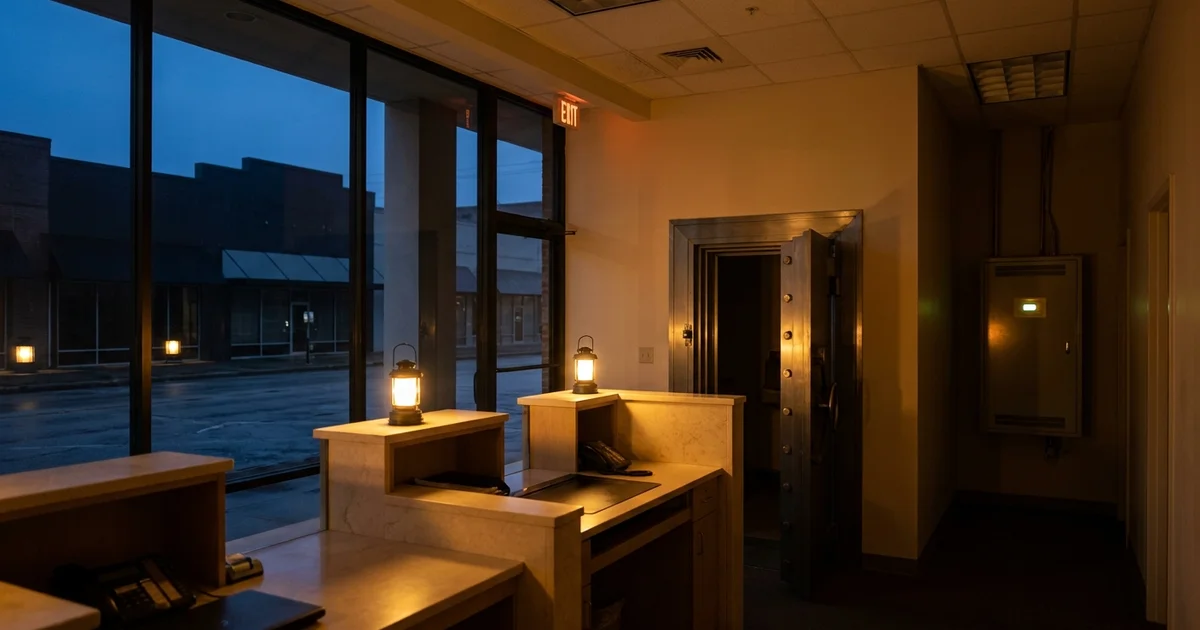
A composite Houston branch, the morning after
The following is a composite drawn from Houston commercial site work, not a specific customer. No real institution is named or described.
Picture a 3,800 square foot branch on a Beryl-style morning. Beryl knocked out power to about 2.2 million CenterPoint customers on July 8, 2024 (Houston Public Media, 2024), and about 226,000 customers were still waiting eight days later in July heat (Texas Tribune, 2024). Nationally, 2024 was the worst year in a decade: U.S. customers averaged 11 hours of interruption, and major events such as Beryl, Helene, and Milton accounted for 80% of those hours (U.S. Energy Information Administration, 2025).
Regulators reacted the way they always do after a landfall. On July 16, 2024, the FDIC said it would expedite requests to operate temporary banking facilities for institutions whose offices were damaged, and encouraged institutions in the affected areas to meet the financial services needs of their communities (FDIC, 2024).
Now the part that matters commercially. In a neighborhood where the grocery store is closed and card terminals are down, a branch with lit teller stations and a live ATM stops being a branch and becomes the block's cash access point. That is a week of goodwill you cannot buy with a marketing budget, and the equipment that produces it is a battery bank in a back corridor.
An open branch with a dead circuit is still closed
Connectivity, not capacity, is where branch continuity plans usually break. The FDIC tells consumers that banks in disaster areas have their computer systems operating so customers can access money through debit and ATM cards even if the physical office is damaged or closed (FDIC). True, and it depends entirely on the path between the branch and the core staying alive.
That path has three failure points: the branch's own power, the ISP's equipment inside the branch, and the carrier's upstream plant. You control the first two. Backing up the rack costs almost nothing in kilowatt-hours and it is why the FFIEC language about redundant connections between branches and data centers pairs so naturally with a battery, since a cellular failover modem is worthless if it isn't powered.
Anyone who has planned a server room in this market recognizes the pattern from small and edge data centers in Houston, where a UPS covers minutes and the outage runs hours. The same math applies here, at a tenth of the load.
How do you size backup power for a bank branch honestly?
Start with what a branch is electrically: a steady, modest, almost entirely electronic load with one big motor problem attached. Teller hardware, the rack, cameras, and lighting draw a predictable few kilowatts around the clock. There is no compressor rack, no commercial fryer, no lift. That profile is why a branch is one of the better single-controller candidates in the whole commercial category.
Our commercial controller delivers 11.5 kW of continuous output with 17.1 kW of surge headroom. For the critical panel described above, that is comfortable. The variable is the rooftop package unit. A branch that wants full comfort cooling on battery is a different design from a branch that wants to stay open, secure, and connected, and the honest answer is that the second one is much easier to deliver for a full day.
So we scope in tiers. Tier one is the rack, teller stations, alarm and cameras, vault vestibule and egress lighting, and the ATM circuit. Tier two adds a single conditioned zone so the lobby stays workable. Tier three is whole-building, which usually means more than one controller and a conversation about your electrical service. Most branches stop at tier two, and are glad they did.
For a wider view of what an outage costs a Texas business before you weigh any of this, see our breakdown of the cost of a business interruption from a power outage in Texas, the general guide to commercial battery backup for Texas businesses, and the tenant-side view in battery backup for Houston office buildings.
Or call Eos at 833-989-3737 to talk through your setup with an installer.
Frequently Asked Questions
Does the FFIEC require a bank branch to have backup power?
No. The FFIEC Business Continuity Management booklet requires a tested continuity program, not a specific device. Its strategies section does point management toward identifying multiple power sources alongside diversified telecommunications and redundant branch-to-data-center connections (FFIEC, 2019).
Do credit unions face the same expectations as banks?
They face a parallel set. The NCUA's Catastrophic Act Preparedness Guidelines recommend a board-approved plan covering restoration of vital member services, annual testing, and documented results (12 CFR Part 749, Appendix B), and NCUA guidance expects plans to span everything from short outages to destroyed premises.
Can a battery keep the ATM running during an outage?
Yes, if the ATM circuit and the network path are both on the backed-up panel. The FDIC notes that customers can reach money through debit and ATM cards even when an office is damaged or closed, provided the institution's systems are operating (FDIC). A dark ATM with a live network is still a dark ATM.
Will backup power keep the vault accessible?
It depends on your hardware. UL 768 covers mechanical combination locks and states that its requirements do not cover electronic locks (UL Standards & Engagement). Mechanical dials need no power. Electronic keypads, motorized day gates, and delay modules do, so put those circuits and the vestibule lighting on the backed-up panel.
How long can a branch run on battery?
That depends on the load tier you choose and the capacity you install, and we would rather measure your panel than guess. A critical-only tier runs far longer than a tier that includes comfort cooling. Publicly comparable runtime figures for branch-specific loads are not available, so we size from your own metered data.
Sources
- FFIEC IT Examination Handbook, Business Continuity Management booklet, Business Continuity Strategies, retrieved 2026-09-08, https://ithandbook.ffiec.gov/it-booklets/business-continuity-management/iv-business-continuity-strategies
- OCC, Bulletin 2019-57: Revised Business Continuity Management Booklet, retrieved 2026-09-08, https://www.occ.treas.gov/news-issuances/bulletins/2019/bulletin-2019-57.html
- OCC, Bulletin 2020-94: Sound Practices to Strengthen Operational Resilience, retrieved 2026-09-08, https://occ.gov/news-issuances/bulletins/2020/bulletin-2020-94.html
- NCUA, 12 CFR Part 749 Appendix B, Catastrophic Act Preparedness Guidelines, retrieved 2026-09-08, https://www.law.cornell.edu/cfr/text/12/appendix-B_to_part_749
- NCUA, Disaster Recovery and Business Resumption (Letter 01-CU-21), retrieved 2026-09-08, https://ncua.gov/regulation-supervision/letters-credit-unions-other-guidance/disaster-recovery-and-business-resumption
- 12 CFR 21.3, Security program (minimum security devices), retrieved 2026-09-08, https://www.law.cornell.edu/cfr/text/12/21.3
- FDIC, Guidance to Help Financial Institutions and Facilitate Recovery in Areas of Texas Affected by Hurricane Beryl, July 16, 2024, retrieved 2026-09-08, https://www.fdic.gov/news/financial-institution-letters/2024/guidance-help-financial-institutions-and-facilitate-2
- FDIC, Hurricane Recovery: Information for Consumers and Bankers, retrieved 2026-09-08, https://www.fdic.gov/consumer-resource-center/hurricane-recovery-information-consumers-and-bankers-affected-areas
- U.S. Energy Information Administration, Hurricanes in 2024 led to the most hours without power in the United States in 10 years, retrieved 2026-09-08, https://www.eia.gov/todayinenergy/detail.php?id=66744
- Houston Public Media, Hurricane Beryl power outages, July 8, 2024, retrieved 2026-09-08, https://www.houstonpublicmedia.org/articles/news/hurricane/2024/07/08/492833/houston-power-outages-hurricane-beryl-centerpoint/
- Texas Tribune, Texans still without power after Hurricane Beryl, July 15, 2024, retrieved 2026-09-08, https://www.texastribune.org/2024/07/15/texans-power-outages-hurricane-beryl/
- UL Standards & Engagement, UL 768 Standard for Combination Locks, retrieved 2026-09-08, https://www.shopulstandards.com/ProductDetail.aspx?productId=UL768_8_S_20060106